

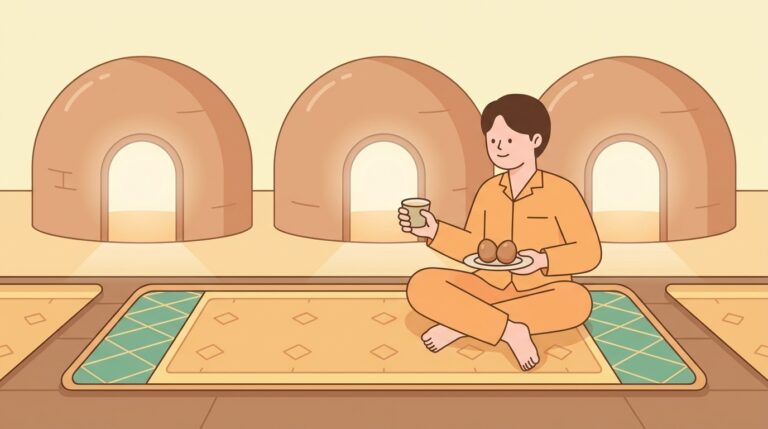
Chilling, Steaming, and Eating Eggs: The Ultimate Guide to Korean Jjimjilbang vs. Finnish Sauna
Phase 1: Empathy (Welcome to the Warmest Spot in Korea!)
안녕하세요! (An-nyeong-ha-se-yo!) Welcome back, my dear language learners and culture explorers. It’s your favorite local navigator from “Daily Hangul” here!
Imagine this: You’ve been walking around Seoul all day. Your legs are sore, your shoulders are stiff, and you need a serious break. You decide to try a Korean sauna (찜질방 – Jjim-jil-bang). But as you step in, you realize… this is nothing like the quiet, woody, steam-filled Finnish saunas back home or the ones you see in Western movies.
In Finland, a sauna is a quiet, almost spiritual sanctuary of wood, hot stones, and birch leaves. In Korea, a Jjimjilbang is practically an indoor amusement park of relaxation where you wear matching pajamas, eat soft-boiled eggs cracked on your friend’s head, sleep on heated floors, and watch TV with families!
If you’ve felt confused about how to describe this unique experience in Korean or how to compare it to the traditional Finnish saunas you know, you are in the right place. Today, we are going to learn the perfect vocabulary to bridge these two warm worlds like a natural! Let’s dive in.
Phase 2: Deep-Dive into 3 Essential Expressions
1. 땀을 빼다 (Ttam-eul ppae-da)
- Pronunciation: [Ttam-eul ppae-da] (Think of ttam as “t” + “am” in “dam” but with a tensed ‘t’ sound, and ppae-da like “pae-da” but with a sharp ‘p’)
- Meaning: To sweat it out (Literally: “to draw out sweat”)
- K-Culture Moment: You will hear this in almost every Korean reality show. When celebrities are tired or stressed, they head to the hot clay rooms to “draw the bad energy out” by sweating.
- Editor’s Insight: While in English we say “I’m sweating,” Koreans use the active verb “to pull out/remove” (빼다) because sweating is seen as a healthy, active process of detoxifying the body.
- Situation Spectrum:
- Casual: ✅ “우리 오늘 땀 좀 뺄까?” (Shall we sweat it out today?)
- Semi-formal: ✅ “땀을 빼고 나니까 시원해요.” (I feel refreshed after sweating it out.)
- Formal: ⚠️ (Slightly too casual for a business meeting, but fine when talking about health habits with colleagues.)
- 🤔 Think About It: Why does Korean culture treat sweating as a group social activity rather than a private hygienic one?
2. 개운하다 (Gae-un-ha-da)
- Pronunciation: [Gae-un-ha-da] (Sounds like “gay-oon-ha-dah”)
- Meaning: To feel refreshed, clean, and relieved (physically and mentally)
- K-Culture Moment: In K-Dramas, after an intense session in the sauna or eating a hot, spicy soup, characters will stretch their arms and sigh, “아, 개운하다!”
- Editor’s Insight: This word is unique because it describes a feeling that is both physical (your body is clean and light) and mental (your worries are washed away). It’s the ultimate “sauna feeling.”
- Situation Spectrum:
- Casual: ✅ “목욕하니까 정말 개운하다!” (I feel so refreshed after bathing!)
- Semi-formal: ✅ “몸이 아주 개운해졌어요.” (My body has become very refreshed.)
- Formal: ✅ “개운한 기분으로 시작해보겠습니다.” (I will start with a refreshed mind.)
- 🤔 Think About It: How does your language express that clean, relieved feeling after a hot bath? Is it one word or a full sentence?
3. 지지다 (Ji-ji-da)
- Pronunciation: [Ji-ji-da] (Sounds like “jee-jee-dah”)
- Meaning: To bake/sear (Colloquially: to heat up sore muscles on a hot floor)
- K-Culture Moment: Grandmothers in Korea love to lie down on hot stone floors and say they are “baking” their backs.
- Editor’s Insight: Originally, 지치다 means to pan-fry or sear food (like Korean pancakes). Using it for your body means lying down on a surface so hot that it feels like you are pleasantly baking your aches away.
- Situation Spectrum:
- Casual: ✅ “뜨거운 바닥에서 몸 좀 지지고 싶다.” (I want to bake my body on a hot floor.)
- Semi-formal: ✅ “따뜻하게 몸을 지지니까 통증이 사라졌어요.” (My pain went away after heating up my body.)
- Formal: 🚫 (Too colloquial and cozy for formal presentations.)
- 🤔 Think About It: Does your culture have a concept of “good heat pain” where hot surfaces actually make your muscles feel better?
Phase 3: Textbook Korean vs. Real-Life Korean
Let’s look at how textbooks teach you to compare things versus how Koreans actually talk at the Jjimjilbang!
Scenario 1: Comparing the humidity/heat style
- 📖 Textbook Korean: “핀란드 사우나는 건조하고, 한국 사우나는 습도가 낮지 않습니다.” (Finnish saunas are dry, and Korean saunas do not have low humidity.) – Too long, stiff, and unnatural!
- 🗣️ 진짜 (Real) Korean: “핀란드식은 돌에 물을 부어서 스팀을 만들고, 한국식은 방 자체가 뜨끈뜨끈해요.” (The Finnish style makes steam by pouring water on stones, while the Korean style has rooms that are warm/hot themselves.)
- 💡 Why the difference? Koreans love descriptive, sensory words like 뜨끈뜨끈하다 (to be comfortably hot/warm) to describe cozy heat instead of scientific terms like humidity (습도).
Scenario 2: Suggesting to go to the sauna
- 📖 Textbook Korean: “사우나에 가서 휴식을 취합시다.” (Let us go to the sauna and take a rest.) – Sounds like a manual!
- 🗣️ 진짜 (Real) Korean: “우리 찜질방 가서 지지면서 식혜 마시자!” (Let’s go to the Jjimjilbang, bake our bodies, and drink sweet rice punch!)
- 💡 Why the difference? Going to a Korean Jjimjilbang is never just about “resting”; it is a package deal of warming up (지시다) and snacking (식혜 – Sweet Rice Punch).
Phase 4: K-Culture Deep-Dive & Non-Verbal Manners
4-1. Nunchi (눈치) & Sauna Etiquette
- The Sheep Head (양머리 – Yang-meo-ri): You’ve probably seen this in K-dramas! People roll their towels to look like sheep heads. It’s not just for cute photos; it actually protects your head and hair from the dry, intense heat of the hotter rooms.
- The Unspoken Eye Contact Rule: Unlike Western saunas where people might make small talk, in the bath area of a Korean Jjimjilbang (where you are fully naked), keep your eyes to yourself. Making direct eye contact for too long is considered bad manners (실례).
4-2. Food is the Heart of Korean Sauna
While Finnish saunas might involve a cold beer or a plunge in a frozen lake, the Korean Jjimjilbang experience is centered around food. You must try:
1. 맥반석 계란 (Maek-ban-seok gye-ran): Baked eggs cooked inside the hot stone rooms. They are brown, chewy, and taste incredibly savory.
2. 식혜 (Sik-hye): A sweet, cold, traditional rice drink served in a massive plastic cup with ice. Drinking this after sweating is heaven!
Phase 5: Real-Life Roleplay Scenario
Setting: Min-jun (a Korean local) takes his friend Elsa (from Finland) to a premium Jjimjilbang in Seoul for the first time.
Characters:
* 민준 (Min-jun): Proud Korean friend who wants to show Elsa the magic of Korean relaxation.
* 엘사 (Elsa): A Finnish sauna enthusiast who is curious but slightly confused by the concept of wearing pajamas in a sauna.
Dialogue:
- 민준: “엘사, 한국 찜질방은 처음이지? 옷 갈아입고 나오니까 귀엽네!”
(Elsa, is this your first time at a Korean Jjimjilbang? You look cute in those clothes!) - 엘사: “(조심스럽게 옷을 만지며) 고마워. 근데 사우나 안에서 옷을 입는 게 신기해. 핀란드에서는 다 벗거나 타월만 쓰거든.”
(Carefully touching the clothes: Thanks. But it’s interesting to wear clothes inside a sauna. In Finland, we go naked or just use a towel.) - 민준: “아, 진짜? 여기선 공용 공간이라 이 찜질복을 꼭 입어야 해. 자, 우리 일단 불가마 들어가서 땀 좀 뺄까?”
(Oh, really? Since this is a shared space, you must wear these sauna clothes. Now, shall we go into the furnace room and sweat it out first?) - 엘사: “(불가마 문을 열며) 와, 여기 진짜 뜨끈뜨끈하다! 그런데 핀란드처럼 사우나 스톤에 물은 안 부어?”
(Opening the furnace room door: Wow, it’s really hot and cozy here! But don’t you pour water on sauna stones like in Finland?) - 민준: “응, 한국식은 바닥이랑 벽에서 나오는 열기 자체로 몸을 지지는 방식이야. 더 뜨겁게 느껴지지?”
(Yeah, the Korean style is about baking your body using the heat coming directly from the floor and walls. Feels hotter, right?) - 엘사: “응, 다른 느낌인데 정말 좋아. 온몸의 긴장이 풀리면서 엄청 개운해!”
(Yeah, it’s a different feeling, but I really love it. My whole body is relaxing and I feel so refreshed!) - 민준: “그치? 이제 나가서 시원한 식혜랑 구운 계란 먹자. 계란은 머리로 깨야 제맛이야!”
(Right? Let’s go out now and have cold sweet rice punch and baked eggs. Cracking the egg on your head makes it taste better!) - 엘사: “(웃으며) 진짜? 내 머리 말고 네 머리에 깰래!”
(Laughing: Really? I want to crack it on your head, not mine!)
🔀 Interactive Choice Point
Min-jun hands Elsa a hot brown egg. What should Elsa do?
- Choice A: Gently crack it on the floor.
- Choice B: Smack it quickly on Min-jun’s forehead while laughing.
- Choice C: Decline the egg because she is too hot.
Feedback:
- Choice A (Safe & Polite – Best for Beginners): Good job! It is clean and polite, though you miss out on the fun K-drama trope.
- Choice B (The True K-Drama Best Friend Move – Best!): Perfect! This shows you understand Korean friendship culture. Min-jun will laugh and feel closer to you. (Just don’t do it too hard!)
- Choice C (The Vibe Killer – Bad): Oh no! Jjimjilbang eggs are a cultural ritual. Even if you are hot, having a cold drink and a salty egg is the best way to replenish your salt!
Phase 6: 10-Second Emotion Shadowing Drill
Let’s practice speaking with real Korean emotion! Watch the slash marks / for pauses, and try to match the mood.
- [😊 Pleased and relaxed]
“땀을 쫙 빼고 나니까 / 정말 / 개운하다!”
(Ttam-eul jjwak ppae-go na-ni-ka / jeong-mal / gae-un-ha-da!)
Meaning: After sweating it all out, I feel so incredibly refreshed! -
[🥺 Exhausted but cozy]
“따뜻한 바닥에서 / 몸 좀 / 지지고 싶어.”
(Tta-tteut-han ba-dak-e-seo / mom jom / ji-ji-go si-peo.)
Meaning: I really want to lay down and bake my body on a warm floor.
Phase 7: K-Culture Mini Dictionary
- 찜질복 (Jjim-jil-bok) | Sauna Clothes | The matching cotton t-shirt and shorts provided by the Jjimjilbang. Everyone wears them in the common areas!
- 한증막 (Han-jeung-mak) | Traditional Sweat Bath | Domed kilns made of stone or clay heated to very high temperatures using pine wood.
- 아이스방 (Ice-bang) | Ice Room | A freezing cold room designed to close your pores after you sweat. It feels amazing after a 70°C clay room!
- 세신사 (Se-sin-sa) | Professional Body Scrubber | Professional scrubbers (often called ‘Ajoomma’ or ‘Ajeossi’) who will scrub away every bit of dead skin from your body. A must-try experience!
Phase 8: Survivor Kit for Travelers
Survival Phrases TOP 3
- “식혜 하나랑 구운 계란 세 개 주세요.”
- (Sik-hye ha-na-rang gu-un gye-ran se gae ju-se-yo.)
- Pro Tip: One sweet rice punch and three baked eggs, please. (The perfect combo!)
- “수건 한 장 더 주실 수 있나요?”
- (Su-geon han jang deo ju-sil su in-na-yo?)
- Pro Tip: Can I get one more towel, please?
- “열쇠로 계산할 수 있어요?”
- (Yeol-soe-ro gye-san-hal su is-seo-yo?)
- Pro Tip: Can I pay with my locker key? (Most modern Jjimjilbangs use digital wristbands for all payments inside.)
Editor’s Travel Note
Before heading to a Jjimjilbang, download Naver Map (do not rely on Google Maps in Korea!) to search for “찜질방” near you. Disclaimer: Many smaller neighborhood saunas closed during the pandemic, so always check recent Naver reviews to ensure they are fully open before visiting.
Phase 9: “Going Deeper” (Reflections on Korean Bath Culture)
In Western cultures, bathing and saunas are highly private. However, in Korea, going to the bathhouse is a deep communal experience. It is a place where friends, families, and even coworkers strip away their societal clothes, titles, and makeup to become completely equal. To “show your naked self” to a friend at a bathhouse is a sign of ultimate trust and closeness. It shows that in Korean culture, vulnerability is not weakness; it is the ultimate way to build strong, warm bonds.
💬 Your Turn: Would you be brave enough to go naked in a Korean bathhouse with your friends, or do you prefer the dry, clothed Jjimjilbang rooms? Let me know in the comments below!
Phase 10: FAQ & Common Mistakes
Q: Can I wear my own clothes inside the common areas of the Jjimjilbang?
A: No, you must wear the provided 찜질복 (Jjimjilbok). This keeps the environment hygienic and ensures everyone is on equal ground.
Q: Is there a time limit for staying inside a Jjimjilbang?
A: Most Jjimjilbangs allow you to stay for up to 12 or 24 hours on a single entry ticket. Many budget travelers actually use them as a cheap place to sleep overnight!
Q: Can I wear my shoes inside the bathhouse?
A: Absolutely not! You must leave your shoes in the entrance lockers. Wearing shoes inside is considered extremely dirty in Korean culture.
🚨 Common Mistakes Warning Board
- Mistake: Jumping straight into the hot tubs without washing.
- Correct Action: You must take a quick shower to wash your body before entering the communal hot tubs.
- Mistake: Bringing towels inside the hot tubs.
- Correct Action: Keep your towel on your head or place it on the side of the tub. Do not let it touch the communal water.
- Mistake: Pouring water onto the heaters in the hot rooms.
- Correct Action: This is a Finnish sauna habit! Korean heaters are electric or clay-based and do not use water steam. Pouring water can damage the systems.
Phase 11: Action Mission & Engagement
- Bronze Mission (Solo): Practice saying “개운하다!” out loud next time you step out of a warm shower.
- Silver Mission (Social): Share a photo of a sauna or bathhouse on your Instagram and caption it using “오늘 땀 좀 뺐어요” (Sweated it out today!).
- Gold Mission (Real Life): Visit a local Korean Jjimjilbang, order 식혜 and 구운 계란, and crack the egg on your partner’s head!
Phase 12: Interactive Quiz Challenge
Test your knowledge of Korean sauna culture and language!
1. Which word best describes the cozy, warm, and relaxing feeling after sweating out your fatigue?
- A) 피곤하다 (Pi-gon-ha-da)
- B) 개운하다 (Gae-un-ha-da)
- C) 차갑다 (Cha-gap-da)
2. True or False: In a Korean Jjimjilbang, you should pour water on hot stones to create steam.
- A) True
- B) False
🔍 Click here to see the answers!
- Correct Answer: B) 개운하다. This means feeling clean, light, and refreshed in both body and mind!
- Correct Answer: B) False. Unlike Finnish saunas, Korean rooms are dry-heated or clay-heated. Pouring water on the heat source is a big no-no!
See you in the next lesson! 다음에 또 만나요! (Da-eum-e tto man-na-yo!)







