

Hello! I’m Your Best Korean Friend and Lead Editor at Daily Hangul 👋
Have you ever ordered a delicious delivery meal in Korea, only to end up with a mountain of plastic spoons, wooden chopsticks, and plastic bags that you don’t even need because you’re eating at home?
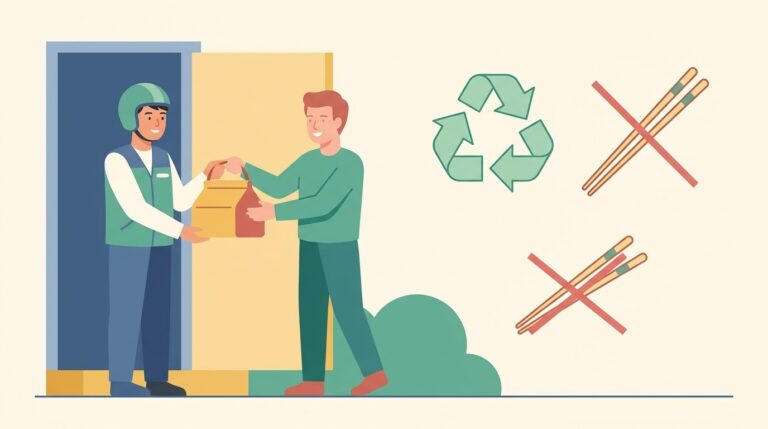
We’ve all been there! Korea has one of the most efficient delivery systems in the world (called 배달 / baedal), but it also comes with a lot of single-use items. In this guide, we will master the simple, eco-friendly phrase that will save plastic and make you look like a seasoned local: “일회용품 안 주셔도 돼요” (I don’t need disposable items). Let’s dive in! 🌍💚
Phase 2: Top 3 Core Expressions Deep Dive
1. 일회용품 안 주셔도 돼요 (Il-hoe-yong-pum an ju-syeo-do dwae-yo)
- Pronunciation: Il-way-yong-poom ahn joo-shuh-doh dway-yo (Sounds like: “Il-way-yong-poom” + “Ahn” + “Joo-shuh-doh” + “Dway-yo”)
- Meaning: You don’t have to give me disposable items. (Direct translation: “Disposables, even if you don’t give them, it is okay.”)
- K-Culture Moment: You are ordering fried chicken on the delivery app Baedal Minjok (배달의민족) and you check the eco-friendly request box at the bottom.
- Editor’s Insight: 일회용품 (il-hoe-yong-pum) means “one-time use items” (disposables). This expression is polite, soft, and extremely common in modern Korea, where eco-friendly living is highly valued!
- Situation Spectrum: Casual: ⚠️ | Semi-formal: ✅ | Formal: ✅
- 🤔 Think About It: In many Western countries, you have to ask for utensils. In Korea, they are often given by default unless you ask them not to. Why do you think delivery culture developed this way?
2. 나무젓가락 빼주세요 (Namu-jeot-garak pae-ju-se-yo)
- Pronunciation: Nah-moo-jut-gah-rak bbae-joo-say-yo
- Meaning: Please leave out the wooden chopsticks.
- K-Culture Moment: You already have metal chopsticks at home, so you want to exclude the wooden ones from your Tteokbokki order.
- Editor’s Insight: 빼주세요 (pae-ju-se-yo) means “please take it out/exclude it.” It is a magic word in Korean food ordering! You can use it for ingredients too (e.g., “오이 빼주세요” = Please exclude cucumbers).
- Situation Spectrum: Casual: ⚠️ | Semi-formal: ✅ | Formal: ✅
- 🤔 Think About It: How does saying “please exclude” make ordering food more customized to your personal lifestyle?
3. 영수증은 버려주세요 (Yeong-su-jeung-eun beoryeo-ju-se-yo)
- Pronunciation: Yung-soo-jeung-eun buh-ryuh-joo-say-yo
- Meaning: Please throw away the receipt.
- K-Culture Moment: The delivery driver hands you the food and tries to hand over a paper receipt, but you already have the digital receipt on your phone.
- Editor’s Insight: 버려주세요 (beoryeo-ju-se-yo) means “please throw it away for me.” It’s a very practical phrase at cafes, convenience stores, and delivery hand-offs.
- Situation Spectrum: Casual: ⚠️ | Semi-formal: ✅ | Formal: ✅
Phase 3: Textbook Korean vs. Real Korean
Situation 1: Declining plastic utensils
- 📖 Textbook Korean: 일회용 식기를 받지 않겠습니다. (Il-hoe-yong sik-gi-reul bat-ji ant-get-seup-ni-da. – “I will not receive disposable tableware.”)
- 🗣️ Real Korean: 일회용품 안 주셔도 돼요. (Il-hoe-yong-pum an ju-syeo-do dwae-yo. – “You don’t need to give me disposables.”)
- 💡 Why the difference? The textbook version is grammatically correct but sounds like a solemn legal pledge. The real Korean version is soft, polite, and uses ~해도 돼요 (it’s okay to/not to) to keep the tone friendly.
Situation 2: Asking to exclude something
- 📖 Textbook Korean: 나무젓가락을 제외해 주십시오. (Namu-jeot-garak-eul je-oe-hae ju-sip-si-o. – “Please exclude wooden chopsticks.”)
- 🗣️ Real Korean: 젓가락은 안 주셔도 돼요. (Jeot-garak-eun an ju-syeo-do dwae-yo. – “You don’t have to give me chopsticks.”)
- 💡 Why the difference? “제외하다” (to exclude) is a very formal, written Sino-Korean word. Locals prefer the simpler and warmer spoken expression “안 주셔도 돼요” (you don’t have to give).
Phase 4: K-Culture Deep Dive & Non-verbal Manners
4-1. Nunchi & Gestures 👋
When declining items in person (like at a convenience store or when receiving food from a rider), do not just say “No.” Koreans use a polite slight head bow combined with a gentle hand wave (palm facing down/forward, gently waving left to right) to soften the refusal. This shows respect and avoids sounding blunt.
4-2. The “Zero-Waste” Delivery Revolution in Korea ♻️
Korea is leading the way in eco-friendly delivery. On popular apps like Baedal Minjok (배달의민족) and Coupang Eats (쿠팡이츠), there is a default toggle switch that says “일회용 수저, 포크 안 받기” (Do not receive disposable spoons and forks). It is checked by default to protect the environment! Choosing this makes you a highly responsible global citizen in Korea.
Phase 5: Real-Life Roleplay Scenario
Characters & Setting
- Yuri (유리): A hungry expat living in Seoul.
- Rider (배달 기사님): A friendly delivery rider delivering warm Jajangmyeon (black bean noodles).
The 8-Turn Dialogue
- Rider: 🎭 Knocks on the door / 배달 왔습니다! (Baedal wat-seup-ni-da!) – “Delivery is here!”
- Yuri: 🎭 Opens the door smiling / 감사합니다! (Gam-sa-ham-ni-da!) – “Thank you!”
- Rider: 🎭 Hands over the bag / 주문하신 짜장면입니다. (Ju-mun-ha-sin jja-jang-myeon-im-ni-da.) – “Here is the Jajangmyeon you ordered.”
- Yuri: 🎭 Notices extra wooden chopsticks in the side pocket / 아, 저… 일회용품 안 주셔도 돼요! (Ah, jeo… il-hoe-yong-pum an ju-syeo-do dwae-yo!) – “Ah, excuse me… you don’t have to give me disposables!”
- Rider: 🎭 Checks the receipt / 아, 영수증에 표시되어 있었네요. 죄송합니다. (Ah, yeong-su-jeung-e pyo-si-doe-eo is-seot-ne-yo. Joe-song-ham-ni-da.) – “Ah, it was marked on the receipt. I’m sorry.”
- Yuri: 🎭 Hands back the chopsticks politely / 아니에요, 괜찮습니다! 젓가락은 가져가 주세요. (An-i-e-yo, gwen-chan-seup-ni-da! Jeot-garak-eun ga-jeo-ga ju-se-yo.) – “No, it’s alright! Please take the chopsticks back.”
- Rider: 🎭 Takes them back with a smile / 네, 감사합니다. 맛있게 드세요! (Ne, gam-sa-ham-ni-da. Mas-it-ge deu-se-yo!) – “Yes, thank you. Enjoy your meal!”
- Yuri: 🎭 Bows slightly / 네, 수고하세요! (Ne, su-go-ha-se-yo!) – “Yes, thank you for your hard work!”
🔀 Interactive Choice
What if the rider also tries to hand you a thick paper menu book for next time?
* A) Take it and throw it away later. (Bad: Waste of paper!)
* B) Say “이것도 안 주셔도 돼요” (I don’t need this either) with a smile. (Best: Eco-friendly and polite!)
* C) Shake your head silently and close the door. (Risk: Highly rude in Korean culture!)
Phase 6: 10-Second Emotion Shadowing Drill
Practice speaking with real Korean emotions! Pay attention to the pauses (/).
- [😊 Politely & Brightly]
일회용품 / 안 주셔도 돼요! (Il-hoe-yong-pum / an ju-syeo-do dwae-yo!) - [🥺 Softly & apologetically]
아, 젓가락은 / 빼주세요. (Ah, jeot-garak-eun / pae-ju-se-yo.) - [👋 Happily waving goodbye]
감사합니다! / 수고하세요! (Gam-sa-ham-ni-da! / Su-go-ha-se-yo!)
Phase 7: K-Culture Mini Dictionary
- 배달 (Baedal) | Delivery | Korea’s famous fast-delivery service for food, groceries, and even books.
- 일회용품 (Il-hoe-yong-pum) | Disposable Items | Single-use plastics, wooden chopsticks, plastic spoons, etc.
- 수저 (Su-jeo) | Spoon and Chopsticks | A compound word combining 숟가락 (spoon) and 젓가락 (chopsticks).
- 수고하세요 (Su-go-ha-se-yo) | Keep up the good work | A standard, polite way to say goodbye to service workers, delivery riders, or taxi drivers.
Phase 8: Traveler’s Survival Kit
Survival Phrases TOP 3
- 이거 빼주세요. (I-geo pae-ju-se-yo.) – “Please take this out.” (Useful when pointing at ingredients like cilantro or onions).
- 봉투 안 주셔도 돼요. (Bong-tu an ju-syeo-do dwae-yo.) – “You don’t have to give me a plastic bag.”
- 여기서 먹고 갈게요. (Yeo-gi-seo meok-go gal-ge-yo.) – “I will eat here.” (To avoid getting a takeout cup/box).
Editor’s Travel Note 🗺️
When ordering delivery in Korea, downloading the Baedal Minjok App or Coupang Eats is a must! Most delivery apps require a local phone number for identity verification, so make sure to get a Korean eSIM or SIM card with a phone number right at the airport.
Phase 9:
Frequently Asked Questions (FAQ)
Q: What does "일회용품 안 주셔도 돼요 (Il-hoe-yong-pum an ju-syeo-do dwae-yo)" mean in Korean and how do you pronounce it?
A: In Korean, "일회용품 안 주셔도 돼요 (Il-hoe-yong-pum an ju-syeo-do dwae-yo)" is pronounced [Il-way-yong-poom ahn joo-shuh-doh dway-yo (Sounds like: "Il-way-yong-poom" + "Ahn" + "Joo-shuh-doh" + "Dway-yo"] and means: You don't have to give me disposable items. (Direct translation: "Disposables, even if you don't give them, it is okay.")
Q: What does "나무젓가락 빼주세요 (Namu-jeot-garak pae-ju-se-yo)" mean in Korean and how do you pronounce it?
A: In Korean, "나무젓가락 빼주세요 (Namu-jeot-garak pae-ju-se-yo)" is pronounced [Nah-moo-jut-gah-rak bbae-joo-say-yo] and means: Please leave out the wooden chopsticks.
Q: What does "영수증은 버려주세요 (Yeong-su-jeung-eun beoryeo-ju-se-yo)" mean in Korean and how do you pronounce it?
A: In Korean, "영수증은 버려주세요 (Yeong-su-jeung-eun beoryeo-ju-se-yo)" is pronounced [Yung-soo-jeung-eun buh-ryuh-joo-say-yo] and means: Please throw away the receipt.







