

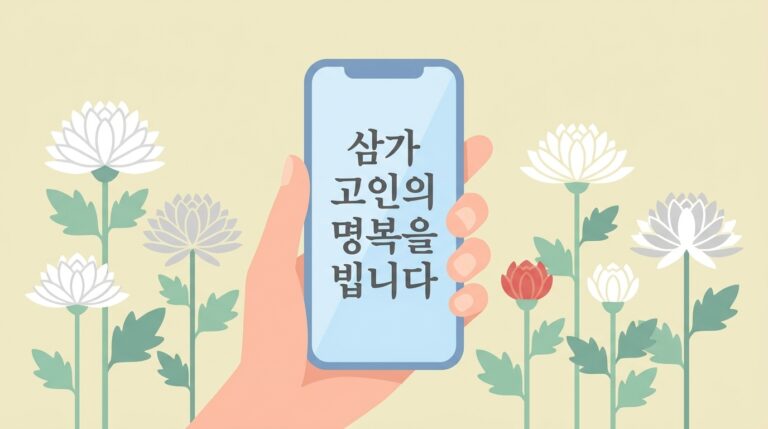
How to Reply to a Korean Obituary Text (부고 문자): Essential Funeral Etiquette for Beginners
Phase 1: Empathy (공감) — When Sad News Arrives
Imagine this: You are sipping a sweet banana milk after a busy day in Seoul, when your phone buzzes. It is a message from your close Korean colleague, Min-su.
“[부고] 민수의 부친께서 별세하셨기에 아래와 같이 알려드립니다…”
Your heart drops. Even in your own country, responding to a message about someone’s passing is difficult. But in Korea, where cultural etiquettes are deeply layered, you might feel completely frozen. “What do I say? Is my Korean too casual? What if I accidentally offend them?”
Don’t worry. This is a very common ‘Pain Point’ for foreigners living in Korea. Today, as your friendly K-Culture Navigator, I will walk you through exactly how to handle a 부고 문자 (bugo munja – obituary text) with warmth, respect, and zero awkwardness. Let’s learn together.
Phase 2: Deep Dive into 3 Essential Expressions (핵심 표현 3선)
Here are the three most respectful, safe, and comforting expressions to use when replying to an obituary text.
1. 삼가 고인의 명복을 빕니다 (Sam-ga go-in-ui myeong-bok-eul bim-ni-da)
- Pronunciation: “Sam-ga go-in-ey myeong-bok-eul bim-ni-da” (Sounds like: “Sam-gah go-een-wee myung-bock-eul beam-nee-dah”)
- Meaning: “Praying for the deceased’s soul to rest in peace.”
- K-Culture Moment: You will see this written in white letters on a black background in Korean news when a famous figure passes away, or in K-Dramas where characters pay their respects.
- Editor’s Insight: This is the absolute gold standard for condolences. 삼가 (sam-ga) means “respectfully/with humility,” 고인 (go-in) means “the deceased,” and 명복 (myeong-bok) refers to happiness in the afterlife.
- Situation Spectrum: Casual (🚫) / Semi-formal (⚠️) / Formal (✅)
- 🤔 Think About It: How does your native language express condolence? Does it refer to the “afterlife” like the Korean word Myeong-bok?
2. 얼마나 상심이 크십니까? (Eol-ma-na sang-sim-i keu-sip-ni-ka?)
- Pronunciation: “Uhl-mah-nah sang-sheem-ee keu-sheep-nee-kah?”
- Meaning: “How great must your sorrow be?” (Deepest sympathy for your loss)
- K-Culture Moment: Used by a main character when hugging a crying friend in a hospital hallway in emotional K-Dramas.
- Editor’s Insight: This focuses on the feelings of the survivor. 상심 (sang-sim) means “wounded/grieved heart.”
- Situation Spectrum: Casual (🚫) / Semi-formal (⚠️) / Formal (✅)
- 🤔 Think About It: Koreans tend to share and acknowledge sorrow deeply rather than trying to find a quick “silver lining.”
3. 힘내세요. 제가 늘 곁에 있을게요. (Him-nae-se-yo. Je-ga neul gyeot-e is-seul-ge-yo.)
- Pronunciation: “Heem-nae-seh-yo. Jeh-gah neul gyut-eh ees-seul-geh-yo.”
- Meaning: “Be strong. I will always be by your side.”
- K-Culture Moment: A warm text sent by a close friend or partner to comfort someone who is exhausted from hosting a funeral.
- Editor’s Insight: While the first two are highly formal, this one is warm and suitable for close friends or peers.
- Situation Spectrum: Casual (✅) / Semi-formal (✅) / Formal (⚠️)
- 🤔 Think About It: Why is offering physical or emotional “presence” (being by someone’s side) so comforting in Korean community culture?
Phase 3: Textbook Korean vs. Real Korean
Let’s compare what dry textbooks teach you versus how Koreans actually handle this emotional situation.
Scenario 1: Expressing Condolence
- 📖 Textbook Korean: “슬픔을 나눕니다.” (Seul-peum-eul na-num-ni-da – “I share your sadness.”)
- 🗣️ Real Korean: “삼가 고인의 명복을 빌며, 깊은 애도를 표합니다.” (Sam-ga go-in-ui myeong-bok-eul bil-myeo, gip-eun ae-do-reul pyo-ham-ni-da.)
- 💡 Why the difference? “Sharing sadness” sounds a bit like a literal translation from English. In Korean, using traditional terms like 애도 (ae-do – mourning) shows a much deeper level of respect and social maturity.
Scenario 2: Asking if you can help
- 📖 Textbook Korean: “도와줄까요?” (Do-wa-jul-kka-yo? – “Shall I help?”)
- 🗣️ Real Korean: “도움이 필요하시면 언제든 말씀해 주세요.” (Do-um-i pil-yo-ha-si-myeon eon-je-deun mal-sseum-hae ju-se-yo.)
- 💡 Why the difference? The textbook version is too casual and puts pressure on the grieving person to assign you tasks. The real Korean version gently opens the door for them to reach out if they need anything.
Phase 4: K-Culture Deep Dive & Non-verbal Manners
4-1. Nunchi (눈치) & Gesture
When replying to an obituary, never use emojis (like 😭, 🙏, or 🤍). In Western cultures, a praying hand emoji 🙏 is common, but in Korea, emojis in an obituary reply can look highly informal and insincere. Keep the text clean, black-and-white, and simple.
4-2. Cultural Code: The 3-Day Funeral (삼일장)
In Korea, most funerals last for three days (삼일장 – sam-il-jang). The chief mourner (usually the eldest son or spouse) stays awake almost the entire time to greet guests. Therefore, keep your text messages short. They do not have the time to read long paragraphs.
Phase 5: Practical Roleplay Scenario
Your Korean language study buddy, Ji-hoon (지훈), just lost his grandfather. You want to send him a supportive text message.
- Ji-hoon (NPC): Mourning his grandfather, exhausted but polite.
- You (A2 Learner): Wanting to offer sincere comfort.
The 8-Turn Dialogue
- You: 지훈 씨, 부고 문자 받았어요. 많이 놀랐겠어요.
(Ji-hoon ssi, bu-go mun-ja bad-as-seo-yo. Man-i nol-rat-get-seo-yo.)
“Ji-hoon, I received the obituary text. You must have been so shocked.” -
Ji-hoon: 🎭 [Sighs deeply] 네, 갑자기 돌아가셔서 경황이 없네요. 연락 주셔서 감사합니다.
(Ne, gap-ja-gi dol-a-ga-syeo-seo gyeong-hwang-i eop-ne-yo. Yeol-rak ju-syeo-seo gam-sa-ham-ni-da.)
“Yes, he passed away so suddenly that I am out of my mind. Thank you for contacting me.” -
You: 삼가 고인의 명복을 빕니다. 할머님과 가족분들은 좀 어떠세요?
(Sam-ga go-in-ui myeong-bok-eul bim-ni-da. Hal-meo-nim-gwa ga-jok-bun-deul-eun jom eo-tteo-se-yo?)
“I pray for his soul to rest in peace. How are your grandmother and family holding up?” -
Ji-hoon: 다들 슬퍼하고 있지만, 잘 견디고 있어요. 빈소는 신촌 세브란스 병원이에요.
(Da-deul seul-peo-ha-go it-ji-man, jal gyeon-di-go is-seo-yo. Bin-so-neun Sin-chon Se-beu-ran-seu byeong-won-i-e-yo.)
“Everyone is grieving, but coping well. The funeral hall is at Sinchon Severance Hospital.” -
You: 🎭 [Soft and warm tone] 오늘 저녁에 조문하러 갈게요. 혹시 필요한 것이 있나요?
(O-neul jeo-nyeok-e jo-mun-ha-reo gal-ge-yo. Hok-si pil-yo-han geos-i in-na-yo?)
“I will visit the funeral hall to pay respects tonight. Do you need anything at all?” -
Ji-hoon: 마음만으로도 정말 고마워요. 와 주는 것만으로도 큰 힘이 됩니다.
(Ma-eum-man-eu-ro-do jeong-mal go-ma-wo-yo. Wa ju-neun geos-man-eu-ro-do keun him-i doem-ni-da.)
“Thank you so much just for your thoughts. Just you coming is a huge comfort.” -
You: 네, 조심히 가겠습니다. 지훈 씨도 밥 꼭 챙겨 먹고 힘내세요.
(Ne, jo-si-mi ga-ges-seum-ni-da. Ji-hoon ssi-do bap kkok chaeng-gyeo meok-go him-nae-se-yo.)
“Yes, I will travel safely. Ji-hoon, make sure to eat something and stay strong.” -
Ji-hoon: 고마워요. 이따가 봐요.
(Go-ma-wo-yo. I-tta-ga bwa-yo.)
“Thank you. See you later.”
🔀 Interactive Choice Point
How will you close your text to Ji-hoon before heading to the funeral?
- Choice A: “슬퍼하지 마세요! 화이팅!” (Seul-peo-ha-ji ma-se-yo! Hwa-i-ting! – Don’t be sad! Fighting!)
- Choice B: “삼가 고인의 명복을 빌며, 곧 찾아뵙겠습니다.” (Sam-ga go-in-ui myeong-bok-eul bil-myeo, got cha-ja-boep-ges-seum-ni-da. – Praying for the deceased, I will visit you soon.)
- Choice C: Send a crying cat sticker to show your sadness.
Feedback:
- Choice A (BAD/RISK): Saying “Fighting!” at a Korean funeral is highly inappropriate. Keep energetic cheers away from solemn mourning.
- Choice B (BEST): Highly respectful, grammatically correct, and perfectly balances warm intention with solemn manners.
- Choice C (BAD): Avoid stickers, emojis, or memes. It looks disrespectful in mourning contexts.
Phase 6: 10-Second Emotion Shadowing Drill
Try reading these sentences out loud. Focus on the emotional pauses (/) and follow the emotional prompts!
- [🥺 Softly and with deep sympathy]
삼가 고인의 / 명복을 빕니다.
(Sam-ga go-in-ui / myeong-bok-eul bim-ni-da.) -
[😔 Sincerely, with low voice tone]
얼마나 / 상심이 크십니까?
(Eol-ma-na / sang-sim-i keu-sip-ni-ka?) -
[Warm and comforting, gently holding hands vibe]
힘내세요. / 제가 늘 / 곁에 있을게요.
(Him-nae-se-yo. / Je-ga neul / gyeot-e is-seul-ge-yo.)
Phase 7: K-Culture Mini Dictionary
- 부고 (Bu-go) | Obituary Announcement
The formal message notifying relatives and acquaintances of someone’s passing. - 조문 (Jo-mun) | Paying Respects
The act of visiting a funeral hall to console the grieving family and bow to the deceased. - 조의금 (Jo-ui-geum) | Condolence Money
Money placed in a white envelope, given to the family to help cover funeral expenses. (Usually starts at 50,000 KRW for acquaintances). - 상주 (Sang-ju) | Chief Mourner
The person who hosts the funeral (usually the eldest son or closest male relative historically, though modern practices vary).
Phase 8: Survivor Kit for Travelers
Survival Expressions TOP 3
- 부의 (Bu-ui) – Written on the front of condolence money envelopes. (Pro Tip: Buy a pre-printed envelope at any convenience store!)
- 상가집 (Sang-ga-jip) – Funeral home / House of mourning.
- 어디로 가야 하나요? (Eo-di-ro ga-ya ha-na-yo?) – “Where should I go?” (Asking hospital staff where the funeral hall is located).
Editor’s Travel Note
If you need to find a funeral parlor inside a large hospital, do not rely on standard English maps. Use the Naver Map App to type in the hospital name followed by “장례식장” (funeral hall) to get precise navigation details. Note: Information on hospital facilities may vary; always check live updates.
Phase 9: “Going Deeper” — Reflections on Korean Grieving
In Korea, grief is rarely private. The 3-day funeral is a communal event where friends, colleagues, and even distant business partners show up to share food, drink, and comfort. This collective sharing of sorrow is called 정 (Jeong – deep emotional attachment/bond). Sending a quick, polite text back is your first step into showing this beautiful, respectful community care.
💬 Your Turn: Have you ever attended a funeral in another culture? How does it compare to the Korean custom of visiting a hospital hall? Leave a comment below!
Phase 10: FAQ & Common Mistakes
Q: Can I send flowers instead of going?
A: In Korea, large flower wreaths (화환 – hwa-hwan) are sent by companies or organizations, not usually by individuals. As an individual, sending a sincere text or visiting in person is highly preferred.
Q: What color clothes should I wear if I go to pay respects?
A: Always wear neat, plain black or dark navy clothing. Avoid colorful socks, bare feet (wear black socks!), or flashy accessories.
Q: Is it okay to say ‘Sorry for your loss’ in English?
A: If the friend is fluent in English, yes. But sending a simple Korean text like “삼가 고인의 명복을 빕니다” shows that you respect their culture deeply.
🚨 Common Mistakes Board
- Mistake 1: Writing “축하합니다” (Congratulations) by confusing it with other life events.
👉 Correct Action: Use 삼가 고인의 명복을 빕니다. - Mistake 2: Wearing bright colors or showing bare ankles at the funeral home.
👉 Correct Action: Wear black socks and long pants/skirts. - Mistake 3: Clinking glasses when drinking alcohol with others at the funeral dining hall.
👉 Correct Action: Do not clink glasses (건배 – geon-bae) during a funeral.
Phase 11: Action Mission!
- 🥉 Bronze Mission: Copy “삼가 고인의 명복을 빕니다” to your phone notes so you have it ready.
- 🥈 Silver Mission: Share this post on your social media to help other expat friends avoid funeral etiquette mistakes.
- 🥇 Gold Mission: Next time a Korean colleague mentions a family loss, courageously send them a warm, respectful condolence text in Korean.
Phase 12: Interactive Quiz Challenge
Test your knowledge below!
1. Which of the following is the most formal way to express condolences in writing?
- A) 힘내세요! (Him-nae-se-yo!)
- B) 삼가 고인의 명복을 빕니다. (Sam-ga go-in-ui myeong-bok-eul bim-ni-da.)
- C) 슬퍼하지 마세요. (Seul-peo-ha-ji ma-se-yo.)
Reveal Answer & Explanation
Correct Answer: B
Explanation: B is the most standard, formal, and respectful written phrase used in Korea to wish peace for the deceased. A is too casual, and C can sound dismissive of their natural grief.
2. True or False: It is polite to use the praying emoji (🙏) in a Korean condolence text.
- True
- False
Reveal Answer & Explanation
Correct Answer: False
Explanation: Emojis should be avoided entirely in Korean obituary replies to maintain the utmost respect and gravity of the situation.






