

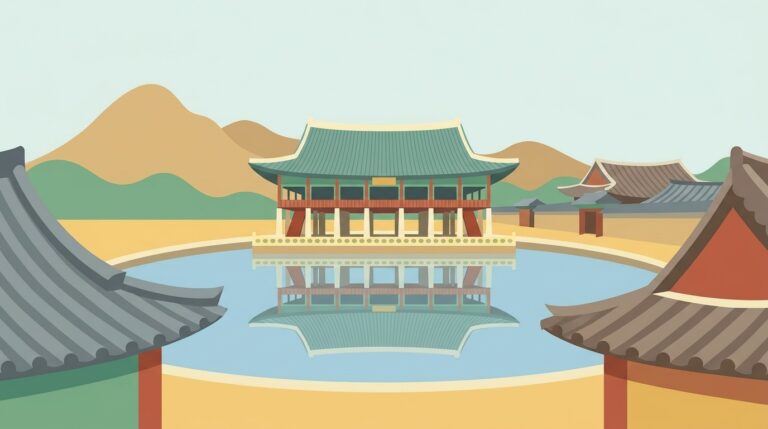
Step into Joseon: Unlocking the Timeless Beauty of Gyeongbokgung Palace
Phase 1: Empathy (Interactive Opening)
안녕하세요! (Annyeonghaseyo!) It’s your Daily Hangul editor and your personal cultural navigator.
Imagine this: You are standing in the middle of Gyeongbokgung Palace. The bustling noises of modern Seoul suddenly fade away, replaced by the gentle rustle of wind through pine trees and the majestic sweep of tiled roofs curving toward the sky. You want to capture this breathtaking harmony of nature and human design. You turn to your friend to express how the palace doesn’t fight against nature but gracefully blends into it. But then you freeze. How do you describe this deep, organic beauty in Korean without sounding like a dry guidebook?
Many of our intermediate learners tell us, “I know words like ‘예쁘다’ (pretty) or ‘멋있다’ (cool), but they feel too shallow for something as grand as traditional Korean architecture.” Today, we are going to bridge that gap. We will move beyond textbook translations and dive into the poetic, nature-loving mindset of traditional Korean architecture. Let’s elevate your Korean to match the elegance of Gyeongbokgung!
Phase 2: Deep-Dive into 3 Essential Expressions
1. 자연과 조화를 이루다 (Jayeon-gwa johwa-reul iruda)
- Pronunciation: Jah-yeohn-gwah joh-wah-reul ee-roo-dah (Rhymes with “joh-wah” as in the expression of realization “Aha!”)
- Meaning: To be in harmony with nature / To blend seamlessly with the natural environment
- K-Culture Moment: In historical K-Dramas (사극 – sageuk) like The King’s Affection or Kingdom, characters often walk through pavilions that seem to grow right out of the ponds. This is the exact visual of johwa.
- Editor’s Insight: Traditional Korean architecture (Hanok) prioritizes the surrounding landscape over the building itself. Instead of flattening mountains, Koreans built structures around them. When you use this phrase, you appreciate the humility of Korean design.
- Situation Spectrum: Casual: ⚠️ | Semi-formal: ✅ | Formal: ✅
- 🤔 Think About It: Does your culture’s traditional architecture try to dominate nature or blend into it? How does this reflect the differences in our philosophical roots?
2. 여백의 미 (Yeobaek-ui mi)
- Pronunciation: Yuh-baek-ee mee (Think of “yuh” as in “yummy” and “baek” as in the back of your hand)
- Meaning: The beauty of empty space / The elegance of understatement
- K-Culture Moment: Think of minimalist K-Beauty packaging or the slow, quiet scenes in Korean indie movies. That breathing room is yeobaek-ui mi.
- Editor’s Insight: Yeobaek literally means “white space” or “margins” in painting. In architecture, it refers to courtyards left deliberately empty, allowing wind, light, and shadows to fill the space. It teaches us that what is left unsaid or unbuilt is just as important as what is there.
- Situation Spectrum: Casual: ✅ | Semi-formal: ✅ | Formal: ✅
- 🤔 Think About It: Why do you think modern life makes us fear empty space, while traditional Korean culture celebrated it?
3. 고즈넉하다 (Gojeoneokhada)
- Pronunciation: Goh-jeu-nuhk-hah-dah (Soft “jeu” as in the French “je”, and “nuhk” rhyming with “duck”)
- Meaning: Cozy, quiet, peaceful, and beautifully desolate (specifically used for old buildings or quiet pathways)
- K-Culture Moment: Walking down the stone-wall paths of Deoksugung or Gyeongbokgung during a light autumn rain or early morning snowfall.
- Editor’s Insight: This is a uniquely Korean untranslatable word. It’s not just “quiet” (조용하다); it carries a warm, historic, slightly nostalgic peace. You can’t use it for a modern library, but it is perfect for a mountain temple or a palace courtyard.
- Situation Spectrum: Casual: ✅ | Semi-formal: ✅ | Formal: ✅
- 🤔 Think About It: What is a place in your hometown that feels truly gojeoneokhada to you?
Phase 3: Textbook Korean vs. Real Conversational Korean
Situation 1: Describing a beautiful building
- 📖 Textbook: “경복궁 건물이 아주 아름답습니다.” (The Gyeongbokgung building is very beautiful.)
- 🗣️ Real Conversational: “지붕 곡선이 하늘이랑 자연스럽게 어우러져서 정말 아름다워요.” (The curve of the roof blends so naturally with the sky; it’s truly beautiful.)
- 💡 Why the difference? Native speakers focus on the harmony between the structural elements (like the curved eaves, 처마 – cheoma) and the natural backdrop rather than just analyzing the building in isolation.
Situation 2: Expressing how peaceful the palace feels
- 📖 Textbook: “여기는 조용하고 평화롭습니다.” (It is quiet and peaceful here.)
- 🗣️ Real Conversational: “복잡한 서울 한복판에 이런 고즈넉한 공간이 있다는 게 믿기지 않아요.” (I can’t believe there’s such a cozy, peaceful space right in the middle of bustling Seoul.)
- 💡 Why the difference? Using the word gojeoneokhada immediately signals that you appreciate the historic and atmospheric quietness, elevating your vocabulary level instantly.
Phase 4: K-Culture Deep-Dive & Non-Verbal Manners
4-1. Palace Etiquette: Walk, Don’t Rush
Traditional Korean spaces are designed to be experienced slowly. When visiting Gyeongbokgung, do not rush from photo spot to photo spot.
* The “Nunchi” (Sensory Awareness) Tip: When entering a courtyard, take a moment to stand still, look through the open wooden doors (which act as natural picture frames), and match your walking pace to the quietness of the surroundings. Stepping lightly on the gravel paths is a form of respect for the historic space.
4-2. Cultural Code: 차경 (Chagyeong) – Borrowed Scenery
One of the most beautiful concepts in Korean architecture is Chagyeong (차경), which literally translates to “borrowing scenery.” Instead of creating artificial gardens inside the palace, architects placed windows and doors so that they “borrowed” the view of Mount Bugaksan or the surrounding hills outside. When you look out a palace window, you aren’t just looking at a wall; you are looking at a living, changing landscape painting.
Phase 5: Real-Life Roleplay Scenario
Setting: You are visiting Gyeongbokgung Palace with Minjun, a local Korean friend who loves history. You are standing in front of Gyeonghoeru Pavilion, which sits majestically on a peaceful pond.
Characters:
- Minjun (민준): An enthusiastic Korean friend who is proud of traditional culture.
- You (학습자): An intermediate learner eager to express your deep appreciation of the view.
민준: 🎭 (Smiling warmly, pointing at the pavilion)
      여기가 제가 경복궁에서 제일 좋아하는 경회루예요. 어때요?
      (This is Gyeonghoeru, my absolute favorite place in Gyeongbokgung. What do you think?)

You: 🎭 (Looking closely at the reflection on the water)
     와, 정말 아름답네요! 물 위에 떠 있는 것 같아요.
     (Wow, it's truly beautiful! It looks like it's floating on the water.)

민준: 🎭 (Nodding proudly)
      맞아요. 인공 연못이지만 뒤에 있는 산이랑 참 잘 어울리죠?
      (Exactly. It's an artificial pond, but it goes so well with the mountain in the back, right?)

You: 🎭 (Gesturing toward the open structure)
     네, 자연과 조화를 이루는 모습이 정말 인상적이에요.
     (Yes, the way it achieves harmony with nature is really impressive.)

민준: 🎭 (Impressed by your vocabulary)
      오, '조화'라는 표현도 아시네요! 한국 건축의 핵심을 짚으셨어요.
      (Oh, you know the expression 'johwa'! You've pointed out the core of Korean architecture.)

You: 🎭 (Laughing softly, looking at the empty courtyard nearby)
     책에서 배웠어요! 그리고 저 빈 공간들도 왠지 마음을 편안하게 해 주네요.
     (I learned it from a book! And those empty spaces somehow make my mind feel at ease, too.)

민준: 🎭 (Brightening up)
      그게 바로 '여백의 미'라는 거예요. 꽉 채우지 않아서 바람도 잘 통하죠.
      (That is exactly what we call 'yeobaek-ui mi'. Because it's not packed tightly, the wind flows through nicely too.)

You: 🎭 (Taking a deep breath of the fresh air)
     서울 도심에 이런 고즈넉한 곳이 있어서 정말 다행이에요.
     (I'm so glad there's such a peaceful, historic spot right in downtown Seoul.)
🔀 Interactive Choice: What will you say next to Minjun?
- Choice A: “우리 이제 배고픈데 떡볶이 먹으러 갈까요?” (Let’s go eat Tteokbokki since we are hungry now.)
- Choice B: “창문 너머로 보이는 산의 풍경이 마치 액자 속 그림 같아요.” (The mountain view through the window looks just like a painting in a frame.)
- Choice C: “경복궁이 너무 넓어서 다리가 아파요. 언제 끝나요?” (Gyeongbokgung is too big and my legs hurt. When does it end?)
Choice Feedback:
- Choice A (Risk): While Tteokbokki is delicious, changing the subject too abruptly breaks the cultural momentum of your deep conversation about the palace.
- Choice B (Best): Fantastic! You’ve perfectly referenced the concept of Chagyeong (borrowed scenery) using poetic intermediate-level Korean. Minjun will be deeply impressed!
- Choice C (Bad): Saying your legs hurt and asking when it ends might make your friend feel rushed and sound a bit unappreciative of the historic experience.
Phase 6: 10-Second Emotion Shadowing Drill
To sound natural, you need to master the emotional flow and pausing. Practice saying these sentences aloud with the indicated pacing and emotion!
[😊 Awe and admiration]
“자연과 / 조화를 이루는 모습이 / 정말 인상적이에요.”
(Jayeon-gwa / johwa-reul iruneun moseubi / jeongmal insang-jeog-ieyo.)
Tip: Pause slightly after “자연과” to emphasize nature, then let the rest flow smoothly.-
[😌 Deep, relaxing peace]
“이 고즈넉한 분위기가 / 제 마음을 / 편안하게 해 주네요.”
(I gojeoneok-han bunwigiga / je maeumeul / pyeon-anhage hae juneyo.)
Tip: Say “고즈넉한” slowly, letting the warm, quiet feeling of the word settle in.
Phase 7: K-Culture Mini Dictionary
- 처마 (Cheoma) | Eaves | The beautifully curved edge of a Hanok roof that controls the amount of sunlight entering the house throughout the seasons.
- 단청 (Dancheong) | Traditional multicolored patterns | The vibrant blue, red, yellow, white, and black patterns painted on wooden buildings to protect the wood from weathering and symbolise royal authority.
- 한옥 (Hanok) | Traditional Korean House | Built using natural materials like clay, wood, and paper, designed to balance hot summers (with wood floors) and cold winters (with underfloor heating).
- 온돌 (Ondol) | Underfloor heating | The traditional heating system that warms the stone floors from underneath, which shaped the floor-sitting culture of Korea.
Phase 8: Traveler’s Survival Kit
Top 3 Survival Expressions
- 한복을 입으면 무료 입장인가요? (Hanbok-eul ibeumyeon muryo ipjang-in-gayo?)
- Pro Tip: Yes! If you wear a traditional Hanok (which you can rent nearby), entry to Gyeongbokgung Palace is completely free.
- 여기서 사진 잘 나오는 곳이 어디예요? (Yeogiseo sajin jal naoneun gosi eodi-yeyo?)
- Pro Tip: Ask palace staff or locals this to find the most scenic, hidden photo spots.
- 가장 가까운 화장실이 어디에 있어요? (Gajang gakkaun hwajangsiri eodie isseoyo?)
- Pro Tip: Palace grounds are vast; it is always wise to know where the restrooms are before exploring deep courtyards.
Editor’s Travel Note
Before heading out, download the Naver Map App for accurate walking paths inside the palace grounds, and check the Gyeongbokgung Palace Official Website for seasonal evening opening events (which sell out fast!). Please note: Palace operating hours may change seasonally, so always check before visiting.
Phase 9: “Going Deeper” (Cultural Reflection)
Traditional Western architecture often sought to show human triumph over nature through towering stone cathedrals and symmetrical gardens. In contrast, Korean architecture embraced “non-action” (무위 – muwi), allowing nature to lead the way. A Hanok is never meant to look complete by itself; it is only complete when nature enters through its windows and people live inside it. This reflects a larger Korean mindset of living in harmony with others and adapting to our environments rather than trying to force our will upon them.
💬 Your Turn: Have you ever visited a place that made you feel completely at peace and in harmony with nature? Let us know in the comments below! We’d love to hear your stories.
Phase 10: FAQ & Common Mistakes
Q: Can I wear Hanbok to any palace to get free admission?
A: Yes! Free entry for Hanbok-wearers applies to all four major palaces in Seoul: Gyeongbokgung, Changdeokgung, Changgyeonggung, and Deoksugung.
Q: What is the difference between 조용하다 (joyonghada) and 고즈넉하다 (gojeoneokhada)?
A: While joyonghada simply means “quiet” (absence of sound), gojeoneokhada implies a cozy, historic, scenic, and peaceful quietness unique to old places.
Q: Is Gyeongbokgung Palace open every day?
A: No, Gyeongbokgung is closed on Tuesdays. Make sure to plan your trip accordingly!
🚨 Common Mistakes Alert!
- Mistake: Saying “경복궁이 조화를 해요” (Gyeongbokgung does harmony).
- Correction: You must use the full verb phrase: “경복궁이 자연과 조화를 이루고 있어요” (Gyeongbokgung is forming harmony with nature).
Phase 11: Action Mission
- 🥉 Bronze Mission: Take a photo of a quiet park or a cozy corner in your room and describe it using “고즈넉하다” in a diary entry.
- 🥈 Silver Mission: Share your favorite scenery photo on Instagram, tag
@DailyHangul, and use the phrase “자연과 조화를 이루다” in your caption. - 🥇 Gold Mission: When you visit Gyeongbokgung Palace, find a guide or a local friend and say, “여백의 미가 느껴져서 참 좋네요.” (I love how I can feel the beauty of empty space here.)
Phase 12: Interactive Quiz Challenge
1. Situation Quiz
Which word is best used to describe the peaceful, quiet atmosphere of a historic mountain temple?
* A) 시끄럽다 (noisy)
* B) 고즈넉하다 (peaceful and historic)
* C) 복잡하다 (crowded)
View Answer
Answer: B
Explain: ‘고즈넉하다’ is the perfect poetic adjective to describe historic, quiet, and cozy atmospheres.
2. Fill in the Blank
“한국의 전통 건축은 자연을 파괴하지 않고, 자연과 _____를 이룹니다.”
(Traditional Korean architecture does not destroy nature, but forms _____ with nature.)
View Answer
Answer: 조화 (harmony)
Explain: ‘조화를 이루다’ means to form harmony.
3. True or False?
Traditional Korean architecture focuses on filling every empty space with decorative structures.
* True / False
View Answer
Answer: False
Explain: Korean architecture values ‘여백의 미’ (the beauty of empty space), intentionally leaving courtyards open to nature.







