C2 Level Korean Masterclass: Navigating Netflix’s Password Sharing Crackdown and Subscription Changes
Phase 1: Empathy (Story-driven Opening)
안녕하세요! It’s your K-Culture Navigator and Korean bestie from Daily Hangul (매일한글).
Imagine this: You’ve just ordered a piping hot plate of Tteokbokki (떡볶이), settled onto your sofa, and opened Netflix to watch the latest hit K-Drama. But instead of the familiar red “whoosh” sound, you are greeted with a cold, digital wall: “Your TV is not part of the Netflix Household for this account.”
Oh, the horror!
With Netflix’s recent global crackdown on password sharing and the introduction of new ad-supported tiers, the era of sharing one premium account among four friends across different apartments in Seoul is officially over. This structural shift in subscription models has not only changed our digital habits but has also birthed a whole new wave of slang, cultural nuances, and social dynamics in South Korea.
As a C2 (Mastery) level learner, you aren’t just looking for simple translations like “Netflix is expensive.” You need to express complex social frustration, negotiate sharing fees with your roommates, and discuss the socioeconomic implications of digital platform policies with native-level eloquence. This guide, backed by real-world case studies of foreign expats and Korean university students trying to split bills, will give you the precise linguistic tools to navigate this digital drama seamlessly.
Phase 2: In-Depth Analysis of 3 Premium Expressions
To sound like a true native speaker when discussing digital subscriptions, master these three advanced expressions.
1. 숟가락을 얹다 (Sut-ga-rak-eul eon-da)
- Pronunciation: Sut-ga-rak-eul eon-da (Imagine sliding a spoon gently onto someone else’s already prepared rice bowl: “soot-gah-rahk-eul eon-dah”).
- Meaning: Lit. “To place one’s spoon [on a set table]”; Fig. To piggyback on someone else’s effort, expense, or subscription without contributing fairly.
- K-Culture Moment: This is the ultimate expression used when someone secretly uses your Netflix, Spotify, or Coupang Play account without paying a dime. In K-Dramas, you’ll hear characters use this to mock freeloaders.
- Editor’s Insight: While originally used for people taking credit for others’ work, in the modern digital age, it has become the default idiom for freeloading on subscriptions.
- Situation Spectrum:
- Casual/Spoken: ✅ (Very common among friends)
- Semi-formal: ⚠️ (Use with caution; slightly informal)
- Formal: 🚫 (Avoid in academic or official corporate reports)
- 🤔 Think About It: In Korean culture, eating from a shared pot is communal and warm, but “placing your spoon” without invitation crosses the boundary of Nunchi (눈치). How does your culture view sharing digital assets versus physical assets?
2. 단독 가구 / 1인 가구 (Dan-dok Ga-gu / Il-in Ga-gu)
- Pronunciation: Dan-dok Ga-gu (“dahn-dohk gah-goo”).
- Meaning: Single-person household / Sole household.
- K-Culture Moment: This is a key socio-demographic term frequently appearing in Korean news and social commentary regarding how Netflix’s new “household” verification system unfairly targets young Koreans who live alone but share accounts with family members living in provincial areas.
- Editor’s Insight: Unlike “혼자 살다” (living alone), “1인 가구” is an advanced, formal sociological term that shows you can discuss demographic shifts and corporate policies with intellectual depth.
- Situation Spectrum:
- Casual/Spoken: ✅ (Natural when discussing lifestyle)
- Semi-formal: ✅ (Perfect for workplace discussions)
- Formal: ✅ (Standard term in journalism and business)
- 🤔 Think About It: Why has the rise of “1인 가구” in Korea made Netflix’s household-based pricing model a highly sensitive topic?
3. 계정 기생수 (Gye-jeong Gi-saeng-su)
- Pronunciation: Gye-jeong Gi-saeng-soo (Derived from the famous movie Parasite [기생충 – Gi-saeng-chung]).
- Meaning: Lit. “Account Parasite”; a slang term for someone who constantly piggybacks on others’ paid streaming services.
- K-Culture Moment: A hilarious, slightly cynical word coined by Gen Z after Bong Joon-ho’s Parasite won the Oscars. It describes friends who ignore your subtle hints to get their own subscription.
- Editor’s Insight: It is highly colloquial and carries a humorous but sharp sting. Use it only with very close friends to avoid sounding genuinely insulting.
- Situation Spectrum:
- Casual/Spoken: ✅ (Great for banter and jokes)
- Semi-formal: 🚫
- Formal: 🚫
- 🤔 Think About It: How does your language humorously describe people who refuse to pay for their own digital services?
Phase 3: Textbook Korean vs. Real-World Korean
Let’s bridge the gap between dry classroom Korean and actual Seoul street slang.
Scenario A: Talking about price increases
- 📖 Textbook Korean:
“넷플릭스 구독료가 인상되어 경제적으로 부담스럽습니다.”
(The Netflix subscription fee has risen, which is financially burdensome.) - 🗣️ 진짜 Korean:
“넷플 요금 또 올려서 진짜 등골 브레이커가 따로 없네.”
(Netflix raised their fees again; it’s a total spine-breaker [extremely expensive/draining].) - 💡 Why the difference? Koreans use the slang “등골 브레이커” (Spine-breaker) to describe things that drain parents’ or one’s own hard-earned money. It sounds much more raw and authentic than the clinical “인상되어” (raised) or “부담스럽다” (burdensome).
Scenario B: Reacting to the account sharing ban
- 📖 Textbook Korean:
“계정 공유가 금지되어 새로운 요금제에 가입해야 합니다.”
(Since account sharing is banned, I must subscribe to a new plan.) - 🗣️ 진짜 Korean:
“이제 동거인 아니면 계정 짤린대서, 눈물 머금고 따로 파야 할 듯.”
(They say if we don’t live together we’ll get kicked off the account, so I’ll probably have to suck it up and open my own.) - 💡 Why the difference? “짤리다” (to get cut/kicked out) and “눈물 머금고” (holding back tears / reluctantly) capture the emotional frustration of modern digital users far better than rigid grammatical structures.
Phase 4: K-Culture Deep Dive & Non-Verbal Etiquette
4-1. Nunchi (눈치) & Digital Boundaries
In Korea, asking someone for their Netflix password requires massive Nunchi (tact/vibe-reading). Since the crackdown, directly asking “Can I use your Netflix?” is considered quite intrusive and cheap.
* The Gesture: When negotiating who pays for the “extra member” slot (추가 회원), Koreans often make a subtle scratching gesture on their palm with their index finger, symbolizing a friendly, slightly sheepish “calculating” or “splitting the bill” (n-bbang / N빵).
4-2. The “OTT Nomad” (OTT 유목민) Culture
Due to the price hikes, Koreans have become “OTT Nomads.” Instead of subscribing to Netflix, Disney+, and Wavve all year round, they subscribe to one for a month, binge-watch a trending K-drama (like Squid Game or The Glory), cancel it, and move to another platform. Knowing how to discuss this “migration” lifestyle is essential for C2 conversations about media consumption.
Phase 5: Real-World Roleplay Scenario
Setting: A hip cafe in Hapjeong, Seoul. Two close friends, Min-jun (민준) and Ji-yeong (지영), are discussing their shared Netflix account after receiving an email warning from Netflix.
Characters:
- Min-jun (민준): The primary account holder who is getting stressed about the extra fees.
- Ji-yeong (지영): The “spoon-layer” (freeloader) who is trying to negotiate a way to stay on the account.
- 민준: 지영아, 너 혹시 넷플릭스 들어가 봤어? 우리 이제 같이 못 쓴대.
(Ji-yeong, have you checked Netflix by any chance? They say we can’t share anymore.) -
지영: 🎭 (깜짝 놀라며 눈을 동그랗게 뜨고) 헐, 진짜로? 우리 가족 단체 프로필 다 거기 있는데 어떡해?
(What, seriously? All my family profiles are on there, what do we do?) -
민준: 메일 왔는데, 가구 등록 안 된 기기는 차단한대. 너 완전 ‘계정 기생수’ 탈출할 때가 된 거지.
(I got an email saying devices not registered in the household will be blocked. It’s time for you to escape your ‘account parasite’ status.) -
지영: 🎭 (민준의 어깨를 툭 치며 아쉬운 척) 아이 참, 정 없게 왜 이래~ 그럼 나 이제 숟가락 못 얹는 거야?
(Aw, come on, don’t be so cold~ So I can’t piggyback on your account anymore?) -
민준: 야, 나도 돈 아까워 죽겠어. 추가 회원 프로필 등록하려면 한 달에 오천 원 더 내야 한대.
(Hey, I’m dying over the cost too. To add an extra member profile, we have to pay an extra 5,000 won a month.) -
지영: 🎭 (비장한 표정으로) 오천 원? 그럼 차라리 내가 그 오천 원 보낼게! ‘N빵’ 해서 같이 가자.
(5,000 won? Then I’d rather just send you that 5,000 won! Let’s split the bill and keep going.) -
민준: 그래? 그럼 매달 자동이체 보내라. 밀리면 바로 강퇴(강제퇴장)야!
(Really? Then set up a monthly auto-transfer. If you’re late, you’re immediately kicked out!) -
지영: 🎭 (손으로 충성을 바치며) 충성! 입금 기한 칼같이 지키겠습니다, 주인님!
(Salute! I will strictly keep the deposit deadline, Master!)
🔀 Interactive Choice Point
How should Min-jun respond to Ji-yeong’s dramatic salute?
- Option A: “장난해? 오천 원 가지고 생색내지 말고 그냥 네가 계정 새로 파라.”
- Feedback (Risk): Too harsh. Even among close friends, this might ruin the playful vibe and cause real awkwardness.
- Option B: “오케이, 그럼 지금 당장 카카오페이 송금 고고!”
- Feedback (Best): Perfect! Natural, modern, and keeps the transaction quick and friendly using Korea’s favorite payment app.
- Option C: “돈은 필요 없고 그냥 사용하지 마세요.”
- Feedback (Bad): Too formal and cold. Switching to honorifics (“~마세요”) suddenly creates an emotional wall. Do not use this with friends.
Phase 6: 10-Second Emotion Shadowing Drill
Practice these sentences with the exact emotional pitch of a native Korean.
- [🥺 Disappointed & Whining]
“넷플 요금 또 올랐어… / 진짜 등골 브레이커라니까?”
Pronunciation Guide: Net-peul yo-geum tto ol-at-seo… / jin-jja deung-gol beu-rei-keo-ra-ni-kka?
Intonation: Drag out the “올랐어…” and put heavy stress on “등골”. -
[😏 Teasing & Playful]
“야, / 너 이제 내 계정에 / 숟가락 얹을 생각 하지 마!”
Pronunciation Guide: Ya, / neo i-je nae gye-jeong-e / sut-ga-rak eon-jeul saeng-gak ha-ji ma!
Intonation: Pause slightly after “야” and “계정에” to build comedic tension.
Phase 7: K-Culture Mini-Dictionary
- 등골 브레이커 (Deung-gol Beu-rei-keo) | Spine-breaker
- Originally used for expensive winter parkas that teenagers forced their parents to buy. Now used for any subscription fee or product that heavily drains one’s disposable income.
- N빵 (En-Bbang) | Splitting the bill equally
- The letter ‘N’ represents the mathematical variable for the number of people, and ‘빵’ is slang for dividing/splitting. Crucial for modern dining and subscription-sharing in Korea.
- 강퇴 (Gang-toet) | Forced expulsion / Kicked out
- Abbreviation of 강제 퇴장. Used online when an admin kicks someone out of a chat room, or metaphorically when you remove a friend from your shared streaming service.
- 우회 가입 (U-hoe Ga-ip) | VPN/Circumventive Registration
- The act of using a VPN to register for streaming services in countries with cheaper subscription fees (like Turkey or Argentina). A highly controversial but heavily discussed topic in Korea.
Phase 8: The Traveler’s Survival Kit
Survival Expressions for Expats in Korea
- “이거 한국 계정으로 로그인해야 나와요?”
(Do I need to log in with a Korean account to see this?)- Pro Tip: Korean Netflix has different licensing agreements. Use this when you can’t find a specific K-Drama while traveling in Seoul.
- “혹시 넷플릭스 멤버십 공유하실 분 구하나요?”
(Are you by any chance looking for someone to share a Netflix membership with?)- Pro Tip: Often used on local community apps like Karrot Market (당근마켓) to find trustworthy roommates or neighbors to split costs with.
- “인터넷 속도가 느려서 자꾸 버퍼링 걸려요.”
(The internet is slow, so it keeps buffering.)- Pro Tip: Essential when complaining to your Airbnb host about streaming issues.
🗺️ Editor’s Travel Note
To manage your subscriptions and split bills easily in Korea, make sure to download the 카카오톡 (KakaoTalk) and use its integrated “KakaoPay” (카카오페이) service. It allows you to send exact “N-bbang” calculation requests to friends with just one tap. Note: Digital subscription policies and payment systems in Korea are subject to frequent updates. Always check the official platform terms for the latest regulations.
Phase 9: “A Step Deeper” (Reflective Cultural Insight)
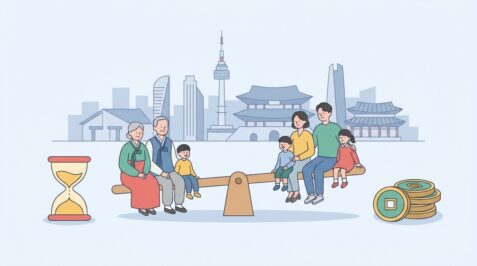
In Western societies, digital accounts are often viewed as highly individualized personal property. However, in Korea, the rapid transition from a deeply communal, family-oriented society to a fragmented landscape of single-person households (1인 가구) has created an interesting paradox.
Sharing streaming passwords was, in a way, a digital extension of the traditional Korean concept of 정 (Jeong – affection/bonding)—a feeling of “we are sharing this experience together.” The enforcement of strict digital boundaries based on geographical “households” has forced young Koreans to redefine their boundaries of sharing. It highlights a shift from collective warmth to pragmatic, transaction-based relationships.
💬 Your Turn: How has the Netflix sharing ban affected your relationship with your friends or family? Have you negotiated “N-bbang” or did you gracefully back out? Let us know in the comments below!
Phase 10: FAQ & Avoiding Misunderstandings
Q: Can I use my Korean friend’s Netflix account if I am traveling in Korea?
A: Yes, but only temporarily. If you use their account on a TV or a stationary streaming device connected to a different Wi-Fi network for more than 31 days, Netflix will flag it as outside the “household” and request verification codes.
Q: Is “우회 가입” (VPN registration) legal in Korea?
A: While not criminally prosecutable under South Korean law, it strictly violates Netflix’s Terms of Service. Netflix has been actively terminating accounts found to be using VPNs to pay lower rates.
Q: How do Koreans usually split the bill for extra member fees?
A: They usually use the “정기 송금” (Automatic Monthly Transfer) feature on banking apps like Toss or KakaoBank to ensure the money arrives on the exact billing date without awkward reminders.
🚨 The “Common Mistakes” Warning Board
- Mistake: Saying “돈을 주세요” (Give me money) when asking for a subscription share fee.
- Correct Action: Use the natural term “송금해 줘” (Transfer the money to me) or “N빵하자” (Let’s split it).
- Mistake: Using “기생충” (Parasite – animal/insect) instead of “기생수” (Parasite – person/hand) when jokingly teasing a friend.
- Correct Action: “기생충” sounds too harsh and dirty. “기생수” or “숟가락 얹는 사람” keeps it lighthearted.
- Mistake: Assuming “가구” (household) means physical furniture.
- Correct Action: In the context of subscriptions and demographics, “가구” (Household – 家口) refers to the social unit living in one residence. Do not confuse it with “가구” (Furniture – 傢具)!
Phase 11: Action Mission & Participation
🏆 The 3-Step Challenge
- Bronze Mission: Read the Phase 6 shadowing drill out loud 5 times, matching the dramatic intonation of a frustrated K-Drama character.
- Silver Mission: Share this post on your social media with the hashtag
#DailyHanguland write down your favorite Korean streaming platform (e.g., Netflix, Watcha, Wavve) in Korean. - Gold Mission: Next time you talk to a Korean friend, casually drop the idiom “숟가락 얹다” when talking about sharing food or plans, and observe their reaction!
🎮 K-Culture Search Mission
Watch a recent Korean YouTube comedy sketch or talk show (like Pinggyego – 핑계고) and try to spot if they mention the word “N빵” or “눈치” when discussing splitting bills. Write down the timestamp and share it in our community!
Phase 12: Interactive Quiz Challenge
Test your mastery of premium Korean slang and cultural nuances!
1. Situation Analysis
Your friend has been using your Netflix for two years without offering to pay. You want to tell them playfully to either pay up or get their own account. What is the most natural native-level phrase?
* A) 가구를 새로 구입하세요.
* B) 내 계정에 숟가락 그만 얹고 이제 독립해라~
* C) 귀하는 계정 기생충이므로 차단합니다.
👉 Click to reveal the Correct Answer & Explanation
Correct Answer: B
* Explanation: “숟가락 그만 얹고 이제 독립해라~” (Stop piggybacking and become independent~) uses the perfect blend of the idiomatic verb “숟가락 얹다” and a friendly, informal ending (“~해라~”).
* Why others are wrong: A translates to “Please buy new furniture,” and C is extremely hostile and uses the clinical term “귀하” (Your Excellency/Dear Customer) which sounds robotic.
2. Fill-in-the-Blank
“우리는 가족이지만 다른 지역에 살아서 넷플릭스 기준으로는 같은 ( )가 아니래요.”
* Hint: Refers to “household/social unit.”
👉 Click to reveal the Correct Answer & Explanation
Correct Answer: 가구 (Ga-gu)
* Explanation: In demographic and subscription terms, “가구” means “household.” Netflix’s sharing ban is based on the “household” (가구) unit, not blood relations.
3. True/False Culture Quiz
Statement: In Korea, asking someone directly for their streaming password without offering compensation is considered perfectly normal and polite under the concept of Jeong (정).
* True or False?
👉 Click to reveal the Correct Answer & Explanation
Correct Answer: False
* Explanation: While Jeong values sharing, modern Korean social etiquette (Nunchi) strongly dictates that you do not impose financial burdens on friends without offering to split the bill (N빵), especially with the recent crackdown and price hikes.