

Navigating Korea’s Healthcare: Master the Art of Talking About ‘Gungang Boheom’ Like a Native C1 Speaker
Phase 1: Empathy (Welcome to the Heart of Korean Healthcare!)
안녕하세요! (Annyeonghaseyo!) Welcome back to Daily Hangul, your trusted cultural navigator. I’m your chief editor, and today we’re diving into a topic that makes Korea the envy of the world, but can also be quite a head-scratcher for advanced learners: The Korean National Health Insurance (국민건강보험 – Gukmin Geongang Boheom) system and Coverage Expansion (보장성 강화 – Bojangseong Ganghwa).
Imagine you’re watching a realistic K-drama like Hospital Playlist (슬기로운 의사생활). A patient’s family member sits anxiously in the consultation room. Instead of worrying about going bankrupt, they ask the doctor: “혹시 이 치료, 건강보험 적용 되나요?” (“Does this treatment get covered by health insurance?”). This single question encapsulates a massive, complex system of national coverage that Koreans navigate daily.
As a C1 learner, you don’t just want to say “I am sick” (아파요). You want to discuss policy, understand your bills, ask about coverage expansions (often referred to historically as “Moon Jae-in Care” or current “Bojangseong” debates), and confidently handle administrative tasks at a clinic. Let’s unlock the highly sophisticated vocabulary you need to discuss Korean health policy and secure your peace of mind!
Phase 2: Deep-Dive into 3 Essential Expressions
1. 건강보험 적용이 되다 (Gungang-bo-heom jeog-yong-i doe-da)
- Pronunciation: Geon-gang-bo-heom jeog-yong-i doe-da (Sounds like: “Gun-gang bo-hum jug-yong-ee dway-da”)
- Meaning: To be covered by National Health Insurance (Literally: “Health insurance application becomes realized”).
- K-Culture Moment: In medical dramas, you will often see patients or guardians breathing a sigh of relief when the administrative coordinator says, “이 시술은 건강보험 적용이 돼서 본인 부담금이 적습니다” (“Since this procedure is covered by health insurance, your out-of-pocket expense is low”).
- Editor’s Insight: “적용” means application or coverage. If a treatment is “비급여” (non-covered/uninsured), it means it is not covered, and you pay 100% of the cost. Asking “보험 적용 되나요?” is the ultimate money-saving phrase at any Korean clinic.
- Situation Spectrum: Casual (⚠️ – too formal for casual chit-chat, but okay if talking about bills) | Semi-formal (✅) | Formal (✅)
- 🤔 Think About It: How does your home country handle medical coverage? In Korea, the collective social agreement is that healthcare is a public good. How is this reflected in the word “적용 (application/benefit)”?
2. 보장성을 강화하다 (Bo-jang-seong-eul gang-hwa-hada)
- Pronunciation: Bo-jang-seong-eul gang-hwa-ha-da (Sounds like: “Bo-jang-sung-ul gahng-hwa-hah-dah”)
- Meaning: To strengthen/expand insurance coverage (Literally: “To strengthen the nature of guarantee”).
- K-Culture Moment: You’ll hear this constantly on the 8 o’clock news (8시 뉴스) or read it in editorials discussing welfare policy. Politicians debate how to expand coverage for expensive treatments like MRI scans or robotic surgeries.
- Editor’s Insight: This is a high-level C1/C2 term. “보장성” (coverage/guarantee level) combined with “강화” (strengthening) refers to the government policy of reducing the patient’s financial burden by moving items from “비급여” (uninsured) to “급여” (insured).
- Situation Spectrum: Casual (🚫) | Semi-formal (⚠️) | Formal (✅)
- 🤔 Think About It: Is there a trade-off between expanding coverage (보장성 강화) and the financial stability of the insurance fund? How would you argue this in Korean?
3. 본인 부담률 / 본인 부담금 (Bon-in bu-dam-ryul / Bon-in bu-dam-geum)
- Pronunciation: Bon-in bu-dam-ryul / Bon-in bu-dam-geum (Sounds like: “Bone-een bu-dahm-ryool / Bone-een bu-dahm-gum”)
- Meaning: Out-of-pocket ratio / Out-of-pocket expense (Literally: “Self-burden rate / Self-burden money”).
- K-Culture Moment: When receiving a receipt (진료비 계산서) at a major university hospital, you will see two columns: “공단부담금” (Amount paid by the National Health Insurance Service) and “본인부담금” (Amount paid by the patient).
- Editor’s Insight: Korea’s system is co-pay based. Even if a treatment is covered by insurance, your “본인 부담률” might range from 20% to 60% depending on the type of hospital (local clinic vs. general hospital). For severe illnesses like cancer, the government reduces the “본인 부담률” to a mere 5% under the “산정특례” (special calculation) system!
- Situation Spectrum: Casual (⚠️) | Semi-formal (✅) | Formal (✅)
- 🤔 Think About It: Why do you think the co-pay system exists instead of offering 100% free healthcare? (Hint: To prevent “moral hazard” or medical overuse).
Phase 3: Textbook Korean vs. Real-Life Native Korean
Let’s compare stiff, textbook sentences with how native Koreans actually negotiate and discuss these concepts in real-life medical settings.
Scenario 1: Asking if a treatment is covered by insurance
- 📖 Textbook Korean: “이 치료는 국가 건강보험의 혜택을 받을 수 있습니까?” (“Can this treatment receive the benefits of national health insurance?” – Grammatically perfect, but sounds like a textbook from 1995.)
- 🗣️ Real-Life Native Korean: “이거 실비 처리 돼요? 아니면 급여 항목인가요?” (“Can this be processed through my private actual-expense insurance? Or is it a public-insured item?”)
- 💡 Why the difference? Real Koreans rely heavily on two terms: 급여 (Gyuyeo – covered by national insurance) and 실비/실손보험 (Silbi/Silson-boheom – private supplemental actual-expense insurance which covers the leftover “본인부담금”). Combining both is the standard way Koreans handle medical bills.
Scenario 2: Expressing frustration about expensive non-covered treatments
- 📖 Textbook Korean: “비보험 치료는 가격이 너무 비싸서 부담스럽습니다.” (“Non-insured treatment is burdensome because the price is too expensive.”)
- 🗣️ Real-Life Native Korean: “이게 비급여라 은근히 돈 폭탄 맞은 기분이에요.” (“Since this is non-covered, it honestly feels like I got hit with a money bomb.”)
- 💡 Why the difference? Native speakers use “비급여” instead of “비보험”. “은근히” (subtly/honestly) and the idiom “돈 폭탄을 맞다” (to get hit with a money bomb/overcharged) bring out natural, vivid emotional color.
Phase 4: K-Culture Deep-Dive & Non-Verbal Manners
4-1. The Art of “Quiet Inquiry” at the Reception Desk
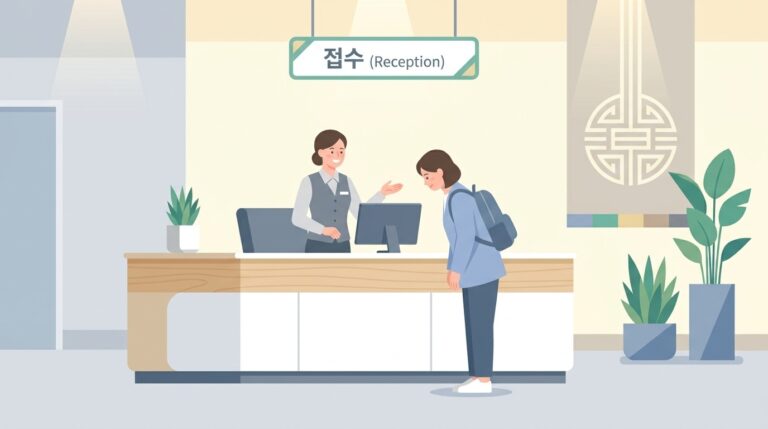
When discussing medical bills or coverage in Korea, keeping a low voice is considered good manners. Medical history is highly private. When asking about “보장성” or “급여 여부” (whether it’s covered), lean in slightly toward the receptionist, speak in a gentle tone, and slightly tilt your head. Shouting “이거 보험 돼요?!” across the lobby is considered rude and disruptive to other patients.
4-2. The “Silbi” Culture of Korea
In Korea, almost every adult has two things: the mandatory National Health Insurance and a private 실비보험 (Silbi-boheom – Actual Loss Insurance). When a doctor suggests an expensive MRI or high-tech treatment, they might ask you, “혹시 실비 있으세요?” (“Do you happen to have private actual-loss insurance?”). If you say yes, they will confidently prescribe the treatment, knowing your private insurance will reimburse 70-90% of the non-covered costs. Understanding this dual-layer system is key to understanding modern Korean medical behavior.
Phase 5: Real-Life Roleplay Scenario
The Setting
You are at the administrative desk of a large university hospital in Seoul, discussing the billing for an upcoming specialized MRI scan with the hospital coordinator, Min-ji.
- Characters:
- 민지 (Min-ji): Highly professional, fast-talking hospital administrative coordinator.
- 민우 (Min-woo / You): An advanced Korean learner who wants to clarify why the bill is higher than expected.
1. 민지: (보험 카드를 조회하며) 김민우 님, 다음 주에 예약하신 MRI 검사 말인데요, 그 항목은 이번에 정부 보장성 강화 항목에서 제외되어서 비급여로 진행하셔야 합니다.
   Min-ji: (Checking the insurance status) Mr. Kim Min-woo, regarding the MRI scan you booked for next week, that specific item was excluded from the government's coverage expansion, so you must proceed with it as non-covered (비급여).

2. 민우: (아쉬운 표정으로) 아, 정말요? 최근에 보장성 강화 대책으로 뇌랑 척추 MRI는 급여화되었다고 들었는데요.
   Min-woo: (With a disappointed look) Oh, really? I heard that brain and spine MRIs recently became covered (급여화) under the coverage expansion policy.

3. 민지: (모니터를 가리키며) 네, 맞아요. 그런데 민우 님은 단순 두통으로 인한 정밀 검사라서 제한적 급여 대상이세요. 이 경우에는 본인 부담률이 80%로 적용됩니다.
   Min-ji: (Pointing at the monitor) Yes, that's correct. However, in your case, it's a detailed scan for a simple headache, making you eligible only for "limited coverage." In this case, an 80% out-of-pocket ratio applies.

4. 민우: (고개를 끄덕이며) 아, 단순 검진 목적이면 본인 부담률이 대폭 올라가는군요. 혹시 제가 가지고 있는 실비보험 청구용 서류를 떼어주실 수 있나요?
   Min-woo: (Nodding) Ah, so for simple diagnostic purposes, the out-of-pocket ratio increases significantly. By the way, could you issue the documents for my private actual-loss insurance claim?

5. 민지: (미소를 지으며) 네, 당연히 가능하죠. 수납하실 때 진료비 상세 내역서랑 실손 청구용 영수증 같이 발급해 드릴게요.
   Min-ji: (Smiling) Yes, of course. When you pay, I will issue both the detailed medical bill statement and the receipt for the actual-loss claim.

6. 민우: (안심하며) 다행이네요. 실비라도 없었으면 진짜 비용 부담이 엄청날 뻔했어요.
   Min-woo: (Relieved) That's a relief. If I didn't even have private insurance, the financial burden would have been massive.

7. 민지: 맞아요. 요즘 보장성이 많이 확대되긴 했어도 여전히 비급여 항목은 실비가 필수예요.
   Min-ji: True. Even though coverage has expanded a lot lately, private insurance is still essential for non-covered items.

8. 민우: 친절한 설명 감사드립니다. 수납은 저쪽 키오스크에서 하면 되나요?
   Min-woo: Thank you for the kind explanation. Can I make the payment at the kiosk over there?
🔀 Interactive Choice Point
How would you respond to Min-ji in step 4 if you wanted to negotiate or query if there is an alternative, cheaper treatment covered by insurance?
* A. “그럼 그냥 검사 안 할래요. 너무 비싸요.” (I won’t do the scan then. It’s too expensive.)
* Feedback: Bad. Too abrupt and halts the medical consultation process without finding an alternative.
* B. “혹시 급여 적용이 되는 다른 대체 검사 방법은 없을까요?” (Is there perhaps any other alternative test method that is covered by insurance?)
* Feedback: Best! Polite, highly advanced (C1 vocabulary like 대체, 급여 적용), and clinically proactive.
* C. “보험 공단에 전화해서 따져봐야겠네요.” (I should call the insurance corporation and complain.)
* Feedback: Risk. Highly confrontational. The hospital staff cannot change government policy guidelines.
Phase 6: 10-Second Emotion Shadowing Drill
To sound truly native, practice these sentences with the correct phrasing, pauses (/), and emotional delivery!
-
[🥺 Disappointed and slightly worried]
“보장성이 / 강화됐다고 해서 / 기대했는데, / 제가 하는 치료는 / 비급여라네요.”
(Bo-jang-seong-i / gang-hwa-dwaet-da-go hae-seo / gi-dae-haet-neun-de, / je-ga ha-neun chi-ryo-neun / bi-geup-yeo-ra-nae-yo.)
“I had high hopes since they said coverage was expanded, but they say the treatment I am getting is non-covered.” -
[😊 Relieved and grateful]
“다행히 / 실비 보험 청구가 / 가능해서, / 본인 부담금이 / 생각보다 / 얼마 안 나왔어요.”
(Da-haeng-hi / sil-bi bo-heom cheong-gu-ga / ga-neung-hae-seo, / bon-in bu-dam-geum-i / saeng-gak-bo-da / eol-ma an na-wat-eo-yo.)
“Fortunately, I can claim private insurance, so the out-of-pocket expense came out to be much less than I thought.”
Phase 7: K-Culture Mini-Dictionary
- 급여 (Gyuyeo) | Covered/Insured Treatment
- Medical services covered by the National Health Insurance. The government pays a large chunk, and you pay a small co-pay.
- 비급여 (Bi-gyuyeo) | Non-covered/Uninsured Treatment
- Medical services not covered by the national system. You pay 100% of the price set by the individual hospital.
- 실손보험 / 실비 (Silson-boheom / Silbi) | Private Actual-Loss Insurance
- A private insurance policy that most Koreans pay monthly (~$10 to $50) to cover the co-pay (본인부담금) and non-covered portions.
- 보장성 (Bojangseong) | Coverage Level/Guaranteed Rate
- The percentage of total national healthcare costs that are covered by the national public insurance scheme.
Phase 8: Survivor’s Kit for Travelers & Expats
Survival Phrases TOP 3
- “외국인 등록번호로 건강보험 가입 여부 확인해 주세요.”
(Oe-guk-in deung-rok-beon-ho-ro geon-gang-bo-heom ga-ip yeo-bu hwa-gin-hae ju-se-yo.)- “Please verify my health insurance eligibility using my Foreign Registration Number (ARC).”
- “실비 청구용 진료비 상세 내역서 발급해 주세요.”
(Sil-bi cheong-gu-yong jin-ryo-bi sang-se nae-yeok-seo bal-geup-hae ju-se-yo.)- “Please issue a detailed medical bill breakdown for my private insurance claim.”
- “이 처방전 약도 건강보험 적용된 가격인가요?”
(I cheo-bang-jeon yak-do geon-gang-bo-heom jeog-yong-doen ga-gyeok-in-ga-yo?)- “Is the medicine in this prescription also at the price covered by health insurance?”
Editor’s Travel Note
- Required Action: If you reside in Korea for more than 6 months as an expat, subscription to the National Health Insurance is mandatory. Keep your ARC (Alien Registration Card) handy. You do not need a physical paper insurance card; hospitals can look you up instantly with your resident/foreigner number via the National Health Insurance Service (국민건강보험공단) portal.
- Disclaimer: Insurance policy criteria and foreigner eligibility criteria are subject to change by the Ministry of Health and Welfare. Always check the latest announcements.
Phase 9:
Frequently Asked Questions (FAQ)
Q: What does "건강보험 적용이 되다 (Gungang-bo-heom jeog-yong-i doe-da)" mean in Korean and how do you pronounce it?
A: In Korean, "건강보험 적용이 되다 (Gungang-bo-heom jeog-yong-i doe-da)" is pronounced [Geon-gang-bo-heom jeog-yong-i doe-da (Sounds like: "Gun-gang bo-hum jug-yong-ee dway-da"] and means: To be covered by National Health Insurance (Literally: "Health insurance application becomes realized").
Q: What does "보장성을 강화하다 (Bo-jang-seong-eul gang-hwa-hada)" mean in Korean and how do you pronounce it?
A: In Korean, "보장성을 강화하다 (Bo-jang-seong-eul gang-hwa-hada)" is pronounced [Bo-jang-seong-eul gang-hwa-ha-da (Sounds like: "Bo-jang-sung-ul gahng-hwa-hah-dah"] and means: To strengthen/expand insurance coverage (Literally: "To strengthen the nature of guarantee").
Q: What does "본인 부담률 / 본인 부담금 (Bon-in bu-dam-ryul / Bon-in bu-dam-geum)" mean in Korean and how do you pronounce it?
A: In Korean, "본인 부담률 / 본인 부담금 (Bon-in bu-dam-ryul / Bon-in bu-dam-geum)" is pronounced [Bon-in bu-dam-ryul / Bon-in bu-dam-geum (Sounds like: "Bone-een bu-dahm-ryool / Bone-een bu-dahm-gum"] and means: Out-of-pocket ratio / Out-of-pocket expense (Literally: "Self-burden rate / Self-burden money").






