

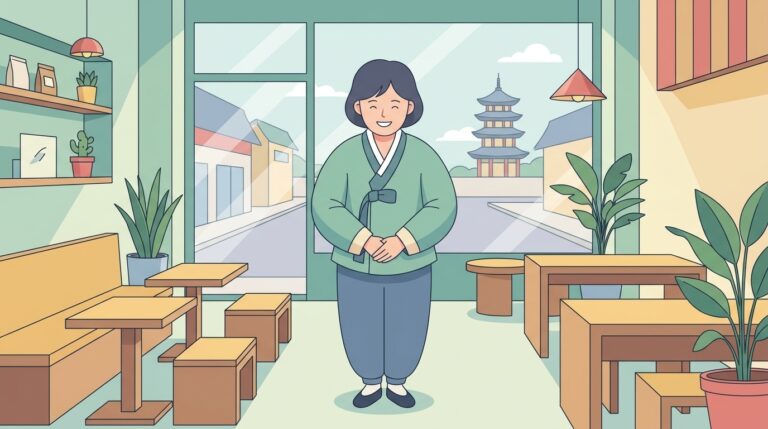
Say Goodbye to Awkward First Meetings! Master ‘Cheoeum Boepgetseumnida’ (처음 뵙겠습니다) Like a Native K-Drama Star 🌟
Phase 1: Empathy (Your First K-Meeting Lifesaver)
안녕하세요! (Annyeonghaseyo!) I’m your Daily Hangul editor and your personal Korean culture navigator! 🇰🇷✨
Picture this: You finally land in Seoul, or maybe you walk into a chic Korean restaurant to meet your Korean friend’s coworkers. Your heart is racing. A polite Korean person bows slightly and says something that sounds like a fast-forward melody. You want to make a killer first impression, but your mind goes blank. Should you bow? Shake hands? Say “Annyeong”?
If you’ve ever felt frozen during a first introduction, you are not alone! Many of my basic-level students tell me, “I know how to say ‘Hello’ (Annyeonghaseyo), but I don’t know what to say right after that when meeting someone for the very first time!”
Today, we are going to master the magic phrase: 처음 뵙겠습니다 (Cheoeum boepgetseumnida). By the end of this guide, you won’t just say it—you’ll feel the cultural heartbeat behind it. Let’s dive in! 🚀
Phase 2: The Big Three First-Meeting Expressions
Let’s break down the three most crucial phrases you need for a perfect first encounter.
1. 처음 뵙겠습니다 (Cheoeum boepgetseumnida)
- Pronunciation: Chuh-eum boep-get-seum-ni-da (Sounds like: “Chuh-um” + “bweb-get-sum-nee-da”)
- Meaning: Lit. “I am meeting you for the first time.” / Real Nuance: “Nice to meet you (very polite/formal).”
- K-Culture Moment: In K-Dramas, when a young professional meets a CEO or when a character meets their partner’s parents for the first time, they always bow at a 30-degree angle and say this phrase with ultimate respect.
- Editor’s Insight: This is the gold standard for adult introductions. It shows you respect the other person and acknowledge this special first moment.
- Situation Spectrum: Casual: 🚫 | Semi-formal: ⚠️ | Formal: ✅
- 🤔 Think About It: Why do you think Koreans have a specific phrase just for the very first meeting, rather than using a general “Nice to meet you” forever? (Hint: First impressions and hierarchical respect are huge in Korea!)
2. 반갑습니다 (Bangapseumnida)
- Pronunciation: Ban-gap-seum-ni-da (Sounds like: “Bahn-gahp-sum-nee-da”)
- Meaning: Lit. “I am glad.” / Real Nuance: “Nice to meet you.”
- K-Culture Moment: Think of K-Pop idols greeting a crowd at a concert or on a variety show. They bow enthusiastically and say, “Bangapseumnida!”
- Editor’s Insight: It’s warm, polite, and safe. If “Cheoeum boepgetseumnida” feels too heavy, this is your go-to safe card.
- Situation Spectrum: Casual: 🚫 | Semi-formal: ✅ | Formal: ✅
- 🤔 Think About It: How does showing your happiness (“I am glad”) change the vibe of a conversation compared to just saying “Hello”?
3. 만나서 반가워요 (Mannaseo bangawa-yo)
- Pronunciation: Man-na-seo ban-ga-wo-yo (Sounds like: “Mahn-nah-suh bahn-gah-wo-yo”)
- Meaning: Lit. “Because I met you, I am glad.” / Real Nuance: “Nice to meet you (friendly & polite).”
- K-Culture Moment: When characters of similar age meet at a university club or a casual social gathering.
- Editor’s Insight: The “요 (yo)” at the end makes it polite but keeps the mood soft and friendly. Perfect for making peer friends!
- Situation Spectrum: Casual: ⚠️ (with close friends) | Semi-formal: ✅ | Formal: 🚫
- 🤔 Think About It: In English, we say “Nice to meet you” to everyone. Why do you think Korean splits this into different politeness levels?
Phase 3: Textbook Korean vs. Real-Life Korean
| Situation | 📖 Textbook Korean | 🗣️ Real-Life Korean |
|---|---|---|
| Meeting a business partner | 처음 뵙겠습니다. (Cheoeum boepgetseumnida.) | 처음 뵙겠습니다. [Your Name]입니다. (Cheoeum boepgetseumnida. [Your Name]-imnida.) |
| Meeting a friend’s friend | 만나서 반갑습니다. (Mannaseo bangapseumnida.) | 반갑습니다! 얘기 많이 들었어요. (Bangapseumnida! Yaegi mani deureosseoyo.) |
- 💡 Why the difference? Textbooks often teach phrases in isolation. In reality, Koreans immediately attach their name (“I am [Name]”) or add a warm phrase like “I’ve heard a lot about you” (얘기 많이 들었어요) to break the ice instantly!
Phase 4: K-Culture Deep Dive & Non-Verbal Manners
4-1. The Art of the Angle: Bowing & Eye Contact
In Korea, your body speaks before your mouth does! When saying Cheoeum boepgetseumnida:
* The Bow: Bow your head and upper body at about a 15 to 30-degree angle. Keep your hands neatly in front of you (or at your sides if you are male).
* Eye Contact: Avoid staring directly into their eyes while bowing. Look down slightly during the bow, then make soft eye contact as you stand back up straight.
4-2. The “Nunchi” (눈치) of First Meetings
Nunchi is Korea’s superpower of reading the room. During a first meeting, observe the other person’s age or status. If they are older or in a higher business position, always use 처음 뵙겠습니다. If they stretch out a hand for a handshake, use both hands (or put your left hand under your right forearm) to shake hands as a sign of respect.
Phase 5: Real-Life Roleplay Scenario
Setting: A cozy cafe in Hongdae. You are meeting Minjun (민준), a Korean language exchange partner arranged by your school, for the very first time.
Characters:
* Minjun (민준): A friendly Korean college student, wearing a warm smile and holding a coffee.
* You: An eager Korean learner ready to test your skills!
The Dialogue
- Minjun: 안녕하세요! 혹시 [Your Name] 씨인가요?
(Annyeonghaseyo! Hoksi [Your Name] ssi-ingayo?)
“Hello! By any chance, are you [Your Name]?”
(🎭 Wave politely with a smile) -
You: 아, 네! 안녕하세요!
(A, ne! Annyeonghaseyo!)
“Ah, yes! Hello!”
(🎭 Bow slightly) -
Minjun: 처음 뵙겠습니다. 저는 김민준입니다.
(Cheoeum boepgetseumnida. Jeoneun Kim Minjun-imnida.)
“Nice to meet you. I am Minjun Kim.” -
You: 처음 뵙겠습니다. 저는 [Your Name]입니다.
(Cheoeum boepgetseumnida. Jeoneun [Your Name]-imnida.)
“Nice to meet you. I am [Your Name].” -
Minjun: 만나서 정말 반가워요! 카페 찾기 힘들지 않았어요?
(Mannaseo jeongmal bangawa-yo! Kape chatgi himdeulji anasseoyo?)
“I am really glad to meet you! Was it hard to find the cafe?” -
You: 아니요, 괜찮았어요!
(Aniyo, gwenchanasseoyo!)
“No, it was fine!” -
Minjun: 다행이네요. 와주셔서 감사합니다.
(Dahaeng-ineyo. Wajusyeoseo gamsahamnida.)
“That’s a relief. Thank you for coming.” -
You: 저도 반갑습니다. 잘 부탁드립니다!
(Jeodo bangapseumnida. Jal butakdeurimnida!)
“Nice to meet you too. Please look after me!”
(🎭 Bow warmly)
—
🔀 Interactive Choice Point
Minjun asks: “한국어 공부한 지 얼마나 됐어요?” (How long have you studied Korean?)
- Choice A: “어… 조금 공부했어요.” (Uh… I studied a little.)
- Choice B: “처음 뵙겠습니다!” (Nice to meet you!)
- Choice C: “한 달 동안 공부했어요! 아직 초보예요.” (I studied for one month! I’m still a beginner.)
Feedback:
- Choice A (Risk): Natural, but a bit too short. It might make the conversation die down quickly!
- Choice B (Bad): Oops! You already said “Nice to meet you” at the beginning. Repeating this sounds like a glitching robot! 🤖
- Choice C (Best!): Excellent! You answered the question honestly and set a friendly, humble tone. Minjun will love helping you!
Phase 6: 10-Second Emotion Shadowing Drill
Let’s practice speaking with real Korean emotion! Pause and mimic the rhythm.
- [😊 Pleased and Respectful]
처음 / 뵙겠습니다!
(Chuh-eum / boepgetseumnida!)
Stress the “뵙” (boep) softly to show maximum sincerity. -
[🌟 Bright and Friendly]
만나서 / 정말 / 반가워요!
(Mannaseo / jeongmal / bangawa-yo!)
Make “정말” (really) sound bouncy and happy!. -
[🤝 Hopeful and Polite]
잘 / 부탁드립니다!
(Jal / butakdeurimnida!)
Lower your pitch slightly at “드립니다” to sound polite and reliable.
Phase 7: K-Culture Mini Dictionary
- 인사 (Insa) | Greeting / Social Skills
- In Korea, doing a good “Insa” means you have great manners. Someone with great social energy is often called an “Inssa” (Insider/Popular person)!
- 존댓말 (Jondaetmal) | Polite/Honorific Language
- The formal way of speaking. Saying “Cheoeum boepgetseumnida” is a key part of Jondaetmal.
- 반말 (Banmal) | Casual/Informal Language
- Used with close friends or younger people. Never use this during a first meeting unless invited to!
- 소개 (Sogae) | Introduction
- The act of introducing yourself. A self-introduction is called “자기소개” (Jagi-sogae).
Phase 8: The Traveler’s Survival Kit
Survival Phrases for Your First Day in Seoul:
- 영어 하세요? (Yeong-eo haseyo?)
- Meaning: “Do you speak English?”
- Pro Tip: Use this politely if you get stuck after your first greeting.
- 한국어 잘 못해요. (Hangugeo jal mothaeyo.)
- Meaning: “I can’t speak Korean well.”
- Pro Tip: Saying this with a smile instantly lowers the pressure!
- 도와주세요! (Dowajuseyo!)
- Meaning: “Please help me!”
- Pro Tip: Essential for emergency situations.
🗺️ Editor’s Travel Note:
Before you step out of Incheon Airport, make sure you download the Naver Map App for navigating streets, and the Kakao T App for booking safe taxis. Google Maps doesn’t work well in Korea due to local security laws! (Note: App features and availability are subject to change over time.)
Phase 9: One Step Deeper (Cultural Reflection)
In English, we say “Nice to meet you” whether we are talking to a cashier, a CEO, or a child. But Korean is a relationship-oriented language. The moment you meet someone, your brain instantly calculates the social connection: Are they older? Are we equals? Is this a formal setting?
This isn’t about being cold or rigid; it’s about showing deep respect and care for the other person’s comfort. By using 처음 뵙겠습니다, you are telling them, “I respect you, and I value our very first connection.”
💬 Your Turn: How do you greet people for the first time in your culture? Is there a difference based on age or status? Share your thoughts in the comments below! 👇
Phase 10: FAQ & Common Mistakes
Q: Can I say “Annyeong” (안녕) when I meet someone older for the first time?
A: Absolutely not! “Annyeong” is highly casual (Banmal). Using it during a first meeting with someone older or in authority can seem incredibly rude, even if you are a foreigner. Stick to “Annyeonghaseyo” or “Cheoeum boepgetseumnida”!
Q: What is the difference between “반갑습니다” and “처음 뵙겠습니다”?
A: “처음 뵙겠습니다” is specifically for the very first time you meet. “반갑습니다” is a general “nice to meet/see you” that can be used on your first meeting or when meeting again in a happy context.
Q: Should I bow and shake hands at the same time?
A: It’s best not to do both simultaneously, as it looks a bit awkward. Bow slightly first, then naturally extend your hand for a handshake if appropriate.
🚨 Common Mistakes Alert:
- Mistake 1: Saying “처음 뵙겠습니다” to someone you already met yesterday. (Instead, use “안녕하세요”!)
- Mistake 2: Bowing so low that your head hits the table. (Keep it neat and controlled at a 15-30 degree angle!)
- Mistake 3: Not looking up after saying the phrase. (Always end with a warm smile!)
Phase 11: Action Missions
- 🥉 Bronze Mission: Pronounce “처음 뵙겠습니다” out loud 5 times in front of your mirror with a polite 20-degree bow!
- 🥈 Silver Mission: Write down “안녕하세요! 처음 뵙겠습니다. 저는 [Your Name]입니다.” on a piece of paper or in your study notes.
- 🥇 Gold Mission: Go to a local Korean grocery store or restaurant, make polite eye contact with the owner, and say “안녕하세요! 반갑습니다!” with a warm smile.
- 🎮 K-Culture Mission: Watch the first episode of any K-Drama this week. Try to spot the exact moment a character bows and says “처음 뵙겠습니다”! (Write the drama name in the comments!)
Phase 12: Interactive Quiz Challenge
1. Situation Quiz
You are meeting your Korean boyfriend/girlfriend’s parents for the very first time at a nice restaurant. What should you say right after saying “안녕하세요”?
* A) 안녕! 잘 지냈어?
* B) 처음 뵙겠습니다.
* C) 반갑습니다, 친구!
🔍 Check Answer & Explanation
Correct Answer: B
Explanation: Since you are meeting elders/parents for the very first time, the highly formal and respectful “처음 뵙겠습니다” is the absolute perfect choice to show your excellent manners!
2. True or False Culture Quiz
True or False: When shaking hands during a polite first meeting in Korea, it is polite to use only one hand with your other hand in your pocket.
🔍 Check Answer & Explanation
Correct Answer: False
Explanation: Keeping your hand in your pocket during a handshake is considered rude in Korea. Always use both hands or support your right shaking arm with your left hand to show respect!






