

Step-by-Step Guide: How to Get Your Sneakers Washed at a Korean Dry Cleaner (세탁소)
Phase 1: Empathy (Welcome, My Friend!)
안녕하세요! (An-nyeong-ha-se-yo!) I’m your Daily Hangul editor and your personal K-culture navigator!
Imagine this: You’ve been enjoying your dream trip to Seoul. You’ve walked through the beautiful traditional alleys of Bukchon Hanok Village, danced at a lively club in Hongdae, and tried delicious street food in Myeongdong. But then, you look down. Oh no! Your favorite white sneakers are covered in city dust and street grime.
In Korea, we don’t just throw sneakers into a home washing machine—we take them to the local 세탁소 (se-tak-so / dry cleaner)! Many beginners feel terrified of walking into a local Korean dry cleaner because they worry, “What if I ruin my shoes?” or “What if I can’t explain what I need?”
Don’t worry! Today, we are going to learn exactly how to ask a friendly local Korean auntie (이모님 / i-mo-nim) or uncle (사장님 / sa-jang-nim) to wash your sneakers. By the end of this guide, you will walk into any Korean laundry shop with absolute confidence! Let’s dive in!
Phase 2: Three Key Expressions (A1 Level)
Let’s learn the three most important sentences you need. They are super simple and perfect for beginners!
1. 운동화 세탁해 주세요. (Un-dong-hwa se-tak-hae ju-se-yo.)
- Pronunciation: Oon-dong-hwa seh-tahk-heh joo-seh-yo (Sounds like “Oon-dong” + “hwa” + “Say-talk” + “hey” + “Juice-yo”)
- Meaning: Please wash my sneakers.
- K-Culture Moment: You will hear this phrase in lifestyle K-Dramas when characters do their seasonal cleaning or prepare for a new school semester.
- Editor’s Insight: 운동화 (un-dong-hwa) means sneakers/sports shoes, and 세탁 (se-tak) means laundry. Adding ~해 주세요 (~hae ju-se-yo) is the magic, polite way to ask for any service in Korea!
- Situation Spectrum: Casual: ⚠️ | Semi-formal: ✅ | Formal: ✅
- 🤔 Think About It: In your country, do you usually wash your sneakers at home, or do you take them to a professional shop? Why do you think Koreans love professional shoe cleaning?
2. 언제 찾을 수 있어요? (Eon-je cha-jeul su is-seo-yo?)
- Pronunciation: Uhn-jeh chah-jeol soo eet-suh-yo? (Sounds like “Own-jay” + “Chah-jool” + “soo” + “East-soy-yo?”)
- Meaning: When can I pick them up?
- K-Culture Moment: Essential for travelers who are on a tight schedule and need to plan their pack-up day.
- Editor’s Insight: 언제 (eon-je) means “when”, and 찾다 (chat-da) means “to find/collect”. Together, it means “When can I collect them?”
- Situation Spectrum: Casual: ⚠️ | Semi-formal: ✅ | Formal: ✅
- 🤔 Think About It: Why is asking for the pickup time so important in Korea’s fast-paced “Ppalli-Ppalli” (hurry-hurry) culture?
3. 깨끗하게 해주세요. (Kkae-kkeut-ha-ge hae-ju-se-yo.)
- Pronunciation: Kkeh-kkeut-hah-geh heh-joo-seh-yo.
- Meaning: Please make them super clean!
- K-Culture Moment: A cute, friendly way to show the shop owner that you really care about your shoes.
- Editor’s Insight: It adds a warm, personal touch to your request. Koreans love it when customers show enthusiastic trust in their work!
- Situation Spectrum: Casual: ⚠️ | Semi-formal: ✅ | Formal: ✅
- 🤔 Think About It: How does adding a friendly request change the vibe of a business interaction in your culture?
Phase 3: Textbook Korean vs. Real Korean
Let’s compare what dry-sounding textbooks teach you versus how real Koreans actually talk!
Situation 1: Asking if they wash sneakers
- 📖 Textbook Korean: 운동화 세탁이 가능합니까? (Un-dong-hwa se-tak-i ga-neung-hap-ni-kka? – “Is sneaker cleaning possible?”)
- 🗣️ Real Korean: 운동화도 돼요? (Un-dong-hwa-do dwae-yo? – “Do you do sneakers too?”)
- 💡 Why the difference? The textbook version is too robotic and formal. In real life, simply adding ~도 돼요? (~do dwae-yo? / Is this also okay/possible?) is much more natural and friendly.
Situation 2: Asking about the price
- 📖 Textbook Korean: 운동화 세탁 비용은 얼마입니까? (Un-dong-hwa se-tak bi-yong-eun eol-ma-im-ni-kka? – “How much is the cost of sneaker laundry?”)
- 🗣️ Real Korean: 얼마예요? (Eol-ma-yeo-yo? – “How much is it?”)
- 💡 Why the difference? No need to say the whole long sentence! Just point to your shoes and say “Eol-ma-yeo-yo?” to keep it simple and sweet.
Phase 4: K-Culture Deep Dive & Non-Verbal Manners
4-1. Nunchi (눈치) & Body Language
- The Polite Bow: When you enter the shop, give a small 15-degree head bow and say “안녕하세요” (An-nyeong-ha-se-yo). This instantly shows respect.
- Using Both Hands: When handing your dirty sneakers to the owner, always hold them or the bag with both hands. In Korea, giving or receiving items with one hand can look impatient or rude.
4-2. The Cozy “Se-tak-so” Culture
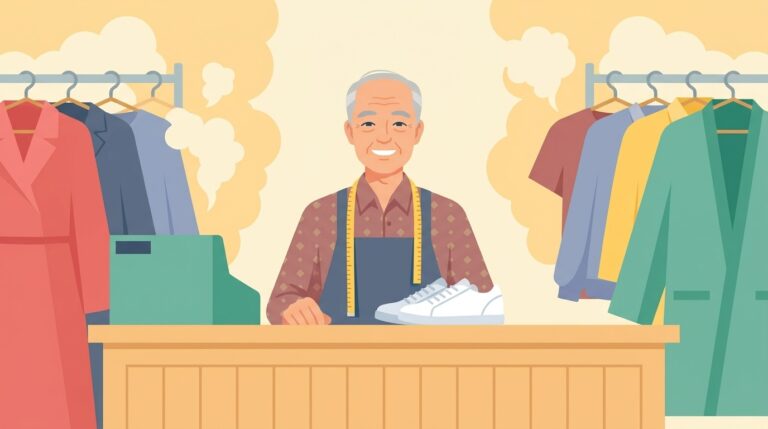
Korean neighborhood dry cleaners are cozy community hubs. They are often run by older couples who have lived in the area for decades. Inside, you’ll hear the loud hiss of steam irons and smell fresh, warm laundry. Taking your shoes here is a great way to experience real, local Korean life away from tourist spots!
Phase 5: Real-Life Roleplay Scenario
Setting: A warm, busy neighborhood dry cleaner called “행복 세탁소” (Happy Dry Cleaners).
Character: 사장님 (Sa-jang-nim / Shop Owner) – A friendly local uncle wearing a tape measure around his neck.
- You: (Entering the shop with a smile)
안녕하세요!
(An-nyeong-ha-se-yo!)
🎭[Polite bow with both hands holding a plastic bag of shoes]
“Hello!” -
Owner: 어서 오세요! 뭐 도와드릴까요?
(Eo-seo o-se-yo! Mwo do-wa-deu-ril-kka-yo?)
“Welcome! How can I help you?” -
You: 운동화 세탁해 주세요.
(Un-dong-hwa se-tak-hae ju-se-yo.)
🎭[Gently hand over the shoe bag using both hands]
“Please wash my sneakers.” -
Owner: 아, 운동화요? 네, 가능해요.
(Ah, un-dong-hwa-yo? Ne, ga-neung-hae-yo.)
“Ah, sneakers? Yes, we can do that.” -
You: 깨끗하게 해주세요!
(Kkae-kkeut-ha-ge hae-ju-se-yo!)
🎭[Smile warmly with hopeful eyes]
“Please make them super clean!” -
Owner: 걱정 마세요. 아주 깨끗하게 해줄게요!
(Geok-jeong ma-se-yo. A-ju kkae-kkeut-ha-ge hae-jul-ge-yo!)
“Don’t worry. I’ll make them very clean!” -
You: 언제 찾을 수 있어요?
(Eon-je cha-jeul su is-seo-yo?)
“When can I pick them up?” -
Owner: 목요일에 오세요.
(Mog-yo-il-e o-se-yo.)
“Come on Thursday.” -
You: 네, 감사합니다!
(Ne, gam-sa-ham-ni-da!)
🎭[Bow politely as you leave]
“Yes, thank you!”
🔀 Interactive Choice Point!
What will you say if you need the sneakers urgently for a weekend trip?
* A) “금요일에 안 돼요?” (Geum-yo-il-e an dwae-yo? / Is Friday not possible?)
* B) “빨리 주세요!” (Ppal-li ju-se-yo! / Give it to me fast!)
* C) “그냥 지금 주세요.” (Geu-nyang ji-geum ju-se-yo. / Just give them to me now.)
Feedback:
- Selection A (Best): 🌟 Excellent! This is polite and naturally asks if an earlier day is possible.
- Selection B (Bad): ⚠️ Too demanding! It sounds a bit rude and impatient.
- Selection C (Risk): 🚫 Oops! This sounds like you are canceling the order abruptly. The owner might get confused.
Phase 6: 10-Second Emotion Shadowing Drill
Practice speaking like a native by pausing at the / marks and mimicking the emotions!
- [😊 Friendly & Hopeful]
운동화 / 세탁해 주세요!
(Un-dong-hwa / se-tak-hae ju-se-yo!) -
[🥺 Polite & Curious]
언제 / 찾을 수 있어요?
(Eon-je / cha-jeul su is-seo-yo?) -
[💖 Sweet & Appreciative]
깨끗하게 / 해주세요!
(Kkae-kkeut-ha-ge / hae-ju-se-yo!)
Phase 7: K-Culture Mini Dictionary
- 운동화 (Un-dong-hwa): Sneakers / Running shoes. Literally translates to “exercise shoes”.
- 세탁소 (Se-tak-so): Dry cleaners / Laundry shop. Found in almost every neighborhood apartment block in Korea.
- 사장님 (Sa-jang-nim): Literally “Company President,” but used daily as a respectful way to address any small business owner.
- 이모님 (I-mo-nim): Literally “Aunt,” used affectionately for middle-aged women working in local shops or restaurants.
Phase 8: Survival Kit for Travelers
Survival Phrases TOP 3
- 카드 돼요? (Ka-deu dwae-yo?): “Do you accept cards?” (Very useful since almost everywhere in Korea takes card!)
- 영수증 주세요. (Yeong-su-jeung ju-se-yo.): “Please give me a receipt.” (Keep this as proof for your pick-up date!)
- 내일 돼요? (Nae-il dwae-yo?): “Is tomorrow possible?” (For express laundry requests!)
✈️ Editor’s Travel Note
Need to find the nearest dry cleaner? Don’t use Google Maps—it doesn’t work well in Korea! Instead, download the Naver Map App and search for “세탁소” (Se-tak-so). It will show you all the nearest neighborhood shops with real customer reviews! (Note: Operating hours and local prices can change depending on the region).
Phase 9: “Going Deeper” (A Touch of Korean Culture)
In Korea, keeping shoes clean is highly valued because of our indoor-living culture. Since we take our shoes off before entering homes, schools, and traditional restaurants, shoes are noticed much more than in Western countries. Beautifully cleaned sneakers are seen as a sign of respect, cleanliness, and self-care.
💬 Your Turn: Have you ever noticed how clean people’s shoes are in K-dramas? Let us know in the comments below if you’ve ever tried a local Korean laundry service!
Phase 10: FAQ & Avoiding Common Mistakes (FAQ Schema)
Q: Can I pay with a foreign credit card at local Korean dry cleaners?
A: Yes! Most local shops are fully equipped with credit card terminals. However, keeping a little bit of cash (about 5,000 to 10,000 KRW) is always a safe backup for very small local neighborhood shops.
Q: How long does sneaker washing normally take?
A: It usually takes about 2 to 4 days because they are carefully hand-washed and dried in special drying rooms to avoid damaging the materials.
Q: Can they wash expensive designer sneakers?
A: Yes, but it is highly recommended to show the brand to the owner and ask “이것도 돼요?” (Is this one okay too?) to make sure they have a premium care option.
🚨 Common Mistakes Alert!
- Mistake 1: Handing over shoes with socks left inside. (Always check and remove your socks first!)
- Mistake 2: Forgetting the receipt. (Local shops use paper slips. Take a photo of it on your phone just in case you lose it!)
- Mistake 3: Not specifying if you have a stain. (Point to any stubborn stain and say “여기 지워주세요” – Yeo-gi ji-wo-ju-se-yo / Please erase here.)
Phase 11: Action Mission
- 🥉 Bronze Mission: Read the three key phrases out loud 3 times in front of your mirror!
- 🥈 Silver Mission: Write down “운동화 세탁해 주세요” in your phone’s memo app so you have it ready for your next trip to Seoul!
- 🥇 Gold Mission: Go to a real local Korean dry cleaner, use these words, and successfully get your favorite shoes cleaned!
🎮 K-Culture Mission
Next time you watch a slice-of-life K-Drama, look closely at the neighborhood scenes. See if you can spot the yellow or blue signs that say 세탁 or 세탁소!
Phase 12: Interactive Quiz Challenge
Test your knowledge with these fun mini-quizzes!
Q1. What is the correct word for “sneakers” in Korean?
1) 구두 (Gu-du)
2) 운동화 (Un-dong-hwa)
3) 슬리퍼 (Seul-li-peo)
Reveal Answer & Explanation
Correct Answer: 2) 운동화 (Un-dong-hwa)
구두 means dress shoes/heels, and 슬리퍼 means slippers. 운동화 is specifically for sneakers or running shoes!
Q2. True or False: You should always use both hands when handing your shoes to the shop owner.
- True
- False
Reveal Answer & Explanation
Correct Answer: True
Using both hands is an essential non-verbal sign of respect and good manners in Korean culture!







