

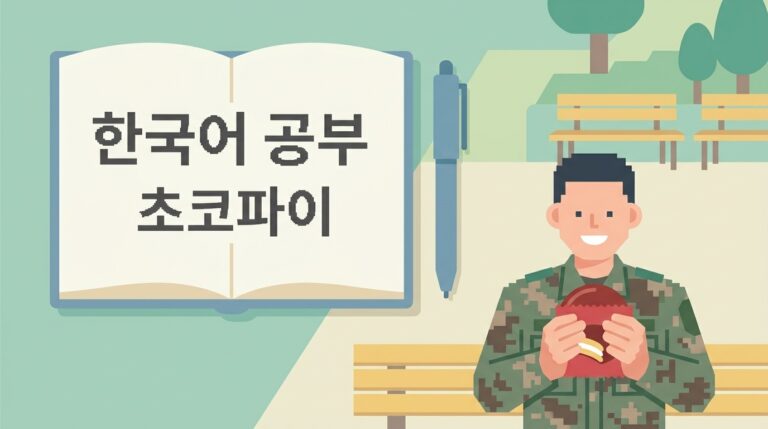
The Sweetest Reward in the Ranks: The Hidden Power of Choco Pie in the Korean Military
Phase 1: Empathy (An Editor’s Warm Welcome)
안녕하세요! (Annyeonghaseyo!) Welcome back to Daily Hangul, your virtual Korean bestie and cultural guide.
Imagine this: You are exhausted after a grueling 20-kilometer night march in the freezing cold. Your boots are heavy, your shoulders ache, and your energy is at absolute zero. Just when you think you can’t take another step, your squad leader hands you a small, round, red-wrapped snack—a Choco Pie (초코파이). You take a bite. The soft chocolate, the crumbly cake, and the sticky marshmallow melt in your mouth. In that exact moment, it doesn’t taste like a cheap convenience store snack; it tastes like pure, unadulterated heaven.
For Korean soldiers, the Choco Pie is not just a sweet treat—it is a symbol of survival, comfort, and emotional connection (정, Jeong). Many of our global learners at the B1 level have told us, “I watched Korean dramas where soldiers cry over a Choco Pie, but I never truly understood why it’s such a big deal!”
Today, we are going to dive deep into the unique military culture surrounding this iconic snack, learn some essential Korean expressions that capture this cozy sentiment, and upgrade your natural, conversational Korean. Ready to march in? Let’s go!
Phase 2: Deep Dive into 3 Essential Expressions
Let’s look at three powerful expressions related to military life, comfort, and sweets. These will instantly make you sound like a local who truly understands Korean society!
1. 당이 떨어지다 (Dang-i tteoreojida)
- Pronunciation: [Dang-ee tteo-reo-jee-da] (Sounds like “Dang” as in dang it + “ee” + “thuh-ruh-jee-dah”)
- Meaning: Lit. “My blood sugar is dropping” -> Fig. “I am completely exhausted/I need something sweet right now.”
- K-Culture Moment: You will see this constantly in K-Dramas when a character is stressed out at work, studying late, or—you guessed it—during military training. They will clutch their head and yell for chocolate.
- Editor’s Insight: While medically it refers to hypoglycemia, Koreans use this casually whenever they feel physically drained and crave sugar. It’s a perfect casual excuse to grab a Choco Pie!
- Situation Spectrum: Casual (✅) | Semi-formal (✅) | Formal (⚠️)
- 🤔 Think About It: In your home country, what is the go-to food or drink people crave when their “sugar drops” after a hard day?
2. 군기가 빠지다 (Gungi-ga ppajida)
- Pronunciation: [Goon-ghee-gah pah-jee-dah] (Sounds like “Goon-key” + “gah” + “pah-jee-dah”)
- Meaning: Lit. “Military discipline has drained out” -> Fig. “To become slack, lazy, or lose one’s edge.”
- K-Culture Moment: Senior soldiers say this to juniors who look too relaxed or make silly mistakes. In daily life, friends use it jokingly when someone is late or slacking off.
- Editor’s Insight: Don’t use this in formal business meetings, but feel free to tease a close friend who forgot their homework by saying “군기 빠졌네!” (You’ve gone soft!).
- Situation Spectrum: Casual (✅) | Semi-formal (⚠️) | Formal (🚫)
- 🤔 Think About It: How does your culture describe someone who has lost their focus or discipline?
3. 정을 나누다 (Jeong-eul nanuda)
- Pronunciation: [Jeong-eul nah-noo-dah] (Sounds like “Jung” + “eul” + “nah-noo-dah”)
- Meaning: Lit. “To share affection/warmth” -> Fig. “To bond deeply with someone through small acts of kindness.”
- K-Culture Moment: This is the ultimate corporate slogan of Orion Choco Pie (which literally has the Hanja character 情 – 정 printed on the box). Sharing a Choco Pie is the ultimate act of sharing Jeong.
- Editor’s Insight: Jeong is a uniquely Korean concept of collective love, attachment, and duty. Sharing food, especially in a harsh environment like the military, is how Jeong is built.
- Situation Spectrum: Casual (✅) | Semi-formal (✅) | Formal (✅)
- 🤔 Think About It: Why do you think sharing food is such a universal way of showing love and connection across different cultures?
Phase 3: Textbook Korean vs. Real-Life Korean
Let’s compare stiff, textbook sentences with the natural, breathing Korean used by real people.
Situation A: Expressing extreme fatigue
- 📖 Textbook Korean: “저는 지금 매우 피곤합니다.” (Jeoneun jigeum maeu pigonhamnida.) – “I am very tired right now.”
- 🗣️ Real-Life Korean: “아, 진짜 당 떨어져요. 초코파이 하나만 주세요!” (Ah, jinjja dang tteoreojyeoyo. Chokopai hanaman juseyo!) – “Ugh, my sugar is seriously dropping. Please give me just one Choco Pie!”
- 💡 Why the difference? Saying “I am tired” is grammatically perfect, but “당 떨어지다” dynamically explains why you need that sweet comfort right away, instantly building a friendly connection.
Situation B: Noticing a friend looking lazy or unfocused
- 📖 Textbook Korean: “당신은 왜 열심히 하지 않습니까?” (Dangsineun wae yeolsimhi haji anseumnikka?) – “Why are you not working hard?”
- 🗣️ Real-Life Korean: “요즘 군기 좀 빠졌네~ 정신 차려!” (Yojeum gungi jom ppajyeonne~ Jeongsin charyeo!) – “You’ve gone a bit soft lately~ Wake up/Snap out of it!”
- 💡 Why the difference? The textbook version sounds accusatory and robotic. The real-life version uses playful military slang to gently tease a friend and motivate them.
Phase 4: K-Culture Deep Dive & Non-Verbal Etiquette
4-1. The Art of Military Giving (Non-Verbal Manners)
In the military (and Korean hierarchy in general), how you receive a Choco Pie matters as much as eating it.
* Two-Handed Respect: When a senior soldier (선임, Seonim) hands you a Choco Pie, you must receive it with both hands, slightly bowing your head.
* Eye Contact: Avoid staring directly into their eyes for too long (which can look challenging), but don’t look at the floor either. Keep a respectful, appreciative gaze.
4-2. The Choco Pie Miracle
Why Choco Pie? During military service, soldiers are cut off from the outside world, undergoing intense physical labor. The body naturally screams for fast sugar. Since chocolate is rare in military rations, the Choco Pie became the ultimate currency of kindness. In fact, many soldiers jokingly admit they changed their religion temporarily during basic training because different religious services (Protestant, Catholic, Buddhist) competed for attendees by offering different brands of Choco Pies and soda!
Phase 5: Real-Life Roleplay Scenario
Setting: A military rest area during a short break.
Characters:
* 민우 (Min-woo): A tired junior soldier (이병) who is physically exhausted.
* 지훈 (Ji-hoon): A cool, experienced senior soldier (병장) who secretly looks after his team.
지훈: (🎭 Worriedly looking at Min-woo) 민우야, 너 얼굴 왜 그래? 어디 아파?
      (Min-woo-ya, neo eolgul wae geurae? Eodi apa? / Min-woo, what's wrong with your face? Are you sick?)

민우: (🎭 Sighing heavily, wiping sweat) 아닙니다, 지훈 병장님! 그냥... 진짜 당이 떨어져서 그렇습니다.
      (Animnida, Ji-hoon byeongjangnim! Geunyang... jinjja dang-i tteoreojyeoseo geureoseumnida. / No, Sergeant Ji-hoon! It's just... my sugar has really dropped.)

지훈: (🎭 Smirking, reaching into his pocket) 에이, 벌써 군기 빠진 거 아니야? 이거 받아라.
      (Ei, beolsseo gungi ppajin geo aniya? Igeo badara. / Hey, have you gone soft already? Here, take this.)

민우: (🎭 Eyes widening as he sees a Choco Pie) 헉! 초코파이 아닙니까? 감사합니다!
      (Heok! Chokopai animnikka? Gamsahamnida! / Oh! Isn't this a Choco Pie? Thank you so much!)

지훈: (🎭 Patting Min-woo's shoulder) 천천히 먹어. 군대에서는 이게 진짜 최고지?
      (Cheoncheonhi meogeo. Gundae-eseonun ige jinjja choegoji? / Eat slowly. In the military, this really is the best, right?)

민우: (🎭 Taking a big bite, looking deeply moved) 네, 진짜 눈물 날 것 같습니다. 정이 느껴집니다!
      (Ne, jinjja nunmul nal geot gatseumnida. Jeong-i neukkyeojimnida! / Yes, I feel like crying. I can literally taste the affection!)

지훈: (🎭 Laughing out loud) 하하, 얼른 먹고 기운 차려! 다음 훈련 준비해야지.
      (Haha, eolleun meoggo giun charyeo! Daeum hullyeon junbihaeyaji. / Haha, eat quickly and cheer up! We have to prepare for the next training.)

민우: (🎭 Saluting playfully) 예! 알겠습니다! 힘내겠습니다!
      (Ye! Algetseumnida! Himnaegetseumnida! / Yes! Understood! I will do my best!)
🔀 Interactive Choice Point
How would you respond if Ji-hoon asks: “민우야, 초코파이 하나 더 줄까?” (Min-woo, do you want one more Choco Pie?)
- Option A: “아닙니다, 괜찮습니다.” (No, I am fine.)
- Feedback (Bad): Too robotic! It rejects the senior’s warm gesture (Jeong) too coldly.
- Option B: “진짜 주십니까? 역시 병장님밖에 없습니다!” (Really? You are truly the best, Sergeant!)
- Feedback (Best): Shows high energy, playfulness, and accepts the kindness with great energy!
- Option C: “네, 하나 더 주세요.” (Yes, give me another one.)
- Feedback (Risk): A bit too direct for military hierarchy. It might make you look slightly greedy if you don’t add polite words of gratitude first.
Phase 6: 10-Second Emotion Shadowing Drill
Practice saying these lines with the exact emotion indicated. Pay attention to the pauses (/) for a natural rhythm!
- [🥺 Exhausted and desperately craving sweets]
- “아… / 진짜 / 당 떨어져요… / 초코파이 먹고 싶다…”
- (Ah… / jinjja / dang tteoreojyeoyo… / chokopai meoggo sipda…)
- [😊 Deeply touched and grateful]
- “군대에서 먹는 초코파이는 / 진짜 / 눈물 나는 맛이에요!”
- (Gundae-eseo meognun chokopai-neun / jinjja / nunmul naneun mas-ieyo!)
Phase 7: K-Culture Mini Dictionary
- PX (피엑스): Military Post Exchange (PX). A magical shop inside military bases where soldiers can buy snacks, cosmetics, and legendary frozen foods (냉동식품) at discounted tax-free prices.
- 정 (Jeong / 情): A deep emotional bond of affection, warm-heartedness, and attachment that grows over shared experiences and time.
- 선임 (Seonim): A senior soldier who entered the military earlier than you.
- 후임 (Huim): A junior soldier who entered the military later than you.
Phase 8: Traveler’s Survival Kit
Survival Expressions TOP 3
- “가장 가까운 편의점이 어디예요?” (Gajang gakkaun pyeonijeom-i eodiyeoyo?)
- Pro Tip: If you ever feel like your sugar is dropping while exploring Seoul, use this to find the nearest store for a quick snack.
- “이거 요즘 인기 있는 과자예요?” (Igeo yojeum ingi inneun gwajayeoyo?)
- Pro Tip: Use this when asking convenience store staff about the trendiest snacks.
- “단것 좀 먹어야겠어요.” (Dan-geot jom meogeoyagetseoyo.)
- Pro Tip: Use this to tell your friends, “I need to eat something sweet.”
Editor’s Travel Note
When traveling in Korea, you must download the Naver Map App rather than Google Maps, as Google Maps does not update real-time walking directions inside Korea due to security regulations. If you need a quick Choco Pie fix, just type “편의점” (Convenience Store) in Naver Map to locate the closest CU, GS25, or Seven-Eleven!
Phase 9: A Step Deeper (Cultural Reflection)
In many Western cultures, individuality and personal space are highly valued. However, Korean military culture—and society as a whole—is built heavily on the concept of 우리가 남이가 (lit. “Are we strangers?”), meaning “We are family.” Sharing a single 40-cent Choco Pie symbolizes that even in the toughest, most isolated environments, you are not alone; you have a community watching your back.
💬 Your Turn: Have you ever eaten a Korean Choco Pie? What is your ultimate comfort food when you feel exhausted? Let us know in the comments below!
Phase 10: FAQ & Common Mistakes
Q: Can I buy Choco Pies easily outside the military?
A: Yes! They are sold in every supermarket, convenience store, and discount mart across South Korea. There are even premium versions available in special department store boutiques.
Q: What is the difference between Orion Choco Pie and Lotte Choco Pie?
A: Orion is the original creator (famous for the word 情 on the box) and is generally known for a softer marshmallow. Lotte is also incredibly popular and delicious. Koreans have passionate debates over which one is superior!
Q: Can I use the expression “군기 빠졌다” to my boss at work?
A: Absolutely not! This is military slang and highly informal. Saying this to a superior or a client will sound extremely rude. Only use it with very close friends or juniors in a playful setting.
🚨 Common Mistakes Warning Board
- Mistake: Calling any chocolate cookie a “Choco Pie.”
- Correct Action: Only the specific soft cake with marshmallow filling should be called 초코파이.
- Mistake: Pronouncing it as “Cho-co Pie” with a flat English accent.
- Correct Action: Say it like 초코파이 [Cho-ko-pa-ee] with clear, separate syllables.
Phase 11: Action Mission & Engagement
- 🥉 Bronze Mission: Go to your local Asian market, buy a box of Choco Pies, and eat one while whispering: “당 떨어질 땐 역시 초코파이!”
- 🥈 Silver Mission: Take a photo of your favorite sweet snack, post it on Instagram, and tag us
@DailyHangulwith the caption: “오늘 진짜 당 떨어지네요!” - 🥇 Gold Mission: Use the phrase “당 떨어지다” in a real text message to a Korean language partner or friend this week!
Phase 12: Interactive Quiz Challenge
Test your knowledge with these fun mini-quizzes!
1. Context Quiz
Which situation is most appropriate for saying “당 떨어졌다”?
* A) When you are angry at your friend.
* B) When you feel physically drained after walking 10,000 steps and need chocolate.
* C) When you wake up early in the morning.
Click to reveal the Answer & Explanation
Correct Answer: B
Explanation: “당 떨어지다” specifically refers to the feeling of physical exhaustion that craves sugar to recharge. It’s the perfect phrase for after long walks or intense study sessions!
2. Fill-in-the-Blank
Fill in the missing syllable:
“요즘 너무 편하게 지냈더니 군__가 빠진 것 같아!”
Click to reveal the Answer & Explanation
Correct Answer: 기 (Gungi)
Explanation: The complete word is 군기 (Gungi – military discipline). The phrase “군기 빠지다” means to lose discipline or go soft.
3. True or False
True or False: You should always use both hands to receive a Choco Pie from a senior soldier in Korea.
Click to reveal the Answer & Explanation
Correct Answer: True
Explanation: Showing respect by using two hands when receiving items is an essential part of Korean polite etiquette, especially in structured environments like the military.







