

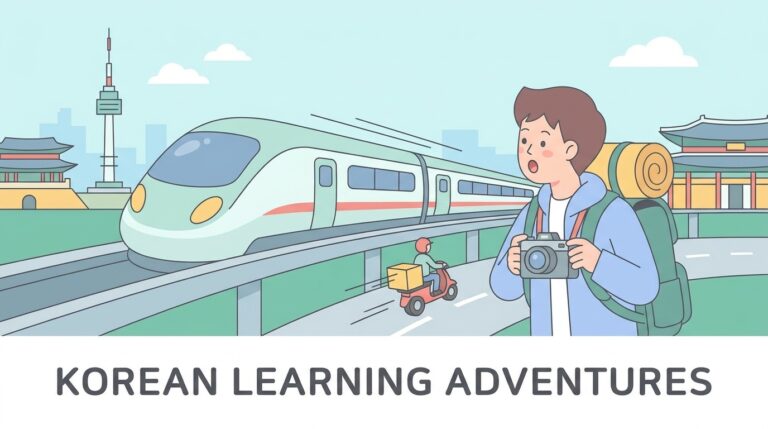
Why is Everything in Korea So Fast? Navigating the ‘Ppalli-Ppalli’ Lifestyle Like a Pro
Phase 1: Empathy (Welcome, Chingu!)
안녕하세요! Welcome back to Daily Hangul, your ultimate Korean culture navigator. I’m your editor and local bestie!
Imagine this: You step off your flight at Incheon Airport, buy an eSIM online, and it’s activated in exactly 45 seconds. You order a cute sweater on Coupang at 11:30 PM, and when you wake up at 7:00 AM, it’s already sitting beautifully at your doorstep. Later, you walk into a restaurant, sit down, and before you even open your mouth, the side dishes are set, and the food arrives within 5 minutes.
Welcome to Korea, the land of 빨리빨리 (Ppalli-Ppalli / Hurry-Hurry)!
If you’re from a culture where a simple package delivery takes a week, this supersonic speed might feel both mind-blowing and slightly overwhelming. You might ask yourself: “Am I rushing the waiter if I ask for the check?” or “Why does everyone tap their transit cards on the bus before it even stops?”
Don’t worry! Today, we are diving deep into the real-world Korean phrases and cultural nuances that will help you ride the wave of Korea’s legendary speed smoothly, confidently, and without accidentally sounding rude!
Phase 2: Deep Dive into 3 Essential Speed Phrases
1. 벌써요? (Beolsseoyo?)
- Pronunciation: Beol-sseo-yo? (Sounds like “Buhl-suh-yo?” with a surprised tone on the “buhl”)
- Meaning: Already? / So soon?
- K-Culture Moment: You order a steaming bowl of Kimchi-jjigae (Kimchi stew), take your phone out to check one Instagram notification, and boom! The sizzling pot is placed in front of you. You look at the server, eyes wide, and say: “벌써요?”
- Editor’s Insight: This is the ultimate reaction word for foreigners in Korea. It expresses polite amazement at the incredible speed of Korean services. Saying this with a big smile will make any server proud of their speed!
- Situation Spectrum: Casual ✅ | Semi-formal ✅ | Formal ⚠️
- 🤔 Think About It: In many Western cultures, a fast meal might feel like the restaurant is trying to kick you out. In Korea, speed equals respect and efficiency. How does your home country view “speedy service”?
2. 금방 돼요. (Geumbang dwaeyo.)
- Pronunciation: Geum-bang dwae-yo. (Sounds like “Keum-bahng dweh-yo.” focus on the flat ‘m’ sound)
- Meaning: It will be ready in a jiffy / It’ll be done shortly.
- K-Culture Moment: You are getting your phone repaired at a Samsung service center, expecting to leave it there for a week. The technician smiles and says: “금방 돼요.” Ten minutes later, your screen is brand new.
- Editor’s Insight: This is a comforting phrase you’ll hear from baristas, dry cleaners, and mechanics. It shows high confidence in their speed. If you are the one doing something quickly for a Korean friend, you can also say this to reassure them!
- Situation Spectrum: Casual ✅ | Semi-formal ✅ | Formal ✅
- 🤔 Think About It: Why does Korean society value minimizing waiting time so much? It ties back to the rapid economic development (The Miracle on the Han River) where time literally meant survival.
3. 아직 멀었어요? (Ajik meoreosseoyo?)
- Pronunciation: Ah-jik muh-reoss-uh-yo? (Roll the ‘r’ slightly like “Ah-jik muh-ross-uh-yo?“)
- Meaning: Is it still far off? / Is it not ready yet?
- K-Culture Moment: You are waiting for your KTX high-speed train tickets at a busy counter, and the line isn’t moving. You need to check if there is an issue.
- Editor’s Insight: Be careful! This phrase can sound a bit impatient if used with the wrong tone. However, in a fast-paced environment, asking this politely is perfectly acceptable if you have been waiting longer than usual. Use a soft, questioning tone rather than an angry one.
- Situation Spectrum: Casual ✅ | Semi-formal ✅ | Formal 🚫 (Too direct for formal settings)
- 🤔 Think About It: Is patience always a virtue? In Korea, checking in on the status of a service shows that you are actively engaged.
Phase 3: Textbook Korean vs. Real-Life Korean
Let’s compare what the textbooks teach you versus how Koreans actually talk in the wild!
Situation 1: Asking when your food will arrive
- 📖 Textbook Korean: “음식이 언제 나옵니까?” (Eumsigi eonje naopnikka? – When does the food come out?)
- 🗣️ Real-Life Korean: “저기요, 저희 음식 아직 멀었나요?” (Jeogiyo, jeohui eumsik ajik meoreonnayo? – Excuse me, is our food going to be a while longer?)
- 💡 Why is it different? The textbook version is too robotic and grammatically stiff. The real-life version uses “저기요” to politely grab attention and “저희” (our) to sound softer and more natural.
Situation 2: Telling someone you’ll finish a task quickly
- 📖 Textbook Korean: “제가 이것을 신속하게 처리하겠습니다.” (Jega igeoseul sinsokhage cheorihagessseumnida. – I will process this rapidly.)
- 🗣️ Real-Life Korean: “이거 빨리 해 드릴게요!” (Igeo ppalli hae deorilgeyo! – I’ll do this quickly for you!)
- 💡 Why is it different? Unless you are in a military briefing, “신속하게” (rapidly) sounds way too formal. “빨리 해 드릴게요” is warm, active, and highly appreciated in daily business or casual service interactions.
Phase 4: K-Culture Deep Dive & Non-verbal Etiquette
4-1. The “Nunchi” (눈치) of Speed
In Korea, speed isn’t just about moving fast; it’s about Nunchi (tact/situational awareness).
* The Transit Card Dance: When getting off a bus, Koreans stand up and walk toward the exit door before the bus stops. If you wait until the bus completely stops to stand up, you might get a collective sigh from the passengers behind you.
* The Table Bell: Have you seen the little red buttons on restaurant tables? Don’t be shy to press them! It’s not considered rude; in fact, waiting silently for a waiter to make eye contact is considered inefficient.
4-2. The “Rocket Delivery” (로켓배송) Culture
Korea’s internet speed and logistics are world-class. From “Rocket Delivery” (next-day delivery) to ” 새벽배송” (dawn delivery by 7 AM), the service industry works 24/7. This has created a culture where waiting more than two days for an online order feels like an eternity.
Phase 5: Real-Life Roleplay Scenario
Setting: You are at a trendy cafe in Hongdae. You ordered a custom-designed cake for your friend’s birthday, but you need to catch a train in 30 minutes! You are talking to the friendly barista, Min-jun.
- Min-jun (Staff): 어서 오세요! 예약하신 케이크 찾으러 오셨나요?
(Welcome! Are you here to pick up your reserved cake?) - You: 네, 맞아요. 그런데 제가 기차 시간이 얼마 안 남아서요. 🎭 (Looking slightly anxious, checking your watch)
(Yes, that’s right. But my train time is very soon.) - Min-jun (Staff): 아, 그러시군요! 지금 바로 포장해 드릴게요.
(Oh, I see! I will pack it up for you right away.) - You: 정말 감사합니다! 금방 돼요? 🎭 (With a hopeful smile)
(Thank you so much! Will it be done in a jiffy?) - Min-jun (Staff): 네, 1분이면 됩니다! 잠시만 기다려 주세요.
(Yes, it only takes one minute! Please wait just a moment.) - You: 우와, 벌써요? 대단해요! 🎭 (Looking amazed and clapping hands lightly)
(Wow, already? Amazing!) - Min-jun (Staff): 하하, 기차 늦으시면 안 되니까요. 여기 있습니다!
(Haha, we can’t have you missing your train. Here you go!) - You: 정말 감사합니다. 덕분에 안 늦겠어요! 안녕히 계세요.
(Thank you so much. Thanks to you, I won’t be late! Goodbye.)
🔀 Interactive Choice Point
What if the barista says: “Sorry, the cream styling is taking a bit longer. It will take 10 more minutes.” How do you respond?
- Choice A: “아, 그래요? 알겠습니다.” (Ah, really? Okay then.)
- Choice B: “앗, 저 기차 타야 하는데.. 아직 멀었나요?” (Ah, I have to catch a train.. Is it still far from done?)
- Choice C: “빨리 안 하면 환불해 주세요!” (If you don’t do it fast, refund me!)
💡 Feedback on Your Choice
- If you chose A (Safe & Polite): A good, calm response. However, you might miss your train if you just wait without communicating your urgency.
- If you chose B (Best – Highly Recommended): Excellent! Using “아직 멀었나요?” with a polite “앗…” soft opener clearly communicates your tight schedule without being rude.
- If you chose C (Bad & Aggressive): Too harsh! Demanding a refund immediately in this tone is considered a major breach of etiquette in Korea.
Phase 6: 10-Second Emotion Shadowing Drill
Let’s practice speaking with real Korean emotions! Pay attention to the pauses (/) and the emotional cues.
- [😲 Amazed and Excited]
- “우와, / 벌써 나왔어요? / 대박!”
- U-wa, / beol-sseo na-wat-eo-yo? / dae-bak!
- (Wow, / is it out already? / Awesome!)
- [🥺 Slightly Anxious but Polite]
- “혹시.. / 저희 음식 / 아직 멀었나요?”
- Hok-si.. / jeoh-ui eum-sik / a-jik meo-reot-na-yo?
- (By any chance.. / is our food / still far from ready?)
Phase 7: K-Culture Mini Dictionary
- 빨리빨리 (Ppalli-Ppalli) | Hurry, Hurry | The fast-paced mindset that acts as the engine of modern Korean society.
- 새벽배송 (Saebyeok-Baesong) | Dawn Delivery | A delivery service where items ordered at night arrive before 7:00 AM the next morning.
- 대기 시간 (Daegi Sigan) | Waiting Time | Something Koreans actively try to minimize through smart apps and reservations.
- 현지인 (Hyeonji-in) | Local Resident | A local Korean who knows exactly how to navigate these speedy services.
Phase 8: Survivor’s Kit for Travelers
Survival Phrases TOP 3
- “빨리 부탁드립니다!” (Ppalli butak-deurimnida!)
- Pro Tip: Use this when you are in a taxi and need to reach the station quickly. It translates to “Please make it fast!”
- “카드 결제 돼요?” (Kadeu gyeolje dwaeyo?)
- Pro Tip:
Frequently Asked Questions (FAQ)
Q: What does "벌써요? (Beolsseoyo?)" mean in Korean and how do you pronounce it?
A: In Korean, "벌써요? (Beolsseoyo?)" is pronounced [Beol-sseo-yo? (Sounds like "Buhl-suh-yo?" with a surprised tone on the "buhl"] and means: Already? / So soon?
Q: What does "금방 돼요. (Geumbang dwaeyo.)" mean in Korean and how do you pronounce it?
A: In Korean, "금방 돼요. (Geumbang dwaeyo.)" is pronounced [Geum-bang dwae-yo. (Sounds like "Keum-bahng dweh-yo." focus on the flat 'm' sound] and means: It will be ready in a jiffy / It'll be done shortly.
Q: What does "아직 멀었어요? (Ajik meoreosseoyo?)" mean in Korean and how do you pronounce it?
A: In Korean, "아직 멀었어요? (Ajik meoreosseoyo?)" is pronounced [Ah-jik muh-reoss-uh-yo? (Roll the 'r' slightly like "Ah-jik muh-ross-uh-yo?"] and means: Is it still far off? / Is it not ready yet?







