

Master the Art of Korean Floristry: Speak Like a Native K-Florist
Phase 1: Empathy (Dive Into the K-Floristry Trend)
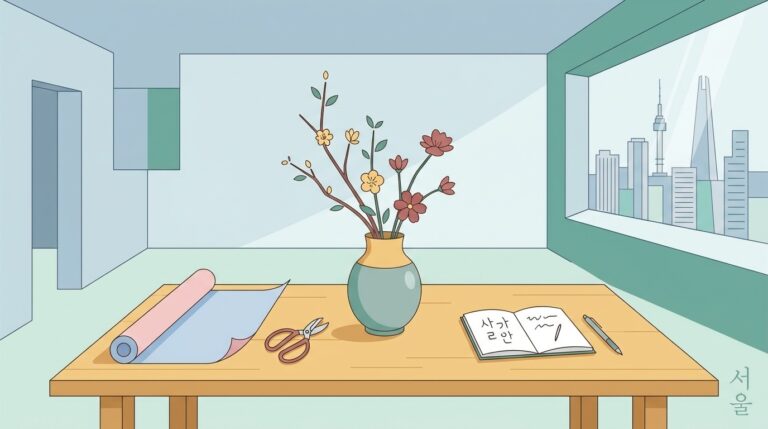
안녕하세요! Welcome back to another immersive cultural guide by Daily Hangul. Have you ever scrolled through Instagram and stumbled upon those breathtakingly delicate, airy, and effortlessly romantic flower arrangements tagged under #KFlorist? Korean floristry has taken the global aesthetic world by storm with its unique philosophy of emphasizing “natural flow” (자연스러운 선) and “negative space” (여백의 미).
However, stepping into a high-end flower design academy in Gangnam for a professional course can be incredibly intimidating. Many C1-level learners tell us: “I know everyday Korean, but when the florist asks me to ‘살리다’ (bring to life) a branch or create a ‘자연스러운 선’ (natural line), I freeze. The artistic nuance gets lost in translation!”
Don’t worry. Today, we are unlocking the exact professional terminology and cultural nuances used in premium Korean florist masterclasses. Let’s elevate your Korean botanical vocabulary to a masterpiece level!
Phase 2: Key Expressions Analysis
1. 선을 살리다 (Seon-eul sal-li-da)
- Pronunciation: Sun-eul sal-li-da (Sounds like “sun” + “ul” + “sal-lee-da”)
- Meaning: Literally “to bring the line alive.” In floristry, it means to position a branch or stem in a way that highlights its natural, organic curve rather than forcing it into a rigid shape.
- K-Culture Moment: You will hear this constantly in K-Beauty and design shows. A florist might gently bend a spirea branch and say, “이 스파이어라 가지는 원래 굽어 있는 선을 살려서 꽂아볼게요.” (I’ll arrange this spirea branch by bringing its natural curve to life.)
- Editor’s Insight: Korean aesthetics value asymmetry and natural imperfection. “살리다” (to save/revive) here implies respecting the plant’s inherent life and direction.
- Situation Spectrum: Casual ✅ | Semi-formal ✅ | Formal ✅
- 🤔 Think About It: How does your culture view floral design? Is it about symmetrical perfection, or do you also cherish the wild, asymmetrical “line” of a single branch?
2. 여백을 두다 (Yeo-baek-eul du-da)
- Pronunciation: Yuh-baek-eul doo-da (Sounds like “yuh-beck” + “ul” + “doo-da”)
- Meaning: Literally “to leave negative space” or “to leave emptiness.”
- K-Culture Moment: In traditional Korean ink-wash paintings (수묵화), the empty background is as important as the painted subject. In K-floristry, overcrowding is a cardinal sin. Instructors will warn: “꽃을 너무 빽빽하게 꽂지 말고, 꼭 여백을 두세요.”
- Editor’s Insight: “여백” is not “empty wasted space.” It is “breathing space” that allows each individual flower to shine.
- Situation Spectrum: Casual ✅ | Semi-formal ✅ | Formal ✅
- 🤔 Think About It: Is “emptiness” in art seen as unfinished in your country, or is it appreciated as a deliberate design choice?
3. 얼굴 방향을 잡다 (Eol-gul bang-hyang-eul jap-da)
- Pronunciation: Uhl-gool bang-hyang-eul jap-da
- Meaning: Literally “to hold/set the direction of the face.” In floral design, the “face” of a flower (얼굴) refers to its main blooming side.
- K-Culture Moment: A florist guiding you through a centerpiece demo will say, “메인 장미의 얼굴 방향을 살짝 앞쪽을 보게 잡아주세요.” (Please position the face of the main rose so it looks slightly forward.)
- Editor’s Insight: Treating flowers like sentient beings with “faces” (얼굴) reflects a deep, empathetic connection to nature in Korean linguistic habits.
- Situation Spectrum: Casual ⚠️ | Semi-formal ✅ | Formal ✅
- 🤔 Think About It: Does your language refer to a flower’s front as its “face,” or do you use more technical terms?
Phase 3: Textbook Korean vs. Real Korean
Let’s compare the stiff, dictionary terms with what professional Korean florists actually whisper in their studios.
Situation 1: Placing a focal flower
- 📖 Textbook: “주요 꽃을 중앙에 배치하세요.” (Place the main flower in the center.)
- 🗣️ 진짜 한국어: “메인 꽃의 얼굴을 이쪽으로 잡아주세요.” (Position the face of the main flower toward this side.)
- 💡 Why the difference? Textbooks use mechanical design words like “배치” (arrange/allocate), but real florists talk about the flower’s “face” to make the arrangement feel alive and organic.
Situation 2: Thinning out excess leaves
- 📖 Textbook: “불필요한 잎사귀를 제거하십시오.” (Remove unnecessary leaves.)
- 🗣️ 진짜 한국어: “가볍게 가지치기 좀 하고, 밑에 지저분한 건 다듬어줄게요.” (Let’s do some light pruning and tidy up the messy parts at the bottom.)
- 💡 Why the difference? “제거” sounds like military disposal. Florists prefer soft, caring verbs like “다듬다” (to groom/tidy/trim) to respect the material.
Phase 4: K-Culture Deep-Dive & Non-verbal Manners
4-1. The “Soft Touch” and Nunchi (눈치)
When handling flowers in a Korean academy, never handle stems roughly. Korean florists emphasize an almost meditative, gentle touch.
* Non-verbal etiquette: When handing tools (such as floral shears/전정가위) to your instructor or classmate, always hand them handle-first, holding the blade closed with both hands while giving a slight nod. This shows supreme respect and professional safety.
4-2. The “Flower Cafe” (플라워 카페) Phenomenon
In Seoul (especially Mapo and Gangnam), you will find fusion “Flower Cafes” where boutique florists operate inside trendy cafes. These spaces showcase the “K-style bouquet”—characterized by layers of pastel-toned wrapping paper, oversized ribbons, and a focus on single, high-end imported stems like Juliet Roses. This style is heavily popularized by K-Dramas, where male leads present minimalist yet luxury bouquets to express understated sincerity.
Phase 5: Live Roleplay Scenario
Setting: A chic florist studio in Sinsa-dong, Seoul. You are taking a 1-on-1 masterclass with Ji-woo, a renowned K-florist.
Dialogue
- 지우 (Ji-woo): “오늘 클래스에서는 프렌치 스타일을 한국적으로 해석한 내추럴 센터피스를 만들어볼 거예요. 먼저 침봉에 침엽수 가지로 베이스를 잡을게요.”
(In today’s class, we’ll make a natural centerpiece with a Korean interpretation of French style. First, we’ll set the base on the kenzan with conifer branches.) - 학습자 (You): “네, 선생님. 가지가 좀 삐죽해서 어려운데, 어떤 선을 살려야 할까요?”
(Yes, teacher. The branches are a bit spiky so it’s hard; which line should I bring to life?) - 지우 (Ji-woo): “오, 역시 감각이 있으시네요! 그 오른쪽 가지의 굽어진 라인이 참 예뻐요. 그 선을 살려서 사선으로 꽂아보세요.”
(Oh, you definitely have an eye for this! The curved line of that right branch is beautiful. Bring that line to life and insert it diagonally.) - 학습자 (You): “이렇게요? 그런데 꽃을 더 꽂다 보니 너무 꽉 차는 느낌이 드는데 괜찮나요?”
(Like this? But as I insert more flowers, it feels a bit too crowded. Is that okay?) - 지우 (Ji-woo): “아, 지금 꽃들의 얼굴 방향이 다 한곳만 보고 있어서 그래요. 그리고 조금 더 여백을 두셔야 꽃들이 숨을 쉽니다.”
(Ah, that’s because the faces of the flowers are all looking in one direction. And you need to leave a bit more negative space so the flowers can breathe.) - 학습자 (You): “아하, 여백을 두는 게 생각보다 어렵네요. 장미 얼굴 방향을 살짝 비껴가게 수정해 볼게요.”
(Aha, leaving negative space is harder than I thought. I’ll adjust the rose faces so they point slightly away from each other.) - 지우 (Ji-woo): “정말 잘하셨어요! 훨씬 더 내추럴하고 리듬감이 살아났네요. 마지막으로 안개꽃으로 가볍게 터치해 주면 완성입니다.”
(Wonderfully done! It looks much more natural and rhythmic now. Finally, just touch it up lightly with baby’s breath and we’re finished.) - 학습자 (You): “선생님 덕분에 여백의 미를 조금은 이해한 것 같아요. 감사합니다!”
(Thanks to you, teacher, I think I understand the beauty of empty space a little bit now. Thank you!)
🔀 Interactive Choice
Your instructor asks you to add the final “accent flower” (포인트 꽃). What do you do?
- Option A: Insert a massive, bright sunflower right in the dead center because you love bold designs.
- Option B: Find a delicate, swaying cosmos stem, trim the lower leaves, and place it slightly higher than the rest to ride the “flow.”
- Option C: Leave it empty because you want to maximize the “여백” (negative space).
Feedback:
- Option B (Best): Excellent choice! K-floristry loves “율동감” (rhythm/movement). A swaying cosmos utilizing the natural line is the perfect finishing touch.
- Option A (Bad): Oops! A massive sunflower in the center ruins the delicate balance and covers up all the “여백” (breathing space).
- Option C (Risk): Too empty! While “여백” is important, a centerpiece still needs an accent to draw the eyes. Leaving it completely bare might make it look unfinished.
Phase 6: 10-Second Emotional Shadowing Drill
Practice speaking like a refined, artistic florist. Focus on the pauses (/) and emotions!
[😊 Softly and encouragingly]
“이 가지는 / 원래 굽어 있는 / 선을 살려서 꽂는 게 / 훨씬 예뻐요.”
(This branch looks much prettier if you bring its original curved line to life.)-
[🤔 Thoughtfully and gently]
“꽃을 너무 꽉 채우지 마시고, / 숨을 쉴 수 있게 / 여백을 두세요.”
(Don’t pack the flowers too tight; leave some negative space so they can breathe.)
Phase 7: K-Culture Mini-Dictionary
- 소재 (So-jae) | Foliage/Greenery used in arrangements. In Korea, we distinguish between “꽃” (flowers) and “소재” (stems, eucalyptus, branches, etc.).
- 침봉 (Chim-bong) | Kenzan / Pin frog. Used in eco-friendly Korean arrangements to secure stems without using floral foam.
- 한지 포장 (Han-ji po-jang) | Wrapping bouquets using traditional Korean handmade paper (Hanji), giving an elegant, muted texture.
- 줄기 (Jul-gi) | Flower stem. Florists often assess the health of a flower by how straight and sturdy its “줄기” is.
Phase 8: Traveler’s Survival Kit
Survival Vocab TOP 3
- 꽃가위 있어요? (Kkot-ga-wi is-seo-yo?) | Do you have floral shears?
- Pro Tip: Useful when attending a workshop or renting space in a shared floral studio.
- 소재 위주로 주세요. (So-jae wi-ju-ro ju-se-yo.) | Please focus mainly on foliage/greenery.
- Pro Tip: Use this at a flower market if you want a clean, botanical look rather than colorful flowers.
- 포장 빼고 그냥 주세요. (Po-jang ppae-go geu-nyang ju-se-yo.) | Please skip the wrapping paper; just give me the raw stems.
- Pro Tip: Perfect for saving money and being eco-friendly when buying flowers for your own vase at home.
📍 Editor’s Travel Note:
If you are visiting Seoul, download the 네이버 지도 앱 (Naver Map App) to find the famous Yangjae Flower Market (양재꽃시장) or Express Bus Terminal Flower Market (고속터미널 꽃시장). Note that wholesale fresh flower markets usually open around midnight and close by noon the next day! (Prices and hours may vary depending on seasons).
Phase 9: Deep Dive Essay
The vocabulary of Korean floristry—treating stems as having “faces” (얼굴) and valuing “emptiness” (여백)—is deeply rooted in the philosophical heritage of East Asia. Unlike western classical arrangements that historically sought to dominate nature by shaping it into perfect geometric domes, traditional Korean design seeks harmony by bending with nature. It reflects a humility toward the natural world where the human designer is merely an assistant helping the flower express its pre-existing beauty.
💬 Your Turn: In your culture, do people prefer perfectly symmetric, dense bouquets, or do they appreciate asymmetrical, wild arrangements? Let us know in the comments below!
Phase 10: FAQ & Common Mistakes
Q: What is the difference between ‘선’ (seon) and ‘줄기’ (jul-gi)?
A: ‘줄기’ refers to the physical anatomical stem of the flower. ‘선’ refers to the abstract artistic visual line, flow, or movement that the stem creates in space.
Q: Can I use ‘얼굴’ for all plants, or just flowers?
A: It is primarily used for flowers with a clear front-facing bloom (like roses, ranunculus, or gerberas). It is rarely used for tiny fillers like baby’s breath.
Q: Is the word ‘여백’ only used in art and flower design?
A: No, it is also used metaphorically in daily life! For example, “바쁜 일상 속에 여백이 필요해” means “I need some breathing room in my busy daily life.”
🚨 Common Mistakes Alert!
- Calling greenery “풀” (pul / grass):
- Mistake: “이 풀 이름이 뭐예요?”
- Correction: In floristry, call it “소재” (so-jae) or “그린” (geu-rin). Calling professional eucalyptus “풀” sounds like you are pointing at weeds on the street!
- Using “자르다” (to cut) aggressively:
- Mistake: “줄기 그냥 다 잘라버렸어요.”
- Correction: Say “다듬다” (to trim) or “사선 자르기 하다” (to cut diagonally) to sound like a seasoned professional.
Phase 11: Action Mission
- Bronze Medal 🥉: Find a flower photo online and point out its “얼굴 방향” (face direction) out loud in Korean.
- Silver Medal 🥈: Go to Instagram, search
#플로리스트or#꽃꽂이, and find a post that utilizes “여백의 미” (beauty of empty space). Write a small Korean comment: “여백의 미가 너무 아름다워요!“ - Gold Medal 🥇: Grab a single branch or flower at home. Trim it while practicing the shadowing drill: “선을 살려서 꽂아볼게요.“
Phase 12: Interactive Quiz
🔍 Quiz 1: What is the correct term for leaving intentional breathing space in a design?
Answer: 여백을 두다 (Yeo-baek-eul du-da)
Explanation: “여백” is the beautiful negative space that makes Korean floral designs feel airy and natural.
🔍 Quiz 2: True or False – In Korean floristry, you should always hide the bent or crooked lines of a branch to keep it straight.
Answer: False
Explanation: You should do the opposite! You should “선을 살리다” (bring the line to life) by utilizing the natural crookedness of the branch.







