

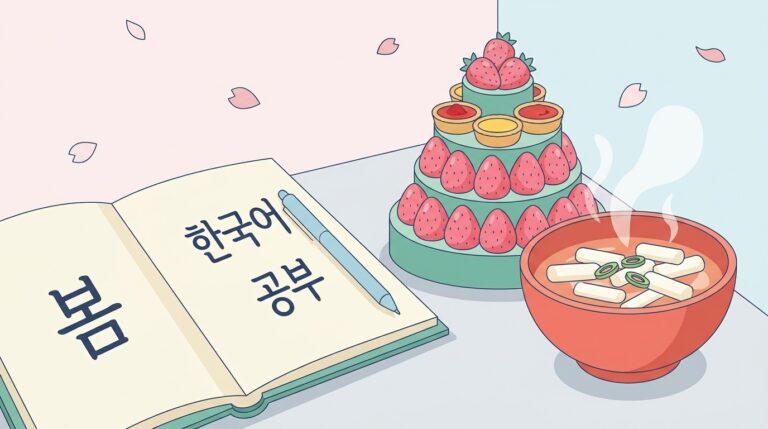
Sweet Spring in Korea: How to Master a Trendy Strawberry Buffet Like a Local
안녕하세요! (An-nyeong-ha-se-yo!) Hello! I’m your Daily Hangul Chief Editor, your trusted cultural navigator. If you’re planning to visit Korea in the spring, you might think of cherry blossoms first. But ask any local foodie, and they will tell you that spring in Korea is officially “Strawberry Season” (딸기철 – ttal-gi-cheol)!
Every spring, luxury hotels and trendy cafes in Seoul transform into pink paradises, hosting lavish Strawberry Desserts Buffets (딸기 뷔페 – ttal-gi bwi-pe). It is a massive trend among young Koreans. However, booking a spot and navigating the buffet like a true local can be intimidating if you don’t know the right expressions or the unspoken social rules.
Today, we are going to learn how to conquer a Korean strawberry buffet with confidence, style, and natural Korean phrases. Let’s dive in!
Phase 2: Three Essential Expressions for Your Sweet Adventure
1. 예약하기 진짜 하늘의 별 따기예요 (Ye-yak-ha-gi jin-jja ha-neul-ui byeol tta-gi-ye-yo)
- Pronunciation: “Yeh-yahk-hah-gee jeen-jjah hah-neul-wee byeol ttah-ghee-yeh-yo” (The word ttagi sounds like “tah-ghee” but with a tense double ‘t’ sound.)
- Meaning: Booking this is like catching a star in the sky (extremely difficult).
- K-Culture Moment: You will hear this expression in lifestyle K-Dramas whenever characters try to book a hot concert ticket, a famous restaurant, or yes—a coveted weekend strawberry buffet slot.
- Editor’s Insight: 하늘의 별 따기 (plucking a star from the sky) is a beautiful idiom for something nearly impossible. In Korea, popular strawberry buffets sell out within seconds of opening online reservations.
- Situation Spectrum: Casual ✅ | Semi-formal ✅ | Formal ⚠️
- 🤔 Think About It: Does your language have a celestial metaphor for something extremely difficult to achieve?
2. 본전 뽑아야죠! (Bon-jeon ppob-a-ya-jyo!)
- Pronunciation: “Bone-jeon ppoh-bah-yah-jyo!” (Emphasize the ppoh with strong air pressure.)
- Meaning: We must get our money’s worth! / Let’s make it worth every penny!
- K-Culture Moment: Commonly used by friends entering an all-you-can-eat restaurant (무한리필 – mu-han-ri-pil) or a high-end dessert buffet.
- Editor’s Insight: 본전 means “principal capital” or “cost price,” and 뽑다 means “to pull out” or “extract.” When Koreans pay a high entry fee for a strawberry buffet, they jokingly say this to motivate each other to eat as many premium strawberries as possible!
- Situation Spectrum: Casual ✅ | Semi-formal ✅ | Formal 🚫
- 🤔 Think About It: Is discussing “getting your money’s worth” considered polite or slightly cheeky in your culture? In Korea, sharing this goal with friends is a fun bonding ritual.
3. 단짠단짠으로 먹어야 많이 먹어요 (Dan-jjan-dan-jjan-eu-ro meog-eo-ya man-i meog-eo-yo)
- Pronunciation: “Dahn-jjan-dahn-jjan-eu-roh meoh-gah-yah mah-nee meoh-gah-yo”
- Meaning: You have to eat sweet-salty-sweet-salty to eat a lot.
- K-Culture Moment: Mukbang (eating show) hosts frequently use 단짠단짠 (sweet-salty-sweet-salty) as a golden culinary rule to prevent getting 물리다 (mul-li-da – getting sick of one flavor).
- Editor’s Insight: 단 comes from 달다 (sweet) and 짠 comes from 짜다 (salty). To get your money’s worth at a strawberry buffet, Koreans alternate sweet strawberry tarts with salty options like spicy tteokbokki or savory sandwiches offered at the hot food section.
- Situation Spectrum: Casual ✅ | Semi-formal ✅ | Formal 🚫
- 🤔 Think About It: What is your ultimate “sweet and salty” food combination?
Phase 3: Textbook Korean vs. Real-Life Korean
Situation 1: Expressing that you are full of sweet desserts
- 📖 Textbook: “배가 부릅니다.” (Bae-ga bu-reup-ni-da. – My stomach is full.)
- 🗣️ Real-Life: “이제 단 거 더는 못 먹겠어요. 속이 달아요.” (I-je dan geo deo-neun mot meog-ges-seo-yo. Sog-i dal-a-yo. – I can’t eat any more sweet things. My stomach/inside feels too sugary/sickly sweet.)
- 💡 Why the difference? While “배가 부르다” is grammatically correct, Koreans use the expression “속이 달다” (literally: “my inside is sweet”) to describe that specific, slightly nauseous feeling after eating too much sugar.
Situation 2: Asking if a reservation is required
- 📖 Textbook: “예약이 필요합니까?” (Ye-yak-i pil-yo-hap-ni-ka? – Is a reservation necessary?)
- 🗣️ Real-Life: “여기 무조건 예약해야 돼요? 워크인도 받아요?” (Yeo-gi mu-jeo-geon ye-yak-hae-ya dwae-yo? Wo-keu-in-do bad-a-yo? – Do we absolutely have to book here? Do they accept walk-ins too?)
- 💡 Why the difference? Real-life Korean is much more conversational. Using “워크인” (walk-in) transliterated into Korean is very common in trendy urban cafes and hotels.
Phase 4: K-Culture Deep Dive & Non-verbal Etiquette
4-1. The “Strawberry Etiquette” (딸기 매너)
At high-end strawberry buffets, presentation is everything. When taking photos, it is polite to wait until other guests have finished taking their photos of a freshly refilled platter before you scoop up the desserts. Also, grabbing only the fresh whole strawberries on top of a cake and leaving the sponge base behind is considered bad manners (민폐 – min-pye). Take the whole slice!
4-2. The Secret Savior: Tteokbokki (떡볶이)
You might wonder why luxury hotel strawberry buffets serve spicy rice cakes (떡볶이), fish cake soup, or even spicy noodles. This is because hotels quickly realized that foreigners and locals alike can only eat so many sweet pastries. Offering spicy, salty Korean street food keeps the palate refreshed, allowing guests to achieve the ultimate 단짠단짠 cycle!
Phase 5: Real-Life Roleplay Scenario
Setting: A luxurious hotel lounge in Yeouido, Seoul. Pink strawberry towers stand tall. You (Minji’s friend) and Minji (your Korean bestie) are staring at the gorgeous dessert spreads.
- 민지 (Minji): 와! 드디어 왔네요! 여기 예약하기 진짜 하늘의 별 따기였어요!
(Wa! Deu-di-eo wat-nae-yo! Yeo-gi ye-yak-ha-gi jin-jja ha-neul-ui byeol tta-gi-yeot-seo-yo!)
(Wow! We are finally here! Booking this place was truly like plucking stars from the sky!) - 나 (You): 🎭 [Looking around in awe] 그러니까요! 민지 씨 덕분에 올 수 있었어요. 오늘 본전 뽑아야죠!
(Geu-reo-ni-kka-yo! Min-ji ssi deok-bun-e ol su is-seot-seo-yo. O-neul bon-jeon ppob-a-ya-jyo!)
(Exactly! Thanks to you, Minji, I could come. We must get our money’s worth today!) - 민지 (Minji): 🎭 [Grabbing a plate with a determined look] 당연하죠! 우리 전략적으로 먹어야 해요. 첫 접시부터 케이크는 금지예요!
(Dang-yeon-ha-jyo! U-ri jeon-ryak-jeok-eu-ro meog-eo-ya hae-yo. Cheot jeop-si-bu-teo ke-i-keu-neun geum-ji-ye-yo!)
(Of course! We have to eat strategically. Cakes are forbidden on the first plate!) - 나 (You): 🎭 [Nodding and pointing at the fresh strawberries] 맞아요. 일단 생딸기부터 시작해서 단짠단짠으로 가야죠?
(Ma-ja-yo. Il-dan saeng-ttal-gi-bu-teo si-jak-hae-seo dan-jjan-dan-jjan-eu-ro ga-ya-jyo?)
(Right. Shall we start with fresh strawberries first and go sweet-salty-sweet-salty?) - 민지 (Minji): 역시 제 친구예요! 저기 핫푸드 코너에 떡볶이도 있어요.
(Yeok-si je chin-gu-ye-yo! Jeo-gi hat-pu-deu ko-neo-e tteok-bok-ki-do is-seo-yo.)
(As expected of my friend! There is also tteokbokki in the hot food section over there.) - 나 (You): 대박! 달콤한 딸기 마카롱 한 입 먹고, 매운 떡볶이 먹으면 무한대로 들어가겠어요.
(Dae-bak! Dal-kom-han ttal-gi ma-ka-rong han ib meog-go, mae-un tteok-bok-ki meog-eu-myeon mu-han-dae-ro deul-eo-ga-ges-seo-yo.)
(Awesome! If I eat a sweet strawberry macaron and then eat spicy tteokbokki, it will go in endlessly!) - 민지 (Minji): 🎭 [Giggling] 맞아요. 자, 그럼 접시 들고 출동해 볼까요?
(Ma-ja-yo. Ja, geu-reom jeop-si deul-go chul-dong-hae bol-kka-yo?)
(Right. Well then, shall we grab our plates and head out?) - 나 (You): 네, 가요! 오늘 배 터지게 먹어 봐요!
(Ne, ga-yo! O-neul bae teo-ji-ge meog-eo bwa-yo!)
(Yes, let’s go! Let’s eat until our stomachs burst today!)
🔀 Interactive Choice Point
How would you respond to Minji when she asks if you want another plate of heavy cream cakes near the end?
- Choice A: “배가 너무 부릅니다. 이제 가요.” (Textbook style)
- Choice B: “이제 속이 너무 달아서, 매운 떡볶이 한 접시 더 먹어야겠어요!” (Pro sweet-salty strategist style)
- Choice C: “단 거 안 좋아해요.” (Slightly buzzkill style)
Feedback:
- Choice A (Bad): Grammatically fine, but a bit cold and formal for a fun outing with a friend.
- Choice B (Best): Excellent! You showed your understanding of the “dan-jjan-dan-jjan” culture and kept the playful vibe alive.
- Choice C (Risk): Oh no! Saying you don’t like sweets after coming to a strawberry buffet might make Minji feel awkward about booking the place.
Phase 6: 10-Second Emotion Shadowing Drill
Practice speaking with real emotions! The / represents a natural pause.
- [😊 Filled with high excitement & energy]
- 예약하기 / 진짜 / 하늘의 별 따기였어요!
- Ye-yak-ha-gi / jin-jja / ha-neul-ui byeol / tta-gi-yeot-seo-yo!
- [🔥 Determined, rubbing hands together playfully]
- 오늘 / 돈 냈으니까 / 본전 뽑아야죠!
- O-neul / don naes-seu-ni-kka / bon-jeon / ppob-a-ya-jyo!
- [😜 Playful & conspiratorial]
- 단짠단짠으로 먹으면 / 무한대로 / 먹을 수 있어요!
- Dan-jjan-dan-jjan-eu-ro meog-eu-myeon / mu-han-dae-ro / meog-eul su is-seo-yo!
Phase 7: K-Culture Mini-Dictionary
- 생딸기 (Saeng-ttal-gi) | Fresh/Raw Strawberries | “생” (saeng) means raw or fresh. In buffets, raw, unprocessed premium strawberries are highly prized.
- 무한리필 (Mu-han-ri-pil) | All-you-can-eat / Infinite refill | A compound of 무한 (infinite) and 리필 (refill). It refers to any buffet or self-serve food joint.
- 인생샷 (In-saeng-syat) | Life shot / Best photo of your life | Used when you take a jaw-droppingly beautiful photo, perfect for Instagram, often featuring the aesthetic pink background of a dessert buffet.
- 소확행 (So-hwak-haeng) | Small but certain happiness | A popular lifestyle keyword in Korea. Buying a ticket to a luxury strawberry buffet is a classic example of treating oneself to a 소확행.
Phase 8: Survivor Kit for Travelers
Survival Phrases TOP 3
- 물티슈 좀 더 주실 수 있나요? (Mul-ti-syu jom deo ju-sil su in-na-yo?)
- Pro Tip: Strawberry juice can make your hands very sticky. Use this to ask, “Could I get some more wet wipes?”
- 디저트 접시는 어디에 두나요? (Di-jeo-teu jeop-si-neun eo-di-e du-na-yo?)
- Pro Tip: “Where should I leave the used dessert plates?” (Usually, staff clear them, but some casual spots have tray drop-off zones).
- 아메리카노 리필 되나요? (A-me-ri-ka-no ri-pil dwe-na-yo?)
- Pro Tip: Ask “Can I get a refill on my Americano?” to wash down the sweetness. Some premium buffets offer one free refill of black coffee.
Editor’s Travel Note
Most luxury hotel strawberry buffets are located in central Seoul (Dongdaemun, Yeouido, Yongsan) and require reservations weeks in advance. Use the Catch Table App (캐치테이블) to secure bookings as an international traveler. Note: Buffet pricing and reservation schedules vary yearly, so check details beforehand.
Phase 9: “A Step Deeper” (Reflections on Korea’s Food Culture)
In Korea, food is rarely just about satisfying hunger—it is a shared social activity and a visual language. The rise of luxury strawberry buffets highlights the “Small Luxury” trend among Korean millennials and Gen Z. Instead of buying expensive luxury goods, young Koreans invest in a 100,000 KRW buffet experience to enjoy beautiful aesthetics, take gorgeous pictures for social media, and share joyful memories with friends. It’s a colorful escape from the highly competitive daily life.
💬 Your Turn: Have you ever splurged on a food experience just for the joy of it? What is your country’s equivalent of a “strawberry buffet”? Let me know in the comments below!
Phase 10: FAQ & Common Mistakes
Q: Can I just walk into a hotel strawberry buffet without a reservation?
A: It is highly unlikely. Weekend slots sell out almost instantly. However, weekday slots occasionally have cancellations, or some hotel lounges offer small-scale “Strawberry Afternoon Tea Sets” that are easier to book. Always check online first!
Q: Is there a dress code for hotel strawberry buffets in Seoul?
A: While there is no strict formal dress code, most people dress in “Smart Casual” or romantic spring outfits to match the aesthetic and take nice photos. Avoid slippers and activewear.
Q: Are drinks included in the ticket price?
A: Generally, yes! Most packages include a welcome strawberry drink and a choice of coffee or premium tea.
🚨 Common Mistakes Warning Board
- Mistake 1: Eating too much cake right at the start.
- Correct Action: Start with light, raw 생딸기 (fresh strawberries) and savory options first to avoid getting full too quickly.
- Mistake 2: Expecting unlimited refills on alcoholic beverages.
- Correct Action: Wine or champagne options usually cost extra or are limited to one welcome glass. Read the menu carefully.
- Mistake 3: Pronouncing “bwi-pe” as “bu-fey”.
- Correct Action: Pronounce it clearly as 뷔페 (bwi-pe) so locals can understand you instantly.
Phase 11: Action Mission & K-Culture Hunt
- Bronze Mission: Practice saying “본전 뽑아야죠!” in front of the mirror 3 times with a playful face.
- Silver Mission: When you eat something sweet and salty next time, take a picture and share it on Instagram with the hashtag
#danjjandanjjan(#단짠단짠). - Gold Mission: Look up a strawberry buffet in Seoul (like Lotte Hotel, JW Marriott, or Dragon City) on Instagram and try reading the comments of Korean food bloggers.
🎮 K-Culture Mission: Watch a Korean Mukbang video on YouTube and spot how many times they use the word 단짠 (dan-jjan) when eating savory-sweet food combinations!
Phase 12: Interactive Quiz Challenge
1. Situational Judgment
If you want to tell your friend to eat sweet macarons followed by salty tteokbokki to eat more, which word should you use?
* A) 생딸기 (Saeng-ttal-gi)
* B) 단짠단짠 (Dan-jjan-dan-jjan)
* C) 하늘의 별 따기 (Ha-neul-ui byeol tta-gi)
Click to reveal the Answer & Explanation
Correct Answer: B
Explanation: 단짠단짠 (Sweet-Salty-Sweet-Salty) is the ultimate strategy to keep eating without getting tired of one flavor! A is fresh strawberries, and C means “plucking stars from the sky.”
2. Fill in the Blanks
“이번 콘서트 티켓팅은 진짜 _________였어요.” (Booking this concert ticket was truly like plucking stars from the sky.)
Click to reveal the Answer & Explanation
Correct Answer: 하늘의 별 따기 (ha-neul-ui byeol tta-gi)
Explanation: This expression is used for any highly competitive booking situation, from strawberry buffets to K-pop concerts!
3. True/False Culture Quiz
True or False: Luxury hotel strawberry buffets in Korea only serve sweet desserts.
Click to reveal the Answer & Explanation
Correct Answer: FALSE
Explanation: They also serve spicy and savory street foods like tteokbokki and sandwiches to help guests maintain the “dan-jjan-dan-jjan” balance!







