

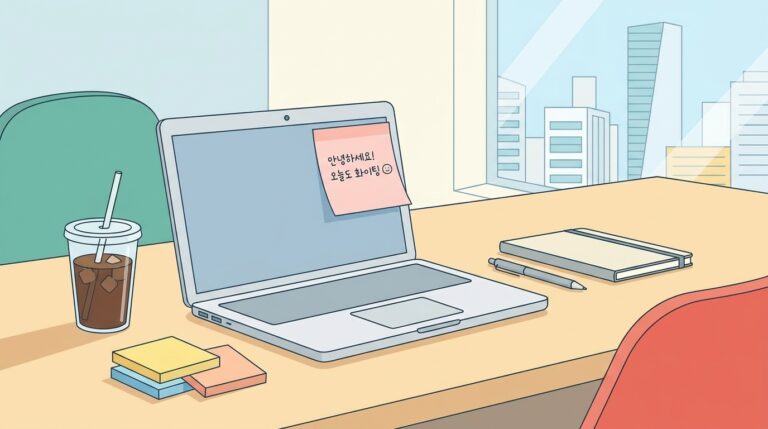
Leaving a Message at a Korean Office: No More Panic, Just Pure Professionalism!
Phase 1: Empathy (Welcome, My Friend!)
안녕하세요! (Annyeonghaseyo!) I’m your Lead Editor and Local Culture Navigator at Daily Hangul.
Imagine this: You are at your new internship or office in Seoul. The phone rings, or a colleague steps away from their desk, and you need to leave a quick sticky note. Your heart beats faster. “Should I use super-formal Korean? What if I sound rude?”
We’ve all been there! Many K-Drama fans watch office dramas like Misaeng (Incomplete Life) or What’s Wrong with Secretary Kim and think office Korean has to be impossibly stiff and complicated. But in reality, leaving a simple memo is one of the easiest ways to show you are organized and polite. Today, we’ll master the art of leaving a quick, professional Korean office memo—A2 style! By the end of this guide, you’ll write notes like a seasoned Seoul pro.
Phase 2: Top 3 Core Expressions Deep Dive
1. 메모 남겨 드릴까요? (Memo nam-gyeo deul-il-kka-yo?)
- Pronunciation: “Meh-mo nam-gyuh deul-il-gga-yo?” (Sounds like “meh-mo” + “nam-g-yo” + “dull-ill-kah-yo”)
- Meaning: “Shall I leave a message for you?” (Literal: “Shall I leave a memo?”)
- K-Culture Moment: You’ll hear this in almost every office drama when a secretary or teammate answers a call for a busy manager.
- Editor’s Insight: The verb 남기다 (nam-gi-da – to leave) combined with -어/아 드릴까요? (deul-il-kka-yo? – polite offering helper) creates a soft, incredibly helpful tone.
- Situation Spectrum: Casual: 🚫 | Semi-formal: ✅ | Formal: ✅
- 🤔 Think About It: Why does Korean use “give (드리다)” when doing a favor for someone else? How does this reflect the polite nature of Korean society?
2. 자리 비우셨어요 (Ja-ri bi-u-syeos-seo-yo)
- Pronunciation: “Jah-ree bee-oo-shuht-suh-yo” (Sounds like “Jah-ree” + “bee-ooh-shutt-suh-yo”)
- Meaning: “They are away from their desk right now.”
- K-Culture Moment: When a coworker goes out for a quick iced americano (아아 – Ah-Ah) and their phone rings, you tell the caller this phrase.
- Editor’s Insight: 자리 (ja-ri) means ‘seat’ or ‘desk’, and 비우다 (bi-u-da) means ‘to empty’. Adding the honorific 시 (si) makes it highly polite to say about your colleague or boss.
- Situation Spectrum: Casual: ⚠️ (only to close friends) | Semi-formal: ✅ | Formal: ✅
- 🤔 Think About It: In many Western offices, people say “They are in a meeting.” Why do you think Koreans focus on the physical “seat (자리)” being empty?
3. 메모 확인해 주세요 (Memo hwa-gin-hae ju-se-yo)
- Pronunciation: “Meh-mo hwah-gheen-hae joo-seh-yo” (Sounds like “Meh-mo” + “wah-geen-hae” + “joo-say-yo”)
- Meaning: “Please check the memo/note.”
- K-Culture Moment: Leaving a colorful post-it note on a colleague’s monitor and sending them a quick Slack message with this phrase.
- Editor’s Insight: 확인하다 (hwa-gin-ha-da) means ‘to check’ or ‘to confirm’. Adding 주세요 (ju-se-yo – please) makes it a polite request.
- Situation Spectrum: Casual: ⚠️ | Semi-formal: ✅ | Formal: ✅
- 🤔 Think About It: How does using a polite request like “주세요” help maintain smooth relationships in a busy office environment?
Phase 3: Textbook Korean vs. Real-Life Korean
Let’s look at how textbooks teach this versus how real Koreans write or speak in modern offices.
Situation 1: Letting someone know a client called
- 📖 Textbook Style: 전화를 받았습니다. 메모를 읽어보십시오. (Jeon-hwa-reul bad-at-seub-ni-da. Memo-reul ilg-eo-bop-si-o.) – “I received a call. Please read the memo.”
- 🗣️ Real-Life Style: 과장님, 콜렉트 유어 카카오톡! 전화 오셔서 메모 남겨요! (Gwa-jang-nim, jeon-hwa o-syeo-seo memo nam-gyeo-yo!) – “Manager, a call came for you, so I’m leaving a note!”
- 💡 Why is it different? The textbook version is grammatically correct but feels like a 1980s military manual. Modern offices prefer friendly politeness (-어요/아요) over stiff military speech (-십시오).
Situation 2: Asking someone to call back
- 📖 Textbook Style: 그분에게 전화를 다시 거십시오. (Geu-bun-e-ge jeon-hwa-reul da-si geo-sip-si-o.) – “Please make a phone call to that person again.”
- 🗣️ Real-Life Style: 회신 부탁드립니다. (Hoi-sin bu-tak-deul-im-ni-da.) – “Please call back / request a reply.”
- 💡 Why is it different? 회신 (Hoi-sin – reply/callback) is the standard professional business vocabulary used daily in Korea. It’s short, efficient, and sounds incredibly professional.
Phase 4: K-Culture Deep Dive & Non-verbal Manners
4-1. The Post-it Placement Etiquette (눈치 – Nunchi)
When leaving a sticky note on a colleague’s desk, Nunchi (tact/social sense) is key:
1. Never stick the note directly in the center of their computer screen unless it’s an extreme emergency. It can feel intrusive.
2. Do stick it on the bottom bezel of the monitor or on the desk keyboard.
3. If it contains sensitive information (like client phone numbers), fold the post-it in half so the text is hidden!
4-2. The “Coffee Run” Memo Culture
In Korea, office workers love their iced americanos. If you leave a memo saying “I’ll be back in 10 minutes,” it is customary to write: “잠시 자리를 비웁니다 (Away briefly)”. If you are close with your team, adding a cute emoji like (카페 다녀올게요~ ☕) shows you are approachable and friendly!
Phase 5: Interactive Roleplay Scenario
Setting: You are working at a trendy marketing agency in Mapo, Seoul. Your desk neighbor, Min-su (민수), is away getting coffee. His desk phone rings, and you pick it up. It’s an important client.
Characters:
* You (A2 Office Hero)
* Min-su (Coworker)
[Scene: Min-su's desk is empty. His phone rings. You pick it up, take a note, and wait for him to return.]

Min-su: (Walking back with two iced coffees) 아, 시원하다! (Ah, so refreshing!)

You: 🎭 (Smiling warmly, handing over a post-it note)
     민수 씨, 자리에 없으셔서 메모 남겼어요.
     (Min-su ssi, ja-ri-e eops-eu-syeo-seo memo nam-gyeot-seo-yo.)
     "Min-su, you weren't at your desk, so I left a memo."

Min-su: (Surprised) 아, 정말요? 누구한테 전화 왔어요?
         (Ah, jeong-mal-yo? Nu-gu-han-te jeon-hwa wat-seo-yo?)
         "Oh, really? Who called?"

You: 🎭 (Pointing to the note)
     한국 상사 김 부장님께서 전화하셨어요.
     (Han-guk sang-sa Kim Bu-jang-nim-kkeo-seo jeon-hwa-ha-syeot-seo-yo.)
     "Director Kim from Hankook Trading called."

Min-su: (Nodding seriously) 아, 김 부장님요! 뭐라고 하셨어요?
         (Ah, Kim Bu-jang-nim-yo! Mwo-ra-go ha-syeot-seo-yo?)
         "Ah, Director Kim! What did he say?"

You: 🎭 (Reading the memo clearly)
     이메일 확인해 달라고 하셨어요.
     (I-me-il hwa-gin-hae dal-la-go ha-syeot-seo-yo.)
     "He asked you to check your email."

Min-su: (Relieved) 아, 다행이네요. 급한 건 아니네요. 고마워요!
         (Ah, da-haeng-i-ne-yo. Geup-han geon a-ni-ne-yo. Go-ma-wo-yo!)
         "Ah, that's a relief. It's nothing urgent. Thank you!"

You: 🎭 (Giving a friendly nod)
     네, 메모 확인해 주세요!
     (Ne, memo hwa-gin-hae ju-se-yo!)
     "Yes, please check the memo!"

Min-su: (Smiling) 네, 바로 확인할게요! 아아(Iced Americano) 한 잔 드세요!
         (Ne, ba-ro hwa-gin-hal-ge-yo! Ah-ah han jan deu-se-yo!)
         "Yes, I'll check it right away! Have an iced americano!"
🔀 Your Turn: How will you respond to Min-su?
- Option A: “아뇨, 괜찮아요!” (No, I’m okay!) ➡️ [Best] Politely declining or accepting with a smile builds great chemistry!
- Option B: “바빠요, 가세요.” (I’m busy, go away.) ➡️ [Bad] Extremely rude. Even if busy, use “지금 좀 바빠서요 (I’m a bit busy now).”
- Option C: “응, 고마워.” (Yeah, thanks.) ➡️ [Risk] Too casual (반말) for a coworker unless you are best friends outside of work.
Phase 6: 10-Second Emotion Shadowing Drill
Practice these with natural office flow. The / indicates a micro-pause for perfect rhythm.
- [😊 Friendly & Helpful]
- 메모 / 남겨 드릴까요? (Memo / nam-gyeo deul-il-kka-yo?)
- [🥺 Regretful & Polite]
- 지금 / 자리를 / 비우셨어요. (Ji-geum / ja-ri-reul / bi-u-syeos-seo-yo.)
- [💼 Direct & Clear]
- 메모 / 확인해 주세요! (Memo / hwa-gin-hae ju-se-yo!)
Phase 7: K-Culture Mini-Dictionary
- 부장님 (Bu-jang-nim) | Department Manager | The standard title for senior office managers in Korea.
- 아아 (Ah-Ah) | Iced Americano | The ultimate fuel for Korean office workers, drank even in freezing winter (얼죽아 – Eol-juk-ah: freeze to death, but still iced coffee!).
- 회신 (Hoi-sin) | Reply/Response | Formal business term used in emails and memos meaning “reply to my message/call.”
- 칼퇴 (Kal-toe) | Leaving work exactly on time | Literal: “Knife-like leaving.” Writing memos quickly helps everyone get a Kal-toe!
Phase 8: Survival Kit for Working Travelers
Survival Vocab TOP 3
- 회의 중 (Hoi-ui jung) – “In a meeting” | Pro Tip: Write this on your memo if your boss cannot pick up the phone.
- 외근 중 (Oe-geun jung) – “Out on business” | Pro Tip: Use this when someone is working outside the main office.
- 연락 바랍니다 (Yeon-rak ba-ram-ni-da) – “Please contact” | Pro Tip: Standard formal ending for memo notes.
Editor’s Travel Note
Need to find an office supply store in Seoul for cute sticky notes? Download the Naver Map App (never use Google Maps in Korea as it doesn’t update well!) and search for “다이소” (Daiso) or “아트박스” (Artbox) for the best selection of memo pads!
Phase 9: A Step Deeper (Reflection)
In Korean business culture, leaving a written memo is more than just passing information—it shows respect for your colleague’s time. By leaving a note instead of constantly calling or interrupting them, you preserve their “focus time.” It’s a quiet, beautiful way of practicing 배려 (Bae-ryeo – consideration) in a fast-paced environment.
💬 Your Turn: Have you ever experienced a communication mishap at work? How do people in your country leave messages for busy coworkers?
Phase 10: FAQ & Common Mistakes
Q: Can I use “반말” (casual speech) on a sticky note to my close office friend?
A: Yes, if you are of the same rank and have agreed to speak casually. However, in Korean office spaces, other people might see your note on their desk. To maintain a professional image, it’s always safer to write in polite style (-요).
Q: What is the difference between ‘메모’ and ‘쪽지’?
A: 메모 (Memo) usually refers to quick business messages or phone records. 쪽지 (Jjok-ji) is a general paper slip or a direct message (DM) in online messenger systems.
Q: How do I write a phone number politely in Korean?
A: Just write the numbers! But you can append “-로 연락 부탁드립니다” (Please call to this number).
🚨 Common Mistakes Alert!
- Writing “너한테 전화 왔어” (You got a call) to a senior:
- Correct Action: Use “부장님, 전화 오셨었습니다” (Manager, a call came for you).
- Forgetting to write the Time:
- Correct Action: Always write the exact time of the call (e.g., 2:30 PM = 오후 2시 반).
- Leaving a note without your name:
- Correct Action: Always sign off so they know who to thank! (e.g., – 드림 / – 올림 or simply – [Your Name]).
Phase 11: Action Mission!
- Bronze: Write a fake sticky note using: “[Name] 씨, 전화 오셨어요. 메모 확인해 주세요!”
- Silver: Take a photo of your practice note and share it on Instagram tagging #DailyHangulOffice!
- Gold 🎮 K-Culture Mission: Watch an episode of a Korean office drama (like Business Proposal) and spot a scene with sticky notes on a computer screen!
Phase 12: Interactive Quiz Challenge
1. Which phrase is the most polite way to say “They are away from their desk”?
- A) 자리 없어 (Ja-ri eops-eo)
- B) 자리에 없습니다 (Ja-ri-e eops-seub-ni-da)
- C) 자리를 비우셨습니다 (Ja-ri-reul bi-u-syeos-seub-ni-da)
👉 Click to reveal Answer & Explanation!
Correct Answer: C
* Explanation: C uses both honorific 시 and formal -습니다, making it the perfect professional choice for business settings!
2. Fill in the blank: “메모 _____ 주세요.” (Please check the memo)
- A) 먹어 (meog-eo)
- B) 확인해 (hwa-gin-hae)
- C) 가 (ga)
👉 Click to reveal Answer & Explanation!
Correct Answer: B
* Explanation: 확인해 (Hwa-gin-hae) means ‘to check’. Option A means ‘eat’ and Option C means ‘go’!







