

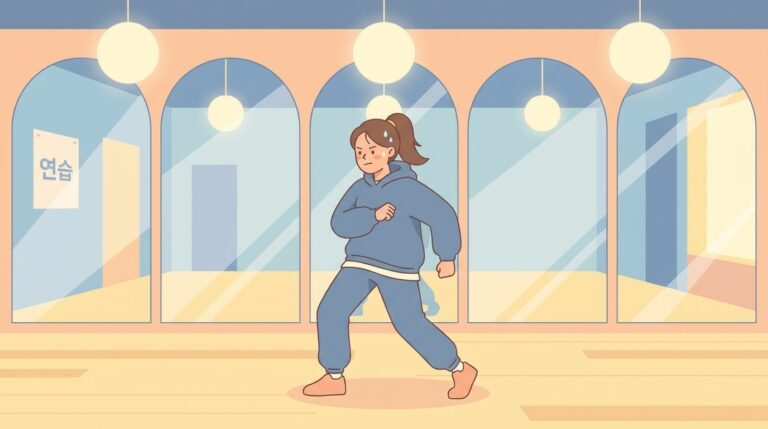
K-Pop Trainee Life: The Sweat, Tears, and Surviving the ‘K-Pop Grind’
Phase 1: Empathy (스토리 몰입형 오프닝)
안녕하세요! (An-nyeong-ha-se-yo!) Hello, my lovely K-culture family! Welcome back to Daily Hangul, your cozy digital Korean cafe. I’m your senior editor and resident cultural navigator, ready to guide you through the real, unfiltered heart of Korea today.
Imagine you are sitting in a cozy cafe in Hongdae with your Korean bestie. You’ve both been watching a survival show like Produce 101 or R U Next?, and you see a trainee burst into tears after a grueling 14-hour dance practice. You turn to your friend, sighing, and say: “I heard idol trainee life is unbelievably tough. Is it really that bad?”
If you’ve ever wanted to express deep sympathy or ask about the legendary “K-pop grind” in natural, authentic Korean, you are in the right place! Many textbooks only teach you clinical, robotic ways to say “It is hard” (어렵습니다 – eo-ryeop-seum-ni-da). Today, we are unlocking the warm, empathetic, and culturally rich expressions Koreans actually use when discussing the blood, sweat, and tears of our favorite idols. Let’s dive in!
Phase 2: Key Expressions In-Depth (핵심 표현 3선 심층 분석)
Let’s break down three powerhouse phrases to talk about the challenging trainee life like a true local.
1. 연습생 생활이 피 말린다고 들었어요 (Yeon-seup-saeng saeng-hwal-i pi mal-lin-da-go deul-eot-seo-yo)
- Pronunciation: Yeon-seup-saeng (trainee) saeng-hwal-i (life [subject marker]) pi mal-lin-da-go (sounds like “pee mahl-lin-dah-go” – that it dries up one’s blood) deul-eot-seo-yo (heard).
- Meaning: “I heard trainee life is blood-drying (nerve-wracking/extremely stressful).”
- K-Culture Moment: You’ll hear this in K-dramas depicting the entertainment industry (like Dream High or The Producers). It describes the high-stakes, hyper-competitive atmosphere of monthly evaluations (월말평가 – wol-mal-pyeong-ga).
- Editor’s Insight: 피 말리다 (pi mal-li-da) literally means “to dry up one’s blood.” It’s a vivid, highly emotional idiom used to describe an intense state of anxiety or stress where you feel like you are wasting away.
- Situation Spectrum: Casual (✅) | Semi-formal (✅) | Formal (⚠️ – use ‘피를 말린다고 합니다’ in formal reports)
- 🤔 Think About It: In English, you might say “nerve-wracking” or “soul-crushing.” Why do you think Korean culture uses “drying up one’s blood”? How does this reflect the physical and emotional intensity valued in Korean passion (열정 – yeol-jeong)?
2. 버티는 것 자체가 기적이에요 (Beo-ti-neun geot ja-che-ga gi-jeok-i-e-yo)
- Pronunciation: Beo-ti-neun (holding out/enduring) geot ja-che-ga (itself [subject marker]) gi-jeok-i-e-yo (sounds like “ghee-juck-ee-eh-yo” – is a miracle).
- Meaning: “Just enduring/surviving it is a miracle in itself.”
- K-Culture Moment: Used by veteran idols when they look back at their trainee years in documentary interviews, acknowledging that staying in the game is half the battle.
- Editor’s Insight: The verb 버티다 (beo-ti-da) is one of the most culturally loaded Korean words. It means to hold on, endure, and grit your teeth through adversity. To say surviving is a “miracle” (기적) shows deep, respectful empathy.
- Situation Spectrum: Casual (✅) | Semi-formal (✅) | Formal (✅)
- 🤔 Think About It: How does the concept of 버티기 (endurance) differ from simply “waiting” or “surviving” in your culture?
3. 뼈를 깎는 노력을 한대요 (Ppyeo-reul kkak-neun no-ryeok-eul han-dae-yo)
- Pronunciation: Ppyeo-reul (bone [object marker]) kkak-neun (sounds like “ppyuh-reul kkahk-neun” – bone-shaving/carving) no-ryeok-eul (effort) han-dae-yo (they say they do).
- Meaning: “They say they put in bone-carving effort.”
- K-Culture Moment: Often found in entertainment articles describing a group’s dramatic comeback preparation or a trainee’s transformation.
- Editor’s Insight: 뼈를 깎는 (ppyeo-reul kkak-neun) means “bone-carving” or “bone-cutting.” It represents an agonizing, ultimate level of effort that reshapes your very skeleton. It is the ultimate compliment for someone’s work ethic.
- Situation Spectrum: Casual (✅) | Semi-formal (✅) | Formal (✅)
- 🤔 Think About It: Would you use “bone-carving” to describe your own studies or hobbies, or is it reserved for life-changing endeavors?
Phase 3: Textbook Korean vs. Real Korean (교과서 한국어 vs 진짜 한국어)
Let’s compare the sterile sentences from standard textbooks with what K-fans and native speakers actually say!
Situation 1: Expressing that trainee life is difficult
- 📖 Textbook: 연습생 생활이 아주 어렵고 힘듭니다. (Yeon-seup-saeng saeng-hwal-i a-ju eo-ryeop-go him-deum-ni-da.)
- Translation: “Trainee life is very difficult and hard.”
- 🗣️ Real Korean: 연습생 생활, 진짜 장난 아니게 힘들대요. (Yeon-seup-saeng saeng-hwal, jin-jja jang-nan a-ni-ge him-deul-dae-yo.)
- Translation: “I heard trainee life is seriously no joke.”
- 💡 Why the difference? Textbooks teach formal adjectives. Real Koreans use 장난 아니다 (jang-nan a-ni-da – literally “not a joke”) to emphasize the extreme reality of a situation in an engaging, natural way.
Situation 2: Expressing sympathy for their busy schedule
- 📖 Textbook: 바쁜 일정 때문에 잠을 못 잡니다. (Ba-ppeun il-jeong ttae-mun-e jam-eul mot jam-ni-da.)
- Translation: “Because of the busy schedule, they cannot sleep.”
- 🗣️ Real Korean: 잠도 못 자고 연습만 하느라 몸이 축나겠어요. (Jam-do mot ja-go yeon-seup-man ha-neu-ra mom-i chuk-na-get-seo-yo.)
- Translation: “They can’t even sleep and only practice; their health must be completely wrecked.
- 💡 Why the difference? 몸이 축나다 (mom-i chuk-na-da) is a beautiful idiomatic expression meaning one’s physical health is deteriorating or wasting away from overwork. It carries much more heartfelt worry than just saying “they can’t sleep.”
Phase 4: K-Culture Deep Dive & Non-Verbal Manners (비언어적 매너)
4-1. Nunchi & Body Language
When discussing the hardships of trainees with a Korean friend, your non-verbal cues must match your words:
* The Sympathetic Head Tilt: Slightly tilt your head and make a small clicking sound with your tongue (called 쯧쯧 – tteut-tteut, though don’t do it too loudly!).
* The Gentle Hand Wave: When saying “It’s no joke” (장난 아니에요), gently wave your hand side-to-side in front of your chest to emphasize the scale of the struggle.
* Respectful Tone Lowering: Lower the pitch of your voice slightly to show genuine empathy for the young trainees’ struggles.
4-2. The Cultural Reality of “De-byu” (Debut)
In K-Pop, the word 데뷔 (de-byu – Debut) isn’t just a career step; it’s a modern-day rite of passage. Trainees enter entertainment agencies as young as 11 or 12 years old. They live in shared dorms (숙소 생활 – suk-so saeng-hwal), balance school, and undergo weekly and monthly evaluations where they can be cut at any moment. Understanding this explains why Korean fans are so fiercely protective of their favorite groups—they watched them survive this brutal trial by fire!
Phase 5: Real-Life Roleplay Scenario (실전 롤플레이)
Setting: A trendy café in Seoul. You (Min-ji’s foreign friend) and Min-ji (a passionate K-pop fan) are watching a YouTube clip of a trainee evaluation.
Characters:
* You (The Curious K-Fan): Sympathetic, eager to practice natural Korean.
* Min-ji (민지 – The K-Pop Expert): Warm, expressive, and full of fandom insider knowledge.
The Dialogue
- You: 민지 씨, 이 연습생 우는 것 좀 봐요. 마음 아파요.
(Min-ji ssi, i yeon-seup-saeng u-neun geot jom bwa-yo. Ma-eum a-pa-yo.)
🎭 (Pointing at your phone screen with a sad expression)
“Min-ji, look at this trainee crying. It breaks my heart.” -
Min-ji: 아, 그 프로그램 보시는군요! 진짜 연습생 생활이 피 말린대요.
(A, geu pro-geu-raem bo-si-neun-gun-yo! Jin-jja yeon-seup-saeng saeng-hwal-i pi mal-lin-dae-yo.)
🎭 (Nodding vigorously and sighing)
“Ah, you’re watching that show! I heard trainee life is seriously blood-drying.” -
You: 하루에 15시간씩 연습한다면서요? 진짜 뼈를 깎는 노력이네요.
(Ha-ru-e yeol-das-eot-si-gan-ssik yeon-seup-han-da-myeon-seo-yo? Jin-jja ppyeo-reul kkak-neun no-ryeok-i-ne-yo.)
🎭 (Widening your eyes in disbelief)
“I heard they practice 15 hours a day? That is truly bone-carving effort.” -
Min-ji: 맞아요. 매달 평가받고 방출될 수도 있으니까 불안해서 잠도 못한대요.
(Ma-ja-yo. Mae-dal pyeong-ga-bat-go bang-chul-doel su-do is-seu-ni-kka bul-an-hae-seo jam-do mot-han-dae-yo.)
🎭 (Grimacing at the thought of the evaluations)
“Exactly. They get evaluated every month and could be kicked out, so they can’t even sleep from anxiety.” -
You: 어휴, 그렇게 경쟁이 치열한데 버티는 것 자체가 기적이에요.
(Eo-hyu, geu-reoh-ge gyeong-jaeng-i chi-yeol-han-de beo-ti-neun geot ja-che-ga gi-jeok-i-e-yo.)
🎭 (Shaking your head slowly)
“Whew, the competition is so fierce; just enduring it is a miracle in itself.” -
Min-ji: 그러니까요. 데뷔하는 팀 보면 다들 대단해 보여요.
(Geu-ri-kka-yo. De-byu-ha-neun tim bo-myeon da-deul dae-dan-hae bo-yeo-yo.)
🎭 (Clasping hands together with respect)
“Tell me about it. When I see groups that actually debut, they all look so incredible.” -
You: 맞아요. 그래서 팬들이 그렇게 열심히 응원하나 봐요.
(Ma-ja-yo. Geu-rae-seo paen-deul-i geu-reoh-ge yeol-sim-hi eung-won-ha-na bwa-yo.)
🎭 (Smiling warmly, finally understanding fandom culture)
“Ah, that’s right. That must be why fans cheer for them so passionately.” -
Min-ji: 정답이에요! 우리의 응원이 그들이 버티는 힘이거든요.
(Jeong-dab-i-e-yo! U-ri-ui eung-won-i geu-deul-i beo-ti-neun him-i-geod-eun-yo.)
🎭 (Giving a thumbs up and laughing happily)
“Bingo! Our support is the very strength that helps them hold on.”
🔀 Interactive Choice Points
Now, how would you respond to Min-ji’s last comment? Choose your path:
- Option A: “저도 이제부터 열심히 응원할래요!” (Jeo-do i-je-bu-teo yeol-sim-hi eung-won-hal-rae-yo!) – “I will also cheer for them passionately from now on!”
- Feedback (Best!): Extremely natural! It shows empathy, aligns perfectly with the flow, and uses correct future intention grammar (-(으)ㄹ래요).
- Option B: “아이돌은 돈을 많이 벌어서 괜찮아요.” (A-i-dol-eun don-eul ma-ni beol-a-seo gwaen-chan-ha-yo.) – “Idols make a lot of money, so they are fine.”
- Feedback (Bad/Faux Pas): Oops! While financially true for top stars, most trainees earn nothing and start with heavy debt. This response breaks the warm, empathetic mood of the conversation.
- Option C: “연습생은 불쌍해요.” (Yeon-seup-saeng-eun bul-ssang-hae-yo.) – “Trainees are pitiful.”
- Feedback (Risk): Grammatically correct, but the word 불쌍하다 (pitiful/pathetic) can sound slightly condescending or overly negative. Better to focus on their hard work and strength instead!
Phase 6: 10-Second Emotion Shadowing Drill (감정 섀도잉)
Practice reading these out loud, mimicking the emotional milestones!
[🥺 Deeply empathetic & sighing]
연습생 생활이 / 진짜 / 피 말린대요.
(Yeon-seup-saeng saeng-hwal-i / jin-jja / pi mal-lin-dae-yo.)-
[😲 Shocked & amazed]
하루에 15시간씩 / 연습한다고요? / 대단해요!
(Ha-ru-e yeol-das-eot-si-gan-ssik / yeon-seup-han-da-go-yo? / Dae-dan-hae-yo!) -
[💪 Determined & encouraging]
끝까지 / 버티는 것 자체가 / 기적이에요!
(Kkeut-kka-ji / beo-ti-neun geot ja-che-ga / gi-jeok-i-e-yo!)
Phase 7: K-Culture Mini Dictionary (K-Culture 미니 사전)
- 피 말리다 (Pi mal-li-da) | To be nerve-wracking / dry up one’s blood | Used for highly stressful situations like waiting for university admission results or final job interviews.
- 방출 (Bang-chul) | Elimination / eviction | Literally “release.” Used in sports and survival shows when a member is cut from the team or agency.
- 월말평가 (Wol-mal-pyeong-ga) | Monthly evaluation | The dreaded monthly test where entertainment agency executives grade trainees’ singing, dancing, and attitude.
- 덕질 (Deok-jil) | Fangirling/Fanboying | Actively pursuing one’s hobby or fandom activities (e.g., buying albums, going to concerts).
Phase 8: Traveler’s Survival Kit (여행자를 위한 생존 키트)
Survival Expressions for K-Pop Fans
- 최애가 누구예요? (Choe-ae-ga nu-gu-yeo-yo?)
- Translation: “Who is your bias (favorite member)?”
- Pro Tip: 최애 (Choe-ae) is a combination of “First/Best” (최) and “Love” (애).
- 포카 교환하실래요? (Po-ka gyo-hwan-ha-sil-rae-yo?)
- Translation: “Would you like to trade photo cards?”
- Pro Tip: Extremely useful outside music shows or pop-up stores in Seoul!
- 공방 신청 어떻게 해요? (Gong-bang sin-cheong eo-tteoh-ge hae-yo?)
- Translation: “How do I apply for the music show live broadcast?”
- Pro Tip: 공방 (Gong-bang) is short for 공개방송 (public broadcast).
✈️ Editor’s Travel Note:
If you are visiting Seoul to experience K-Pop, download the 네이버 지도 (Naver Map) App immediately. Google Maps does not work well in Korea. Use Naver Map to navigate your way to the famous agency buildings in Mapo-gu and Gangnam-gu! Note: Fandom event locations and café operating hours change frequently; always check official artist fan community apps like Weverse or Phoning before traveling.
Phase 9:
Frequently Asked Questions (FAQ)
Q: What does "연습생 생활이 피 말린다고 들었어요 (Yeon-seup-saeng saeng-hwal-i pi mal-lin-da-go deul-eot-seo-yo)" mean in Korean and how do you pronounce it?
A: In Korean, "연습생 생활이 피 말린다고 들었어요 (Yeon-seup-saeng saeng-hwal-i pi mal-lin-da-go deul-eot-seo-yo)" is pronounced [Yeon-seup-saeng (trainee] and means: "I heard trainee life is blood-drying (nerve-wracking/extremely stressful)."
Q: What does "버티는 것 자체가 기적이에요 (Beo-ti-neun geot ja-che-ga gi-jeok-i-e-yo)" mean in Korean and how do you pronounce it?
A: In Korean, "버티는 것 자체가 기적이에요 (Beo-ti-neun geot ja-che-ga gi-jeok-i-e-yo)" is pronounced [Beo-ti-neun (holding out/enduring] and means: "Just enduring/surviving it is a miracle in itself."
Q: What does "뼈를 깎는 노력을 한대요 (Ppyeo-reul kkak-neun no-ryeok-eul han-dae-yo)" mean in Korean and how do you pronounce it?
A: In Korean, "뼈를 깎는 노력을 한대요 (Ppyeo-reul kkak-neun no-ryeok-eul han-dae-yo)" is pronounced [Ppyeo-reul (bone [object marker] and means: "They say they put in bone-carving effort."







