

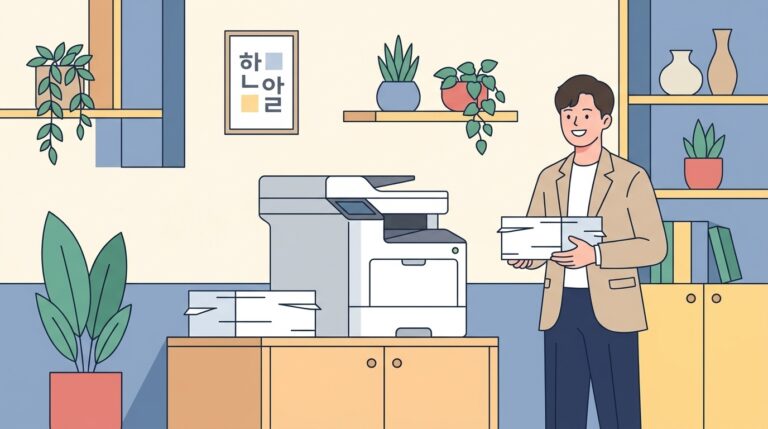
Master Office Korean: “I’ll make copies of the meeting materials.”
Phase 1: Empathy (Your Korean Office Survival Guide!)
안녕하세요! (Annyeonghaseyo!) It’s your Daily Hangul editor and trusty local cultural navigator! 👋
Picture this: You are sitting in a sleek, glass-walled conference room in Yeouido, Seoul. Your team leader, Team Jang, looks over and says, “Who can prepare the materials for the 2 PM meeting?” You want to show you’re proactive, organized, and reliable. You know the words for “copy” (복사 – boksa) and “material” (자료 – jaryo), but how do you piece them together so you sound like an efficient, polite Korean professional, rather than an online translator?
In Korean corporate culture, taking initiative on small tasks like preparing meeting packets is a highly respected trait. It shows you have 눈치 (Nunchi – situational quickness). Today, we will master the perfect, natural way to say “회의 자료 복사해 두겠습니다” (I will make copies of the meeting materials), along with business nuances that will make your Korean colleagues go, “Wow, they are a true K-office expert!”
Phase 2: Deep Dive into 3 Essential Corporate Expressions
Let’s break down the three most vital expressions you need to own the meeting room preparation like a pro.
1. 회의 자료 복사해 두겠습니다 (Hwe-ui jaryo boksa-hae du-gess-seumnida)
- Pronunciation: Hway-ee jah-ryoh bohk-sah-hay doo-get-seum-nee-dah (Think of ‘Hway’ as in ‘way’, and ‘doo-get-seum-nee-dah’ with a polite, firm drop in tone at the end).
- Meaning: “I will copy the meeting materials (in advance for future use).”
- K-Culture Moment: You’ll hear this in office K-Dramas like Misaeng (Incomplete Life) or What’s Wrong with Secretary Kim. The junior staff member swiftly stands up to handle the printing before a major presentation.
- Editor’s Insight: The magic lies in -해 두겠습니다 (-hae du-gess-seumnida). The verb auxiliary -두다 (duda) means “to do something in advance and keep it in that state.” By using this, you are telling your boss, “I will get this done beforehand so you don’t have to worry about it.”
- Situation Spectrum: Casual: 🚫 | Semi-formal: ⚠️ (복사해 둘게요) | Formal: ✅
- 🤔 Think About It: Why does Korean have a specific grammatical structure (-아/어 두다) just to show preparation? It reflects a culture that deeply values foresight and minimizing inconvenience for others.
2. 출력물 준비해 놓겠습니다 (Chullyeongmul junbi-hae noh-gess-seumnida)
- Pronunciation: Chool-lyeok-mool joon-bee-hay noh-get-seum-nee-dah (Glide the ‘l’ sounds in Chool-lyeok!).
- Meaning: “I will prepare the printouts.”
- K-Culture Moment: Used when the documents aren’t just photocopies, but high-quality color printouts fresh off the laser printer for VIP clients.
- Editor’s Insight: 출력물 (Chullyeongmul) means “printed output” or “hard copies.” -해 놓겠습니다 (-hae noh-gess-seumnida) is interchangeable with -해 두겠습니다, also carrying the nuance of “completing an action beforehand.”
- Situation Spectrum: Casual: 🚫 | Semi-formal: ⚠️ | Formal: ✅
- 🤔 Think About It: How does your native language express doing something in advance for someone else’s comfort? Is there a single grammar pattern for it?
3. 유인물 챙기겠습니다 (Yuinmul chaeng-gi-gess-seumnida)
- Pronunciation: Yoo-een-mool chang-ghee-get-seum-nee-dah (‘Chaeng’ sounds like the ‘cha’ in ‘champion’ followed by ‘ng’).
- Meaning: “I will gather/take care of the handouts.”
- K-Culture Moment: Often heard when heading into a weekly team huddle where sheets are distributed.
- Editor’s Insight: 유인물 (Yuinmul) translates to “handouts.” The verb 챙기다 (chaeng-gida) is one of the most versatile Korean verbs. It means to pack, organize, take care of, or make sure not to forget. Saying you will chaeng-gida the handouts shows great responsibility.
- Situation Spectrum: Casual: ⚠️ (챙길게) | Semi-formal: ✅ (챙길게요) | Formal: ✅
- 🤔 Think About It: “Chaeng-gida” is used for packing bags, taking vitamins, and looking after juniors. What does this tell you about Korean relational dynamics?
Phase 3: Textbook Korean vs. Real-Life Office Korean
Let’s compare what textbooks teach with what actually happens at a real Korean company.
Scene 1: Preparing Handouts
- 📖 Textbook Korean: “회의 문서를 복사하겠습니다.” (Hwe-ui munseo-reul boksa-hagess-seumnida – I will copy the meeting documents.)
- 🗣️ Real-Life Korean: “회의 자료 미리 복사해 두겠습니다.” (Hwe-ui jaryo miri boksa-hae du-gess-seumnida – I’ll make copies of the meeting materials in advance.)
- 💡 Why the difference? Adding 미리 (miri – beforehand/in advance) and using -해 두다 sounds much more proactive and thoughtful than a flat, robotic “I will copy.”
Scene 2: Asking for Copy Count
- 📖 Textbook Korean: “몇 장 복사할까요?” (Myeot jang boksa-hal-kka-yo? – How many pages shall I copy?)
- 🗣️ Real-Life Korean: “부장님, 자료 몇 부 출력할까요?” (Bujang-nim, jaryo myeot bu chullyeok-hal-kka-yo? – Department Manager, how many copies of the materials should I print?)
- 💡 Why the difference? In business, we count documents in 부 (bu – copies/sets) rather than 장 (jang – individual sheets). Using 부 shows you understand professional administrative terms.
Phase 4: K-Culture Deep Dive & Non-Verbal Manners
4-1. The Art of Document Delivery (The Hand-off)
When you hand over the copied materials to your boss or colleagues, your body language speaks louder than your Korean!
1. Two Hands rule (두 손): Always hold the documents with both hands.
2. Direction: Rotate the document so it is facing the recipient, making it easy for them to read immediately without spinning it around.
3. Eye Contact & Bow: Make brief eye contact, lightly bow your head, and say: “여기 자료 있습니다.” (Yeogi jaryo isseumnida – Here are the materials.)
4-2. The “Nunchi” of Stapling
In Korean offices, presentation is key. When copying multiple pages, make sure they are stapled perfectly in the top-left corner at a neat, 45-degree angle. If the staples are crooked or messy, it might imply a lack of care in your work. It’s a small detail, but in Korea, it’s called 디테일 (Detail), and it’s highly valued!
Phase 5: Real-Life Roleplay Scenario
Meet your coworker: 민우 대리 (Assistant Manager Min-woo). He is friendly but incredibly fast-paced. You are preparing for the weekly marketing review.
- 🎭 [민우 대리]: “OO 씨, 오늘 오후 두 시 회의 준비 다 됐어요?”
(OO-ssi, oneul ohu du si hwe-ui junbi da dwaess-eoyo? / OO, is everything ready for the 2 PM meeting today?) - 🎭 [You]: “아, 회의 자료를 아직 다 못 뽑았습니다.”
(Ah, hwe-ui jaryo-reul ajik da mot ppob-ass-seumnida. / Ah, I haven’t printed all the meeting materials yet.) - 🎭 [민우 대리]: (Checking his watch) “그래요? 아직 30분 남았으니까 지금 빨리 준비해야겠어요.”
(Geurae-yo? Ajik samsip-bun nam-ass-euni-kka jigeum ppalli junbi-haeya-gess-eoyo. / Really? We still have 30 minutes left, so we should prepare them quickly now.) - 🎭 [You]: “네, 제가 지금 회의 자료 복사해 두겠습니다. 총 몇 부 준비하면 될까요?”
(Ne, jega jigeum hwe-ui jaryo boksa-hae du-gess-seumnida. Chong myeot bu junbi-haemyon dwel-kka-yo? / Yes, I will copy the meeting materials right now. How many sets should I prepare in total?) - 🎭 [민우 대리]: “참석자가 여덟 명이니까, 여유 있게 열 부 출력해 주세요.”
(Chamseokja-ga yeodeol myeong-ini-kka, yeoyu it-ge yeol bu chullyeok-hae ju-seyo. / There are eight attendees, so please print ten copies just to be safe.) - 🎭 [You]: “알겠습니다. 열 부 복사해서 회의실에 미리 세팅해 놓겠습니다.”
(Al-gess-seumnida. Yeol bu boksa-haeseo hwe-uisil-e miri setting-hae noh-gess-seumnida. / Got it. I’ll make ten copies and set them up in the meeting room in advance.) - 🎭 [민우 대리]: (Smiling warmly) “고마워요, 역시 일 처리가 빠르시네요!”
(Gomawoyo, yeoksi il cheori-ga ppareu-sineyo! / Thank you, as expected, you work fast!) - 🎭 [You]: “별말씀을요. 다 되면 바로 말씀드리겠습니다.”
(Byeol-malsseum-eul-yo. Da dwe-myeon baro malsseum-deurigess-seumnida. / Don’t mention it. I will let you know as soon as it’s done.)
🔀 Interactive Choice Point
Min-woo asks you to bind the documents, but the stapler is empty. What do you do?
- Option A: Ask loudly across the quiet office: “대리님! 스테이플러 심 어디 있어요?” (Manager! Where are the staples?)
- Option B: Silently look through the supply cabinet yourself, fill the stapler, finish the job, and present the neat packets.
- Option C: Just hand over the loose pages unstapled, saying “스테이플러 알이 없어서 그냥 드립니다.” (I’m giving them to you loose because there were no staples.)
💡 Feedback on Your Choice:
- Best Choice – Option B: This shows high 눈치 (Nunchi)! Finding and fixing minor issues independently is highly valued in Korean offices.
- Risky Choice – Option A: Not terrible, but shouting in a quiet office might disrupt others. Try to ask quietly or look for supplies first.
- Worst Choice – Option C: Handing over loose pages shows a lack of attention to detail and care, which can negatively affect your work evaluation.
Phase 6: 10-Second Emotion Shadowing Drill
Practice speaking with the natural flow and professional cadence of a Korean office worker. Pay attention to the pauses (/) and emotional tone!
- [😊 Proactive and polite]
- “제가 / 지금 / 회의 자료 복사해 두겠습니다.“
- Jega / jigeum / hwe-ui jaryo boksa-hae du-gess-seumnida.
- [👍 Assured and helpful]
- “회의실에 / 미리 / 세팅해 놓겠습니다.“
- Hwe-uisil-e / miri / setting-hae noh-gess-seumnida.
- [🙇 Modest and professional]
- “다 되면 / 바로 / 말씀드리겠습니다.“
- Da dwe-myeon / baro / malsseum-deurigess-seumnida.
Phase 7: K-Culture Mini-Dictionary
- 부 (Bu / ㅂㅜ) | Set/Copy (Counter)
- Used specifically for counting books, documents, or sets of papers. (e.g., 자료 열 부 = ten sets of materials).
- 탕비실 (Tangbisil / ㅌㅏㅇㅂㅣㅅㅣㄹ) | Pantry / Breakroom
- The office kitchen area where coffee, tea, snacks, and sometimes the big printer are kept. A major hub for office gossip!
- 상사 (Sangsa / ㅅㅏㅇㅅㅏ) | Boss / Superior
- Anyone who is higher in rank than you in the company hierarchy.
- 야근 (Yageun / ㅇㅑㄱㅡㄴ) | Overtime Work
- Working late past regular office hours. Often accompanied by ordering night snacks (야식 – yasik).
Phase 8: Survivor Kit for Expats in Korea
Top 3 Office Survival Phrases
- “이거 복사 어떻게 해요?” (Igeo boksa eotteohge haeyo?)
- Pro Tip: “How do I copy this?” Essential if the office copy machine has complex settings or is set entirely to Korean.
- “A4 용지 어디 있어요?” (A-four yongji eodi isseoyo?)
- Pro Tip: “Where is the A4 paper?” Paper runs out fast in copy rooms!
- “수고하셨습니다!” (Sugohasyeoss-seumnida!)
- Pro Tip: “Thank you for your hard work!” Say this when leaving work or when a colleague finishes a tough meeting.
📌 Editor’s Travel Note: If you ever need to print documents outside of your office, download the Naver Map App and search for “인쇄” (Inswe – Printing) or “프린트 카페” (Print Cafe – 24/7 self-service printing shops). They are incredibly convenient and located near almost every Korean university and subway station!
Phase 9: “Going Deeper” (Reflections on Korean Hierarchy)
In Korean corporate environments, language is deeply tied to 존칭 (Jonching – Honorifics) and organizational roles. The way you perform tasks like printing and copying reflects your team spirit and respect for the group’s collective goals. Taking initiative on these “small” chores is not looked down upon; rather, it is viewed as a rite of passage and a sign of a team player who is ready for bigger responsibilities.
💬 Your Turn: How does office etiquette differ in your home country? Would a junior employee volunteering to do copies be seen as proactive, or is it strictly divided by job descriptions? Let me know in the comments below!
Phase 10: FAQ & Common Pitfalls
Q: Can I use “복사해 줄게요” (Boksa-hae julgeyo) to my boss?
A: No! The ending -아/어 줄게요 is used for peers or people younger/lower in rank. When speaking to a boss, always use -겠습니다 or -아/어 드리겠습니다 (e.g., 복사해 드리겠습니다) to show proper business respect.
Q: What is the difference between 복사 (Boksa) and 인쇄 (Inswe)?
A: 복사 (Boksa) is photocopying an existing physical document. 인쇄 (Inswe) or 출력 (Chullyeok) is printing a digital file from a computer.
Q: How do I address my coworker? Is “Mr./Ms.” okay?
A: Avoid calling colleagues by just their name + Mr./Ms. in Korean. Use their title, like 민우 대리님 (Dae-ri-nim) or 성민 과장님 (Gwa-jang-nim). If they don’t have a specific title, use [Name] 씨 (ssi).
🚨 Common Mistakes Alert!
- Wrong: “부장님, 이거 복사해 줄게요.” (Bujang-nim, igeo boksa-hae julgeyo.) – Too casual and rude!
- Right: “부장님, 이거 복사해 드리겠습니다.” (Bujang-nim, igeo boksa-hae deurigess-seumnida.)
Phase 11: Action Mission
- Bronze Medal: Read the sentence “회의 자료 복사해 두겠습니다” out loud 5 times using our Emotion Shadowing guide.
- Silver Medal: Write a comment below using the grammar -해 두다 (e.g., “커피를 사 두었습니다” – I bought coffee in advance).
- Gold Medal (The K-Culture Challenge): Watch an episode of a Korean office drama (like Misaeng or Today’s Webtoon) and listen for the words 자료 (jaryo), 출력 (chullyeok), or 회의 (hwe-ui)!
Phase 12: Interactive Quiz Challenge
Test your knowledge of Korean office manners and language!
1. Situation Quiz
You need to copy 5 sets of a 3-page document. How should you ask your manager?
* A) 이거 몇 장 복사해요? (Igeo myeot jang boksa-haeyo?)
* B) 자료 몇 부 출력해 둘까요? (Jaryo myeot bu chullyeok-hae dulkka-yo?)
Reveal Answer & Explanation
Correct Answer: B
In business, counting document sets is done with 부 (bu), and asking with the polite -해 둘까요? shows excellent professional initiative!
2. True or False
*When handing over documents to a superior, it is perfectly fine to hand them over with one hand as long as you say







