

Phase 1: Empathy (스토리 몰입형 오프닝)
안녕하세요! (Annyeonghaseyo!) Hello! Your friendly neighborhood Korean tutor and Daily Hangul Editor is here.
Imagine this: You’ve just had an amazing day exploring the beautiful, neon-lit streets of Seoul. Your feet are tired from walking around Bukchon Hanok Village, and you finally get back to your cozy hotel room, ready to dive into bed. You reach into your pocket… and cold sweat. Your room card is gone! 😱
Don’t panic! This is one of the most common hiccups when traveling, and Korean hotel staff are incredibly helpful and used to this. Today, we are going to learn how to solve this exact problem with super-easy, A1-level Korean phrases. You don’t need to be fluent to get your door open. Let’s learn how to speak like a local, even when you’re in a pinch!
Phase 2: Key Expressions Deep Dive (핵심 표현 3선)
Here are the top 3 easiest phrases you can use at the hotel front desk right away.
1. 방 키 잃어버렸어요. (Bang ki ireobeoryeosseoyo.)
- Pronunciation: Bahng kee ee-ruh-buh-ryuh-ssuh-yo
- Meaning: I lost my room key.
- K-Culture Moment: You often see this in K-Dramas when the clumsy lead character gets locked out of their hotel room on Jeju Island, leading to a romantic hallway encounter.
- Editor’s Insight: “방” (Bang) means room, and “키” (ki) is just the English word “key” written in Korean. “잃어버렸어요” (ireobeoryeosseoyo) means “I lost [it].” It’s polite and clear.
- Situation Spectrum: Casual: ⚠️ | Semi-formal: ✅ | Formal: ✅
- 🤔 Think About It: Koreans love borrowing English words like “key” (키) to make communication easier for everyone. Isn’t it neat how some Korean words sound just like home?
2. 카드 키 새로 발급해 주세요. (Kadeu ki saero balgeupae juseyo.)
- Pronunciation: Kah-deu kee sae-ro bahl-geup-hae joo-sae-yo
- Meaning: Please issue a new card key.
- K-Culture Moment: In luxury Seoul hotels, automated systems are common, but the staff will happily tap a few keys on their computer to hand you a fresh card with a warm smile.
- Editor’s Insight: “새로” (saero) means “newly,” and “발급해 주세요” (balgeupae juseyo) means “please issue.” If the grammar feels too long, you can just say: “카드 키 주세요” (Kah-deu kee joo-sae-yo / “Please give me the card key”).
- Situation Spectrum: Casual: 🚫 | Semi-formal: ✅ | Formal: ✅
- 🤔 Think About It: Adding “주세요” (juseyo) to any action makes it an instant polite request in Korean culture!
3. 몇 호실이세요? (Myeot hosiriseyo?)
- Pronunciation: Myut ho-sheer-ee-seh-yo?
- Meaning: What room number are you in?
- K-Culture Moment: This is the question the kind hotel receptionist will ask you immediately after you tell them you lost your key.
- Editor’s Insight: “호실” (hosil) means room number. To answer this, you just need to say your room number plus “호요” (ho-yo). For example, Room 502 is “오백이호요” (O-baek-ee-ho-yo).
- Situation Spectrum: Casual: ⚠️ | Semi-formal: ✅ | Formal: ✅
- 🤔 Think About It: Korean room numbers are read as normal numbers followed by “호” (ho), which acts as a counter for rooms.
Phase 3: Textbook Korean vs. Real Korean
Let’s compare the stiff textbook phrases with what Koreans actually say!
Scenario 1: Telling them you lost the key
- 📖 Textbook Korean: 열쇠를 분실하였습니다. (Yeolsoe-reul bunsil-hayeossseumnida.) – “I have misplaced the physical key device.”
- 🗣️ Real Korean: 방 키 잃어버렸어요. (Bang ki ireobeoryeosseoyo.) – “I lost my room key.”
- 💡 Why the difference? Traditional textbooks teach “열쇠” (yeolsoe – physical key) and “분실” (bunsil – official loss), which sound like a police report! Modern hotels use plastic card keys, so “방 키” (bang ki) is much more natural and common.
Scenario 2: Asking for a new one
- 📖 Textbook Korean: 재발급을 요청합니다. (Jaebalgeup-eul yocheonghamnida.) – “I formally request a re-issuance.”
- 🗣️ Real Korean: 하나 더 주세요. (Hana deo juseyo.) – “Please give me one more.”
- 💡 Why the difference? When you are stressed, short and sweet is best! Saying “하나 더 주세요” (One more, please) gets the point across instantly and warmly.
Phase 4: K-Culture Deep Dive & Non-Verbal Manners
4-1. Nunchi (눈치) & Bowing Gestures
When approaching the front desk, slight body language goes a long way in Korea:
* The Soft Head Bow: When you say “안녕하세요” (Hello), tilt your head and upper shoulders down about 15 degrees. It shows immense respect.
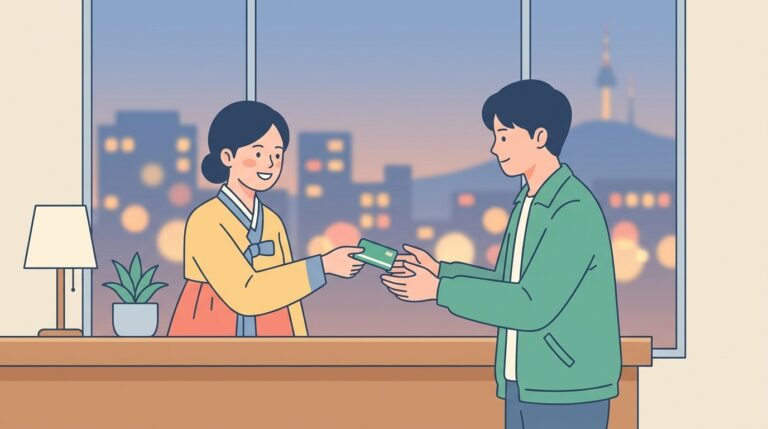
* Two-Hand Rule: When they hand you your new card key, receive it with both hands. This is a crucial sign of respect in Korean culture!
4-2. K-Hotel Culture
Korean hotels are known for their fast, high-tech, and polite service. Most modern hotels in Seoul use keyless digital cards. If you lose yours, do not worry about paying a massive fine—most hotels will replace plastic card keys for free!
Phase 5: Real-Life Roleplay Scenario
Meet Min-ji (민지), the ultra-friendly front desk receptionist at a cozy hotel in Myeongdong. Let’s practice a conversation with her!
- Min-ji: 안녕하세요! 무엇을 도와드릴까요?
(Annyeonghaseyo! Mueoseul dowadeurilkkayo?)
“Hello! How can I help you?” - You (🎭 Looking embarrassed, slightly bowing): 저기… 방 키 잃어버렸어요.
(Jeogi… bang ki ireobeoryeosseoyo.)
“Excuse me… I lost my room key.” - Min-ji: 아, 괜찮습니다! 몇 호실이세요?
(Ah, gwenchansumnida! Myeot hosiriseyo?)
“Ah, that’s okay! What room number are you in?” - You: 삼백오호요.
(Sambaek-o-ho-yo.)
“Room 305.” - Min-ji (🎭 Typing on the computer): 성함이 어떻게 되세요?
(Seonghami eotteoke doeseyo?)
“What is your name, please?” - You: [Your Name] 이에요.
([Your Name] ieyo.)
“I am [Your Name].” - Min-ji: 확인되었습니다. 여기 새 카드 키 있습니다.
(Hwagin-doe-eossseumnida. Yeogi sae kadeu ki isseumnida.)
“Confirmed. Here is your new card key.” - You (🎭 Receiving the key with both hands and bowing slightly): 감사합니다!
(Gamsahamnida!)
“Thank you!”
🔀 Interactive Choice Point!
What will you say if you want an extra card key just in case?
* Option A: “하나 더 주세요.” (Hana deo juseyo.) -> Best! Friendly, natural, and super easy.
* Option B: “카드 더 필요해.” (Kadeu deo piryohae.) -> Bad. This is casual language (Banmal) and sounds rude to hotel staff.
* Option C: “키를 주지 않으면 안 됩니다.” (Kireul juji aneumyeon an deumnida.) -> Risk. Too aggressive and translates to “It won’t do if you don’t give me the key.”
Phase 6: 10-Second Emotion Shadowing Drill
Let’s practice speaking with real emotions! Pay attention to the pauses (/).
- [🥺 Shy and Sorry]
저기… / 방 키 / 잃어버렸어요.
(Jeogi… / bang ki / ireobeoryeosseoyo.) -
[😊 Super Relieved & Grateful]
아! / 정말 / 감사합니다!
(Ah! / jeongmal / gamsahamnida!)
Phase 7: K-Culture Mini Dictionary
- 방 (Bang) | Room | Used in many compound words like 노래방 (Noraebang – Karaoke room) and PC방 (PC bang – Internet cafe).
- 카드 키 (Kadeu ki) | Card Key | The standard plastic tap-to-enter room key.
- 프런트 (Peureonteu) | Front Desk | Short for “Front Desk”, borrowed from English.
- 주세요 (Juseyo) | Please give me | The magic word of polite Korean. Put any noun before it to ask for it!
Phase 8: Traveler’s Survival Kit
Survival Phrases TOP 3:
- 와이파이 비밀번호 뭐예요? (Wa-i-pa-i bi-mil-beon-ho mwo-yae-yo?) – “What is the Wi-Fi password?”
- 수건 더 주세요. (Su-geon deo juseyo.) – “Please give me more towels.”
- 체크아웃 몇 시예요? (Che-keu-a-ut myeot si-yae-yo?) – “What time is checkout?”
💡 Editor’s Travel Note: To navigate Korea like a local, make sure you download the Naver Map App before you arrive. Google Maps does not work well in South Korea due to local security regulations.
Phase 9: “A Step Deeper” (한 발 더 깊이)
In Korean culture, the way you speak changes based on who you talk to. Even when you are a paying customer, speaking politely with “~요” (yo) at the end of your sentences shows that you respect the hotel staff as human beings. This concept of mutual respect creates a warm, welcoming energy called “정” (Jeong).
💬 Your Turn: Have you ever lost your hotel key while traveling? How did you handle it? Let me know in the comments below!
Phase 10: FAQ & Common Mistakes
Q: Do I have to pay if I lose my hotel card key in Korea?
A: In most standard and luxury hotels in Korea, there is no charge for a lost plastic card key. They will simply deactivate the old one and issue a new one instantly. However, always double-check with the front desk!
Q: How do I say my room number if it has 4 digits (e.g., 1024)?
A: You can say it digit by digit or as a full number. The easiest way is “일공이사호요” (Il-gong-ee-sa-ho-yo / One-Zero-Two-Four).
Q: What is the most common mistake foreigners make?
A: Pronouncing “키” (ki) as “지” (ji). Make sure you use a strong ‘K’ sound, like the English word “key.”
🚨 Common Mistakes Warning Board:
- Saying “키 잃었어” (Ki ireosseo) -> Why it’s wrong: This is informal. Always use polite “요” ending: “잃어버렸어요”.
- Pointing at the desk when asking -> Why it’s wrong: Pointing with one finger can feel aggressive in Korea. Use an open palm instead.
Phase 11: Action Mission & Engagement
- 🥉 Bronze Mission: Write “방 키 잃어버렸어요” on a sticky note and practice saying it out loud 3 times today!
- 🥈 Silver Mission: Share this post on your social media with the hashtag #DailyHangul and tag a friend you want to travel to Korea with.
- 🥇 Gold Mission: Next time you stay at a hotel (even in your own country), pretend you are in Seoul and quietly practice saying “카드 키 주세요” at the counter!
Phase 12: Interactive Quiz Challenge
Can you pass our quick hotel survival quiz? Click to reveal the answers!
1. Which phrase means “I lost my room key”?
- A) 방 키 주세요 (Bang ki juseyo)
- B) 방 키 잃어버렸어요 (Bang ki ireobeoryeosseoyo)
🔍 Click here for the Answer & Explanation!
Correct Answer: B
“방 키 잃어버렸어요” means “I lost my room key.” Option A means “Please give me the room key.”
2. True or False: You should receive the new key card from the hotel receptionist using only one hand.
🔍 Click here for the Answer & Explanation!
Correct Answer: False
In Korea, receiving items with both hands is a vital sign of politeness and respect!







