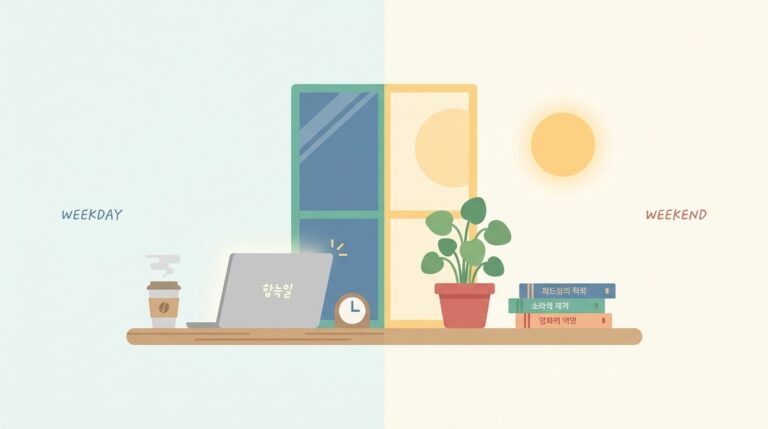
안녕하세요! Welcome back to Daily Hangul!
Do you ever feel like your weekdays and weekends are two completely different worlds? During the week, you might be chugging iced americanos to survive work, while on the weekend, you’re finally breathing and catching up on your favorite K-dramas.
Many of our beginner students tell us: “I know how to say ‘I work’ and ‘I rest,’ but I don’t know how to compare my busy weekdays and relaxing weekends naturally like Koreans do!”
Today, we’re going to master the art of comparing 평일 (weekdays) and 주말 (weekends). By the end of this guide, you’ll be able to chat about your weekly rhythm with your Korean friends over coffee! Let’s dive in! 🚀
Phase 1: Empathy & K-Culture Connection
Picture this: It’s Friday night. You’re watching a K-drama, and the main characters are wrapping up a grueling week at their office. One of them sighs deeply and says, “아, 드디어 주말이다!” (Ah, finally the weekend!).
In Korea, the contrast between the hectic weekday work/study culture (often called 야근 – overtime, or 갓생 – living a busy, exemplary life) and the relaxing weekend culture (like 호캉스 – hotel vacation, or cafe hopping) is huge. Learning how to express this contrast is key to sounding natural and understanding the lifestyle of your Korean friends.
Phase 2: Key Expressions Deep Dive
Let’s learn 3 essential expressions to talk about your routine.
1. 평일에는 바쁘고, 주말에는 쉬어요. (Pyeong-il-e-neun ba-ppeu-go, ju-mal-e-neun swi-eo-yo.)
- Pronunciation Analogy: Pyeong-il (sounds like “pure-ing-il”) e-neun ba-ppeu-go (sounds like “bah-bboo-go”), ju-mal (sounds like “jew-mal”) e-neun swi-eo-yo (sounds like “she-uh-yo”).
- Meaning: “I’m busy on weekdays, and I rest on weekends.”
- K-Culture Moment: You will hear this in almost every slice-of-life K-drama when characters grab a drink after work.
- Editor’s Insight: The -고 (-go) ending is the easiest way for beginners to connect two contrasting thoughts in one sentence, acting like “and”.
- Situation Spectrum: Casual ✅ | Semi-formal ✅ | Formal ⚠️
- 🤔 Think About It: How do you balance your weekdays and weekends? Is your country’s work-life balance similar to Korea’s?
2. 평일보다 주말이 훨씬 좋아요. (Pyeong-il-bo-da ju-mal-i hwol-ssin jo-a-yo.)
- Pronunciation Analogy: Pyeong-il-bo-da (sounds like “bo-dah”) ju-mal-i hwol-ssin (sounds like “whole-seen”) jo-a-yo (sounds like “jo-ah-yo”).
- Meaning: “I like weekends much more than weekdays.”
- K-Culture Moment: Used when expressing relief on a Friday afternoon to classmates or coworkers.
- Editor’s Insight: -보다 (-bo-da) means “than”. Put it right after the thing you are comparing (weekday) to say “compared to weekdays, weekends are…”
- Situation Spectrum: Casual ✅ | Semi-formal ✅ | Formal ✅
- 🤔 Think About It: Why do we cherish weekends so much? Is it the freedom, or just sleep?
3. 주말이 순식간에 지나갔어요. (Ju-mal-i sun-sik-gan-e ji-na-gat-eo-yo.)
- Pronunciation Analogy: Ju-mal-i sun-sik-gan-e (sounds like “soon-seek-gan-eh”) ji-na-gat-eo-yo (sounds like “jee-nah-gah-ssuh-yo”).
- Meaning: “The weekend went by in the blink of an eye (so fast).”
- K-Culture Moment: This is a universal Monday morning office cry in Korea.
- Editor’s Insight: 순식간에 (sun-sik-gan-e) means “in an instant”. It’s a wonderful idiomatic expression that makes you sound highly fluent.
- Situation Spectrum: Casual ✅ | Semi-formal ✅ | Formal ⚠️
Phase 3: Textbook Korean vs. Real Korean
Let’s compare how textbooks teach routines versus how native speakers actually talk.
Situation 1: Describing a busy day
- 📖 Textbook: “평일에는 일이 아주 많습니다.” (I have a lot of work on weekdays.)
- 🗣️ Real Korean: “평일에는 진짜 정신없어요.” (On weekdays, I seriously have no mind/it’s chaotic.)
- 💡 Why is it different? 정신없다 (Jeong-sin-eop-da) literally means “to have no spirit/mind.” Koreans use this daily to describe a hectic, crazy schedule.
Situation 2: Asking about weekend plans
- 📖 Textbook: “주말에 무엇을 합니까?” (What do you do on weekends?)
- 🗣️ Real Korean: “주말에 뭐 해요?” (What are you doing this weekend?)
- 💡 Why is it different? “무엇을 합니까” is too stiff and formal for normal conversations. “뭐 해요?” is warm, natural, and friendly.
Phase 4: K-Culture Deep Dive & Non-verbal Manners
4-1. The “Friday Sigh” and Office Nunchi (눈치)
When talking about how tired you are on weekdays compared to the weekend, Koreans often let out a gentle sigh (하아~) or roll their eyes playfully to show solidarity. If a colleague says they are tired, nodding deeply and saying “맞아요 (That’s true)” shows great empathy.
4-2. Bul-geum (불금) – Fire Friday!
In Korea, Friday night is called 불금 (Bul-geum), short for 불타는 금요일 (Burning Friday / Fire Friday). Since weekdays are so intense, Koreans celebrate the arrival of the weekend with late-night food like Chimaek (chicken and beer) or Korean BBQ.
Phase 5: Real-Life Roleplay Scenario
Meet Ji-a (지아), your friendly Korean coworker. It is Monday morning, and you are standing by the office coffee machine.
Ji-a: “좋은 아침이에요! 주말 잘 보냈어요?”
(Good morning! Did you have a good weekend?)
You (🎭 Smiling tiredly): “네, 잘 보냈어요. 지아 씨는요?”
(Yes, I had a good one. How about you, Ji-a?)
Ji-a: “저도 잘 쉬었어요. 아, 그런데 벌써 월요일이네요.”
(I rested well too. Ah, but it’s already Monday.)
You (🎭 Nodding in agreement): “맞아요. 평일에는 너무 바빠서 시간이 안 가는데, 주말은 진짜 순식간에 지나가요.”
(Right. Weekdays are so busy that time doesn’t fly, but the weekend seriously passed in the blink of an eye.)
Ji-a: “진짜 그래요! 평일보다 주말이 백 배는 더 좋은데 말이에요.”
(Indeed! Even though weekends are a hundred times better than weekdays.)
You (🎭 Laughing): “맞아요. 우리 이번 주 평일도 힘내요!”
(Agreed. Let’s find strength for this weekday, too!)
🔀 Interactive Choice!
How do you want to respond to Ji-a’s invite for a quick coffee break?
* A) “평일에는 커피를 많이 마셔요. 고마워요!”
* B) “주말보다 평일이 더 좋아요!”
* C) “싫어요. 바빠요.”
Feedback:
- A (Best): Excellent! You correctly expressed that you drink a lot of coffee on weekdays and showed gratitude. Very natural!
- B (Risk): Hmm, saying you like weekdays more than weekends might make Ji-a think you are a workaholic, but it’s grammatically correct!
- C (Bad): Too blunt! “싫어요 (I don’t want to)” sounds very rude in a workplace setting.
Phase 6: 10-Second Emotion Shadowing Drill
Practice saying these lines out loud with the right emotion!
[🥺 Sighing, sad tone]
평일은 / 진짜 / 안 가요…
(Pyeong-il-eun / jin-jja / an ga-yo…)
“Weekdays / seriously / don’t pass…”-
[😊 Bright and excited]
드디어 / 불금이다! / 주말에 / 쉴 거예요!
(Deu-di-eo / bul-geum-i-da! / Ju-mal-e / swil geo-yeo-yo!)
“Finally / it’s Fire Friday! / On the weekend / I will rest!”
Phase 7: K-Culture Mini-Dictionary
- 평일 (Pyeong-il) | Weekdays | Mon-Fri. Used when talking about work or school routines.
- 주말 (Ju-mal) | Weekend | Sat-Sun. Used when discussing hobbies and resting.
- 월요병 (Wol-yo-byeong) | Monday Blues | Literally “Monday disease.” The tired feeling you get when a new week starts.
- 순삭 (Sun-sak) | Instant disappearance | Slang. Often used for weekends: “주말 순삭” (The weekend vanished!).
Phase 8: Survivor’s Kit for Travelers
Survival Phrases TOP 3
- 평일 요금은 얼마예요? (Pyeong-il yo-geum-eun ol-ma-yeo-yo?) – “How much is the weekday rate?” (Useful for hotels/spas!)
- 주말에는 예약해야 돼요? (Ju-mal-e-neun ye-yak-hae-ya dwae-yo?) – “Do I need to make a reservation on weekends?”
- 평일에만 영업해요. (Pyeong-il-e-man yeong-eop-hae-yo.) – “We are only open on weekdays.” (Keep an eye out for this on restaurant doors!)
📌 Editor’s Travel Note:
Popular cafes in Seoul are extremely crowded on weekends. Always check operating hours and crowd status before visiting! If you’re looking for popular locations, we highly recommend searching on the Naver Map App instead of Google Maps for real-time Korean user reviews and peak times.
Phase 9: “A Step Deeper” (Reflection)
In Korea, the concept of work-life balance (워라밸 – Warabal) has become highly valued among younger generations. The extreme focus on hard work during the week makes the freedom of weekends deeply treasured. Sharing your own routine with Korean friends is not just about exchanging schedules; it is sharing in the shared human experience of working hard and enjoying rest.
💬 Your Turn: How do your weekdays compare to your weekends? Let us know in the comments below using 평일 and 주말!
Phase 10: FAQ & Common Mistakes
Q: Can I use “주말” to mean just Saturday?
A: No, 주말 refers to the entire weekend (Saturday and Sunday). If you want to specify Saturday, say 토요일 (To-yo-il).
Q: What is the difference between 주말에 (ju-mal-e) and 주말에는 (ju-mal-e-neun)?
A: Adding -는 (neun) emphasizes contrast. Use “주말에는” when you want to highlight that weekends are different from your weekdays.
🚨 Common Mistakes Alert!
- Incorrect: “평일 주말 다 좋아해요.” (Doesn’t make sense without connectors)
- Correct: “평일이랑 주말 다 좋아해요.” (I like weekdays and weekends all.)
Phase 11: Action Mission
- 🥉 Bronze: Write a sentence in your diary comparing your Tuesday to your Saturday.
- 🥈 Silver: Post a photo of your weekend coffee on Instagram and caption it: “행복한 주말!” (Happy weekend!).
- 🥇 Gold: Next time you speak to a Korean friend, ask them: “주말에 뭐 했어요?” (What did you do on the weekend?).
Phase 12: Interactive Quiz Challenge
1. Fill in the blank:
“평일에는 일해요. ________에는 쉬어요.”
* A) 월요일 (Monday)
* B) 주말 (Weekend)
* C) 아침 (Morning)
2. True or False?
“불금 (Bul-geum) means Monday morning blues.”
* True
* False
🔍 Click here for Answers & Explanations!
- Answer: B (주말). The sentence translates to: “I work on weekdays. I rest on weekends.”
- Answer: False. Bul-geum means “Fire Friday,” celebrating the start of the weekend!