

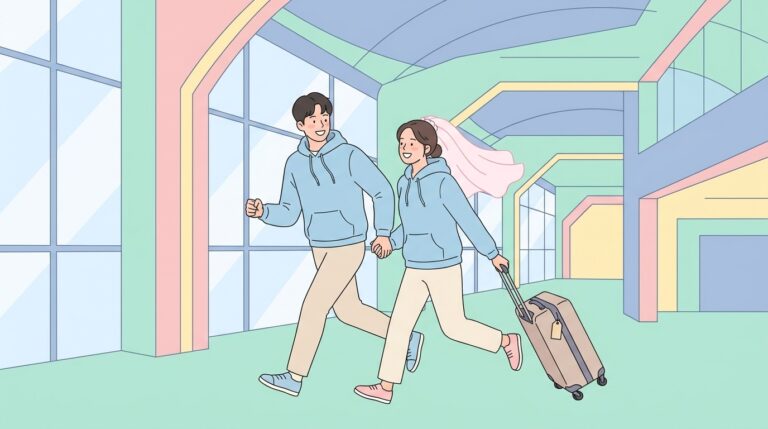
Straight to the Airport! ✈️ Surviving the Post-Wedding Honeymoon Rush in Korea
Phase 1: Empathy (Welcome, New Married Friends!)
안녕하세요! (An-nyeong-ha-se-yo!) I’m your Lead Editor at Daily Hangul, your trusty Korean culture navigator.
Imagine this: You’ve just finished a beautiful, fast-paced Korean wedding. Your makeup is flawless, your hair is sprayed to perfection, and your heart is beating fast. But instead of heading to a relaxing hotel suite, you are sprinting to a changing room. In Korea, many couples head straight to the airport (바로 신혼여행을 가다) right after their wedding reception!
Many of our B1-level students tell us: “I know how to say ‘airport’ and ‘wedding,’ but how do I express the crazy, exciting rush of leaving for my honeymoon immediately after the ceremony in natural Korean?” Today, we will dive into the exact phrases, cultural quirks, and survival tips you need to discuss this unique Korean wedding rush like a local. Let’s get started!
Phase 2: Deep Dive into 3 Essential Expressions
Let’s look at the three most natural expressions you’ll hear in Korea when a couple is rushing from the wedding hall to Incheon Airport.
1. 식 끝나고 바로 출발해요 (Sik kkeut-na-go ba-ro chul-bhal-hae-yo)
- Pronunciation: Sheek kkeut-nah-go bah-ro chool-bahl-heh-yo (Think of “Sik” as in “seek”, and “Ba-ro” as “bar-oh” meaning immediately).
- Meaning: We are leaving right after the ceremony.
- K-Culture Moment: In K-Dramas, you often see the bride still wearing her heavy wedding makeup at the airport, eating spicy ramen in her lounge clothes. She might tell an acquaintance she bumps into: “식 끝나고 바로 출발해요!”
- Editor’s Insight: “식” (Sik) is a casual shorthand for “결혼식” (wedding ceremony). Using “바로” (ba-ro) highlights the instant transition from the wedding hall to the airplane.
- Situation Spectrum: Casual (✅) | Semi-formal (✅) | Formal (⚠️ – Use “식이 끝난 후 바로 출발합니다” instead)
- 🤔 Think About It: In many Western cultures, couples wait a day or two before traveling to rest. Why do you think Koreans prefer to dash “바로” (immediately) to their honeymoon destination?
2. 폐백 끝나자마자 공항 가야 돼요 (Pye-baek kkeut-na-ja-ma-ja gong-hang ga-ya dwae-yo)
- Pronunciation: Pyeh-baek kkeut-nah-jah-mah-jah gong-hahng gah-yah dweh-yo.
- Meaning: I have to go to the airport as soon as the Pyebaek (traditional ceremony) ends.
- K-Culture Moment: The Pyebaek is the traditional Korean ceremony where the couple bows to parents in Hanbok and catches chestnuts/dates in a white fabric. Since this happens after the modern ceremony, it’s the final hurdle before the airport sprint.
- Editor’s Insight: The grammatical structure -자마자 (-ja-ma-ja) means “as soon as.” It emphasizes that there is absolutely no gap between the event and the departure.
- Situation Spectrum: Casual (✅) | Semi-formal (✅) | Formal (🚫)
- 🤔 Think About It: How does your native language express the urgent feeling of “as soon as”? Does it sound as snappy as “-자마자”?
3. 정신없이 가느라 인사를 제대로 못 드렸어요 (Jeong-sin-eop-si ga-neu-ra in-sa-reul jeo-dae-ro mot deu-ryeo-sseo-yo)
- Pronunciation: Jung-shin-up-shee gah-neu-rah een-sah-reul jeh-deh-ro moht deu-ryuh-ssuh-yo.
- Meaning: We left in such a hectic rush that we couldn’t say goodbye properly.
- K-Culture Moment: Sending a text message like this to elderly relatives from the airport gate is an absolute must in Korean politeness!
- Editor’s Insight: “정신없이” (jeong-sin-eop-si) literally means “without a mind/spirit,” translating to “hectically” or “crazily.” It shows your relatives that you cared about saying goodbye, but the schedule was simply too tight.
- Situation Spectrum: Casual (⚠️) | Semi-formal (✅) | Formal (✅)
- 🤔 Think About It: Why is apologizing for a hasty departure so important in community-focused cultures like Korea?
Phase 3: Textbook Korean vs. Real Korean
Let’s compare what you learn in classroom textbooks with how Koreans actually talk in this high-energy scenario.
Scenario A: Telling guests you are leaving immediately
- 📖 Textbook Korean: “결혼식이 끝나면 곧바로 신혼여행을 떠날 것입니다.” (Gyeol-hon-si-gi kkeut-na-myeon got-ba-ro sin-hon-yeo-haeng-eul tteo-nal geot-im-ni-da.) – “When the wedding ends, we will depart for the honeymoon immediately.”
- 🗣️ Real Korean: “우리 식 끝나고 바로 공항으로 쏴야 돼!” (U-ri sik kkeut-na-go ba-ro gong-hang-eu-ro sswa-ya dwae!) – “We have to shoot straight to the airport right after the ceremony!”
- 💡 Why the difference? Textbooks use formal, written-style verbs like “떠나다” (to depart). Locals use the slang verb “쏘다” (sso-da – literally “to shoot/fire”), which dynamically describes speeding fast toward a destination.
Scenario B: Texting your family from the airport
- 📖 Textbook Korean: “바쁘게 가느라 작별 인사를 하지 못했습니다.” (Ba-ppeu-ge ga-neu-ra jak-byeol in-sa-reul ha-ji mot-haet-seum-ni-da.) – “Because we went busily, we could not say our parting greetings.”
- 🗣️ Real Korean: “정신없이 공항 오느라 제대로 인사도 못 드렸어요. 잘 다녀올게요!” (Jeong-sin-eop-si gong-hang o-neu-ra je-dae-ro in-sa-do mot deu-ryeo-sseo-yo. Jal da-nyeo-ol-ge-yo!) – “We rushed to the airport so crazily that we couldn’t greet you properly. We’ll be back safely!”
- 💡 Why the difference? “작별 인사” sounds incredibly dramatic, like a movie farewell. Real Koreans use “제대로 인사도 못 드렸다” to show warm, polite regret.
Phase 4: K-Culture Deep Dive & Non-verbal Manners
4-1. Nunchi (눈치) & Gesture Etiquette
If you are attending a Korean wedding where the couple is leaving immediately, do not hold them back for long chats or selfies after the ceremony. They have a tight window to get their heavy hairpins removed, wash off thick makeup, and catch their flight. Give them a quick, warm hug or handshake, say “축하해! 잘 다녀와!” (Congratulations! Have a safe trip!), and let them go.
4-2. The “Honeymoon Run” Culture
Historically, Korean weddings are quick (often finished within 60 to 90 minutes in specialized wedding halls). Because of busy work cultures and limited vacation days, couples want to maximize every single hour of their honeymoon. It is very common to see a bride with her wedding hair still styled (tightly sprayed curls) sitting in the Incheon Airport departure lounge!
Phase 5: Real-Life Roleplay Scenario
The Background: Ji-hoon (the groom) and Min-ji (the bride) have just finished their wedding ceremony. They are in the dressing room changing into casual clothes, talking to Min-ji’s friend, Sarah (you!).
Characters:
- 지훈 (Ji-hoon): The groom, currently checking his watch anxiously.
- 민지 (Min-ji): The bride, trying to take out 50 hairpins from her hair.
- 사라 (Sarah – You): The supportive friend helping them pack.
The Dialogue:
- 지훈: “민지야, 벌써 2시 반이야! 우리 비행기 6시 반인데!”
(Min-ji-ya, beol-sseo du-si ban-i-ya! U-ri bi-haeng-gi yeo-seot-si ban-in-de!)
🎭 (Checking his watch with wide eyes)
“Min-ji, it’s already 2:30! Our flight is at 6:30!” -
민지: “어떡해! 헤어핀이 안 빠져! 사아야, 이것 좀 도와줘!”
(Eo-tteok-hae! He-eo-pin-i an ppa-jyeo! Sa-ra-ya, i-geot jom do-wa-jwo!)
🎭 (Tugging at her hair frantically)
“What do I do! The hairpins won’t come out! Sarah, help me with this!” -
사라: “천천히 해, 민지야. 머리 망가지겠다. 내가 빼 줄게.”
(Cheon-cheon-hi hae, Min-ji-ya. Meo-ri mang-ga-ji-get-da. Nae-ga ppae jul-ge.)
🎭 (Gently pulling out hairpins one by one)
“Take it easy, Min-ji. Your hair will get ruined. I’ll pull them out for you.” -
지훈: “우리 식 끝나고 바로 출발하는 거라 진짜 정신이 하나도 없네.”
(U-ri sik kkeut-na-go ba-ro chul-bhal-ha-neun geo-ra jin-ja jeong-sin-i ha-na-do eop-ne.)
🎭 (Throwing suitcases into a cart)
“Since we are leaving right after the wedding, I really feel out of my mind.” -
사라: “맞아, 한국은 진짜 바로 공항 가는 커플이 많더라. 신기해!”
(Ma-ja, Han-guk-eun jin-ja ba-ro gong-hang ga-neun keo-peul-i man-deo-ra. Sin-gi-hae!)
🎭 (Smiling warmly)
“Right, in Korea, there are so many couples who go straight to the airport. It’s fascinating!” -
민지: “휴, 부모님께 제대로 인사도 못 드리고 가는 것 같아서 마음에 걸려.”
(Hyu, bu-mo-nim-kke je-dae-ro in-sa-do mot deu-ri-go ga-neun geot gat-a-seo ma-eum-e geol-lyeo.)
🎭 (Sighing with a bit of regret)
“Phew, it weighs on my mind because it feels like we are leaving without saying a proper goodbye to our parents.” -
사라: “걱정 마. 내가 이따가 어머님 아버님께 잘 말씀드릴게!”
(Geok-jeong ma. Nae-ga i-tta-ga eo-meo-nim a-beo-nim-kke jal mal-sseum-deu-ril-ge!)
🎭 (Patting Min-ji's shoulder reassuringly)
“Don’t worry. I will explain it well to your parents and parents-in-law later!” -
지훈: “와, 사라야 진짜 고마워! 우리 얼른 쏘자!”
(Wa, Sa-ra-ya jin-ja go-ma-wo! U-ri eol-reun sso-ja!)
🎭 (Grabbing the bags and heading for the door)
“Wow, Sarah, thank you so much! Let’s shoot/speed out of here!”
🔀 Interactive Choice Point
How should Sarah respond to Ji-hoon’s final rush?
- Choice A: “야! 돈(축의금)은 챙겼어?” (Hey! Did you pack the congratulatory money?)
- Choice B: “조심히 잘 다녀와! 면세점 쇼핑 잊지 말고!” (Go safely! Don’t forget duty-free shopping!)
- Choice C: “비행기 놓치면 안 되니까 빨리 가세요!” (You shouldn’t miss the plane, so go quickly! – spoken in formal honorifics)
Feedback:
- Choice A (Best Practical Advice): 🌟 Highly realistic! Couples often forget the envelope of cash (축의금) received at the desk. Reminding them is a lifesaver.
- Choice B (Warm & Fun): 😊 Great! It keeps the mood light and reminds them of the joys of Incheon Airport.
- Choice C (Slight Tone Mismatch): ⚠️ Grammatically correct, but switching to the highly formal “-세요” (se-yo) with close friends like Min-ji and Ji-hoon sounds a bit distant or robotic.
Phase 6: 10-Second Emotion Shadowing Drill
Practice speaking like a native speaker by focusing on the pause points (/) and the emotional cues.
[🥺 Worried and Rushed]
“식 끝나고 / 바로 가야 돼서 / 정신이 / 하나도 없어요!”
(Sik kkeut-na-go / ba-ro ga-ya dwae-seo / jeong-sin-i / ha-na-do eop-seo-yo!)
Translation: Because we have to go right after the wedding, I am completely out of my mind!-
[😊 Comforting and Warm]
“걱정하지 말고 / 잘 다녀오세요! / 제가 / 인사 전해 드릴게요.”
(Geok-jeong-ha-ji mal-go / jal da-nyeo-o-se-yo! / Je-ga / in-sa jeon-hae deu-ril-ge-yo.)
Translation: Don’t worry and have a safe trip! I will pass on your greetings.
Phase 7: K-Culture Mini Dictionary
- 축의금 (Chug-ui-geum) | Congratulatory Money
- Cash gifts given in white envelopes at the wedding reception. It is the absolute lifesaver that pays for the wedding hall!
- 헬퍼 이모님 (Helper Imo-nim) | Helper Auntie
- The professional lady hired to help the bride manage her heavy wedding dress, hair, and accessories throughout the day.
- 공항 패션 (Gong-hang Pae-syeon) | Airport Fashion
- What celebrities wear to the airport, but for newlyweds, it means transitioning from a heavy tuxedo/dress to comfortable but cute matching couple clothes.
- 뒷풀이 (Dwit-pu-ri) | After-party
- The drinking party after the wedding. Couples leaving immediately for their honeymoon usually have to skip this entirely!
Phase 8: Traveler’s Survival Kit
Survival Phrases for the Airport Rush:
- “인천공항 제1터미널로 최대한 빨리 가주세요.” (In-cheon-gong-hang je-il-teo-mi-neol-lo choe-dae-han ppal-li ga-ju-se-yo.)
- Pro Tip: Tell this to your taxi driver. It means: “Please take me to Incheon Airport Terminal 1 as fast as possible.”
- “체크인 카운터 어디예요?” (Che-keu-in ka-un-teo eo-di-yeo-yo?)
- Pro Tip: “Where is the check-in counter?” essential when time is ticking.
- “신혼부부 우대 서비스가 있나요?” (Sin-hon-bu-bu u-dae seo-bi-seu-ga in-na-yo?)
- Pro Tip: “Is there any special service/priority for newlyweds?” (Some airlines offer fast-track or small perks!).
Editor’s Travel Note:
When rushing from the wedding hall, do not waste time flagging a taxi on the street. Download the Kakao T App to book a premium “Venti” (large taxi) in advance so your massive suitcases and wedding dress bags fit comfortably without any stress.
Phase 9: “Going Deeper” (Cultural Reflection)
In Korea, the concept of “Ppalli-Ppalli” (빨리빨리 – Hurry, Hurry) is deeply embedded in society. Even one of the happiest, most sacred days of life—the wedding—is executed with military precision. While some might find this exhausting, Koreans see it as efficient. Going straight to the airport represents a clean break: once the official duties to society and family are paid at the wedding hall, the couple immediately escapes into their private, romantic paradise without wasting a single second.
💬 Your Turn: Would you prefer a fast-paced wedding where you head straight to the airport, or a slow, relaxed schedule? Let us know in the comments below!
Phase 10: FAQ & Avoiding Common Mistakes
Q: Can I wear my wedding dress to Incheon Airport?
A: While it makes for a wild K-Drama scene, practically no one does this! The wedding helper (헬퍼 이모님) must take the rented dress back immediately after the ceremony. Couples change into comfortable “Airport Fashion” (often matching tracksuits) in the dressing room.
Q: What if I don’t have time to wash off my heavy makeup?
A: This is a very common issue! Many brides wash their faces in the premium lounges at Incheon Airport or boarding gates. Bringing cleansing wipes in your carry-on bag is highly recommended.
Q: Do couples really skip the wedding after-party (뒷풀이)?
A: Yes! If they are going “바로 출발” (leaving immediately), they wave goodbye during the buffet and head straight to the exit. Their friends will host the after-party without them.
🚨 Common Mistakes Alert:
- Mistake 1: Forgetting to say goodbye to the elders.
- Correct Action: If you rush out, always send a polite KakaoTalk message to your parents and parents-in-law once you pass security.
- Mistake 2: Saying “신혼여행 잘 가” to the elders.
- Correct Action: “잘 가” is casual. Use “잘 다녀오겠습니다” (We will return safely) when speaking to family elders.
Phase 11: Action Mission
- 🥉 Bronze Mission: Read the dialogue in Phase 5 out loud once.
- 🥈 Silver Mission: Share this post on your Instagram Story and tag @DailyHangul with the phrase: “식 끝나고 바로 출발!”
- 🥇 Gold Mission: Watch a K-Drama wedding episode (like Because This Is My First Life or Queen of Tears) and spot the exact moment the couple worries about their travel schedule!
Phase 12: Interactive Quiz Challenge
Test your knowledge of Korean wedding rush culture!
1. What does the grammar “-자마자” mean?
- A) Before doing something
- B) As soon as
- C) While doing something
Check Answer
Answer: B
“-자마자” means “as soon as.” Example: “결혼식 끝나자마자” (As soon as the wedding ends).
2. True or False: In Korea, couples always wear Hanbok on the airplane.
Check Answer
Answer: False
Hanbok is rented and returned to the shop. Couples wear comfortable personal clothing (공항 패션) to travel.







