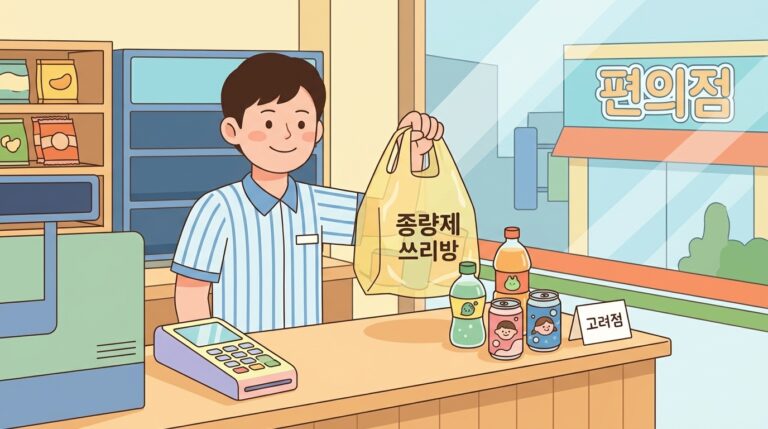
Master Korea’s Garbage System: How to Ask for a ‘General Trash Bag’ Like a Local!
Phase 1: Empathy (Welcome to Korea’s Trash Maze! 🗑️)
안녕하세요! (An-nyeong-ha-se-yo!) I’m your Korean bestie and Daily Hangul editor!
Imagine this: You’ve just moved into your dream studio apartment in Seoul. You’ve unpacked your bags, ordered a delicious Jajangmyeon (black bean noodles), and now you have some trash to throw away. You gather your garbage, walk down to the convenience store, and ask the cashier for a “trash bag.”
But wait! The cashier looks at you with a puzzled face and asks, “몇 리터요?” (How many liters?) and “일반 쓰레기요?” (General trash?). Suddenly, a simple chore feels like a high-level gaming quest! 🎮
Don’t worry, you are not alone! Almost 99% of expats in Korea experience this exact “trash shock” in their first week. Korea has one of the strictest waste management systems in the world, called Jongnyangje (종량제). Today, we will master the absolute survival phrase you need to buy a “General Trash Bag” at any convenience store or supermarket. Let’s make you look like a seasoned resident!
Phase 2: Deep Dive into 3 Essential Expressions
1. 일반 쓰레기 봉투 (Il-ban sseu-re-gi bong-tu)
- Pronunciation: Il-bahn ssoo-reh-gee bong-too (Think of “il” as in ill, “ban” as in bun, “sseu” like making a short suh sound, “re-gi” like reggy in reggae, and “bong-tu” like bong-too)
- Meaning: General Waste Bag (Standard plastic bag for non-recyclable waste)
- K-Culture Moment: You will see these specialized, colorful (usually white, yellow, or blue depending on your district) bags piled neatly in front of buildings in any K-drama set in Seoul.
- Editor’s Insight: In Korea, you cannot use just any plastic bag for trash. You must use these official government-issued bags. If you use a regular grocery bag, you can get a big fine!
- Situation Spectrum: Casual ✅ | Semi-formal ✅ | Formal ✅
- 🤔 Think About It: In your home country, do you have to buy special government-approved bags to throw away your daily trash, or is it included in your building’s maintenance fee?
2. 종량제 봉투 (Jong-ryang-je bong-tu)
- Pronunciation: Jong-ryang-jeh bong-too (Rhymes with “song-ryahng-jeh”)
- Meaning: Volume-rate garbage bag
- K-Culture Moment: This is the official, administrative term. Cashiers at big supermarkets like E-Mart or Homeplus will often ask if you need a “종량제 봉투” instead of a paper bag to carry your groceries home. Double-duty shopping bag!
- Editor’s Insight: “종량제” means “system where you pay based on the volume.” Since the price of the bag includes the waste treatment fee, buying the bag means you paid your trash tax!
- Situation Spectrum: Casual ⚠️ | Semi-formal ✅ | Formal ✅
- 🤔 Think About It: Why do you think Korea adopted this “pay-as-you-throw” system? How does it affect how people consume plastic?
3. 몇 리터짜리 있어요? (Myeot ri-teo-myeot-jja-ri is-seo-yo?)
- Pronunciation: Myut lee-tuh-jjah-ree eet-suh-yo? (“Myut” sounds like mute without the ‘oo’ sound, “ri-teo” like liter)
- Meaning: Which liter sizes do you have?
- K-Culture Moment: Usually, for a single-person household (like most cozy K-drama rooftop apartments), the 10-liter (10L) or 20-liter (20L) bags are the absolute gold standard. Ask this to find the perfect size for your room!
- Editor’s Insight: Don’t buy a 50L bag if you live alone! It will take a month to fill up, and it will start to smell really bad before you can even tie it up!
- Situation Spectrum: Casual ✅ | Semi-formal ✅ | Formal ✅
Phase 3: Textbook Korean vs. Real-Life Korean
Let’s compare what textbooks teach you versus what real Koreans say at the convenience store!
Scenario 1: Buying the bag
- 📖 Textbook Korean: “일반 쓰레기 봉투를 주십시오.” (Il-ban sseu-re-gi bong-tu-reul ju-sip-si-o.) -> “Please give me a general trash bag.” (Very stiff, sounds like a robot or a military officer!)
- 🗣️ 진짜 (Real) Korean: “쓰레기 봉투 20리터짜리 하나 주세요.” (Sseu-re-gi bong-tu ee-sip-ri-teo-jjah-ri ha-na ju-se-yo.) -> “Can I get one 20-liter trash bag, please?”
- 💡 Why the difference? Real Koreans drop formal particles like “-를” in daily conversations and directly state the size and quantity (“20-liter one piece”) to make it fast and natural.
Scenario 2: Asking if they sell them
- 📖 Textbook Korean: “이곳에서 쓰레기 봉투를 판매합니까?” (I-gos-e-seo sseu-re-gi bong-tu-reul pan-mae-hap-ni-ka?) -> “Do you sell trash bags at this location?”
- 🗣️ 진짜 (Real) Korean: “혹시 쓰레기 봉투 있어요?” (Hok-shi sseu-re-gi bong-tu is-seo-yo?) -> “By any chance, do you have trash bags?”
- 💡 Why the difference? “혹시” (By any chance) is a magical politeness booster in Korean. It softens your question instantly!
Phase 4: K-Culture Deep Dive & Non-Verbal Manners
4-1. The Magic “Cashier Bow” 🙇♂️
When buying trash bags in Korea, cashiers are often very busy scanning items. To show polite Korean manners (Nunchi):
* When asking for the bag, make eye contact and slightly nod your head.
* Crucial Tip: In Korea, trash bags are cash-friendly. In some small local marts, they prefer cash for trash bags because they are official government items with zero profit margin for the shopkeeper. Having some cash handy is a massive green flag!
4-2. The Ward-by-Ward Rules (Gu-cheong / 구청)
Did you know that trash bags in Seoul are regional? A trash bag bought in Mapo-gu (Hongdae area) cannot be thrown away in Gangnam-gu! Each district (Gu / 구) has its own color and design. Always buy your bags from a convenience store in your direct neighborhood!
Phase 5: Real-Life Roleplay Scenario
Meet Min-su (민수), the friendly neighborhood GS25 convenience store cashier. He’s fast, efficient, and ready to help you with your first trash bag purchase!
Character Profile: Min-su (GS25 Cashier, 23 years old. Fast-talking but super helpful to foreigners).
- Min-su: 어서오세요! GS25입니다. 뭐 찾으시는 거 있으세요?
(Eo-seo-o-se-yo! GS-ee-sip-o-im-ni-da. Mwo chat-eu-si-neun geo is-seo-se-yo?)
“Welcome! This is GS25. Are you looking for something?”
🎭 Smiling warmly while wiping the counter -
You: 저기… 혹시 일반 쓰레기 봉투 있어요?
(Jeo-gi… hok-shi il-ban sseu-re-gi bong-tu is-seo-yo?)
“Excuse me… by any chance, do you have general trash bags?”
🎭 Pointing slightly to the shelf behind the cashier counter -
Min-su: 네, 있어요! 몇 리터짜리 드릴까요?
(Ne, is-seo-yo! Myeot ri-teo-jja-ri deu-ril-kka-yo?)
“Yes, we do! What liter size should I give you?”
🎭 Reaching under the counter where bags are kept -
You: 어떤 사이즈가 있어요?
(Eo-tteon sa-i-jeu-ga is-seo-yo?)
“What sizes do you have?”
🎭 Tilting your head curiously -
Min-su: 보통 혼자 사시면 10리터나 20리터 많이 써요.
(Bo-tong hon-ja sa-si-myeon yeol-ri-teo-na ee-sip-ri-teo ma-ni sseo-yo.)
“Usually, if you live alone, people use 10-liter or 20-liter a lot.”
🎭 Holding up two different colored bags -
You: 아, 그래요? 그럼 10리터짜리로 다섯 장 주세요.
(Ah, geu-rae-yo? Geureom yeol-ri-teo-jja-ri-ro da-seot jang ju-se-yo.)
“Ah, really? Then please give me five sheets of the 10-liter ones.”
🎭 Showing 5 fingers -
Min-su: 네, 10리터짜리 다섯 장이요. 카드로 계산하시겠어요?
(Ne, yeol-ri-teo-jja-ri da-seot jang-i-yo. Ka-deu-ro gye-san-ha-si-get-seo-yo?)
“Okay, five sheets of 10-liter. Would you like to pay by card?”
🎭 Pointing to the card reader -
You: 네, 카드로 해주세요. 감사합니다!
(Ne, ka-deu-ro hae-ju-se-yo. Gam-sa-ham-ni-da!)
“Yes, by card please. Thank you!”
🎭 Slightly bowing your head while inserting your card
🔀 Choose Your Path!
What if the cashier asks: “봉투에 넣어드릴까요?” (Should I put them in a bag for you?)
* A) “네, 넣어주세요.” (Yes, please put them in.) -> Best! They will hand you the trash bags inside a small plastic carry bag. Simple and easy.
* B) “괜찮아요, 그냥 들고 갈게요.” (It’s okay, I’ll just carry them.) -> Eco-friendly! You just roll them up and put them in your pocket.
* C) “아니요, 쓰레기통에 버려주세요.” (No, throw them in the trash can.) -> Oops! You just asked him to throw away the brand new trash bags you just bought! 😱
Phase 6: 10-Second Emotion Shadowing Drill
Practice speaking like a native by adding emotional rhythm! The / represents a tiny pause.
- [🥺 Shy & Polite]
저기… / 혹시 / 쓰레기 봉투 / 있어요?
(Jeo-gi… / hok-shi / sseu-re-gi bong-tu / is-seo-yo?) -
[💡 Confident & Decisive]
일반 쓰레기 / 10리터짜리로 / 주세요!
(Il-ban sseu-re-gi / yeol-ri-teo-jja-ri-ro / ju-se-yo!) -
[😊 Grateful & Friendly]
네! / 감사합니다! / 수고하세요!
(Ne! / gam-sa-ham-ni-da! / su-go-ha-se-yo!) -> The last phrase means “Keep up the good work!” (Super friendly!)
Phase 7: K-Culture Mini Dictionary
- 음식물 쓰레기 (Eum-sik-mul sseu-re-gi) | Food Waste | In Korea, food waste must be separated from general waste. It usually goes into special yellow bags or designated bins.
- 분리수거 (Bun-ri-su-geo) | Recycling Separation | Separating plastics, paper, glass, and cans. This is usually done on specific days of the week in villa areas.
- 대형 폐기물 (Dae-hyeong pye-gi-mul) | Large Waste | Furniture or electronics. You cannot just throw these out! You must buy a special sticker from your local community center or online.
- 편의점 (Pyeon-ui-jeom) | Convenience Store | The absolute holy grail of Korean life. Open 24/7, sells everything from delicious ramyun to your regional trash bags.
Phase 8: Survivor’s Travel Kit
Top 3 Survival Phrases
- 이거 어디에 버려요? (I-geo eo-di-e beo-ryeo-yo?)
- Meaning: Where do I throw this away?
- Pro Tip: Perfect for asking hotel staff or cafe staff when you can’t find a bin.
- 영수증 버려주세요. (Yeong-su-jeung beo-ryeo-ju-se-yo?)
- Meaning: Please throw away the receipt.
- Pro Tip: Say this to cashiers if you don’t need the paper slip.
- 종이봉투 하나 주세요. (Jong-i-bong-tu ha-na ju-se-yo.)
- Meaning: Please give me a paper bag.
- Pro Tip: Use this when shopping at clothing stores.
Editor’s Travel Note 🗺️
If you are confused about recycling rules while traveling in Seoul, download the Naver Map App (네이버 지도). You can search for local community centers (주민센터) where you can pick up English/Chinese guides on district-specific waste separation. Note: Local waste policy details can change yearly, so always check with your local accommodation host first!
Phase 9: Deep Thoughts (The Philosophy of Korean Trash)
In Western countries, trash disposal is often private and invisible. But in Korea, garbage disposal is a community act. Since your trash bags are transparent or semi-transparent, neighbors can see if you did a good job separating your recycling. This creates a cultural concept of “Nunchi” (social awareness). Throwing away trash properly is seen as a sign of being a respectful neighbor and a civilized member of society.
💬 Your Turn: How does your neighborhood handle trash? Is it a private affair or a communal responsibility? Tell me in the comments below!
Phase 10: FAQ & Mistake Prevention
Q: Can I buy trash bags at any supermarket in Seoul?
A: Yes! You can buy them at major marts (E-mart, Lotte Mart), local supermarkets, and almost all major convenience stores (GS25, CU, Seven-Eleven) within your neighborhood.
Q: What happens if I put plastic bottles in the general trash bag?
A: Technically, you can face a fine of up to 300,000 KRW! In Korea, plastics, papers, cans, and food waste must be strictly separated from the general waste bag.
Q: Are the bags the same color everywhere?
A: No! Each local ward (Gu) uses different colors (e.g., Mapo-gu might use orange, while Seocho-gu might use blue). Always check the text on the bag to see which “Gu” (구) it belongs to.
🚨 Common Mistakes Alert!
- Mistake 1: Buying Mapo bags and using them in Gangnam. (Result: Your trash won’t be collected!)
- Mistake 2: Putting leftover chicken bones in the food waste bag. (Correction: Bones are hard and cannot be recycled as animal feed, so they go into the General Trash Bag!)
- Mistake 3: Saying “쓰레기 봉지” (sseu-re-gi bong-ji). While understood, “봉투” (bong-tu) is the more standard, polite, and common term used in shops.
Phase 11: Action Missions
- 🥉 Bronze Mission: Pronounce “일반 쓰레기 봉투 주세요” out loud 3 times in front of your mirror today!
- 🥈 Silver Mission: Write a comment below telling us which size bag (10L, 20L, or 50L) you think fits your lifestyle best!
- 🥇 Gold Mission: Go to your nearest Korean convenience store (or Asian market) and purchase a bag using only Korean phrases!
Phase 12: Interactive Quiz
Test your knowledge before you head out!
1. Which item belongs in the General Trash Bag (일반 쓰레기)?
a) Clean plastic water bottles
b) Chicken bones and eggshells
c) Watery watermelon rinds
2. Translate “10-liter trash bag, please.”
a) 10리터 쓰레기 봉투 주세요.
b) 10리터 물병 주세요.
c) 10리터 우유 주세요.
🔍 Click here to see the Answers & Explanations!
- Correct Answer: b) Chicken bones and eggshells cannot be processed into animal feed, so they are categorized as general waste! Watermelon rinds are food waste, and plastic bottles must be recycled.
- Correct Answer: a) “10리터 쓰레기 봉투 주세요” (10-liter trash bag, please). Option b is for water bottles, and option c is for milk!