

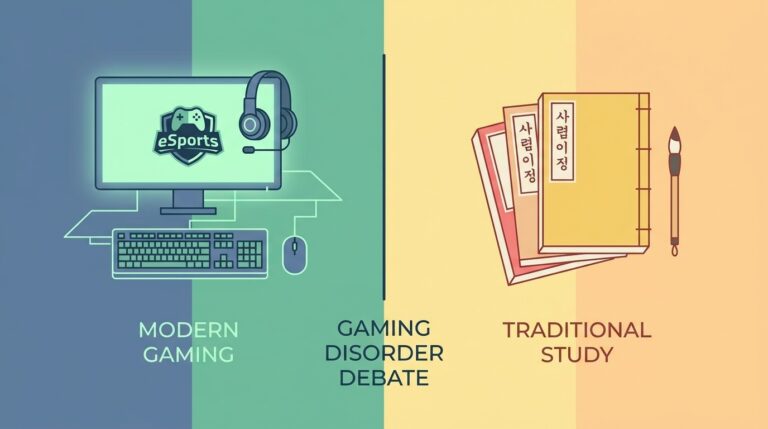
Gaming: Passion or Disease? Discussing the Gaming Disorder Controversy in Korean
안녕하세요! Welcome back to Daily Hangul! It’s your cultural navigator and editor.
Have you ever found yourself in an intense debate about whether gaming is a legitimate professional sport, a harmless hobby, or… a medical condition? In South Korea—the undisputed mecca of eSports and home to legendary players like Faker—this isn’t just an academic question. It is a highly sensitive social, economic, and cultural debate.
When the World Health Organization (WHO) classified “Gaming Disorder” as a disease, it triggered an absolute firestorm in Korea. On one side, the powerful gaming industry and passionate fans argue that this stigmatizes a thriving cultural sector. On the other side, worried parents and medical professionals point to academic pressure and severe screen addiction.
If you want to join high-level discussions with Korean friends, colleagues, or fellow gamers about this hot topic, you need more than just textbook vocabulary. Today, we are diving deep into C1-level Korean expressions, cultural nuances, and debate etiquettes surrounding the gaming addiction controversy. Let’s get started!
Phase 2: Deep-Dive into 3 Essential Expressions
1. 질병코드 등재 (jil-byeong-ko-deu deung-jae)
- Pronunciation: Jeel-byeong-koh-deu deung-jae (Sounds like “jeel-byung” + “code” + “deung-jay”)
- Meaning: Classification/Listing as a disease code
- K-Culture Moment: This formal term is the absolute centerpiece of any news broadcast, panel discussion, or YouTube debate concerning the WHO’s decision. You will hear industry representatives arguing against the “질병코드 등재” of gaming.
- Editor’s Insight: 등재 (deung-jae) means official registration or listing (often used for UNESCO heritage or official databases). Combining it with 질병코드 (disease code) elevates your speech to a highly sophisticated, academic level.
- Situation Spectrum: Casual: 🚫 | Semi-formal: ⚠️ | Formal: ✅
- 🤔 Think About It: In your home country, is gaming discussed in such medical and regulatory terms, or is it treated purely as a lifestyle issue?
2. 낙인 효과 (na-gin hyo-gwa)
- Pronunciation: Nah-geen hyoh-gwah (Sounds like “nah-geen” + “hyo-gwa”)
- Meaning: Stigma effect (Stigmatization)
- K-Culture Moment: Game developers and cultural critics in Korea frequently use this term. They worry that labeling gaming as a disease will create a 낙인 효과, making every passionate gamer look like a patient.
- Editor’s Insight: 낙인 originally refers to a branding iron used on criminals or cattle. In modern psychology and sociology, 낙인 효과 is the phenomenon where someone is labeled negatively, and their subsequent behavior or public perception conforms to that label.
- Situation Spectrum: Casual: ⚠️ | Semi-formal: ✅ | Formal: ✅
- 🤔 Think About It: How does the fear of “stigma” shape public policies and parental attitudes in highly competitive societies?
3. 과몰입 (gwa-mo-rip)
- Pronunciation: Gwah-moh-reep (Sounds like “gwah” + “mo-reep”)
- Meaning: Over-absorption / Excessive immersion (Often used as a softer, non-clinical alternative to ‘addiction’)
- K-Culture Moment: While doctors use the heavy word 중독 (jung-dok – addiction), the gaming industry prefers the term 게임 과몰입 (game gwa-mo-rip – excessive immersion) to avoid pathologizing the hobby.
- Editor’s Insight: 몰입 (mo-rip) means deep focus or flow state, which is generally positive. Adding 과- (gwa-), meaning “excessive,” turns it into an over-indulgence. It is a fantastic euphemism to use when you want to remain objective and neutral.
- Situation Spectrum: Casual: ✅ | Semi-formal: ✅ | Formal: ✅
- 🤔 Think About It: What is the line between healthy passion (몰입) and dangerous excess (과몰입)?
Phase 3: Textbook Korean vs. Real Korean
Scenario 1: Describing someone who plays games all day
- 📖 Textbook: “그는 게임 중독자입니다.” (He is a game addict.)
- 🗣️ Real Korean: “걔 완전 겜돌이/겜순이잖아. 하루 종일 겜방(PC방)에 살아.”
- 💡 Why the difference?: The textbook version sounds like a clinical diagnosis. Locals use the affectionate/playful terms 겜돌이 (gem-dol-i for males) or 겜순이 (gem-sun-i for females) to describe gaming enthusiasts, and use the hyperbole “living at the PC bang” to show how much they play.
Scenario 2: Expressing opposition to gaming regulation
- 📖 Textbook: “정부의 게임 규제에 반대합니다.” (I oppose the government’s gaming regulation.)
- 🗣️ Real Korean: “게임 산업을 이렇게 적폐 취급하면서 규제만 하는 건 에러죠.”
- 💡 Why the difference?: 적폐 (jeok-pye) refers to deep-seated evils or systemic ills. Describing regulation as treating gaming like an “evil” (적폐 취급) shows a sharp, contemporary understanding of Korean political and social rhetoric.
Phase 4: K-Culture Deep-Dive & Non-Verbal Manners
4-1. Nunchi & Gestures during Debates
When discussing sensitive topics like gaming addiction in Korea, non-verbal cues are critical:
* The “Softening” Gesture: When expressing a contrasting opinion, Koreans often tilt their head slightly, rub their chin, or use hand gestures that suggest “on one hand, but on the other hand.”
* Avoid Pointing: Pointing fingers during a heated debate is considered highly aggressive. Keep your hands open and palms slightly facing upwards when making a point.
4-2. The Cultural Paradox: PC Bangs vs. Hagwons
In South Korea, gaming exists in a strange paradox. On one side, Korea pioneered the PC 방 (PC bang) culture and legalized eSports. On the other hand, the intense academic pressure of 학원 (hagwons/cram schools) means that any time spent gaming is often viewed by parents as a direct threat to a child’s future. Thus, the debate over “Gaming Disorder” is deeply tied to the broader societal anxieties about academic success and productivity.
Phase 5: Practical Roleplay Scenario
Setting: A trendy cafe in Sinchon. You are discussing the WHO gaming disorder decision with Min-su, an indie game developer, and Hye-won, a middle school counselor.
- Min-su (민수): Active defender of game culture.
- Hye-won (혜원): Concerned about youth mental health.
Dialogue:
- 민수: “솔직히 WHO가 게임 중독을 질병코드로 등재한 건 너무 성급한 결정이었다고 봐요.”
(Sol-jik-hi WHO-ga ge-im jung-dog-eul jil-byeong-ko-deu-ro deung-jae-han geon neo-mu seong-geub-han gyeol-jeong-i-eot-da-go bwa-yo.)
(Honestly, I think the WHO’s classification of gaming addiction as a disease code was a hasty decision.) -
혜원: “하지만 민수 씨, 현장에서 아이들을 상담해 보면 일상생활이 불가능할 정도로 과몰입한 경우가 정말 많아요.”
(Ha-ji-man Min-su ssi, hyeon-jang-e-seo a-i-deul-eul sang-dam-hae bo-myeon il-sang-saeng-hwal-i bul-ga-neung-hal jeong-do-ro gwa-mo-rip-han gyeong-u-ga jeong-mal manh-a-yo.)
(But Min-su, counseling kids in the field shows there are so many cases of excessive immersion where normal daily life is simply impossible.) -
You (유저): “🎭 [Nodding slowly] 양쪽 다 일리가 있는 말씀이네요. 하지만 산업계가 우려하는 낙인 효과도 무시할 순 없죠.”
(Yang-jjok da il-ri-ga in-neun mal-sseum-i-ne-yo. Ha-ji-man san-eob-gye-ga u-ryeo-ha-neun na-gin hyo-gwa-do mu-si-hal sun eop-jyo.)
(Both of you have valid points. However, we cannot ignore the stigma effect that the industry is worried about.) -
민수: “맞아요! 게임 자체의 문제라기보다는 학업 스트레스 같은 환경적 요인이 더 큰데, 게임만 희생양으로 삼는 느낌이에요.”
(Ma-ja-yo! Ge-im ja-che-ui mun-je-ra-gi-bo-da-neun hag-eob seu-tre-seu gat-eun hwang-gyeong-jeok yo-in-i deo keun-de, ge-im-man hui-saeng-yang-eul-ro sam-neun neu-kkim-i-e-yo.)
(Exactly! Rather than the game itself, environmental factors like academic stress play a bigger role, but it feels like gaming is being scapegoated.) -
혜원: “하지만 국가 차원의 예산 지원과 체계적인 치료 가이드라인이 있으려면 질병코드가 필요해요.”
(Ha-ji-man guk-ga cha-won-ui ye-san ji-won-gwa che-gye-jeog-in chi-ryo ga-i-deu-ra-in-i isseu-ryeo-myeon jil-byeong-ko-deu-ga pil-yo-hae-yo.)
(But we need the disease code for state-level budget support and systematic treatment guidelines.) -
You (유저): “🎭 [Thoughtful tone] 제도적 지원도 중요하지만, 규제 위주보다 게임 리터러시 교육을 늘리는 건 어떨까요?”
(Je-do-jeok ji-won-do jung-yo-ha-ji-man, gyu-je wi-ju-bo-da ge-im ri-teo-reo-si gyo-yug-eul neol-ri-neun geon eo-tteol-kka-yo?)
(Systemic support is important, but instead of focusing solely on regulation, what about expanding game literacy education?) -
민수: “오, 그거 아주 건설적인 대안이네요! 무조건 막기보다 올바르게 즐기는 법을 가르쳐야죠.”
(Oh, geu-geo a-ju geon-seol-jeog-in dae-an-i-ne-yo! Mu-jo-geon mak-gi-bo-da ol-ba-reu-ge jeul-gi-neun beob-eul ga-reu-chyeo-ya-jyo.)
(Oh, that is a very constructive alternative! Instead of unconditionally blocking it, we should teach how to enjoy it properly.) -
혜원: “저도 동감해요. 치료와 예방 교육이 병행된다면 합의점을 찾을 수 있을 것 같아요.”
(Jeo-do dong-gam-hae-yo. Chi-ryo-gwa ye-bang gyo-yug-i byeong-haeng-doen-da-myeon hab-ui-jeom-eul chat-eul su isseu-ggeo gat-a-yo.)
(I agree. If treatment and preventive education go hand in hand, I think we can find common ground.)
🔀 Interactive Choice
How would you steer the conversation next?
* A. “한국의 경쟁 사회 구조가 먼저 바뀌어야 게임 과몰입도 줄어들 것 같아요.” (Focusing on structural societal pressure)
* B. “게이머들이 알아서 조절해야지, 법으로 막는 건 에러예요.” (Strong personal responsibility stance)
* C. “게임사들이 중독성 높은 비즈니스 모델을 줄여야 합니다.” (Pointing out corporate responsibility)
Feedback:
- A (Best): Excellent! This shows an advanced (C1) understanding of Korean societal structures and links the conversation to the underlying causes beautifully.
- B (Risk): A bit too casual and opinionated. The word “에러” might sound slightly dismissive in a balanced discussion.
- C (Good): A very solid point. Korean MMORPG business models (gacha/probabilistic items) are a hot topic of criticism inside Korea as well.
Phase 6: 10-Second Emotion Shadowing Drill
Try speaking these sentences out loud, focusing on the pauses (/) and emotional tone!
- [😤 Strongly Convincible & Confident]
“게임은 / 단순한 중독 물질이 아니라 / 세계가 주목하는 / 하나의 문화 콘텐츠산업입니다.”
(Ge-im-eun / dan-sun-han jung-dok mul-jil-i a-ni-ra / se-gye-ga ju-mok-ha-neun / ha-na-ui mun-hwa kon-ten-tsu san-eob-im-ni-da.)
(Gaming is / not just an addictive substance, but / a cultural content industry / that the world is watching.) -
[🥺 Empathetic & Concernced]
“청소년들이 / 게임에 과몰입하는 근본적인 이유에 / 먼저 귀를 기울여야 / 하지 않을까요?”
(Cheong-so-nyeon-deul-i / ge-im-e gwa-mo-rip-ha-neun geun-bon-jeog-in i-yu-e / meon-jeo gwi-reul gi-ul-ryeo-ya / ha-ji anh-eul-kka-yo?)
(Shouldn’t we / first listen carefully / to the fundamental reasons why / youth immerse themselves so excessively in games?)
Phase 7: K-Culture Mini-Dictionary
- 셧다운제 (Shutdown-je) | Youth Shutdown System: A law (now abolished) that banned kids under 16 from playing online games between midnight and 6 AM. It is a prime example of government regulation debate in Korea.
- 질병화 (Jil-byeong-hwa) | Pathologization / Medicalization: The process of treating a human behavior or condition as a medical disease.
- e스포츠 종주국 (e-Sports Jong-ju-guk) | The Birthplace/Supranational Home of eSports: A prideful title Koreans use to describe their country’s massive contribution to the professional competitive gaming scene.
- 셧업앤스폰서 (Shut up & Sponsor): A humorous modern slang referring to corporate-backed gaming events or supportive fans who fund creators unconditionally.
Phase 8: Traveler’s Survival Kit
Survival Expressions for Gamers in Korea
- “PC방 몇 시간 충전할 수 있어요?” (PC-bang myeot si-gan chung-jeon-hal su isseo-yo?)
- Pro Tip: Use this when asking how many hours you can top-up at a Korean PC Bang terminal.
- “롤(LoL) 한판 하실래요?” (Rol han-pan ha-sil-lae-yo?)
- Pro Tip: The ultimate icebreaker for making young Korean friends. “Do you want to play a round of League?”
- “사양 어떻게 돼요?” (Sa-yang eo-tteo-ke dwae-yo?)
- Pro Tip: Ask this to know the computer specifications (CPU/GPU) of the PC bang or gaming lounge.
💡 Editor’s Travel Note:
To experience Korean gaming culture safely and seamlessly, we highly recommend utilizing the Kakao T App for late-night rides home from the PC Bang, and Naver Map to find the highest-rated PC lounges in gaming hubs like Hongdae or Gangnam.
Phase 9: One Step Deeper (Reflection)
In Korea, gaming is not just a game. It is a battleground of generations. To the older generation who rebuilt Korea through sheer, relentless hard work, gaming is often seen as a distraction, a waste of precious time. To the younger generation, it represents a digital playground, a meritocratic escape, and a source of global pride. Discussing the “disease classification” of gaming is actually discussing how Korean society defines productive time and success.
💬 Your Turn: Do you think excessive gaming should be medically classified as a mental health disorder, or is it simply a symptom of societal stress? Share your thoughts in Korean in the comments below!
Phase 10: FAQ & Avoiding Common Mistakes
Q: Is gaming addiction currently classified as a disease in South Korea?
A: Not yet officially. While the WHO added it to the ICD-11, South Korea’s domestic medical code (KCD) implementation is currently under heavy discussion by a joint government-private committee due to strong opposition from the Ministry of Culture, Sports and Tourism and the gaming industry.
Q: Can I use the word “중독” (addiction) casually to friends?
A: Yes! Just like in English, saying “나 요즘 탕후루 중독이야” (I’m addicted to Tanghulu lately) is perfectly fine and natural in casual settings.
Q: What is the difference between ‘몰입’ and ‘과몰입’?
A: ‘몰입’ (immersion) is a positive flow state (e.g., studying or working passionately). ‘과몰입’ (over-immersion) has a negative connotation, implying that the focus is excessive and harmful to daily life.
🚨 Common Mistakes Alert!
- Wrong: “저는 게임 병에 걸렸어요.” (I have a game sickness.)
- Correct: “저는 게임 과몰입 성향이 있어요.” (I have a tendency toward excessive gaming immersion.)
- Reason: Calling it “게임 병” (game sickness) sounds like a physical virus. Use “과몰입” to describe the psychological behavioral pattern correctly.
Phase 11: Action Missions
- 🥉 Bronze Medal: Write a 2-sentence comment below stating your favorite game and how long you play it using 과몰입.
- 🥈 Silver Medal: Record yourself speaking the Phase 6 Shadowing Drill sentences with correct emotional intonation and share it on your social media!
- 🥇 Gold Medal: Start a discussion with a Korean friend using the sentence: “게임 중독을 질병으로 등록하는 것에 대해 어떻게 생각해?”
Phase 12: Interactive Quiz Challenge
1. Which of the following terms is the most formal, neutral way to refer to ‘excessive immersion’ in gaming without using clinical stigma?
* A) 게임 중독 (Game Jung-dok)
* B) 게임 과몰입 (Game Gwa-mo-rip)
* C) 게임 병 (Game Byeong)
Reveal Answer & Feedback
Correct Answer: B
- Feedback:
- A (게임 중독) is commonly used but carries a heavy clinical and negative stigma.
- B (게임 과몰입) is the preferred industry and neutral sociological term for excessive immersion.
- C is grammatically unnatural.
2. True or False: South Korea instantly made gaming addiction a crime after the WHO decision.
* A) True
* B) False
Reveal Answer & Feedback
Correct Answer: B (False)
- Feedback: Korea has not crime-categorized gaming, and the debate on whether to officially include it in the national medical code is still ongoing with intense discussions among medical, governmental, and industrial bodies.






