

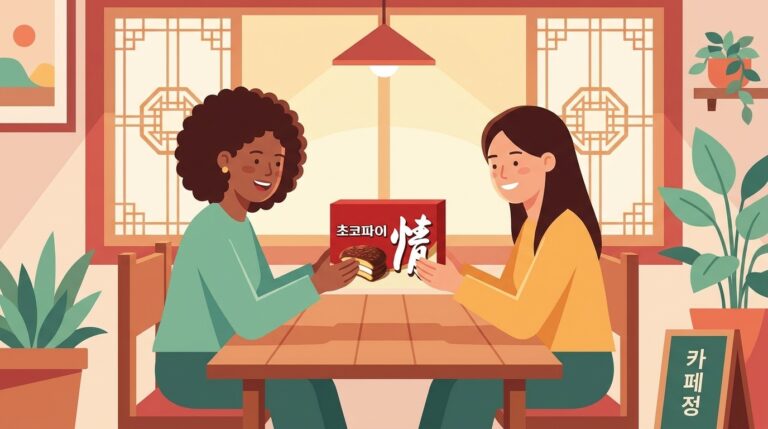
The Sweet Chemistry of ‘Jeong’: Unlocking Korea’s Invisible Bond Through the Choco Pie Story
Phase 1: Empathy (Welcome to the Heart of Korea!)
안녕하세요! (An-nyeong-ha-se-yo!) Hello, my dear Korean-learning friends! It’s your K-Culture Navigator and Daily Hangul Editor, here to bring you another warm slice of Korean life.
Have you ever walked into a small neighborhood supermarket in Korea, bought a few things, and suddenly found the owner sliding a free Choco Pie (초코파이) into your bag with a warm, silent smile? Or maybe you’ve watched a Korean drama where characters share a small, chocolate-covered marshmallow cake and suddenly start tearing up?
If you felt a bit puzzled by how a simple, cheap snack could carry so much emotional weight, you are not alone! Many of my B1-level students often ask, “Teacher, why is everyone so obsessed with Choco Pie? Is it really that delicious?”
The secret isn’t in the ingredients—it’s in a single, beautiful Korean word written on the red box: 정 (Jeong). Today, we are going to dive deep into the legendary Choco Pie advertisements that defined Korean warm-heartedness for decades, and learn how you can express this beautiful, invisible bond in your daily Korean conversations. Let’s get started!
Phase 2: Deep Dive into 3 Essential Expressions of ‘Jeong’
Let’s look at three powerful expressions that capture the essence of ‘Jeong’ and the Choco Pie culture. These will instantly make your Korean sound more emotionally mature and natural!
1. 정이 들다 (Jeong-i deul-da)
- Pronunciation: Jeong-ee deul-da (Sounds like “Jung-ey deul-da”)
- Meaning: To grow fond of someone/something; to develop an emotional attachment over time.
- K-Culture Moment: This is the exact feeling in the famous 1990s Choco Pie commercial where a rough-around-the-edges neighborhood uncle secretly leaves a Choco Pie on a young student’s desk. Without saying a word, they have “grown fond” of each other’s presence.
- Editor’s Insight: Unlike “사랑하다” (to love) which can happen instantly, 정이 들다 always requires time and shared experiences. It can even happen with an old desk, a neighborhood, or someone you used to bicker with!
- Situation Spectrum: Casual (✅) | Semi-formal (✅) | Formal (✅)
- 🤔 Think About It: Is there a word in your native language that describes loving someone or something simply because you have spent a lot of time together, even if they aren’t perfect?
2. 정을 나누다 (Jeong-eul na-nu-da)
- Pronunciation: Jeong-eul na-nu-da (Sounds like “Jung-eul nah-noo-dah”)
- Meaning: To share affection/warmth; to bond deeply with someone.
- K-Culture Moment: In Korea, sharing food is the ultimate way to ‘정과 온기’ (warmth). When coworkers pass around Choco Pies during a stressful overtime shift, they aren’t just eating sugar; they are 정을 나누는 중 (sharing warmth).
- Editor’s Insight: You cannot share ‘Jeong’ alone. It is a transactional, circular energy. When you do something kind without expecting anything back, you are casting a circle of ‘Jeong’.
- Situation Spectrum: Casual (✅) | Semi-formal (✅) | Formal (⚠️ – feels slightly poetic, but beautiful)
- 🤔 Think About It: Why do you think sharing a small snack like Choco Pie is more powerful than buying someone an expensive luxury gift when it comes to bonding?
3. 정이 많다 (Jeong-i man-ta)
- Pronunciation: Jeong-ee mhan-tah (Sounds like “Jung-ey mahn-tah”)
- Meaning: To be warm-hearted, affectionate, and caring (literally, “to have a lot of Jeong”).
- K-Culture Moment: In Choco Pie ads, the main characters are always ordinary, humble people—like a bus driver, a security guard, or a grandmother—who show small acts of kindness. They are described as 정 많은 사람들 (people with a lot of warmth).
- Editor’s Insight: Calling someone “정이 많다” is one of the highest compliments in Korea. It means they are empathetic and put others’ feelings first.
- Situation Spectrum: Casual (✅) | Semi-formal (✅) | Formal (✅)
- 🤔 Think About It: Who is the most “정 많은” person in your life right now? How do they show it?
Phase 3: Textbook Korean vs. Real-Life Korean
Let’s compare what textbooks teach you about showing appreciation versus how native Koreans actually express ‘Jeong’ in real life!
Situation 1: Giving a small treat/snack to a coworker
- 📖 Textbook Korean: “선물을 가져왔으니 맛있게 드세요.” (I brought a gift, so please eat it deliciously.)
- 🗣️ Real-Life Korean: “오다가 생각나서 샀어요. 하나 드셔보세요!” (I thought of you on my way here, so I bought this. Have one!)
- 💡 Why the difference? Saying “I brought a gift” can make the other person feel pressured to return the favor. Saying “I thought of you on my way” (오다가 생각나서) makes the gesture feel light, casual, and purely driven by warm affection (Jeong).
Situation 2: Expressing sadness when a classmate or colleague is leaving
- 📖 Textbook Korean: “헤어지게 되어서 매우 슬픕니다.” (I am very sad that we are parting ways.)
- 🗣️ Real-Life Korean: “그동안 정 많이 들었는데 정말 아쉬워요.” (I’ve grown so fond of you over this time, I’m really going to miss you.)
- 💡 Why the difference? Using “정 들다” expresses a much deeper, lived-in connection than just saying you are “sad” (슬프다). It acknowledges the beautiful time you spent together.
Phase 4: K-Culture Deep Dive & Non-Verbal Manners
4-1. The Art of the ‘Silent Hand-Over’ (비언어적 매너)
When you want to share ‘Jeong’ with a Choco Pie or any small snack, you don’t make a big announcement. Here is the non-verbal guide:
1. The Eye Contact: Make eye contact and give a gentle, knowing smile (not a big, business-like grin).
2. The Soft Slide: Gently slide or place the snack on their desk or next to them. If they are older, use both hands to hand it over slightly.
3. The Magic Words (Optional): You don’t even have to say anything! But if you do, a soft “이거 드시면서 하세요” (Have this while you work) is perfect.
4-2. The Legend of the Choco Pie “Jeong (情)” Campaign
In 1989, Orion (the company that makes Choco Pies) added the Hanja character 情 (정) to their red packaging. They launched a series of touching TV commercials showing ordinary Koreans helping each other—like a schoolboy leaving a Choco Pie for his favorite teacher who was leaving, or a young soldier sharing his precious snack with a homesick comrade. This campaign was so successful that “Choco Pie” and “Jeong” became synonymous in Korea. It taught an entire generation that sometimes, a small 400-won cake can say what words cannot.
Phase 5: Real-Life Roleplay Scenario
Scenario: You (the learner) have been working at a Korean office for 6 months. Your sweet teammate, Min-ji (민지), has been helping you adjust to the new environment. Today is your last day before transferring to another branch. You want to give her a Choco Pie and express your ‘Jeong’.
🎭 Characters:
- You: A warm B1-level foreign employee.
- Min-ji (민지): Your supportive, sweet Korean coworker (NPC).
- You: 민지 씨, 잠시 시간 괜찮으세요?
(Min-ji ssi, jam-si si-gan gwen-cha-neu-se-yo?)
Translation: Min-ji, do you have a moment?
🎭 (Handing over a red Choco Pie box with both hands while smiling warmly) -
Min-ji: 어? 이게 뭐예요? 초코파이네요!
(Eo? I-ge mwo-yeo-yo? Cho-ko-pa-i-ne-yo!)
Translation: Oh? What is this? It’s a Choco Pie! -
You: 그동안 저 도와주시느라 고생 많으셨어요. 정말 감사해요.
(Geu-dong-an jeo do-wa-ju-si-neu-ra go-saeng man-eu-syeos-seo-yo. Jeong-mal gam-sa-hae-yo.)
Translation: You went through a lot of trouble helping me all this time. Thank you so much. -
Min-ji: 아니에요, 제가 한 것도 별로 없는데요. 오히려 제가 더 즐거웠어요.
(A-ni-e-yo, je-ga han geot-do byeol-lo eob-neun-de-yo. Oh-hi-ryeo je-ga deo jeul-geo-wos-seo-yo.)
Translation: No, I didn’t really do much. Actually, I had more fun. -
You: 아니에요. 저 민지 씨랑 정 많이 들어서 다른 지사 가기 싫어요.
(A-ni-e-yo. Jeo Min-ji ssi-rang jeong man-i deul-eo-seo da-reun ji-sa ga-gi sil-heo-yo.)
Translation: No way. I’ve grown so fond of you, Min-ji, that I don’t want to go to the other branch. -
Min-ji: (Glancing emotional) 아, 저도 눈물 나려고 해요. 저도 정 정말 많이 들었어요.
(Ah, jeo-do nun-mul na-ryeo-go hae-yo. Jeo-do jeong jeong-mal man-i deul-eot-eo-yo.)
Translation: Oh, I’m about to cry too. I also grew very fond of you. -
You: 자주 연락하고 꼭 놀러 올게요. 이거 드시면서 화이팅하세요!
(Ja-ju yeon-rak-ha-go kkok nol-leo ol-ge-yo. I-ge deu-si-myeon-seo hwa-i-ting-ha-se-yo!)
Translation: I’ll keep in touch often and definitely come visit. Eat this and fighting! -
Min-ji: 네! 꼭 연락하셔야 해요. 맛있는 거 먹으러 가요!
(Ne! Kkok yeon-rak-ha-syeo-ya hae-yo. Mas-it-neun geo meog-eu-reo ga-yo!)
Translation: Yes! You must contact me. Let’s go eat something delicious!
🔀 Interactive Choice Point
How would you respond if Min-ji asks: “우리 나중에 또 만날 수 있겠죠?” (We will be able to meet again later, right?)
- Choice A: “네, 기회가 되면 만나요.” (Yes, let’s meet if there is an opportunity.)
- Choice B: “당연하죠! 제가 먼저 맛있는 거 사드릴 테니까 연락할게요!” (Of course! I will buy you delicious food first, so I will contact you!)
- Choice C: “약속은 할 수 없지만 노력해 볼게요.” (I cannot promise, but I will try.)
💡 Feedback on your choice:
- Choice A (Risk – Too Cold!): “기회가 되면” (If there is a chance) sounds very business-like and distant in Korean. It might break the ‘Jeong’ you just built!
- Choice B (Best – Warm and full of Jeong!): Offering to buy food (맛있는 거 사드릴게요) is the ultimate Korean way of showing you truly care about maintaining the relationship.
- Choice C (Bad – Super Blunt!): While honest, saying “I can’t promise” sounds incredibly cold and rude in a friendly social context in Korea.
Phase 6: 10-Second Emotion Shadowing Drill
Let’s practice the rhythm and feelings of these sentences. Pay attention to the pauses (/) and try to mimic the emotional state!
[🥺 Warm and slightly sad]
그동안 / 정이 많이 들어서 / 아쉬워요.
(Geu-dong-an / jeong-i man-i deul-eo-seo / a-swi-wo-yo.)
Stop points: Pause slightly after “그동안” and “들어서”.-
[😊 Cheerful and giving]
지나가다가 / 생각나서 / 샀어요. / 하나 드세요!
(Ji-na-ga-da-ga / saeng-gak-na-seo / sat-eo-yo. / Ha-na deu-se-yo!)
Stop points: Keep the tone light and bouncy.
Phase 7: K-Culture Mini-Dictionary
- 초코파이 정 (Choco Pie Jeong): The legendary Korean snack made by Orion, iconic for representing quiet, warm-hearted sharing.
- 덤 (Deom): Extra free items given by vendors out of ‘Jeong’. If a market auntie slides an extra apple into your bag, that’s 덤!
- 눈치 (Nunchi): The art of sensing other people’s feelings and needs without them speaking. Crucial for showing ‘Jeong’.
- 인간미 (In-gan-mi): Human warmth or charm. Someone who has “human flaws” but is incredibly warm-hearted.
Phase 8: Survivor Kit for Travelers
Survival Expressions for ‘Jeong’ Moments
- 이거 서비스예요! (I-geo seo-bi-seu-yeo-yo!)
- Meaning: “This is on the house!” (When a restaurant owner gives you free food out of Jeong).
- Pro Tip: Respond with a huge smile and say: “우와, 감사합니다! 잘 먹을게요!” (Wow, thank you! I will eat well!)
- 정이 정말 많으시네요. (Jeong-i jeong-mal man-eu-si-ne-yo.)
- Meaning: “You are so warm-hearted.”
- Pro Tip: Use this when a guesthouse owner or local guide goes out of their way to help you.
Editor’s Travel Note 🗺️
If you want to experience real, old-school Korean ‘Jeong’, skip the fancy department stores in Seoul and head to a traditional market like Mangwon Market (망원시장) or Gwangjang Market (광장시장). Download the Naver Map App to find your way. Don’t be afraid to sit at the food stalls; the warm interactions with the stall owners are pure ‘Jeong’. Disclaimer: Guesthouse and market operational hours may vary, so always double-check online before visiting.
Phase 9: Going One Step Deeper (Reflection)
In western cultures, relationships are often built on explicit communication and clear personal boundaries. In Korea, however, 정 (Jeong) operates in the unspoken spaces. It is the invisible glue that says, “We are connected, and I care about your well-being just as much as mine.” This is why Koreans often use “우리” (Our) instead of “내” (My)—as in “우리 나라” (Our country) or “우리 엄마” (Our mom). Sharing a Choco Pie is not about the sugar; it is a small physical manifestation of this communal warmth.
💬 Your Turn: Have you ever experienced a moment of ‘Jeong’ in Korea or with Korean friends? Let me know in the comments below! I read and reply to every single one!
Phase 10: FAQ & Avoiding Misunderstandings
Q: Can ‘Jeong’ (정) also be negative?
A: Yes! Because ‘Jeong’ is an attachment built over time, you can actually have ‘Jeong’ with an enemy, or stay in a bad relationship because of 미운 정 (Mi-un Jeong)—which is the affection/attachment built through arguing and struggling together. It makes leaving very difficult!
Q: Is Choco Pie the only snack that represents ‘Jeong’?
A: While Orion Choco Pie is the official king of ‘Jeong’ due to its 30-year marketing history, any small food item (like hot sweet potatoes in winter, or homemade side dishes) can represent ‘Jeong’.
Q: How do I respond when someone gives me ‘Deom’ (free extra food)?
A: Never offer money for it! It destroys the spirit of ‘Jeong’. Instead, accept it graciously with both hands and express enthusiastic gratitude.
🚨 Common Mistakes Alert!
- Mistake 1: Translating “Jeong” directly as “Love” (사랑).
- Correct Action: Don’t say “민지 씨를 사랑해요” to a coworker you like. Use “민지 씨랑 정이 많이 들었어요” instead.
- Mistake 2: Giving someone a Choco Pie and saying “정이에요” (This is Jeong).
- Correct Action: This sounds very unnatural and forced. Just say “드셔보세요” (Please try some) with a smile. The ‘Jeong’ is silent!
Phase 11: Action Mission for Today
- Bronze Mission (Solo): Buy a Choco Pie from your local Asian market, take a picture, and write down the word 정 (情) in your journal.
- Silver Mission (Social): Share a Choco Pie with a friend or colleague today without saying why. Just say: “I thought of you!”
- Gold Mission (Real Life): Next time you talk to your Korean language partner or teacher, use the phrase: “선생님/친구 씨랑 정이 많이 들었어요!”
Phase 12: Interactive Quiz Challenge
Test your understanding of Korean ‘Jeong’ and the Choco Pie culture!
1. Situation Quiz
You are leaving your homestay in Korea. What is the most natural way to express your gratitude to your homestay host mother?
* A) 아주 감사합니다.
* B) 그동안 정이 많이 들었는데 떠나려니 너무 아쉬워요.
* C) 안녕히 계십시오.
👉 Click to reveal the Answer & Explanation
Correct Answer: B
Explanation: B expresses that you have grown incredibly fond of them over time (정이 많이 들었다), which is the warmest and most natural way to say goodbye to someone who cared for you.
2. True or False?
In Korea, ‘Jeong’ (정) can only exist between romantic partners.
* True
* False
👉 Click to reveal the Answer & Explanation
Correct Answer: False
Explanation: ‘Jeong’ can exist between coworkers, neighbors, teachers and students, and even between you and your pet or favorite neighborhood street corner!
See you in the next lesson! 항상 감기 조심하시고, 오늘도 정이 가득한 하루 보내세요!







