

C1 Korean Masterclass: Identifying Stroke Symptoms (FAST) in Korean
Phase 1: Empathy – A Heart-Stopping Scene in Itaewon
안녕하세요! (An-nyeong-ha-se-yo!) Your trusty Korean culture navigator and Daily Hangul Editor is here.
Imagine you are enjoying a warm cup of yuzu tea in a cozy cafe in Itaewon, chatting with an elderly Korean gentleman who has been sharing stories about Seoul in the 1980s. Suddenly, his speech becomes slurred. He tries to smile, but only one side of his face lifts. When he reaches for his tea, his arm drops limply.
In English, you instantly recognize F.A.S.T. (Face, Arm, Speech, Time). But as a C1-level speaker, do you have the precise, nuanced Korean vocabulary to explain these specific neurological deficits to a 119 paramedic under immense pressure?
Many advanced learners know basic emergency words like “아파요” (It hurts), but during a stroke, pinpointing how and where the motor dysfunction occurs can save a life. Today, we are going to master the medical and everyday nuances of expressing stroke symptoms in Korean, ensuring you can act as a bridge of safety in critical moments.
Phase 2: Deep-Dive – Three Critical Clinical Expressions
1. 한쪽 얼굴에 마비가 오다 (Han-jjok eol-gul-e ma-bi-ga o-da)
- Pronunciation: Han-jjok eol-gul-e mah-bee-gah oh-dah (Rhymes with “ma-bee” as in the stinging insect, meaning paralysis or numbness).
- Meaning: Facial paralysis/numbness on one side.
- K-Culture Moment: In medical K-Dramas like Hospital Playlist (슬기로운 의사생활), you often hear neurosurgeons describing a patient’s onset of hemiplegia.
- Editor’s Insight: Koreans use the verb “오다” (to come) for sudden onset of symptoms (e.g., 감기가 오다, 마비가 오다). It implies that the condition has “arrived” and taken over.
- Situation Spectrum: Casual 🚫 | Semi-formal ⚠️ | Formal ✅ (This is a precise clinical description suitable for paramedics).
- 🤔 Think About It: How does your native language describe sudden physical changes? Does it “come” to you, or do you “get” it?
2. 발음이 어눌해지다 (Bal-eum-i eo-nul-hae-ji-da)
- Pronunciation: Bahl-eum-ee uh-nool-hae-jee-dah (Think of “eo-nul” as sounding like the French “un-oeil” – meaning slurred or clumsy speech).
- Meaning: Speech becomes slurred/unclear.
- K-Culture Moment: Often depicted when characters are intoxicated, but in medical thrillers, it is the key indicator of a transient ischemic attack (TIA).
- Editor’s Insight: “어눌하다” means clumsy or awkward. It is more sophisticated than “말을 잘 못하다” (cannot speak well) because it specifically denotes motor-articulation difficulty.
- Situation Spectrum: Casual ⚠️ | Semi-formal ✅ | Formal ✅
- 🤔 Think About It: In Korean culture, saving face is important. How would you gently ask someone if their slurred speech is due to fatigue or something more serious?
3. 거동이 부자연스럽다 (Geo-dong-i bu-ja-yeon-seu-reop-da)
- Pronunciation: Guh-dong-ee boo-jah-yuhn-seu-ruhpt-dah (“Geo-dong” refers to bodily movements/mobility).
- Meaning: Movements/gait are unnatural or clumsy.
- K-Culture Moment: Paramedics assessing stroke patients on-screen will evaluate their gait using this formal terminology.
- Editor’s Insight: This phrase is essential for reporting physical weakness (the ‘A’ in FAST – Arm weakness/gait issues) objectively to emergency services.
- Situation Spectrum: Casual 🚫 | Semi-formal ⚠️ | Formal ✅
- 🤔 Think About It: Why does Korean have so many different words for “clumsy” based on the specific body part or action involved?
Phase 3: Textbook Korean vs. Real-World Street Korean
Situation 1: Describing a lopsided smile
- 📖 Textbook Korean: “얼굴 비대칭이 관찰됩니다.” (Facial asymmetry is observed.)
- 🗣️ Real-World Korean: “입꼬리 한쪽이 축 처졌어요.” (One side of the mouth has drooped completely.)
- 💡 Why the Difference? Paramedics in Korea need vivid, immediate physical descriptions over the phone rather than abstract medical jargon.
Situation 2: Describing arm weakness
- 📖 Textbook Korean: “상지 근력이 저하되었습니다.” (Upper limb muscle strength has decreased.)
- 🗣️ Real-World Korean: “한쪽 팔에 힘이 빠져서 물건을 자꾸 떨어뜨려요.” (One of his arms has lost strength, so he keeps dropping things.)
- 💡 Why the Difference? Real-world emergency reporting relies on functional examples (dropping things) to convey urgency.
Phase 4: K-Culture Deep-Dive & Non-Verbal Manners
4-1. Nunchi (눈치) & Physical Respect in Emergencies
When administering aid or assessing stroke symptoms in Korea, especially with older adults, do not grab them aggressively. Maintain respectful posture. Lean in, look directly into their eyes, and state clearly:
“제 손을 한 번 꽉 쥐어보시겠어요?” (Could you try squeezing my hand tightly?)
Using polite, honorific verbs (~시겠어요) even in critical moments preserves the patient’s dignity and keeps them calm.
4-2. The K-Drama Golden Hour Code
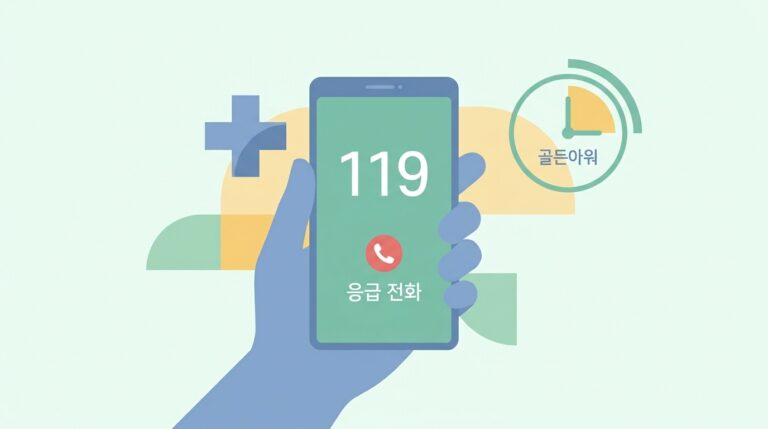
In Korea, the term “골든 아워” (Golden Hour) is widely known thanks to intense medical dramas like Golden Time (골든 타임). Stroke victims have a strict 3-hour window. Knowing how to say “골든타임 놓치면 안 돼요!” (We must not miss the golden hour!) immediately alerts bystanders to mobilize.
Phase 5: Real-Life Roleplay Scenario
Setting: An old, traditional market in Seoul (시장). You are at a pancake stall, and the elderly chef (사장님) suddenly exhibits neurological symptoms.
- Characters:
- You (C1 Expert Learner)
- 119 Paramedic (우직한 구급대원 – Reliable Paramedic)
- You: 🎭 (Notice the owner’s spatula slipping) 사장님, 괜찮으세요? 손에 힘이 안 들어가세요?
- Paramedic: 🎭 (Answering the emergency call) 119입니다. 어떤 상황이신가요?
- You: 여기 종로 시장 빈대떡집인데요, 사장님이 갑자기 쓰러지실 것 같아요.
- Paramedic: 환자분 상태가 구체적으로 어떠신가요?
- You: 🎭 (Checking the owner’s face) 지금 말씀하시는데 /발음이 완전히 어눌해지셨어요/.
- Paramedic: 얼굴 모양이나 팔다리 움직임은 어떠신가요?
- You: 🎭 (Supporting the owner) 왼쪽 입꼬리가 처지셨고, 왼팔에 마비가 온 것 같아요. 힘을 전혀 못 주십니다.
- Paramedic: 네, 즉시 구급차 출동시킵니다. 절대 물이나 약을 먹이지 마시고 환자를 편하게 뉘어주세요.
🔀 Choose Your Next Action:
- A) Keep attempting to make them drink warm water to wake them up.
- B) Check the exact time the symptoms started to report to the paramedics.
- C) Shake them vigorously to see if they regain sensation in their left arm.
💡 Feedback:
- Selection A (Bad): 🚫 Never give liquids to a stroke victim; it can cause choking (asphyxiation).
- Selection B (Best): ✅ Perfect! Knowing the onset time (초발 시간) is critical for administering tPA (clot-busting medication) within the Golden Hour.
- Selection C (Risk): ⚠️ Rough physical stimulation can worsen blood pressure or cause physical injury if they fall.
Phase 6: 10-Second Emotional Shadowing Drill
Practice these high-stakes sentences with realistic emotional urgency!
[🚨 Extremely Urgent]
“지금 / 한쪽 마비가 온 것 같아요! / 빨리 구급차 보내주세요!”
(Ji-geum / han-jjok ma-bi-ga on geot gat-a-yo! / Ppal-li gu-geup-cha bo-nae-ju-se-yo!)
(I think one side is paralyzed! Please send an ambulance quickly!)-
[🥺 Calm but Firmly Reassuring]
“어르신, / 제 목소리 들리시면 / 제 손을 꽉 쥐어보세요.”
(Eo-reu-sin, / je mok-so-ri deul-li-si-myeon / je son-eul kkwak jwi-eo-bo-se-yo.)
(Sir, if you can hear my voice, please squeeze my hand tightly.)
Phase 7: K-Culture Mini Dictionary
- 골든타임 (Golden Time) | The critical window of time (usually 3 hours for stroke) where medical intervention can prevent permanent damage.
- 마비 (Mabi) | Paralysis or numbness. Used broadly in both medical situations and figuratively (e.g., “교통 마비” – traffic paralysis).
- 119 (Il-il-gu) | South Korea’s primary emergency number for fire and medical emergencies.
- 어르신 (Eo-reu-sin) | A highly respectful term for elderly individuals, essential for maintaining polite rapport during emergencies.
Phase 8: Emergency Survival Kit for Travelers
Survival Phrases TOP 3
- “119에 전화해 주세요!” (Il-il-gu-e jeon-hwa-hae ju-se-yo!)
- Pro Tip: Use this to command bystanders directly to ensure someone calls immediately.
- “의식이 없어요.” (Ui-sig-i eop-seo-yo.)
- Pro Tip: Use this if the patient becomes unresponsive.
- “증상이 10분 전에 시작되었어요.” (Jeung-sang-i sip-bun jeon-e si-jak-doe-eot-seo-yo.)
- Pro Tip: Conveying the timeline is crucial for triage.
Editor’s Travel Note
Always have the KakaoMap Kakao Map App or Naver Map Naver Map App installed on your phone. In an emergency, you can pin your exact GPS location to read the address to the 119 dispatcher, as many traditional alleys in Korea lack straightforward street signs.
Phase 9: “Going Deeper” – The Language of Safety and Respect
In Korea, community solidarity (정, Jeong) runs deep. It is not uncommon for complete strangers to rush to help an elderly person on the street. However, because of strict social hierarchies and respect for the elderly, younger helpers often struggle with how to intervene without seeming intrusive. By mastering highly respectful medical prompts, you bypass social awkwardness and step up as a competent, compassionate guardian in public spaces.
💬 Your Turn: Have you ever had to assist someone in an emergency abroad? How did the language barrier impact the situation? Share your experiences in the comments below!
Phase 10: FAQ & Avoiding Common Pitfalls
Q: Can I use “중풍” (Jung-pung) instead of “뇌졸중” (Noe-jol-jung)?
A: Yes, “중풍” is the traditional Sino-Korean/oriental medicine term for stroke, which older generations use frequently. However, modern medical staff and dispatchers prefer the clinical term “뇌졸중”.
Q: How do I tell the dispatcher that someone is slurring their words without sounding rude?
A: Use objective phrasing: “말씀하시는 발음이 많이 흐려지셨습니다” (The pronunciation of their words has become very blurred).
Q: Should I perform CPR on a stroke patient?
A: Only if they stop breathing and have no pulse. If they are breathing but paralyzed, place them in the recovery position and wait for 119.
🚨 Common Mistakes Warning Board
- Using “바보 같다” (Foolish) instead of “어눌하다” (Slurred): Saying “말을 바보 같이 해요” (He talks like a fool) is highly offensive. Use “발음이 어눌해요”.
- Mispronouncing 마비 (Ma-bi) as 마디 (Ma-di): “마디” means joint/knuckle. Say “마비” clearly to denote paralysis.
- Calling 112 instead of 119: 112 is for police emergencies; 119 is for medical rescue and fire services.
Phase 11: Action Mission
- Bronze Medal: Practice saying “한쪽 얼굴에 마비가 왔어요” (One side of the face is paralyzed) 5 times in front of the mirror.
- Silver Medal: Take a screenshot of the Emergency Survival Phrases in Phase 8 and save it to your phone’s favorites folder.
- Gold Medal: Watch an episode of a Korean medical drama and write down how characters describe emergency symptoms in the comments below!
Phase 12: Interactive Quiz Challenge
Test your life-saving Korean skills!







