

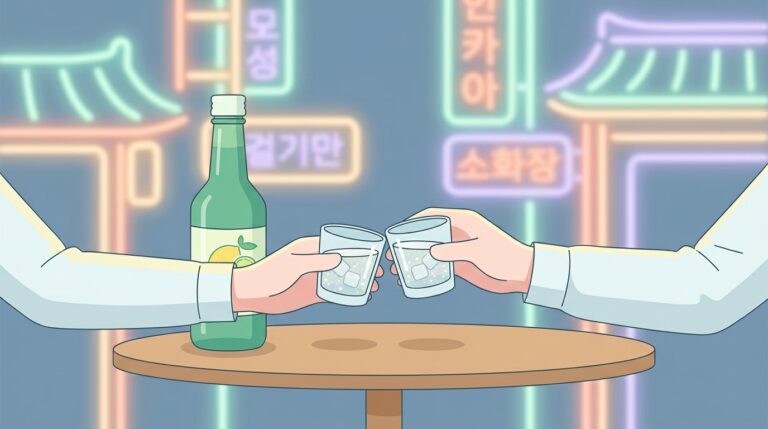
술 못 마셔요 (I can’t drink alcohol): How to Gracefully Say “No” at a Korean Drinking Table
Phase 1: Empathy (Welcome to the Korean Drinking Table!)
안녕하세요! (An-nyeong-ha-se-yo!) I’m your Daily Hangul editor and your personal Korean culture navigator.
Picture this: You are at a cozy, neon-lit Korean BBQ restaurant with your new Korean friends or colleagues. The grill is sizzling with delicious samgyeopsal (pork belly), laughter is flowing, and suddenly, someone raises a green bottle of Soju. They look at you with a warm smile and start pouring a shot for you.
Your heart rate spikes. You don’t drink alcohol—maybe due to health, religion, or you simply get red like a tomato after one sip (the famous “Asian flush”). You want to be polite, but you don’t want to ruin the high-energy vibe. In many Western cultures, a simple “No thanks, I don’t drink” works. But in Korea, where drinking is a major bonding ritual, how do you decline without causing an awkward silence?
Don’t worry! Today, we are going to learn three simple, polite magic phrases that will make you look culturally savvy, respectful, and keep the party vibes alive. Let’s dive in!
Phase 2: Deep Dive into 3 Essential Phrases
1. 저 술 못 마셔요 (Jeo sul mot ma-shyeo-yo)
- Pronunciation: Chuh sool mote mah-shuh-yo (Sounds like “Chuh” as in church + “sool” + “mote” + “mah-shuh-yo”)
- Meaning: “I can’t drink alcohol.”
- K-Culture Moment: You will hear this in almost every K-Drama when a character gently declines a drink from a senior coworker during a Hwesik (company dinner).
- Editor’s Insight: This is the most standard, polite, and safe way to say you cannot drink. Using “못” (mot/cannot) instead of “안” (an/do not) is key. It implies “I want to, but my body/circumstances won’t allow it,” which Koreans find very polite and understandable.
- Situation Spectrum: Casual (✅) / Semi-formal (✅) / Formal (✅)
- 🤔 Think About It: In your country, is it common to explain why you don’t drink, or is a simple “No” enough? In Korea, giving a soft, humble reason helps maintain harmony (Hwa-mok).
2. 저 알코올 쓰레기예요 (Jeo al-ko-ol sseu-re-gi-ye-yo)
- Pronunciation: Chuh al-co-ol ssuh-reh-gi-yeh-yo (Note: “Sseu” has a tense, sharp ‘S’ sound like the hiss in “spit“.)
- Meaning: “I am an alcohol trash.” (Slang for “I am a lightweight/terrible drinker”)
- K-Culture Moment: This is a hilarious self-deprecating slang popularized by K-Pop idols on variety shows when joking about their low alcohol tolerance. Often shortened to “알쓰” (Al-Sseu)!
- Editor’s Insight: Use this only with friends your age! It instantly breaks the ice and makes everyone laugh. It turns a potentially awkward rejection into a funny, relatable moment.
- Situation Spectrum: Casual (✅) / Semi-formal (⚠️ – only with close colleagues) / Formal (🚫)
- 🤔 Think About It: Why do you think self-deprecating humor works so well in Korean social settings? It shows you don’t take yourself too seriously!
3. 오늘은 그냥 사이다 마실게요 (Oneul-eun geu-nyang sa-i-da ma-shil-ge-yo)
- Pronunciation: Oh-neul-eun guh-nyang sah-ee-dah mah-shil-geh-yo
- Meaning: “Today, I will just drink cider (lemon-lime soda).”
- K-Culture Moment: In K-Dramas, you’ll see a character raise a glass of Sprite or Coke while everyone else drinks beer, yelling “Geon-bae!” (Cheers!).
- Editor’s Insight: “사이다” (Sa-i-da) in Korea is not apple cider; it’s a clear lemon-lime soda (like Sprite). This phrase is brilliant because it focuses on what you will drink to join the fun, rather than what you can’t drink.
- Situation Spectrum: Casual (✅) / Semi-formal (✅) / Formal (✅)
Phase 3: Textbook Korean vs. Real Korean
Let’s compare what boring textbooks teach you versus how real Koreans actually talk!
- Scenario A: Declining a drink from a boss
- 📖 Textbook: “저는 술을 마시지 않습니다.” (Jeo-neun sul-eul ma-si-ji anh-seup-ni-da. – Too robotic, cold, and overly formal.)
- 🗣️ Real Korean: “죄송한데, 제가 술을 잘 못 마셔요.” (Joe-song-han-de, je-ga sul-eul jal mot ma-shyeo-yo. – “I am sorry, but I can’t drink alcohol very well.” – Warm, polite, and natural.)
- 💡 Why? Adding “죄송한데” (I’m sorry but) softs the blow of refusal, and “잘” (well) makes it sound less abrupt.
- Scenario B: Telling friends you get drunk easily
- 📖 Textbook: “저는 알코올 해독 능력이 낮습니다.” (Jeo-neun al-ko-ol hae-dok neung-ryeok-i nat-seup-ni-da. – “My alcohol detox ability is low.” – Sounds like a medical textbook!)
- 🗣️ Real Korean: “나 진짜 알쓰야!” (Na jin-jja al-sseu-ya! – “I’m such an Al-Sseu!”)
- 💡 Why? “알쓰” (Al-Sseu) is the perfect, trendy slang to keep the vibe young and fun.
Phase 4: K-Culture Deep Dive & Non-verbal Manners
4-1. The “Water-in-a-Soju-Glass” Trick & Nunchi (눈치)
In Korea, Nunchi (tact/situational awareness) is everything. If someone wants to pour you a drink, never leave your glass empty. An empty glass signals “Fill me up!”
* The Trick: If you don’t drink, secretly fill your empty Soju cup with water (mul) or Sprite (sa-i-da).
* The Gesture: When people clink glasses for a toast, raise your water-filled cup, make eye contact, clink, and take a sip of your water! This keeps you fully included in the team bonding without drinking a single drop of alcohol.
4-2. The “Two-Hand” Rule
Even if you are drinking water, if an elder or superior pours it for you, always hold your cup with two hands as a sign of respect.
Phase 5: Real-Life Roleplay Scenario
Setting: A lively Korean BBQ restaurant. You are eating dinner with your friendly Korean coworker, Min-woo (민우).
- Min-woo: “지우 씨, 삼겹살 진짜 맛있죠? 소주 한잔 하실래요?”
(Ji-woo-ssi, sam-gyeop-sal jin-jja ma-sit-jyo? So-ju han-jan ha-sil-lae-yo?)
“Ji-woo, the pork belly is delicious, right? Would you like a shot of Soju?” - You: 🎭 [Smiling politely, waving your hands slightly] “아, 민우 씨! 죄송한데 저 술 못 마셔요.”
(Ah, Min-woo-ssi! Joe-song-han-de jeo sul mot ma-shyeo-yo.)
“Ah, Min-woo! I’m sorry, but I can’t drink alcohol.” - Min-woo: “아, 진짜요? 아쉽네요. 전혀 못 마셔요?”
(Ah, jin-jja-yo? A-swip-nae-yo. Jeon-hyeo mot ma-shyeo-yo?)
“Oh, really? That’s a pity. You can’t drink at all?” - You: 🎭 [Laughing playfully] “네, 저 진짜 알쓰거든요. 한 잔만 마셔도 얼굴이 빨개져요!”
(Ne, jeo jin-jja al-sseu-geo-deun-yo. Han jan-man ma-shyeo-do eol-gul-i ppal-gae-jyeo-yo!)
“Yeah, I’m a total Al-Sseu (lightweight). Even if I drink just one glass, my face turns red!” - Min-woo: “아하하, 그래요? 그럼 소주 대신 음료수 시켜 드릴게요. 콜라? 사이다?”
(A-ha-ha, geu-rae-yo? Geu-reom so-ju dae-sin eum-ryo-su si-kyeo deu-ril-ge-yo. Kol-la? Sa-i-da?)
“Ahaha, really? Then instead of Soju, I’ll order you a soft drink. Coke? Cider?” - You: “사이다 좋아요! 감사합니다!”
(Sa-i-da jo-a-yo! Gam-sa-ham-ni-da!)
“Cider is great! Thank you!” - Min-woo: 🎭 [Pours Sprite into your glass] “자, 아쉬운 대로 사이다로 건배해요!”
(Ja, a-swi-un dae-ro sa-i-da-ro geon-bae-hae-yo!)
“Now, let’s toast with Cider instead!” - You: 🎭 [Holding cup with two hands, clinking] “건배! 감사합니다!”
(Geon-bae! Gam-sa-ham-ni-da!)
“Cheers! Thank you!”
🔀 Interactive Choice Point!
What would you do if a strict senior manager insists, “Just take one shot, it’s fine!”?
* A) Say “No, I said I can’t!” coldly.
* B) Say “저 건강 때문에 약 먹고 있어요.” (I am taking medicine for my health.) with an apologetic smile.
* C) Drink it and suffer.
Feedback:
- Best Choice – B: Using a health/medicine excuse is the ultimate “shield” in Korea. No one will force you to drink if you are on medication. It keeps the relationship polite and safe.
- Risk Choice – A: It might sound too aggressive and break the harmony (Bun-wi-gi) of the table.
- Bad Choice – C: Never force yourself to drink! Your health and comfort always come first.
Phase 6: 10-Second Emotion Shadowing Drill
Let’s practice saying these with real Korean emotion! The / represents a tiny pause.
- [🥺 Apologetic & polite]
“죄송한데, / 저 술 못 마셔요.”
(Joe-song-han-de, / jeo sul mot ma-shyeo-yo.) -
[😊 Playful & cheerful]
“저 / 진짜 / 알쓰예요!”
(Jeo / jin-jja / al-sseu-ye-yo!) -
[🥳 Energetic & ready to party]
“저는 / 사이다로 / 건배할게요!”
(Jeo-neun / sa-i-da-ro / geon-bae-hal-ge-yo!)
Phase 7: K-Culture Mini Dictionary
- 알쓰 (Al-Sseu) | Lightweight / Someone bad at drinking | A cute slang combined from “알코올” (Alcohol) and “쓰레기” (Trash).
- 건배 (Geon-bae) | Cheers! | Literally means “empty glass”.
- 회식 (Hwe-sik) | Company dinner | A dining gather with coworkers, highly common in Korean work culture.
- 사이다 (Sa-i-da) | Lemon-lime Soda | Similar to Sprite/7-Up. Used metaphorically to describe a refreshing, clear-cut situation.
Phase 8: Traveler’s Survival Kit
Survival Phrases TOP 3
- 물 주세요 (Mul ju-se-yo) | “Please give me water.” | Essential when your throat is dry from salty Korean BBQ.
- 음료수 메뉴 있어요? (Eum-ryo-su me-nyu it-seo-yo?) | “Do you have a soft drink menu?” | Good for checking non-alcoholic options.
- 술 빼고 주세요 (Sul ppai-go ju-se-yo) | “Please make it without alcohol.” | Useful if ordering cocktails or mixed drinks.
Editor’s Travel Note ✈️
When traveling in Korea, download the Naver Map App to find restaurants that offer great non-alcoholic drinks or dessert cafes. Also, most Korean convenience stores (CU, GS25) offer an amazing selection of zero-sugar sodas and delicious fruit juices if you want to join the late-night hangouts with your own fun drinks!
Phase 9: “Going Deeper” (Cultural Insight)
In Western cultures, drinking is largely an individual choice. In Korea, drinking has historically been a “collective glue” to lower social barriers in a highly hierarchical society. However, modern Korea is changing rapidly! The younger generation heavily respects personal choices, and forcing drinks is slowly becoming a thing of the past. By politely expressing your limits using phrases like “알쓰” (Al-Sseu), you show that you understand their culture while staying true to yourself.
💬 Your Turn: Have you ever been to a Korean-style dinner? How did you handle the drinking culture? Let me know in the comments below!
Phase 10: FAQ & Common Mistakes
Q: Can I just say “아니요” (An-i-yo / No) when offered a drink?
A: While grammatically correct, just saying “No” can sound a bit cold in Korean. It is much warmer and more polite to say “죄송한데 저 술 못 마셔요” (I’m sorry, but I can’t drink).
Q: Is it disrespectful to turn down a drink from an elder?
A: Historically, yes. But today, absolutely not! As long as you decline politely and keep your glass filled with water or soda to participate in the toasts, everyone will be happy.
Q: What is “Sa-i-da” in Korea?
A: It is a carbonated lemon-lime soda (like Sprite), not alcoholic apple cider! Feel free to order it safely.
🚨 Common Mistakes Alert!
- Mistake 1: Saying “술 안 마셔요” (Sul an ma-shyeo-yo – I don’t drink) forcefully.
- Fix: Say “술 못 마셔요” (Sul mot ma-shyeo-yo – I can’t drink). It sounds softer and more polite.
- Mistake 2: Pouring your own non-alcoholic drink under the table.
- Fix: Let others pour it for you, or ask permission to pour yours so you remain a part of the social interaction!
Phase 11: Action Mission!
- 🥉 Bronze: Say “저 술 못 마셔요” out loud 3 times in front of your mirror with an apologetic smile!
- 🥈 Silver: Leave a comment below telling us your favorite non-alcoholic Korean drink (Sprite, Pear Juice, or Barley Tea?).
- 🥇 Gold: Next time you watch a K-Drama eating scene, try to spot if anyone is drinking soda or water instead of alcohol!
Phase 12: Interactive Quiz Challenge
Test your Korean drinking etiquette!
Q1. What is the trendiest, cute slang for a “lightweight” drinker?
a) 술고래 (Sul-go-rae)
b) 알쓰 (Al-Sseu)
c) 사이다 (Sa-i-da)
See Answer & Explanation
Correct Answer: b) 알쓰 (Al-Sseu)
* Explanation: “알쓰” is short for “알코올 쓰레기” (Alcohol trash), a cute self-deprecating slang for lightweights. (a) means “drinking whale” (heavy drinker), and (c) is lemon-lime soda!
Q2. True or False: You should leave your glass empty if you don’t want to drink anymore.
See Answer & Explanation
Correct Answer: False!
* Explanation: In Korea, an empty glass invites people to pour you more! Keep your glass half-filled with water or soda so they know you are set.







