

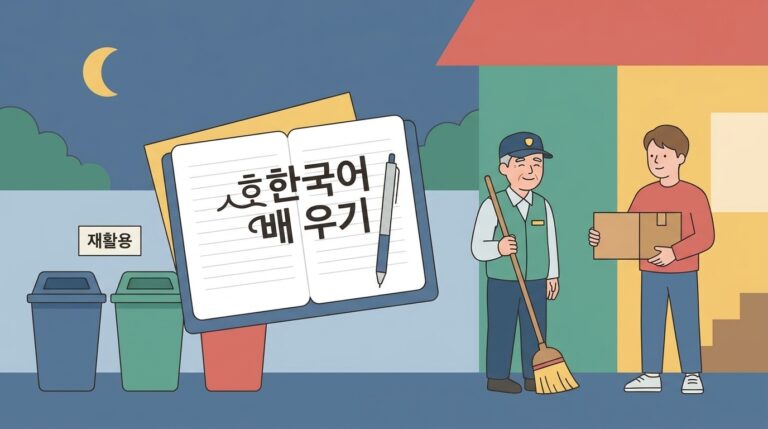
Master Korea’s Complex Recycling Rules: How to Avoid the Dreaded Apartment Fine Like a Local
Phase 1: Empathy (Welcome to the Ultimate Trash Test!)
안녕하세요! (Annyeonghaseyo!) Welcome back, dear friends! It’s your favorite “Daily Hangul” chief editor and local cultural navigator.
Imagine this: You’ve just moved into a beautiful, high-rise Korean apartment. You are enjoying your morning coffee, looking at the city view, when suddenly, you hear a loud, crackling announcement over the apartment loudspeaker. The security guard (Gyeong-ui-ajeossi) is talking fast about “Bunriseugeo” (분리수거 – recycling) and “Yoil” (요일 – days of the week).
Next thing you know, you go downstairs with your trash bag on a Tuesday, only to receive a stern, direct look from the security guard. He points to a sign and says, “오늘은 분리수거 날이 아니에요!” (Today is not recycling day!). You freeze. Your heart sinks. You have to carry your smelly plastic bottles back up to the 15th floor.
Don’t worry! This is the ultimate rite of passage for anyone living in Korea. Today, we are going to master the art of Korea’s strict apartment recycling culture, learn the exact phrases to sound like a polite local, and make sure you never get a “yellow card” from your apartment’s friendly neighborhood protector.
Phase 2: Deep Dive into 3 Essential Expressions
1. 분리수거 요일이 언제예요? (Bun-ri-su-geo yo-il-i eon-je-yeo?)
- Pronunciation: Boon-ree-soo-guh yo-eel-eeuhn-jeh-yo? (Think of “Boon” as in boon, “ree” as in green, “soo” as in soup, “guh” as in gutter).
- Meaning: “When is the recycling day?”
- K-Culture Moment: You will hear this in almost every realistic Korean slice-of-life drama (like Reply 1988 or Because This Is My First Life). Neighbors gathering near the recycling bins on a specific night, gossiping while crushing cardboard boxes.
- Editor’s Insight: Bunriseugeo (분리수거) literally means “separate collection.” Unlike in many Western countries where you throw all recyclables into one big blue bin, Korea requires micro-sorting. Asking this question to your landlord or security guard on day one shows you respect local community rules.
- Situation Spectrum: Casual (⚠️ 분리수거 언제야?) | Semi-formal (✅ 분리수거 요일이 언제예요?) | Formal (✅ 분리수거일이 어떻게 됩니까?)
- 🤔 Think About It: In Korea, recycling is not just an individual choice; it is a highly cooperative community responsibility. How does this compare to your home country’s recycling system?
2. 이거 그냥 버려도 돼요? (I-geo geu-nyang beo-ryeo-do dwae-yo?)
- Pronunciation: Ee-guh gyuh-nyahng buh-ryuh-doh dweh-yo? (Think of “gyuh” as in girl without the ‘rl’, “buh” as in bus).
- Meaning: “Can I just throw this away (like this)?”
- K-Culture Moment: Usually asked when holding something confusing, like a half-clean pizza box, a delivery container with red sauce stains, or a broken umbrella.
- Editor’s Insight: This is a survival phrase! In Korea, if a recyclable item is dirty (e.g., stained with spicy Tteokbokki sauce), it can no longer be recycled and must go into the general waste bag (ilban sseuregi). Asking this saves you from accidental illegal dumping.
- Situation Spectrum: Casual (✅ 이거 그냥 버려?) | Semi-formal (✅ 이거 그냥 버려도 돼요?) | Formal (🚫 이것을 그냥 배출해도 되겠습니까? – too stiff!)
- 🤔 Think About It: Why do you think Korea is so strict about cleaning food containers before recycling? (Hint: It is related to land mass and high population density!)
3. 경비아저씨한테 물어볼게요. (Gyeong-bi-a-jeo-ssi-han-te mul-eo-bol-gae-yo.)
- Pronunciation: Gyuhng-bee-ah-juh-shee-hahn-teh mool-uh-bohl-geh-yo. (Pronounce “ssi” with a sharp, tense ‘s’ sound like the hiss of steam).
- Meaning: “I will ask the security guard.”
- K-Culture Moment: In Korean apartments, the Gyeongbi-ajeossi (security guard) is the king of the castle. He knows everything, fixes everything, and manages the trash compound with absolute authority.
- Editor’s Insight: While “Ajeossi” means middle-aged man, combining it with “Gyeongbi” (security) makes it a respectful title. Showing politeness to your apartment’s guard will make your life in Korea 200% easier!
- Situation Spectrum: Casual (⚠️ 경비아저씨한테 물어볼게) | Semi-formal (✅ 경비아저씨한테 물어볼게요) | Formal (✅ 경비원분께 여쭤보겠습니다)
- 🤔 Think About It: In Korea, security guards often act as community managers rather than just security. How does this change the way you should interact with them?
Phase 3: Textbook Korean vs. Real-Life Korean
Situation 1: Asking if trash goes in the general bin or recycling
- 📖 Textbook Korean: “이 쓰레기는 재활용품입니까, 일반 쓰레기입니까?” (Is this waste a recyclable or general waste?)
- 🗣️ Real-Life Korean: “이거 재활용이에요, 아니면 그냥 일반이에요?” (Is this recycling, or just general?)
- 💡 Why is it different? Koreans rarely use the heavy word “재활용품” (recyclable item) in daily speech. They simply shorten it to “재활용” (recycling) and refer to general waste as “일반” (general).
Situation 2: Asking when to take out the recycling
- 📖 Textbook Korean: “쓰레기 배출 요일이 언제인지 알려주십시오.” (Please inform me when the waste discharge day is.)
- 🗣️ Real-Life Korean: “분리수거 언제 내놓으면 돼요?” (When should I put out the recycling?)
- 💡 Why is it different? “배출” (discharge) is an administrative term used on posters. In real life, native speakers use the active verb phrase “내놓다” (to put/take out).
Phase 4: K-Culture Deep Dive & Non-verbal Manners
4-1. The “Ajeossi Salute” and Eye Contact
When disposing of your recycling, you will almost always meet the guard.
* The Gesture: Do not just walk past. Give a slight, polite nod (about 15 degrees) and say “안녕하세요!” (Annyeonghaseyo).
* The Action: If you are unsure about an item, hold it up slightly with both hands (a sign of respect in Korea) and ask, “이거 비닐에 버려요?” (Do I throw this in the plastic vinyl bin?). Showing effort goes a long way!
4-2. The “Clean Out” Culture
If you watch Korean reality shows like I Live Alone (나 혼자 산다), you’ll see celebrities diligently rinsing out delivery containers. In Korea, “Plastics” does not just mean plastic. If a container has food residue, it is considered general waste. You must wash it until it is white/transparent again, peel off all plastic labels from plastic water bottles, and crush them flat before throwing them away.
Phase 5: Real-life Roleplay Scenario
The Setup
- Setting: The recycling station outside the Green Narae Apartments (초록나래 아파트) on a chilly Thursday night.
- Your Character: Alex (알렉스), a foreign resident who is holding a pile of cardboard boxes and plastic containers.
- NPC: Mr. Kim (김씨), the veteran security guard who takes recycling very seriously but has a warm heart.
Dialogue (8 Turns)
- Alex: (🎭 Carrying a heavy box, looking confused)
저기… 실례합니다. 오늘 분리수거 하는 날 맞아요?
(Jeogi… sillyehamnida. Oneul bunriseugeo haneun nal maj-ayo?)
“Excuse me… Is today the recycling day?” -
Mr. Kim: (🎭 Sweeping the area, looking up)
어, 맞아요. 목요일 저녁 6시부터 금요일 아침까지예요.
(Eo, maj-ayo. Mog-yo-il jeon-yeog yeosot-si-buteo geum-yo-il a-chim-kkaji-yeo.)
“Oh, yes. It’s from Thursday evening 6 PM to Friday morning.” -
Alex: (🎭 Smiling in relief)
아, 다행이네요! 이거 상자는 테이프 다 떼고 버려야 하죠?
(Ah, dahaeng-ine-yo! Igeo sang-janeun te-i-peu da tte-go beoryeoya hajyo?)
“Ah, what a relief! I have to peel all the tape off these boxes before throwing them away, right?” -
Mr. Kim: (🎭 Nodding approvingly)
그럼요! 테이프랑 택배 송장은 꼭 떼서 일반 쓰레기에 버려줘요. 아주 잘하시네!
(Geureom-yo! Te-i-peu-rang taek-bae song-jang-eun kkok tteseo il-ban sseuregi-e beoryeojwoyo. A-ju jal-ha-si-ne!)
“Of course! Make sure to peel off the tape and shipping labels and throw them in the general trash. You’re doing great!” -
Alex: (🎭 Pointing to a plastic container)
감사합니다! 그런데 이 빨간 양념 묻은 배달 용기도 플라스틱에 버려도 돼요?
(Gam-sa-ham-nida! Geu-reon-de i ppal-gan yang-nyeom mud-eun bae-dal yong-gi-do peu-las-tik-e beoryeo-do dwae-yo?)
“Thank you! But can I throw this delivery container with red sauce stains into the plastic bin too?” -
Mr. Kim: (🎭 Wagging his finger slightly)
아이고, 그건 안 돼요! 깨끗하게 씻겨야 플라스틱이고, 안 지워지면 일반 쓰레기로 버려야 해요.
(Aigo, geugeon an dwae-yo! Kkae-kkeut-ha-ge ssit-gyeoya peu-las-tik-i-go, an ji-wo-ji-myeon il-ban sseuregi-ro beoryeoya hae-yo.)
“Oh, no! It’s only plastic if it washes clean. If the stain won’t come off, you must throw it in the general trash.” -
Alex: (🎭 Nodding and bowing slightly)
아, 그렇군요! 몰랐어요. 지금 집에 가서 다시 씻어 올게요.
(Ah, geureog-un-yo! Mol-lass-eoyo. Ji-geum jib-e ga-seo da-si ssis-eo ol-ge-yo.)
“Ah, I see! I didn’t know. I’ll go back home now, wash it again, and bring it back.” -
Mr. Kim: (🎭 Smiling warmly)
에이, 다음부터 그렇게 해요! 오늘은 내가 대충 헹궈줄 테니 여기 두고 가요.
(Ei, da-eum-bu-teo geu-reoh-ge hae-yo! Oneul-eun nae-ga dae-chung heng-gwo-jul te-ni yeo-gi du-go ga-yo.)
“Hey, just do that from next time! I’ll rinse it lightly today, so just leave it here.”
🔀 Interactive Choice
What should Alex do next?
- A. “정말 감사합니다! 다음에는 꼭 다 씻어서 올게요!” (Thank you so much! Next time I’ll make sure to wash everything before coming!)
- B. “귀찮은데 그냥 여기 두고 갈게요. 안녕히 계세요!” (It’s a hassle, so I’ll just leave it here. Goodbye!)
- C. “아니요, 제가 벌금 내기 싫어서 그냥 집에 가져가서 버릴게요.” (No, I don’t want to get fined, so I’ll just take it home and throw it away.)
Feedback
- Best Choice (A): Excellent! This shows deep gratitude, acknowledges the guard’s kindness, and promises better behavior next time. This builds a great relationship with Mr. Kim!
- Bad Choice (B): Oh no! This is extremely rude. The guard offered to help out of kindness, but taking it for granted will make you the “unpopular resident” very quickly.
- Risk Choice (C): A bit too defensive and transactional. Mentioning “fines” (beolgeum) makes the friendly interaction feel cold and awkward.
Phase 6: 10-Second Emotion Shadowing Drill
Practice speaking like a native by following the rhythm, pauses (/), and emotional guides below!
- [🥺 Confused & Politer than ever]
저기… / 오늘 / 분리수거 / 하는 날 맞아요?
(Jeogi… / oneul / bunriseugeo / haneun nal maj-ayo?) -
[💡 Aha! Moment of realization]
아! / 빨간 양념은 / 일반 쓰레기로 / 버려야 하는군요!
(Ah! / ppal-gan yang-nyeom-eun / il-ban sseuregi-ro / beoryeoya haneungun-yo!) -
[😊 Super grateful & Friendly]
경비아저씨, / 정말 감사합니다! / 수고하세요!
(Gyeongbi-ajeossi, / jeongmal gamsahamnida! / Sugohaseyo!)
Phase 7: K-Culture Mini Dictionary
- 종량제 봉투 (Jong-ryang-je Bong-tu) | Official Food & General Trash Bags
In Korea, you cannot use normal plastic bags for trash. You must buy government-approved “pay-as-you-throw” bags at local convenience stores or supermarkets. They are divided by district (e.g., Mapo-gu, Gangnam-gu). - 음식물 쓰레기 (Eum-sik-mul Sseuregi) | Food Waste
This is highly regulated. Rule of thumb: If an animal can eat it, it’s food waste. Things like chicken bones, eggshells, and onion peels are NOT food waste—they go in the general trash! - 대형 폐기물 (Dae-hyeong Pye-gi-mul) | Large-Sized Waste
For furniture, electronics, or suitcases, you cannot just throw them away. You must buy a special sticker online or from your local community center, stick it on the item, and then place it outside. - 수고하세요 (Su-go-ha-se-yo) | Keep up the good work
A highly natural greeting used when leaving someone who is working (like security guards, taxi drivers, or shop owners).
Phase 8: Survivor Kit for Travelers & Expats
Survival Phrases TOP 3
- 이거 어디에 버려요? (Igeo eodie beoryeoyo?) – Where do I throw this away?
- 음식물 쓰레기 봉투 어디 있어요? (Eumsikmul sseuregi bongtu eodi isseoyo?) – Where are the food waste bags?
- 박스는 접어서 버려주세요. (Bakseuneun jeobeoseo beoryeojuseyo.) – Please fold the boxes before throwing them away. (You might hear this from the guard!)
🗺️ Editor’s Travel Note
If you are renting an Airbnb or staying long-term, search for your local district office website to check specific recycling days. You can also download the Naver Map App to find the nearest convenience store where you can buy “종량제 봉투” (trash bags). Just go to the counter and ask for “일반 쓰레기 봉투 이십 리터짜리 주세요” (Please give me a 20-liter general trash bag).
Note: Local waste collection regulations are subject to change by district; always check local notices.
Phase 9:
Frequently Asked Questions (FAQ)
Q: What does "분리수거 요일이 언제예요? (Bun-ri-su-geo yo-il-i eon-je-yeo?)" mean in Korean and how do you pronounce it?
A: In Korean, "분리수거 요일이 언제예요? (Bun-ri-su-geo yo-il-i eon-je-yeo?)" is pronounced [Boon-ree-soo-guh yo-eel-eeuhn-jeh-yo? (Think of "Boon" as in boon, "ree" as in green, "soo" as in soup, "guh" as in gutter] and means: "When is the recycling day?"
Q: What does "이거 그냥 버려도 돼요? (I-geo geu-nyang beo-ryeo-do dwae-yo?)" mean in Korean and how do you pronounce it?
A: In Korean, "이거 그냥 버려도 돼요? (I-geo geu-nyang beo-ryeo-do dwae-yo?)" is pronounced [Ee-guh gyuh-nyahng buh-ryuh-doh dweh-yo? (Think of "gyuh" as in girl without the 'rl', "buh" as in bus] and means: "Can I just throw this away (like this)?"
Q: What does "경비아저씨한테 물어볼게요. (Gyeong-bi-a-jeo-ssi-han-te mul-eo-bol-gae-yo.)" mean in Korean and how do you pronounce it?
A: In Korean, "경비아저씨한테 물어볼게요. (Gyeong-bi-a-jeo-ssi-han-te mul-eo-bol-gae-yo.)" is pronounced [Gyuhng-bee-ah-juh-shee-hahn-teh mool-uh-bohl-geh-yo. (Pronounce "ssi" with a sharp, tense 's' sound like the hiss of steam] and means: "I will ask the security guard."







