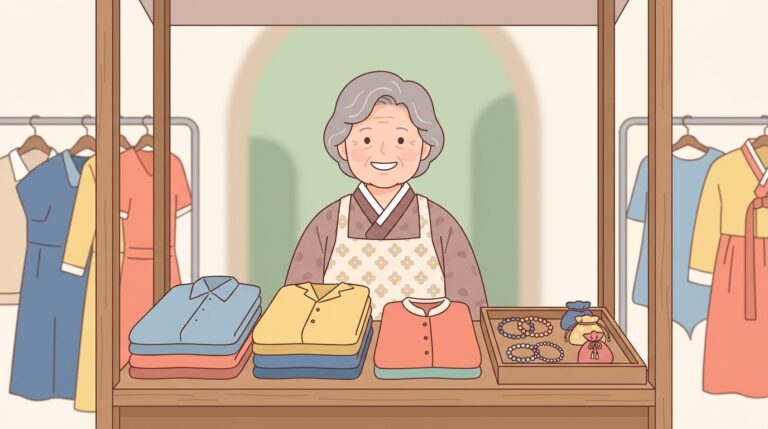
Mastering the Art of Friendly Bargaining in Korea’s Traditional Markets
Phase 1: Empathy (Welcome to the Bustling Market!)
안녕하세요! (An-nyeong-ha-se-yo!) Daily Hangul’s Senior Editor and your cultural bestie is here! ‐‐‐‐
Imagine this: You are walking through the vibrant, colorful alleys of Mangwon Market (망원시장) or Gwangjang Market (광장시장). The aroma of sizzling hotteok (sweet pancakes) fills the air, and piles of gorgeous vintage clothes or handmade souvenirs catch your eye. You find the perfect item, but the price tag is just a tiny bit over your budget.
You want to ask for a friendly discount, but your heart starts racing. “Will I sound rude? What if they get angry?”
Don’t worry! In Korea, bargaining in traditional markets is not a battle—it’s a warm, rhythmic dance of human connection. It’s built on Jeong (정), the Korean concept of warm-hearted attachment. Today, we’ll teach you exactly how to ask for a discount like a polite, charming local, making the market shopkeepers smile and willingly wrap up your goodies with a happy discount!
Phase 2: Top 3 Key Expressions Deep Dive
1. 조금만 깎아주세요 (Jo-geum-man kkak-a-ju-se-yo)
- Pronunciation: “Jo-geum-man kkah-kah-joo-seh-yo” (Sounds like “Jo-gum” + “man” + “car-car-joo-say-yo” with soft ‘k’ sounds)
- Meaning: “Please give me a little discount.” (Directly: “Please cut the price just a little.”)
- K-Culture Moment: You will see this in almost every Korean travel variety show! The host looks at the market vendor with sparkling, hopeful eyes and says this phrase with a warm smile.
- Editor’s Insight: This is the gold standard of market bargaining. It is polite yet clear. The word 조금만 (just a little) is the magic key; it shows you respect their business and aren’t trying to lowball them.
- Situation Spectrum: Casual ✅ | Semi-formal ⚠️ | Formal 🚫
- 🤔 Think About It: In your home country, is bargaining common? How does the tone of asking for a discount differ from Korea’s friendly “cutting the price” metaphor?
2. 남는 게 없어요 (Nam-neun ge op-so-yo)
- Pronunciation: “Nam-nun geh up-so-yo”
- Meaning: “There is no profit left for me.”
- K-Culture Moment: This is the vendor’s classic, affectionate defense! In dramas, when a customer asks for a discount, the sweet market grandma (할머니) shakes her hands playfully and says this.
- Editor’s Insight: If you hear this, don’t worry! It’s usually a playful reply. It means they are already giving you a great price. You can respond with a cute smile and say, “서비스 주세요!” (Give me a little freebie instead!).
- Situation Spectrum: Casual ✅ | Semi-formal ⚠️ | Formal 🚫
- 🤔 Think About It: Why do you think Korean market vendors prefer to negotiate with a playful complaint rather than a flat “No”?
3. 많이 파세요 (Ma-ni pa-se-yo)
- Pronunciation: “Mah-nee pah-seh-yo”
- Meaning: “Please sell a lot!” (Wishing them great business)
- K-Culture Moment: When leaving a store, especially after a successful bargain, customers say this with a warm bow to show mutual respect.
- Editor’s Insight: This is the ultimate insider phrase! It shows you care about their success. Even if you didn’t get the discount, saying this as you pay makes you the most beloved customer of the day.
- Situation Spectrum: Casual ✅ | Semi-formal ✅ | Formal ⚠️
- 🤔 Think About It: How does wishing someone “good business” change the dynamic of a transaction from selfish to communal?
Phase 3: Textbook Korean vs. Real-Life Korean
Let’s compare what formal textbooks teach you versus how real Koreans actually talk in the marketplace!
Situation A: Asking for a discount
- 📖 Textbook Korean: “할인해 주시겠습니까?” (Ha-rin-hae ju-si-get-seup-ni-ka? / “Would you be kind enough to discount this?”)
- 🗣️ Real-Life Korean: “이모님, 조금만 깎아주세요~” (I-mo-nim, jo-geum-man kkak-a-ju-se-yo~ / “Auntie, please give me a little discount~”)
- 💡 Why the difference? Textbook Korean is too robotic and formal for a lively market. Using 이모님 (I-mo-nim – Auntie) instantly creates a family-like bond, making them much more likely to give you a discount!
Situation B: Accepting the final price happily
- 📖 Textbook Korean: “감사합니다. 그것을 사겠습니다.” (Gam-sa-hap-ni-da. Geu-geot-eul sa-get-seup-ni-da. / “Thank you. I will purchase that.”)
- 🗣️ Real-Life Korean: “우와, 감사해요! 많이 파세요!” (U-wa, gam-sa-hae-yo! Ma-ni pa-se-yo! / “Wow, thank you! Sell a lot!”)
- 💡 Why the difference? Real Korean conversations are emotional and expressive. Showing genuine excitement builds a warm connection (Jeong) with the vendor.
Phase 4: K-Culture Deep Dive & Non-Verbal Manners
4-1. The Art of “Aegyo” (애교) and Hand Gestures
Bargaining in Korea is 40% words and 60% vibe!
* The Tilt & Smile: When saying “깎아주세요” (Please discount), tilt your head slightly and smile. This isn’t demanding; it’s a friendly request.
* The Two-Hand Handover: When paying with cash or a card, always hand it over with both hands. This is a crucial sign of respect in Korea.
* No Pointing: Avoid pointing directly at products with one finger. Instead, gesture towards the item with an open palm.
4-2. The Traditional Market Culture Code
In Korean culture, traditional markets (전통시장) are places of community, warmth, and 덤 (Deom). Deom means getting a little extra for free—like an extra piece of fruit or a free pair of socks. If a vendor says they can’t lower the price, ask for Deom instead of pushing for a discount!
Phase 5: Real-Life Roleplay Scenario
Setting: A colorful vintage clothing shop inside Gukje Market (국제시장) in Busan.
Characters:
* Min-ji (민지): An enthusiastic traveler looking for a cool jacket.
* Imo (이모): A warm but sassy market vendor in her 50s.
Turn 1
민지: 이모님! 이 자켓 너무 예뻐요. 얼마예요?
(I-mo-nim! I ja-ket neo-mu yeop-peo-yo. Eol-ma-yeo?)
Min-ji: [😊 With sparkling eyes] Auntie! This jacket is so pretty. How much is it?

Turn 2
이모: 어머, 눈이 높네! 그거 삼만 원(30,000원)이야. 진짜 좋은 가죽이야.
(Eo-meo, nun-i nop-ne! Geu-geo sam-man won-i-ya. Jin-ja jo-eun ga-juk-i-ya.)
Imo: [😎 Proudly holding up the jacket] Oh, you have high standards! That's 30,000 won. It's real good leather.

Turn 3
민지: 정말 예쁜데... 이모, 조금만 깎아주세요!
(Jeong-mal yeop-peun-de... I-mo, jo-geum-man kkak-a-ju-se-yo!)
Min-ji: [🥺 Putting hands together politely] It really is pretty... Auntie, please give me a little discount!

Turn 4
이모: 에이, 이거 진짜 싸게 파는 거야! 남는 게 없어~
(E-i, i-geo jin-ja ssa-ge pa-neun geo-ya! Nam-neun ge op-so-yo~)
Imo: [👋 Waving her hand playfully] Hey, I'm selling this so cheap! There is no profit left for me~

Turn 5
민지: 제가 현금으로 할게요! 이만 오천 원(25,000원)에 해주시면 안 돼요?
(Je-ga hyeon-geum-eu-ro hal-ge-yo! I-man o-cheon won-e hae-ju-si-myeon an dwae-yo?)
Min-ji: [💡 Whispering with a friendly smile] I will pay with cash! Can you do 25,000 won for me?

Turn 6
이모: 아이고, 현금이면 어쩔 수 없지! 좋아, 이만 오천 원에 가져가!
(A-i-go, hyeon-geum-i-myeon eo-jeol su eop-ji! Jo-a, i-man o-cheon won-e ga-jeo-ga!)
Imo: [😆 Laughing warmly] Oh my, if it's cash, I can't help it! Okay, take it for 25,000 won!

Turn 7
민지: 우와! 이모, 정말 감사해요. 최고예요!
(U-wa! I-mo, jeong-mal gam-sa-hae-yo. Choe-go-yeo!)
Min-ji: [🙌 Jumping slightly with joy] Wow! Auntie, thank you so much. You're the best!

Turn 8
이모: 그래, 예쁘게 입어! 많이 파세요 하고 가~
(Geu-rae, yeop-peug-e ib-eo! Ma-ni pa-se-yo ha-go ga~)
Imo: [🥰 Wrapping the jacket] Yes, wear it beautifully! Don't forget to wish me good business before you go~

Turn 9
민지: 네! 이모, 많이 파세요!
(Ne! I-mo, ma-ni pa-se-yo!)
Min-ji: [🙇 Bowing politely] Yes! Auntie, please sell a lot!
🔀 Interactive Choice Point
What should Min-ji do if the vendor absolutely refuses the discount?
* A) Walk away angrily.
* Feedback: ❌ Bad. Traditional markets value friendly interaction. Walking away angrily breaks the connection.
* B) Say “아이구, 아쉬워요! 그럼 양말 한 켤레만 서비스로 주세요!” (Oh, what a pity! Then can you give me a pair of socks as a freebie?)
* Feedback: 🌟 Best! This is a very natural way to get a “Deom” (freebie) when a price discount is difficult.
* C) Keep insisting on a discount for 10 minutes.
* Feedback: ⚠️ Risk. Insisting too long can make the vendor uncomfortable and stall their business.
Phase 6: 10-Second Emotional Shadowing Drill
Let’s practice the flow and emotion! Pause at the / and match the emotional guide.
- [🥺 Pleading & Friendly]
- 이모님, / 조금만 / 깎아주세요~
- I-mo-nim, / jo-geum-man / kkak-a-ju-se-yo~
- [😊 Cheerful & Grateful]
- 감사합니다! / 진짜 / 최고예요!
- Gam-sa-hap-ni-da! / Jin-ja / choe-go-ye-yo!
- [💖 Warm & Respectful]
- 이모, / 대박 나세요! / 많이 파세요!
- I-mo, / dae-bak na-se-yo! / Ma-ni pa-se-yo!
Phase 7: K-Culture Mini Dictionary
- 이모님 (I-mo-nim) | Auntie | Used to friendly address female shopkeepers or restaurant owners who feel warm like family.
- 현금 (Hyeon-geum) | Cash | Traditional markets highly prefer cash. Offering cash is the easiest way to secure a discount.
- 대박 (Dae-bak) | Awesome/Jackpot | Used to wish someone great success (e.g., “대박 나세요” – Make a jackpot profit!).
- 덤 (Deom) | Freebie/Extra gift | The beautiful culture of giving a small extra item for free to build relationship.
Phase 8: Traveler’s Survival Kit
Survial Expressions TOP 3
- 이거 얼마예요? (I-geo eol-ma-yeo?) – How much is this?
- 카드 돼요? (Ka-deu dwae-yo?) – Do you accept credit cards?
- 봉투 필요해요. (Bong-tu pil-yo-hae-yo.) – I need a bag.
Editor’s Travel Note
Before heading to traditional markets, download the Naver Map App for perfect transit routing, as Google Maps is often outdated in Korea. Keep around 10,000 ~ 20,000 KRW in physical cash for smaller street food vendors who might not accept overseas cards.
(Disclaimer: Merchant card acceptance may vary depending on local network conditions.)
Phase 9: “A Step Deeper” (Thinking Question)
In Western cultures, bargaining is often viewed as a cold transaction of numbers. However, in Korean traditional markets, bargaining is a lively conversation filled with laughter, cute complaints, and warm wishes. It shows that Koreans value Jeong (정)—human attachment and connection—even in simple business transactions.
💬 Your Turn: Have you ever bargained in a market before? How did it feel? Let us know in the comments below!
Phase 10: FAQ & Common Mistakes
Q: Is bargaining allowed in department stores or supermarkets like E-mart?
A: No, price negotiation is strictly for traditional open markets (전통시장) and street vendors. Modern retail stores have fixed POS pricing.
Q: Can I bargain if I am paying by credit card?
A: It is highly unlikely. Card processing fees make it hard for vendors to offer discounts. Offering 현금 (cash) is key!
Q: How much of a discount is polite to ask for?
A: Aim for about 10% to 15% off the original price. Asking for a 50% discount is considered rude and unrealistic.
🚨 Common Mistakes Alert!
- Mistake: Shout “깎아줘!” (Kkak-a-jwo!) aggressively.
- Correct Action: Use polite ending particles and a soft tone: “깎아주세요~” (Kkak-a-ju-se-yo).
Phase 11: Action Mission!
- Bronze Medal: Read the Phase 5 Roleplay out loud twice.
- Silver Medal: Comment below using the phrase “많이 파세요!” to support our blog!
- Gold Medal: Visit a traditional market on your next trip to Korea and use “조금만 깎아주세요” successfully!
Phase 12: Interactive Quiz Challenge
Test your market skills!
1. Which word means “extra freebie” in Korean traditional markets?
- A) 현금 (Hyeon-geum)
- B) 덤 (Deom)
- C) 이모 (Imo)
Click to reveal the Answer
Correct Answer: B) 덤 (Deom)
Explanation: ‘Deom’ refers to the sweet extra freebies given out of affection!
2. True or False: Saying “많이 파세요” is a polite way to wish a shopkeeper good business as you leave.
- A) True
- B) False
Click to reveal the Answer
Correct Answer: A) True
Explanation: Yes! It literally means “sell a lot” and is a highly respected phrase.