

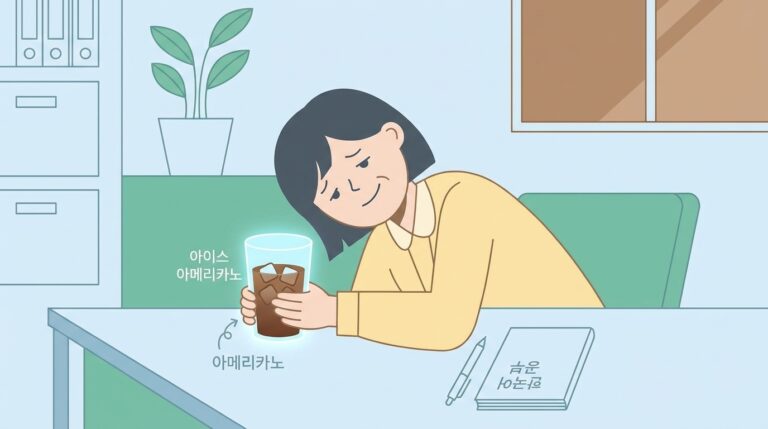
Survived Today Thanks to ‘Caffeine Power’: Inside Korea’s Intense Coffee Culture
Phase 1: Empathy (스토리 몰입형 오프닝)
안녕하세요! Welcome back, language adventurers! It’s your K-Culture Navigator from Daily Hangul (매일한글). 👋
Picture this: It’s 1:50 PM on a Tuesday in Yeouido, the bustling financial heart of Seoul. The lunch rush is winding down, but the sidewalks are packed with office workers in neat suits, all walking like zombies. Surprisingly, they aren’t looking at their phones—their eyes are locked on the small plastic cups in their hands. Inside is a dark, ice-cold liquid.
In Korea, we call this ‘수혈 (su-hyeol)’—a literal blood transfusion, but with iced americano (아아 – A-A). If you’ve ever felt that you cannot survive a workday without your morning drip or afternoon double-shot, you will deeply relate to Korean office workers. Today, we are diving into the intense, hilarious, and culturally rich topic of Korean Caffeine Addiction (한국의 카페인 중독).
By the end of this guide, you won’t just learn how to talk about your coffee habit; you’ll understand the deep-rooted Korean work ethic and how to debate coffee dependency like a true Seoulite at a local hoe-sik (office dinner).
Phase 2: Core Expression Deep Dive (핵심 표현 3선 심층 분석)
1. 카페인 수혈 (Caffeine Su-hyeol)
- Pronunciation: Ka-pe-in su-hyeol (Sounds like “kah-peh-een soo-hyuhl”)
- Meaning: Caffeine Transfusion (Injecting caffeine directly into the veins)
- K-Culture Moment: In K-Dramas like Misaeng or Start-Up, you often see exhausted interns staring blankly at computer screens until they take a massive sip of iced coffee. That instant ‘revival’ is the classic cafe-in su-hyeol.
- Editor’s Insight: Suhyeol literally means medical blood transfusion. Using it for coffee highlights just how essential coffee is for survival in the fast-paced “Pali-Pali” (hurry-hurry) Korean work culture. It’s not a luxury; it’s life support!
- Situation Spectrum: Casual (✅) | Semi-formal (✅) | Formal (🚫)
- 🤔 Think About It: Why does modern society treat energy as something we must constantly ‘borrow’ from substances rather than getting through rest? How does your country view the daily coffee grind?
2. 아아 (A-A)
- Pronunciation: Ah-Ah (Sounds like “Ah-Ah” as in opening your mouth at the dentist)
- Meaning: Iced Americano (Ice Amye-ri-ka-no)
- K-Culture Moment: There is a famous Korean internet meme/slang: “얼죽아” (Eol-juk-ah), which means “Even if I freeze to death, I’ll drink iced Americano!” (얼어 죽어도 아메리카노). You will see Koreans holding iced cups in -10°C blizzards.
- Editor’s Insight: While Westerners might opt for a cozy hot latte in winter, young Koreans overwhelmingly prefer “Ah-Ah” because it’s quick to consume, gives an instant brain freeze to wake you up, and doesn’t interrupt the fast workflow.
- Situation Spectrum: Casual (✅) | Semi-formal (✅) | Formal (⚠️ – Use full name ‘Iced Americano’ in board meetings)
- 🤔 Think About It: Is there a specific menu item in your culture that people obsess over regardless of the weather?
3. 버티다 (Beo-ti-da)
- Pronunciation: Beo-ti-da (Sounds like “buh-tee-dah”)
- Meaning: To hold out, endure, or physically withstand a tough situation
- K-Culture Moment: Characters in Korean office dramas don’t just ‘work’; they beotyeo-naeda (successfully endure). It carries a bittersweet tone of resilience.
- Editor’s Insight: This verb is crucial when talking about coffee. Koreans don’t just drink coffee because it tastes good; they drink it “버티려고” (beo-ti-ryeo-go – in order to endure/survive the day).
- Situation Spectrum: Casual (✅) | Semi-formal (✅) | Formal (✅)
- 🤔 Think About It: How does the linguistic nuance of “enduring” work differ from simply “getting through” the day?
Phase 3: Textbook Korean vs. Real-World Korean
Situation 1: Expressing that you are tired at work
- 📖 Textbook Korean: “오늘 아주 피곤합니다. 커피를 마시고 싶어요.”
(I am very tired today. I want to drink coffee.) - 🗣️ 진짜 한국어: “오늘 진짜 피곤하네요. 지금 완전히 카페인 방전 상태예요.”
(I’m so beat today. My caffeine battery is completely discharged/drained.) - 💡 Why is it different? While the textbook version is grammatically perfect, native Korean office workers love using battery metaphors (방전 – bang-jeon) to describe their physical state, treating caffeine as their primary charging source.
Situation 2: Suggesting a coffee break to a colleague
- 📖 Textbook Korean: “동료님, 우리 카페에 같이 갈까요?”
(Colleague, shall we go to the cafe together?) - 🗣️ 진짜 한국어: “민우 씨, 우리 머리 좀 식힐 겸 커피 한잔 때리러 갈래요?”
(Minwoo, want to go ‘hit’ a cup of coffee to cool our brains?) - 💡 Why is it different? “때리다” (tteo-ri-da) literally means “to hit,” but in casual slang, it means to consume something intensely or satisfyingly (e.g., “Let’s hit a beer,” “Let’s hit a coffee”). It sounds incredibly friendly and natural.
Phase 4: K-Culture Deep Dive & Non-Verbal Manners
4-1. The ‘Two-Hand’ Coffee Handover
In a Korean office context, non-verbal cues speak louder than words. If you are buying coffee for your senior coworker (seon-bae) or manager:
1. Use two hands when passing the coffee cup to them.
2. When they drink, or if you are drinking in front of a high-ranking boss, it is polite to slightly turn your head away to the side when taking a sip, though this is much more relaxed in modern cafes compared to drinking alcohol.
4-2. The Korean Corporate Coffee Ritual
Why is coffee so big in Korea? Historically, after the Korean War, sweet instant coffee mix (다방 커피 – dabang coffee) kept workers going during the rapid economic development era (The Miracle on the Han River). Today, this has evolved into the “after-lunch cafe migration.” Walking around with a brand-name coffee cup after lunch is not just about caffeine; it’s a social signal that says, “I am taking my legally permitted break and socializing with my team.”
Phase 5: Real-World Roleplay Scenario
The Setup
- Setting: A resting zone near the office pantry of a tech startup in Gangnam at 2:15 PM.
- Characters:
- Ji-won (지원): A highly energetic senior manager who practically runs on espresso.
- You (학습자): A foreign marketing specialist who is trying to survive their first month in Korea.
Dialogue
- 지원: (하품을 크게 하며) 아, 진짜 죽겠네요. 점심 먹고 나니까 졸음이 밀려와요.
(Ah, jin-jja juk-get-nae-yo. Jeom-sim meok-go na-ni-ka jol-eum-i mil-ryeo-wa-yo.)
“Ugh, I’m dying. The food coma is hitting hard after lunch.” -
You: 저도요. 눈이 자꾸 감겨요. 지금 카페인 수혈이 시급해요.
(Jeo-do-yo. Nun-i ja-ku gam-gyeo-yo. Ji-geum ka-pe-in su-hyeol-i si-geup-hae-yo.)
“Me too. My eyes keep closing. I urgently need a caffeine transfusion right now.” -
지원: 🎭 (웃으며 커피머신을 가리킨다) 역시 우리 팀 신입사원답네요! 오늘 몇 잔째예요?
(Yeok-si u-ri tim sin-ip-sa-won-dap-nae-yo! O-neul myeot jan-jjae-yeo?)
“(Laughing and pointing at the coffee machine) As expected of our team’s rookie! How many cups is this today?” -
You: 벌써 세 잔째예요. 안 마시면 오후에 일을 버틸 수가 없어요.
(Beol-seo se jan-jjae-yeo. An ma-si-myeon o-hu-e il-eul beo-til su-ga eop-seo-yo.)
“It’s already my third cup. If I don’t drink it, I can’t endure work in the afternoon.” -
지원: 맞아요. 한국 직장인들은 다 커피 힘으로 일하는 거죠. 거의 ‘합법적 마약’이라니까요?
(Ma-ja-yo. Han-guk jik-jang-in-deul-eun da keo-pi him-eu-ro il-ha-neun geo-jyo. Geo-ui ‘hap-beop-jeok ma-yak’-i-ra-ni-ka-yo?)
“Exactly. Korean office workers all run on coffee power. It’s practically a ‘legal drug’.” -
You: 하하, 그러니까요. 저도 벌써 얼죽아 회원이 된 것 같아요.
(Ha-ha, geu-ri-ka-yo. Jeo-do beol-seo eol-juk-ah hoe-won-i doen geot gat-ae-yo.)
“Haha, tell me about it. I think I’ve already become a member of the ‘Freeze-to-death Iced Americano’ club.” -
지원: 🎭 (동의하듯 고개를 끄덕이며) 좋습니다. 그럼 우리 시원하게 아아 한잔 때리러 1층 카페로 내려갈까요?
(Jot-seum-ni-da. Geu-reom u-ri si-won-ha-ge ah-ah han-jan ttae-ri-reo il-cheung ka-pe-ro nae-ryeo-gal-ka-yo?)
“Awesome. Then, shall we head down to the first-floor cafe to ‘hit’ a refreshing iced americano?” -
You: 네, 제가 살게요! 대리님 덕분에 정신이 좀 드는 것 같아요.
(Ne, je-ga sal-gae-yo! Dae-ri-nim deok-bun-e jeong-sin-i jom deu-neun geot gat-ae-yo.)
“Yes, my treat! Thanks to you, Assistant Manager, I think I’m finally waking up.”
—
🔀 Interactive Choice Points
How do you respond when Ji-won suggests going down to the cafe?
- Choice A: “네, 가요! 저는 따뜻한 차 마실게요.” (Yes, let’s go! I will drink hot tea.)
- Feedback (Risk): Perfectly polite, but you might lose the “caffeine companion” vibe. Hot tea is healthy, but it breaks the solidarity of the “zombie coffee alliance”! 🍵
- Choice B: “좋아요! 역시 직장인의 동반자는 아아죠. 가시죠!” (Great! As expected, the life partner of an office worker is ‘A-A’. Let’s go!)
- Feedback (Best!): Perfect! It shows high cultural fluency, uses the essential slang, and establishes a great bond with your senior colleague. 🌟
- Choice C: “커피 너무 많이 마시면 몸에 안 좋아요. 그냥 물 마시세요.” (Drinking too much coffee is bad for your health. Just drink water.)
- Feedback (Bad): Oops! Too direct. While healthy, it ruins the fun office banter and might make Ji-won feel self-conscious about their coffee addiction. 😬
Phase 6: 10-Second Emotion Shadowing Drill
Let’s practice speaking with real-life, dramatic Korean emotions! Pay attention to the pauses (/) and emotional cues.
- [🥺 Exhausted & pleading for caffeine]
- 아… / 진짜 피곤하다… / 지금 / 카페인 수혈이 필요해… 😭
- (Ah… / jin-jja pi-gon-ha-da… / ji-geum / ka-pe-in su-hyeol-i pil-yo-hae…)
- [🥶 Stubbornly proud during winter]
- 영하 십도라도 / 나는 무조건 / 얼죽아야! ❄️
- (Yeong-ha sip-do-ra-do / na-neun mu-jo-geon / eol-juk-ah-ya!)
- [😊 Brightly proposing a quick break]
- 머리 좀 식힐 겸, / 우리 / 아아 한잔 때리러 갈래요? ☕
- (Meo-ri jom sik-hil gyeom, / u-ri / ah-ah han-jan ttae-ri-reo gal-rae-yo?)
Phase 7: K-Culture Mini-Dictionary
- 얼죽아 (Eol-Juk-Ah) | Freeze-to-death Iced Americano | Used to describe people who absolutely refuse hot drinks, even in winter.
- 야근 (Ya-geun) | Overtime Work | Working past official hours. Often the primary reason behind Korea’s astronomical coffee consumption.
- 당 충전 (Dang Chung-jeon) | Sugar Recharge | Consuming sweet snacks (like caramel macchiato or donuts) to boost energy during a crash.
- 소확행 (So-Hwak-Haeng) | Small but Certain Happiness | A lifestyle trend in Korea where a simple cup of coffee in a busy workday brings immense peace.
Phase 8: Traveler’s Survival Kit
Survival Expressions TOP 3
- “샷 추가해 주세요.” (Syat chu-ga-hae ju-se-yo.)
- Meaning: “Please add an extra shot (of espresso).” (For those extremely tough mornings)
- “테이크아웃 잔에 주세요.” (Te-i-keu-a-ut jan-e ju-se-yo.)
- Meaning: “Please put it in a to-go cup.”
- “연하게 타 주세요.” (Yeon-ha-ge ta ju-se-yo.)
- Meaning: “Please make it weak/diluted.” (If you are sensitive to heavy caffeine)
Editor’s Travel Note
When traveling or working in Seoul, do not miss out on using local delivery apps. You can use the Coupang Eats App or Baemin App to order coffee straight to your desk or hotel room lobby. Also, most local coffee chains like Mega Coffee or Compose Coffee offer super-sized, high-quality “A-A” for under 2,000 KRW (about $1.50 USD)!
(Disclaimer: Prices and app availability may vary based on local conditions.)
Phase 9:
Frequently Asked Questions (FAQ)
Q: What does "카페인 수혈 (Caffeine Su-hyeol)" mean in Korean and how do you pronounce it?
A: In Korean, "카페인 수혈 (Caffeine Su-hyeol)" is pronounced [Ka-pe-in su-hyeol (Sounds like "kah-peh-een soo-hyuhl"] and means: Caffeine Transfusion (Injecting caffeine directly into the veins)
Q: What does "아아 (A-A)" mean in Korean and how do you pronounce it?
A: In Korean, "아아 (A-A)" is pronounced [Ah-Ah (Sounds like "Ah-Ah" as in opening your mouth at the dentist] and means: Iced Americano (Ice Amye-ri-ka-no)
Q: What does "버티다 (Beo-ti-da)" mean in Korean and how do you pronounce it?
A: In Korean, "버티다 (Beo-ti-da)" is pronounced [Beo-ti-da (Sounds like "buh-tee-dah"] and means: To hold out, endure, or physically withstand a tough situation







