

Housewarming Like a Local: Mastering Korea’s Jipdeuri Culture (집들이)
안녕하세요! It’s your K-culture navigator and Daily Hangul Editor. Have you ever been invited to a Korean friend’s new home and suddenly panicked about what to wear, what to say, or—most importantly—what on earth to buy as a housewarming gift?
In Korea, moving into a new place is a major life milestone, celebrated with a unique tradition called 집들이 (jipdeuri). It’s not just a casual hangout; it’s a warm, laughter-filled ritual of welcoming good fortune and clearing out bad vibes. Today, we’ll dive into the intermediate-level (B2) expressions, subtle social cues (눈치, nunchi), and modern gift trends that will make you the most thoughtful and beloved guest at any Korean housewarming party. Let’s get started!
Phase 2: Essential Housewarming Expressions (핵심 표현 3선)
1. 초대해 주셔서 감사해요! (Chodaehae juseoseo gamsahaeyo!)
- Pronunciation: Cho-dae-hae joo-seo-seo gahm-sa-hae-yo! (Sounds like: “Cho-deh-heh ju-suh-suh gahm-sa-heh-yo”)
- Meaning: Thank you for inviting me!
- K-Culture Moment: You’ve probably seen this in K-dramas when a character steps into a beautiful apartment, carrying a beautifully wrapped gift. It’s the absolute gold standard of polite entries.
- Editor’s Insight: Even if you are extremely close with the host, starting with this polite expression shows that you respect the effort they put into preparing the space and food.
- Situation Spectrum: Casual: ⚠️ | Semi-formal: ✅ | Formal: ✅
- 🤔 Think About It: How does thanking someone for an invitation set the tone for hospitality in your culture compared to Korea?
2. 집이 너무 아늑하고 예뻐요. (Jibi neomu aneukhago yeppeoyo.)
- Pronunciation: Jeep-ee nuh-moo ah-neuk-ha-go yeh-ppuh-yo.
- Meaning: Your home is so cozy and beautiful.
- K-Culture Moment: Often heard in home tour vlogs on YouTube (랜선 집들이 – online housewarming) where hosts show off their minimalist, beige-toned aesthetic.
- Editor’s Insight: The word 아늑하다 (aneukhada) means “cozy” or “snug.” Complimenting the atmosphere (not just the size or price) is highly valued in Korea, as it praises the host’s personal taste.
- Situation Spectrum: Casual: ✅ | Semi-formal: ✅ | Formal: ⚠️
- 🤔 Think About It: Why is praising the cozy vibe of a home more polite than commenting on its size in Korean society?
3. 두 손 가득 복이 들어오길 바랄게요! (Du son gadeuk bogi deureoogil baralgeyo!)
- Pronunciation: Doo son gah-deuk bok-ee deul-uh-o-gheel bah-ral-geh-yo.
- Meaning: I hope blessings/good fortune fill your hands (home)!
- K-Culture Moment: Used in warm family dramas or when writing a heartfelt card to a newlywed couple moving into their first home.
- Editor’s Insight: While a bit poetic, using the word 복 (bok – blessing/fortune) connects deeply with traditional Korean beliefs that a new house needs positive energy to flourish.
- Situation Spectrum: Casual: ⚠️ | Semi-formal: ✅ | Formal: ✅
- 🤔 Think About It: How does the Korean concept of “Bok” (복) compare to the concept of “luck” in your hometown?
Phase 3: Textbook Korean vs. Real-Life Korean
Scenario A: Entering the house
- 📖 Textbook Korean: “새 집에 오게 되어 기쁩니다.” (Sae jibe ogae doeeo gippeumnida. – I am glad to come to the new house.)
- 🗣️ Real-Life Korean: “와, 집 진짜 대박이에요! 구경해도 돼요?” (Wa, jip jinjja daebagieoyo! Gugyeonghaedo dwaeyo? – Wow, this place is amazing! Can I look around?)
- 💡 Why the difference? The textbook phrase sounds like a formal speech. Real friends use energetic slangs like 대박 (daebak – awesome) and express instant curiosity about the interior design.
Scenario B: Giving the gift
- 📖 Textbook Korean: “선물을 준비했습니다. 받아주세요.” (Seonmureul junbihaessnida. Badajuseeyo. – I prepared a gift. Please accept it.)
- 🗣️ Real-Life Korean: “오다가 집들이 선물로 딱 요새 핫한 걸로 골라봤어요!” (Odaga jipdeuri seonmullo ttak yosae hathang geollo golrabwasseoyo! – On my way, I picked up something that’s really trendy these days for your housewarming!)
- 💡 Why the difference? Modern Koreans love sharing “trending items” (핫템 – hot items) and downplay the gift naturally with “오다가” (on my way/casually) to reduce the pressure of receiving.
Phase 4: K-Culture Deep-Dive & Non-Verbal Manners
4-1. Nunchi & Gestures
- The Shoes-Off Protocol: This is basic, but pay close attention to how you leave your shoes. Place them neatly facing the door. If the host provides indoor slippers (실내화), put them on immediately.
- Two-Handed Delivery: Always present your housewarming gift with both hands. It shows respect and sincerity.
- The Bathroom Tour Cue: If the host shows you the bathroom, pay attention to where the light switch is. Always turn it off and close the door when finished, as Koreans are sensitive to energy consumption and bathroom aesthetics.
4-2. The Logic Behind the Classic Gifts
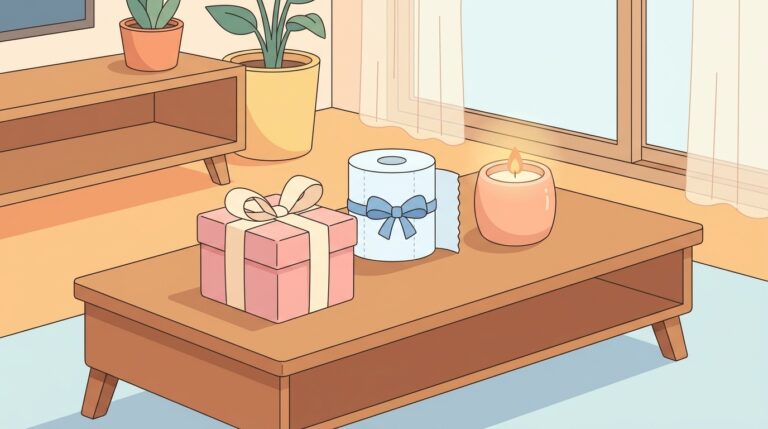
Historically, the most famous Korean housewarming gifts are toilet paper (휴지) and laundry detergent (세제). Why?
* Toilet Paper: Because it unrolls easily, it symbolizes that all the host’s affairs and businesses will unroll smoothly and easily.
* Detergent: The bubbles symbolize multiplying wealth and prosperity.
* Modern Twist: Today, young Koreans also love scented candles, aesthetic hand wash, or coffee capsule machines!
Phase 5: Real-Life Roleplay Scenario
Meet Ji-min (지민), your Korean colleague who just moved into a cozy officetel (오피스텔) in Mapo.
- Ji-min (Host): 어서 와요! 찾기 힘들지 않았어요?
- You: 아니요, 역이랑 가까워서 금방 찾았어요. 초대해 주셔서 진짜 감사해요!
- Ji-min (Host): 별말씀을요. 들어와서 편하게 앉으세요.
- You: (🎭 Handing over a gift bag with both hands) 와, 집 진짜 대박이다! 아늑하고 너무 예뻐요. 이거 오다가 집들이 선물로 골라봤어요.
- Ji-min (Host): 어머, 뭘 이런 걸 다 준비했어요? 고마워요!
- You: 요새 인스타에서 완전 핫한 캔들이에요. 향이 진짜 좋아요.
- Ji-min (Host): 센스 대박! 안 그래도 캔들 필요했는데 잘 쓸게요. 배고프죠? 얼른 밥 먹어요.
- You: 우와, 엄청 기대돼요! 맛있게 먹을게요.
🔀 Choose Your Path!
The host offers you another serving of home-cooked food, but you are absolutely full.
- A) “배불러서 더 못 먹겠어요. 사양할게요.” (I’m full, can’t eat. I decline.)
- Feedback (Bad): Too direct and cold. It breaks the warm housewarming atmosphere.
- B) “진짜 너무 맛있는데, 제가 배가 터질 것 같아서 더 먹으면 큰일 나요! 아쉬워요.” (It’s so delicious, but my stomach is about to burst! What a pity.)
- Feedback (Best): Highly expressive, compliments the chef, and decline politely with humor.
- C) “다이어트 중이라서 사양합니다.” (I’m on a diet, so no.)
- Feedback (Risk): Makes the host feel guilty for cooking delicious food.
Phase 6: 10-Second Emotion Shadowing Drill
Practice these natural pacing pauses (/) and emotional cues:
[😊 Excited & Grateful]
*
Frequently Asked Questions (FAQ)
Q: What does "초대해 주셔서 감사해요! (Chodaehae juseoseo gamsahaeyo!)" mean in Korean and how do you pronounce it?
A: In Korean, "초대해 주셔서 감사해요! (Chodaehae juseoseo gamsahaeyo!)" is pronounced [Cho-dae-hae joo-seo-seo gahm-sa-hae-yo! (Sounds like: "Cho-deh-heh ju-suh-suh gahm-sa-heh-yo"] and means: Thank you for inviting me!
Q: What does "집이 너무 아늑하고 예뻐요. (Jibi neomu aneukhago yeppeoyo.)" mean in Korean and how do you pronounce it?
A: In Korean, "집이 너무 아늑하고 예뻐요. (Jibi neomu aneukhago yeppeoyo.)" is pronounced [Jeep-ee nuh-moo ah-neuk-ha-go yeh-ppuh-yo.] and means: Your home is so cozy and beautiful.
Q: What does "두 손 가득 복이 들어오길 바랄게요! (Du son gadeuk bogi deureoogil baralgeyo!)" mean in Korean and how do you pronounce it?
A: In Korean, "두 손 가득 복이 들어오길 바랄게요! (Du son gadeuk bogi deureoogil baralgeyo!)" is pronounced [Doo son gah-deuk bok-ee deul-uh-o-gheel bah-ral-geh-yo.] and means: I hope blessings/good fortune fill your hands (home)!







