

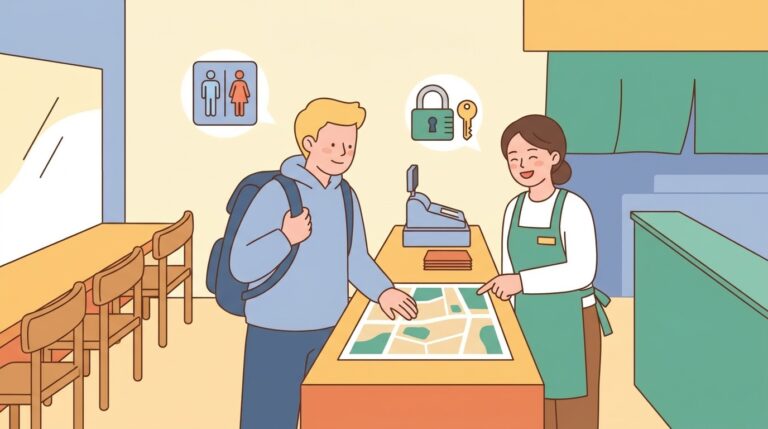
Finding the Restroom in a Korean Restaurant: The Ultimate Survival Guide for Beginners
Phase 1: Empathy (An Interactive Opening)
안녕하세요! (Annyeonghaseyo!) I’m your friendly editor from Daily Hangul, your personal neighborhood Korean bestie!
Picture this: You are at a trendy restaurant in Hongdae, Seoul, enjoying a delicious, sizzling plate of Samgyeopsal (grilled pork belly). The food is amazing, the music is a vibey K-Pop playlist, and you’re having the time of your life. But suddenly, nature calls. 🚨
You look around. No restroom sign in sight. You want to ask the server, but your mind goes blank. “How do I say ‘toilet’ without sounding rude? What if they don’t understand English?” You start sweating.
Don’t panic! We have all been there. Asking for the restroom in a foreign language can feel incredibly awkward. But today, you are going to learn exactly how to ask where the restroom is in Korean, naturally and politely, using three simple magic phrases. By the end of this guide, you’ll handle this situation like an absolute local!
Phase 2: Deep Dive into 3 Essential Phrases
1. 화장실 어디에 있어요? (Hwajangsil eodie isseoyo?)
- Pronunciation: Hwa-jang-sil eo-di-eyo ee-sseo-yo? (Sounds like: Hwah-jahng-sheel uh-dee-eh ee-suh-yo?)
- Meaning: “Where is the restroom?”
- K-Culture Moment: This is the ultimate classic. You see this in countless K-Dramas when a character suddenly needs to excuse themselves during a dinner date.
- Editor’s Insight: This is the most versatile, standard, and polite way to ask. If you only memorize one phrase today, make it this one! Hwajangsil means “restroom,” eodi means “where,” and isseoyo means “is there / exists.”
- Situation Spectrum: Casual ⚠️ | Semi-formal ✅ | Formal ✅
- 🤔 Think About It: In English, we often use euphemisms like “powder room” or “bathroom.” In Korean, “화장실” (Hwajangsil) literally translates to “makeup/grooming room.” Beautiful, isn’t it?
2. 저기요, 화장실 비밀번호가 뭐예요? (Jeogiyo, hwajangsil bimilbeonhoga mwoyeyo?)
- Pronunciation: Jeo-gi-yo, hwa-jang-sil bi-mil-beon-ho-ga mwo-ye-yo? (Sounds like: Juh-gee-yo, hwah-jahng-sheel bee-meel-buhn-ho-gah mwoh-yeh-yo?)
- Meaning: “Excuse me, what is the restroom password?”
- K-Culture Moment: If you visit a modern cafe in Gangnam, you will often find the restroom is outside the main shop, locked with a digital keypad.
- Editor’s Insight: In Korea, many restaurants share restrooms with the whole building. To keep them clean, they lock them with digital keypads. You must ask for the bimilbeonho (password) or check your receipt!
- Situation Spectrum: Casual ✅ | Semi-formal ✅ | Formal ⚠️
3. 화장실 열쇠 좀 주세요. (Hwajangsil yeolsoe jom juseoyo.)
- Pronunciation: Hwa-jang-sil yeol-soe jom ju-se-yo. (Sounds like: Hwah-jahng-sheel yuhl-sweh johm joo-seh-yo.)
- Meaning: “Please give me the restroom key.”
- K-Culture Moment: In older, cozy local restaurants (called Mat-jib), the restroom key is often attached to a hilarious, giant object like a wooden spoon or a plastic doll so people don’t lose it!
- Editor’s Insight: If the restroom isn’t keypad-locked, it might require a physical key (yeolsoe). Jom juseoyo means “please give me.”
- Situation Spectrum: Casual ⚠️ | Semi-formal ✅ | Formal ✅
Phase 3: Textbook Korean vs. Real-Life Korean
Let’s compare what textbooks teach you versus how real Koreans actually talk in a restaurant!
Scenario 1: Catching the Server’s Attention
- 📖 Textbook Korean: 실례합니다 (Sillyehamnida) — “Excuse me / Pardon me”
- 🗣️ Real-Life Korean: 저기요! (Jeogiyo!) — “Excuse me (literally: Over there!)”
- 💡 Why is it different? While sillyehamnida is polite, it sounds way too formal, like you are in a corporate meeting. In a bustling restaurant, shouting a friendly “Jeogiyo!” is the standard, perfectly polite way to grab a server’s attention.
Scenario 2: Asking for the Location
- 📖 Textbook Korean: 화장실이 어디에 위치합니까? (Hwajangsiri eodie wichihamnika?) — “Where is the restroom situated?”
- 🗣️ Real-Life Korean: 화장실 어디예요? (Hwajangsil eodiyeyo?) — “Where’s the restroom?”
- 💡 Why is it different? Nobody uses “situated” in a casual dining setting. Just shorten it to “Hwajangsil eodiyeyo?” for a smooth, natural flow.
Phase 4: K-Culture Deep Dive & Non-Verbal Manners
4-1. Nunchi & Gestures
When asking for the restroom in Korea, don’t just yell across the room! Use Nunchi (눈치)—the Korean art of reading the room.
1. Make brief eye contact with the staff.
2. Raise your hand slightly (around chest/shoulder level) as you say “Jeogiyo.”
3. When they answer, give a slight nod of your head to show respect and gratitude.
4-2. The Secret “Receipt” Code
In Korea, space is premium. Many restaurants and cafes have restrooms located on the staircase or a different floor. If you ask for the password, they might say, “영수증에 있어요” (Yeongsujeunge isseoyo – It’s on the receipt). Always keep your receipt! The 4-digit password (often followed by an * or #) is printed at the very bottom.
Phase 5: Interactive Roleplay Scenario
Meet Min-ji, the friendly server at a cozy noodle shop in Insadong.
[Setting: A busy noodle shop. You are sitting at a table near the back.]

You: 🎭 (Politely raising your hand)
     저기요! (Jeogiyo!)
     "Excuse me!"

Min-ji: 네, 손님! 필요하신 거 있으세요? (Ne, sonnim! Piryohasin geo isseuseyo?)
        "Yes, customer! Is there something you need?"

You: 🎭 (Making eye contact, smiling nervously)
     혹시 화장실 어디에 있어요? (Hoksi hwajangsil eodie isseoyo?)
     "By any chance, where is the restroom?"

Min-ji: 아, 화장실은 밖으로 나가셔서 오른쪽에 있어요. (Ah, hwajangsireun bakkuro nagasyeoseo oreunjjoge isseoyo.)
        "Ah, the restroom is outside, to the right."

You: 🎭 (Looking slightly confused about the lock)
     혹시 비밀번호 있어요? (Hoksi bimilbeonho isseoyo?)
     "Is there a password, by any chance?"

Min-ji: 네, 비밀번호 1234 별표 누르시면 돼요. (Ne, bimilbeonho il-i-sam-sa byeolpyo nureusimyeon dwaeyo.)
        "Yes, you can press 1-2-3-4 and the star (*) key."

You: 🎭 (Nodding happily)
     아, 일 이 삼 사 별표요? 감사합니다! (Ah, il-i-sam-sa byeolpyoyo? Kamsahamnida!)
     "Ah, 1-2-3-4-star? Thank you!"

Min-ji: 네, 천천히 다녀오세요! (Ne, cheoncheonhi danyeooseyo!)
        "Yes, take your time!"
🔀 Your Turn! Choose your reaction:
- A) You forgot the password halfway there and decide to guess it.
- Feedback (Bad ❌): Korean keypads often freeze if you input the wrong code too many times. You’ll end up locked out in the cold! Go back and ask again.
- B) You say “감사합니다!” (Kamsahamnida!) and write “1234*” on your hand or phone.
- Feedback (Best ⭐): Perfect! Smart move. Writing down or repeating the numbers ensures you don’t forget the code on your way out.
- C) You run out without saying “감사합니다” because you are in a rush.
- Feedback (Risk ⚠️): While understandable in an emergency, leaving without a quick thank-you can seem a bit impolite to the server who just helped you.
Phase 6: 10-Second Emotion Shadowing Drill
To sound natural, you need the right rhythm and emotion! Practice saying these out loud with the correct vibes:
- [🥺 Urgent & Polite]
저기요… / 화장실 어디에 있어요?
(Jeo-gi-yo… / Hwa-jang-sil eo-di-e is-seo-yo?)
Pause slightly after “Jeogiyo” to catch their attention, then ask softly but clearly. -
[😊 Relieved & Thankful]
아! / 감사합니다!
(Ah! / Kam-sa-ham-ni-da!)
Make the “Ah!” sound energetic and happy!
Phase 7: K-Culture Mini Dictionary
- 비밀번호 (Bimilbeonho) | Password | Used everywhere in daily Korean life, from digital door locks to Wi-Fi passwords at cafes.
- 열쇠 (Yeolsoe) | Key | A physical key, often attached to funny, oversized objects in traditional restaurants.
- 영수증 (Yeongsujeung) | Receipt | Always look at the bottom of your receipt in Korea; it contains Wi-Fi codes and restroom passwords!
- 휴지 (Hyuji) | Toilet Paper/Tissue | Some older places require you to grab tissue from the restaurant counter before heading to the restroom.
Phase 8: Traveler’s Survival Kit
Survival Phrases TOP 3
- 휴지 좀 주세요. (Hyuji jom juseoyo.) – “Please give me some toilet paper.”
- 남녀 공용이에요? (Namnyeo gongyong-ieyo?) – “Is it a unisex restroom?” (Common in smaller buildings)
- 안에 사람 있어요. (Ane saram isseoyo.) – “There is someone inside.” (If someone knocks while you are inside!)
🗺️ Editor’s Travel Note
Navigating Seoul can be tough with foreign map apps. For the ultimate local experience, download KakaoMap or Naver Map. They show exact restroom locations inside subway stations and public parks!
Phase 9: “A Step Deeper” (Cultural Insight)
In many Western countries, restrooms in establishments are strictly for paying customers, often locked behind heavy doors. In Korea, while some require a password, the concept of public safety and shared community spaces means people are generally very helpful. Even if you aren’t eating there, if you politely ask a local shop owner, “화장실 좀 써도 될까요?” (Hwajangsil jom sseodo doelkkayo? – May I use the restroom?), they will often smile and guide you. It shows the warm culture of Jeong (정)—the feeling of connection and sharing with others.
💬 Your Turn: Have you ever experienced a funny or confusing moment trying to find a restroom abroad? Let us know in the comments below!
Phase 10: FAQ & Avoiding Mistakes
Q: What if the door is locked but there is no keypad?
A: Look around the cash register or exit door. There is likely a key hanging on the wall, often attached to a wooden block or a toy. You need to take that key with you!
Q: Is it okay to use the word “Toilet” (토일렛)?
A: While some Koreans might understand “Toilet,” it sounds very foreign. Using “Hwajangsil” is much more natural and guarantees you get the right directions immediately.
Q: Why do some restrooms have trash cans next to the toilet for toilet paper?
A: In older buildings, the plumbing system is delicate. You will often see a sign asking you to throw toilet paper in the trash bin (hyujitong) instead of flushing it.
🚨 Common Mistakes Alert!
- Saying “Sillyehamnida” loudly to get a waiter’s attention.
- Correct Action: Use “Jeogiyo!” instead. It’s much more natural.
- Forgetting to check the receipt for the password.
- Correct Action: Check the bottom of the receipt before leaving the counter.
- Knocking loudly on a locked door without speaking.
- Correct Action: Knock gently. If someone is inside, they will knock back or say “안에 사람 있어요” (Ane saram isseoyo).
Phase 11: Action Missions
- 🥉 Bronze Mission: Practice saying “Hwajangsil eodie isseoyo?” out loud 3 times in front of a mirror with a polite smile.
- 🥈 Silver Mission: Write down the word 화장실 (Restroom) and 비밀번호 (Password) in your travel notebook or phone notes app.
- 🥇 Gold Mission: Next time you visit a Korean restaurant or a local K-town spot, ask the staff for the restroom location in Korean!
Phase 12: Interactive Quiz Challenge
Test your knowledge before you go! Click on the tabs below to reveal the answers.
1. Which phrase means “What is the restroom password?”
- A) 화장실 어디에 있어요?
- B) 화장실 비밀번호가 뭐예요?
- C) 화장실 열쇠 좀 주세요.
👉 Click to reveal the Answer!
Correct Answer: B
Bimilbeonho means “password.” A is asking for location, and C is asking for the physical key!
2. True or False: You should shout “Sillyehamnida!” to get a server’s attention in a busy restaurant.
👉 Click to reveal the Answer!
Correct Answer: False
While grammatically correct, it is too formal. Shouting “Jeogiyo!” is the standard, polite way to call a server.







