

Going Green in Seoul: Master the ‘Zero-Waste’ Eco-Phrases Like a Local!
Phase 1: Empathy (Welcome, Eco-Warriors!)
안녕하세요! (Annyeonghaseyo!) Your friendly neighborhood Korean editor from Daily Hangul is here!
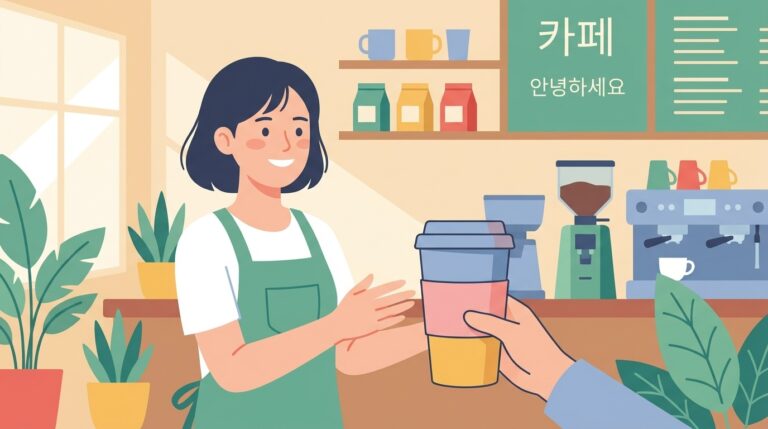
Imagine this: You are standing in a trendy cafe in Seongsu-dong, Seoul’s hipster heaven. You order a delicious iced matcha latte. The barista asks you a question with a friendly smile, but you freeze. Do you need a plastic straw? Are you drinking here or taking it to go? Did you bring your own tumbler?
With South Korea’s strict eco-laws and passionate “Zero-Waste” (제로 웨이스트) movement, navigating cafes, convenience stores, and food trucks without using single-use plastics can feel like a cultural exam. But don’t worry! Today, we are going to learn how to confidently refuse single-use items like a true eco-conscious Seoulite. Based on real feedback from our B1-level learners who struggled at Korean cafes, this guide is packed with realistic, friendly, and practical phrases that will make both your Korean tutor and Mother Earth proud!
Phase 2: Deep Dive into 3 Essential Eco-Phrases
1. 빨대는 안 주셔도 돼요 (Pal-dae-neun an ju-syeo-do dwae-yo)
- Pronunciation: Pal-dae-neun (sounds like “Paul-dae” with a soft ‘p’) an ju-syeo-do (sounds like “ahn joo-shuh-doh”) dwae-yo (sounds like “dweh-yo”).
- Meaning: You don’t have to give me a straw / I don’t need a straw.
- K-Culture Moment: You will hear this in eco-conscious K-Dramas when the environmentally friendly lead character orders a drink at a local cafe.
- Editor’s Insight: The structure
-아/어/여도 되다means “it is okay to (not) do something.” By adding안(not) and the polite honorific주시다(to give), you are gently telling the barista, “It is perfectly fine even if you don’t give me a straw.” - Situation Spectrum: Casual (⚠️ 빨대 안 줘도 돼) | Semi-formal (✅ 빨대 안 주셔도 돼요) | Formal (✅ 빨대는 안 주셔도 괜찮습니다)
- 🤔 Think About It: In English, we often say “No straw, please.” In Korean, softening the refusal by saying “It is okay even if you don’t give me…” shows consideration for the server’s busy routine.
2. 제 텀블러에 담아주세요 (Je teom-beul-reo-e dam-a-ju-se-yo)
- Pronunciation: Je (sounds like “jeh”) teom-beul-reo-e (sounds like “tumbler” + “eh”) dam-a-ju-se-yo (sounds like “dahm-ah-joo-seh-yo”).
- Meaning: Please put it in my tumbler (reusable cup).
- K-Culture Moment: Many K-Pop idols during live broadcasts proudly show off their reusable tumblers to encourage fans to join the green movement.
- Editor’s Insight:
담다means to fill or put into a container. In Korea, using your own tumbler often gets you a discount of 300 to 500 KRW at major franchises! - Situation Spectrum: Casual (⚠️ 내 텀블러에 담아줘) | Semi-formal (✅ 제 텀블러에 담아주세요) | Formal (✅ 제 개인 컵에 담아주시겠어요?)
- 🤔 Think About It: Why does Korean use the borrowed word “텀블러” (tumbler) more often than “개인 컵” (personal cup) in daily cafe interactions?
3. 일회용품은 빼고 주세요 (Il-hoe-yong-pum-eun ppae-go ju-se-yo)
- Pronunciation: Il-hoe-yong-pum-eun (sounds like “ill-way-yong-poom-eun”) ppae-go (sounds like “p-peh-go”) ju-se-yo (sounds like “joo-seh-yo”).
- Meaning: Please exclude single-use items / Please leave out the disposables.
- K-Culture Moment: When ordering delivery food on apps like Baemin (배달의민족), there is a mandatory checkbox that says this exact phrase to save plastic cutlery.
- Editor’s Insight:
일회용품literally means “one-time use goods.”빼다means to subtract or exclude. - Situation Spectrum: Casual (⚠️ 일회용품은 빼줘) | Semi-formal (✅ 일회용품은 빼고 주세요) | Formal (✅ 일회용품은 제외해 주세요)
- 🤔 Think About It: How does the convenience of rapid delivery culture in Korea coexist with the strict social pressure to reduce plastic waste?
Phase 3: Textbook Korean vs. Real-Life Korean
Situation 1: Refusing a plastic bag at a convenience store
- 📖 Textbook Korean: “비닐봉지를 원하지 않습니다.” (Bi-nil-bong-ji-reul won-ha-ji an-seup-ni-da. – I do not want a plastic bag.)
- 🗣️ Real-Life Korean: “봉투 안 주셔도 돼요. 그냥 가져갈게요.” (Bong-tu an ju-syeo-do dwae-yo. Geu-nyang ga-jyeo-gal-ge-yo. – I don’t need a bag. I’ll just carry it.)
- 💡 Why the difference? Saying “원하지 않습니다” sounds incredibly robotic and overly dramatic. Locals use “봉투” instead of “비닐봉지” and gently decline with “안 주셔도 돼요.”
Situation 2: Asking to use your reusable container for take-out food
- 📖 Textbook Korean: “저의 용기에 음식을 넣어주십시오.” (Jeo-ui yong-gi-e eum-sik-eul neo-eo-ju-sip-si-o. – Please put the food inside my container.)
- 🗣️ Real-Life Korean: “여기 제 용기에 담아주실 수 있나요?” (Yeo-gi je yong-gi-e dam-a-ju-sil su in-na-yo? – Could you put it in my container here?)
- 💡 Why the difference? The textbook version uses the archaic formal imperative “-하십시오”. The real-life version uses the soft, polite questioning form “-실 수 있나요?” which sounds much friendlier and warmer.
Phase 4: K-Culture Deep Dive & Non-Verbal Manners
4-1. The “Eco-Smile” and Reusable Item Hand-over
When presenting your tumbler or multi-use container to a Korean barista, hand it over with both hands while making eye contact and nodding slightly. This shows respect for their service and signals that you appreciate them taking the extra step to wash/fill your personal item. Handing something over with one hand can sometimes look dismissive in Korea’s polite social hierarchy.
4-2. The “Yong-gi-nae-gi” (용기내기) Campaign
In Korean, “용기” (yong-gi) is a homonym. It means both “courage” and “container.” The viral green campaign called “용기내기” (Yong-gi-nae-gi) clever plays on this double meaning. It literally translates to “Bring a container” but also means “Be brave!” It encourages people to have the courage to bring their own multi-use containers to local markets, bakeries, and restaurants to reduce single-use plastic packaging.
Phase 5: Interactive Roleplay Scenario
Characters
- 지우 (Ji-woo): An eco-conscious barista at a beautiful Hanok cafe in Insadong.
- You: A passionate traveler trying to minimize plastic waste during your trip.
Ji-woo: 어서 오세요! 주문 도와드릴까요?
        (Eo-seo o-se-yo! Ju-mun do-wa-deu-ril-kka-yo?)
        [😊 Welcoming you with a bright smile] Welcome! How can I help you?

You: 아이스 아메리카노 한 잔 주세요.
     (A-i-seu a-me-ri-ka-no han jan ju-se-yo.)
     [☕ Pointing at the menu] An Iced Americano, please.

Ji-woo: 매장에서 드시고 가시나요, 아니면 테이크아웃 하세요?
        (Mae-jang-e-seo deu-si-go ga-si-na-yo, a-ni-myeon te-i-keu-a-ut ha-se-yo?)
        [📝 Holding a tablet to take your order] Will you drink here, or is it for take-out?

You: 테이크아웃 할게요. 그리고 제 텀블러에 담아주세요.
     (Te-i-keu-a-ut hal-ge-yo. Geu-ri-go je teom-beul-reo-e dam-a-ju-se-yo.)
     [🎒 Smiling and taking out your personal stainless steel tumbler from your bag] I'll take it to go. And please put it in my tumbler.

Ji-woo: 아, 텀블러 가져오셨군요! 300원 할인해 드릴게요. 빨대도 필요하세요?
        (A, teom-beul-reo ga-jyeo-o-syeot-gun-yo! Sam-baek-won hal-in-hae deu-ril-ge-yo. Pal-dae-do pil-yo-ha-se-yo?)
        [✨ Nodding appreciatively] Oh, you brought a tumbler! I'll give you a 300 won discount. Do you also need a straw?

You: 아니요, 빨대는 안 주셔도 돼요. 그냥 마실게요.
     (A-ni-yo, pal-dae-neun an ju-syeo-do dwae-yo. Geu-nyang ma-sil-ge-yo.)
     [👋 Waving your hand gently to say no] No, I don't need a straw. I will just drink it.

Ji-woo: 네, 확인했습니다! 잠시만 기다려 주세요.
        (Ne, hwag-in-haet-seup-ni-da! Jam-si-man gi-da-ryeo ju-se-yo.)
        [🙏 Bowing politely] Got it! Please wait a moment.

You: 감사합니다! 수고하세요.
     (Gam-sa-hap-ni-da! Su-go-ha-se-yo.)
     [☺️ Receiving your tumbler with both hands] Thank you! Keep up the good work.
🔀 Interactive Choice Points
- Choice A: “빨대 꼭 주세요!” (Give me a straw, definitely!)
- Feedback (Bad): Oops! While not grammatically incorrect, it sounds a bit demanding and goes against your green goal.
- Choice B: “빨대는 괜찮아요. 그냥 마실게요.”
- Feedback (Best): Perfect! Natural, highly polite, and clearly states your eco-friendly preference.
- Choice C: “빨대 필요 없어요.”
- Feedback (Risk): Correct, but slightly blunt/cold depending on your tone. Adding “괜찮아요” makes it much warmer!
Phase 6: 10-Second Emotion Shadowing Drill
Let’s practice speaking with the right rhythm and emotion! Pay attention to the pauses (/) and your tone.
[😊 Proudly and confidently]- 제 텀블러에 / 담아주세요!
- Je teom-beul-reo-e / dam-a-ju-se-yo!
[👋 Politely refusing with a friendly smile]- 아니요, / 빨대는 / 안 주셔도 돼요.
- A-ni-yo, / pal-dae-neun / an ju-syeo-do dwae-yo.
[🎒 Gently at the checkout counter]- 봉투는 / 괜찮아요. / 그냥 가져갈게요!
- Bong-tu-neun / gwen-cha-na-yo. / Geu-nyang ga-jyeo-gal-ge-yo!
Phase 7: K-Culture Mini-Dictionary
- 다회용기 (Da-hoe-yong-gi) | Reusable container | Used frequently to describe metal or silicone containers used instead of plastic bags.
- 장바구니 (Jang-ba-gu-ni) | Reusable shopping bag | Literally “market basket.” Koreans always bring this to grocery chains like E-Mart.
- 친환경 (Chin-hwan-gyeong) | Eco-friendly / Green | A prefix used everywhere now, from “친환경 카페” (eco-friendly cafe) to “친환경 제품” (eco-friendly products).
- 줍깅 (Jup-ging) | Plogging (Picking up trash while jogging) | A trendy combination of “줍다” (to pick up) and “조깅” (jogging) popular among young Koreans.
Phase 8: Traveler’s Green Survival Kit
Top 3 Survival Phrases
- 캐리어는 안 주셔도 돼요. (Kae-ri-eo-neun an ju-syeo-do dwae-yo.)
- Pro Tip: Use this to refuse those cardboard multi-cup drink carriers when you order multiple drinks but can carry them by hand.
- 영수증은 버려주세요. (Yeong-su-jeung-eun beo-ryeo-ju-se-yo.)
- Pro Tip: “Please throw away the receipt.” Korea is highly digitized, and most people don’t keep paper receipts.
- 개인 컵 할인 되나요? (Gae-in keop hal-in doe-na-yo?)
- Pro Tip: Ask this to check if they offer a discount for bringing your personal cup!
Editor’s Travel Note
When traveling in Seoul, download the Naver Map App (네이버 지도) to find nearby zero-waste lifestyle shops and vegan-friendly cafes. Many trendy cafes in areas like Yeonnam-dong offer discounts for bringing your own tumbler. Also, remember that in Seoul, trash sorting (분리배출) is extremely detailed. If you finish a drink on the street, look for designated sorting bins near subway stations rather than tossing it in a general bin!
Phase 9:
Frequently Asked Questions (FAQ)
Q: What does "빨대는 안 주셔도 돼요 (Pal-dae-neun an ju-syeo-do dwae-yo)" mean in Korean and how do you pronounce it?
A: In Korean, "빨대는 안 주셔도 돼요 (Pal-dae-neun an ju-syeo-do dwae-yo)" is pronounced [Pal-dae-neun (sounds like "Paul-dae" with a soft 'p'] and means: You don't have to give me a straw / I don't need a straw.
Q: What does "제 텀블러에 담아주세요 (Je teom-beul-reo-e dam-a-ju-se-yo)" mean in Korean and how do you pronounce it?
A: In Korean, "제 텀블러에 담아주세요 (Je teom-beul-reo-e dam-a-ju-se-yo)" is pronounced [Je (sounds like "jeh"] and means: Please put it in my tumbler (reusable cup).
Q: What does "일회용품은 빼고 주세요 (Il-hoe-yong-pum-eun ppae-go ju-se-yo)" mean in Korean and how do you pronounce it?
A: In Korean, "일회용품은 빼고 주세요 (Il-hoe-yong-pum-eun ppae-go ju-se-yo)" is pronounced [Il-hoe-yong-pum-eun (sounds like "ill-way-yong-poom-eun"] and means: Please exclude single-use items / Please leave out the disposables.







