

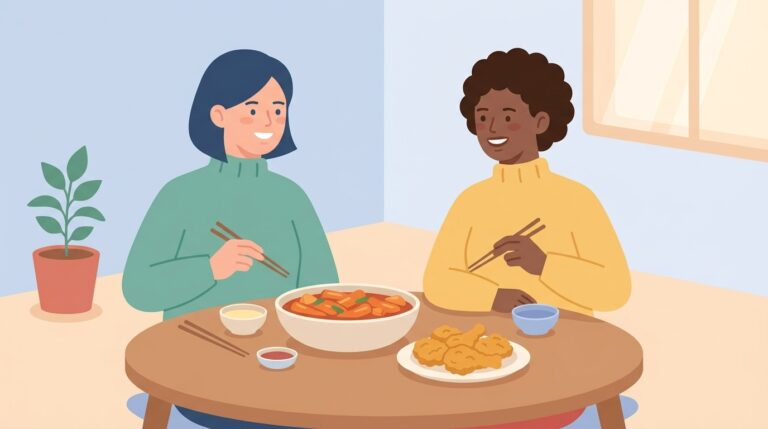
Sharing Food, Sharing Hearts: Navigating Korea’s Warm ‘Jeong’ (정) Culture at the Dinner Table
Phase 1: Empathy – Sharing is Caring (The ‘Jeong’ Way!)
안녕하세요! (An-nyeong-ha-se-yo!) I’m your Korean tutor and best friend from Daily Hangul!
Imagine this: You are sitting at a cozy Korean BBQ restaurant with your new Korean friends. The sizzling pork belly (samgyeopsal) smells amazing. Suddenly, your friend wraps a perfect lettuce roll (ssam) and gently tries to hand it directly to you, or they plop a juicy piece of meat right onto your rice bowl.
If you come from a culture where “personal plates” are the norm, this might make you freeze. “Wait, is this polite? Should I eat it? Am I supposed to share my food too?”
Don’t worry! This is the ultimate sign of Jeong (정)—the invisible, warm bond of affection, care, and sharing that defines Korean relationships. Today, we’ll learn the exact, simple phrases you need to share food like a local and show your own Jeong without any awkwardness. Let’s dive in!
Phase 2: Top 3 Essential Expressions for Food Sharing
1. 한입만 먹어봐! (Han-ip-man meog-eo-bwa!)
- Pronunciation: Han-im-man meog-eo-bwa! (Sounds like: “Han-eem-mahn mug-uh-bwah!”)
- Meaning: “Just try one bite!”
- K-Culture Moment: You often see this in K-Dramas when one character is eating delicious ramen, and another character looks at them with puppy eyes.
- Editor’s Insight: Han-ip means “one bite.” In Korea, insisting someone try a bite of your food is a warm gesture of inclusion, not peer pressure!
- Situation Spectrum: Casual ✅ | Semi-formal ⚠️ | Formal 🚫
- 🤔 Think About It: In your country, is it polite to offer someone a bite of your food, or is it preferred to keep plates strictly separate?
2. 이거 좀 나눠 먹을래요? (I-geo jom na-nwo meog-eul-lae-yo?)
- Pronunciation: Ee-guh jom nah-nwo mug-eul-lae-yo?
- Meaning: “Shall we share this?”
- K-Culture Moment: Perfect when ordering a giant bowl of bingsu (shaved ice) or a large pot of stew (jjigae) with colleagues after work.
- Editor’s Insight: Na-nwo meok-da means “to divide and eat.” It shows you want to bond with the other person.
- Situation Spectrum: Casual ✅ | Semi-formal ✅ | Formal ⚠️
- 🤔 Think About It: How does “sharing a dish” change the atmosphere of a social gathering compared to ordering individual meals?
3. 많이 드세요! (Man-i deu-se-yo!)
- Pronunciation: Mahn-ee deu-seh-yo!
- Meaning: “Please eat a lot!” / “Enjoy your meal!”
- K-Culture Moment: A warm-hearted restaurant owner (Imo-nim or auntie) places extra side dishes (banchan) on your table and says this with a big smile.
- Editor’s Insight: In Korea, food is love. Wishing someone to “eat a lot” is the ultimate expression of hospitality.
- Situation Spectrum: Casual ⚠️ (Use * 많이 먹어!* to friends) | Semi-formal ✅ | Formal ✅
- 🤔 Think About It: Why do you think wishing someone to eat “a lot” is considered a polite blessing in Korean culture?
Phase 3: Textbook Korean vs. Real-Life Korean
Let’s compare the stiff textbook phrases with what Koreans actually say at the table!
Scenario A: Asking to share a snack
- 📖 Textbook Korean: 이것을 같이 먹읍시다. (I-geos-eul gat-i meog-eup-si-da.) – “Let us eat this together.”
- 🗣️ Real-Life Korean: 이거 같이 먹어요! (I-geo gat-i meog-eo-yo!) – “Let’s eat this together!”
- 💡 Why the difference? The textbook version sounds like a formal speech campaign. The real-life version is warm, inviting, and natural for everyday sharing.
Scenario B: Offering a taste of your food
- 📖 Textbook Korean: 제 음식을 한 번 맛보십시오. (Je eum-sig-eul han beon mat-bo-sip-si-o.) – “Please taste my food once.”
- 🗣️ Real-Life Korean: 이거 진짜 맛있어요. 한입 먹어볼래요? (I-geo jin-jja mas-is-seo-yo. Han-ip meog-eo-bol-lae-yo?) – “This is really delicious. Want to try a bite?”
- 💡 Why the difference? Real Koreans share food because they are genuinely excited about how tasty it is, using casual questions rather than formal commands.
Phase 4: K-Culture Deep Dive & Table Manners
4-1. Nunchi & The Cozy Double-Dip
In many Western cultures, double-dipping or sharing a single pot of soup with multiple spoons is a big no-no. However, in Korea, sharing jjigae (stew) from a single pot is a classic symbol of closeness.
- The Gesture Tip: If you want to be polite but hygienic, use Nunchi (눈치 – situational wit). You can use a communal ladle (guk-ja) to scoop some soup into your individual small bowl (ap-jeob-si). If your Korean friends are dipping directly, feel free to join in to show you feel close to them!
4-2. The “Ssam” of Love
In K-Dramas, you’ve probably seen couples or family members wrapping a meat lettuce wrap (ssam) and putting it directly into each other’s mouths. This is the ultimate, affectionate act of Jeong. If someone does this for you, accept it with a big smile and a happy “고마워요!” (Go-ma-wo-yo! / Thank you!).
Phase 5: Real-Life Roleplay Scenario
Setting: A popular Korean Fried Chicken restaurant. You are eating with your Korean language partner, Minji.
- Minji: 와! 치킨 진짜 맛있겠다!
(Wa! Chi-kin jin-jja mas-is-get-da!)
(Wow! The chicken looks so delicious!) - You: 😊 맞아요! 냄새가 너무 좋아요.
(Ma-ja-yo! Naem-sae-ga neo-mu jo-a-yo.)
(That’s right! The smell is so good.) - Minji: 🎭 [Hands you a plastic glove] 자, 이거 끼고 많이 먹어요!
(Ja, i-geo kki-go man-i meog-eo-yo!)
(Here, put this on and eat a lot!) - You: 🎭 [Taking a piece of spicy chicken] 민지 씨, 이거 진짜 맛있어요! 한입 먹어볼래요?
(Minji-ssi, i-geo jin-jja mas-is-seo-yo! Han-ip meog-eo-bol-lae-yo?)
(Minji, this is really delicious! Do you want to try a bite?) - Minji: 🎭 [Eyes wide open] 정말요? 저 매운 것 좋아해요!
(Jeong-mal-yo? Jeo mae-un geot jo-a-hae-yo!)
(Really? I love spicy food!) - You: 🎭 [Passing a piece carefully] 여기요. 이거 좀 나눠 먹어요.
(Yeo-gi-yo. I-geo jom na-nwo meog-eo-yo.)
(Here you go. Let’s share this.) - Minji: 🎭 [Taking a bite] 음~! 진짜 맛있네요! 우리 사이드 메뉴도 더 시킬까요?
(Eum~! Jin-jja mas-is-ne-yo! U-ri sa-i-deu me-nyu-do deo si-kil-kka-yo?)
(Mmm~! It’s really delicious! Shall we order some side menus too?) - You: 👍 좋아요! 같이 나눠 먹어요!
(Jo-a-yo! Gat-i na-nwo meog-eo-yo!)
(Sounds great! Let’s share them together!)
🔀 Interactive Choice!
Minji offers you her favorite pickled radish, but you are not a fan of sour food. What do you do?
* A. “No, I don’t like sour food.” (Reject bluntly)
* B. “아, 괜찮아요! 많이 드세요!” (Ah, gwen-cha-na-yo! Man-i deu-se-yo!) (Politely decline with a smile and tell her to eat a lot)
* C. Eat it anyway and make a sour face. (Suffer in silence)
Feedback:
- Choice A (Bad): Too blunt! It might break the warm atmosphere of Jeong.
- Choice B (Best!): Perfect! ” 괜찮아요” (Gwen-chan-a-yo / I’m fine) plus wishing her to eat a lot shows great manners and maintains the warm mood.
- Choice C (Risk): Although sweet, making a funny face might make your friend feel guilty for forcing it on you!
Phase 6: 10-Second Emotion Shadowing Drill
Practice speaking like a native speaker with these emotional pause guides! / means pause briefly.
- [😊 Expressing excited generosity]
이거 / 진짜 맛있어요! / 한입만 / 먹어봐요!
(I-geo / jin-jja mas-is-seo-yo! / Han-im-man / meog-eo-bwa-yo!) - [🥺 Sharing warm consideration]
우리 / 이거 좀 / 나눠 먹을래요?
(U-ri / i-geo jom / na-nwo meog-eul-lae-yo?)
Phase 7: K-Culture Mini Dictionary
- 정 (Jeong): Deep affection, attachment, and bond that develops over time through shared experiences and kindness.
- 앞접시 (Ap-jeob-si): A small personal plate used to transfer shared food from a main pot or dish.
- 반찬 (Banchan): Side dishes served alongside rice in Korean meals, which are naturally shared by everyone at the table.
- 쌈 (Ssam): A wrap made of lettuce or sesame leaves filled with meat, garlic, and sauce, often shared with loved ones.
Phase 8: The Traveler’s Survival Kit
Top 3 Survival Phrases
- 앞접시 좀 주세요. (Ap-jeob-si jom ju-se-yo.)
- Meaning: “Please give me small personal plates.”
- Pro Tip: Perfect when eating shared stews with friends!
- 덜 매운 맛으로 주세요. (Deol mae-un mas-eu-ro ju-se-yo.)
- Meaning: “Please make it less spicy.”
- Pro Tip: Essential if sharing spicy dishes like tteokbokki.
- 같이 나눠 먹을게요. (Gat-i na-nwo meog-eul-ge-yo.)
- Meaning: “We will share it together.”
- Pro Tip: Say this when ordering one big portion at a restaurant.
Editor’s Travel Note
When navigating Korean restaurants, finding local gems is key! Download the Naver Map App instead of Google Maps, as it is much more accurate for finding cozy shared-food restaurants in Korea. Note: Restaurant menus and payment methods are subject to change, so keeping some cash or a credit card ready is recommended.
Phase 9:
Frequently Asked Questions (FAQ)
Q: What does "한입만 먹어봐! (Han-ip-man meog-eo-bwa!)" mean in Korean and how do you pronounce it?
A: In Korean, "한입만 먹어봐! (Han-ip-man meog-eo-bwa!)" is pronounced [Han-im-man meog-eo-bwa! (Sounds like: "Han-eem-mahn mug-uh-bwah!"] and means: "Just try one bite!"
Q: What does "이거 좀 나눠 먹을래요? (I-geo jom na-nwo meog-eul-lae-yo?)" mean in Korean and how do you pronounce it?
A: In Korean, "이거 좀 나눠 먹을래요? (I-geo jom na-nwo meog-eul-lae-yo?)" is pronounced [Ee-guh jom nah-nwo mug-eul-lae-yo?] and means: "Shall we share this?"
Q: What does "많이 드세요! (Man-i deu-se-yo!)" mean in Korean and how do you pronounce it?
A: In Korean, "많이 드세요! (Man-i deu-se-yo!)" is pronounced [Mahn-ee deu-seh-yo!] and means: "Please eat a lot!" / "Enjoy your meal!"







