

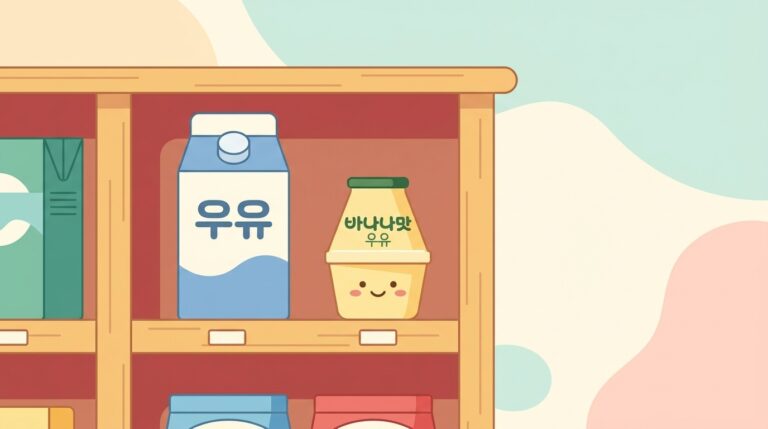
Finding the Milk! 🥛 How to Ask for Dairy in a Korean Supermarket
Phase 1: Empathy (Welcome, My Friend!)
안녕하세요! (Annyeonghaseyo!) Hello there, fellow foodies and K-culture lovers! I’m your Daily Hangul editor, and your ultimate Korean culture navigator. 🇰🇷✨
Picture this: You are standing in the middle of a bustling Korean supermarket like E-Mart or Lotte Mart. Your goal? To make that delicious, creamy dalgona coffee (달고나 커피) or simply enjoy a comforting bowl of cereal in your Airbnb. You wander around the aisles, but all you see are colorful packages and Hangul signs. You want to ask a store clerk, but your throat tightens. “How do I say ‘Where is the milk?’ without sounding like a robotic textbook?”
Don’t worry! We have all been there. Today, we’re going to master the exact, natural phrases to locate milk and other dairy products in Korea. This guide is built based on real feedback from dozens of expat students who used to get lost in the grocery store but now shop like local Seoulites. Let’s dive in! 🛒
Phase 2: Deep Dive into 3 Key Expressions
Let’s learn the three most important phrases you will need.
1. 우유 어디에 있어요? (U-yu eo-di-e is-seo-yo?)
- Pronunciation: “Oo-yoo eo-dee-eh ees-suh-yo?” (Sounds like “Oo-yoo” as in “Oooh, you!” + “eo-di-e” as in “uh-dee-eh”).
- Meaning: Where is the milk?
- K-Culture Moment: You will hear this exact phrase in slice-of-life K-dramas when a character is searching for ingredients to make bingsu (빙수 – shaved ice) or baking a cake.
- Editor’s Insight: This is the ultimate “survival phrase.” “우유” (u-yu) means milk, “어디” (eo-di) means where, and “있어요?” (is-seo-yo?) means “is there? / does it exist?”. It’s incredibly polite and works everywhere.
- Situation Spectrum: Casual (⚠️) / Semi-formal (✅) / Formal (✅)
- 🤔 Think About It: In English, we say “Where is the milk?”. In Korean, we literally say “Milk, where does it exist?”. Why do you think Korean puts the location word “어디” right before the verb?
2. 유제품 코너가 어디예요? (Yu-je-pum ko-neo-ga eo-di-ye-yo?)
- Pronunciation: “Yoo-jeh-poom koh-nuh-gah eo-dee-yeh-yo?”
- Meaning: Where is the dairy section?
- K-Culture Moment: Used by health-conscious characters in dramas who are looking for specialized Greek yogurt or organic butter.
- Editor’s Insight: “유제품” (yu-je-pum) means dairy products. “코너” (ko-neo) is the English word “corner/section” transliterated into Korean! If you want to sound a bit more specific and find cheese, butter, and yogurt all at once, use this phrase.
- Situation Spectrum: Casual (🚫) / Semi-formal (✅) / Formal (✅)
3. 저기요, 우유는 어디쯤에 있나요? (Jeo-gi-yo, u-yu-neun eo-di-jjeum-e in-na-yo?)
- Pronunciation: “Juh-gee-yo, oo-yoo-neun eo-dee-jjeum-eh een-nah-yo?”
- Meaning: Excuse me, around where is the milk?
- K-Culture Moment: A polite shopper gently tapping a supermarket clerk on the shoulder.
- Editor’s Insight: Adding “저기요” (Jeo-gi-yo – Excuse me) at the start is crucial for politeness. Adding “~쯤” (jjeum – around/approximately) makes your question sound much softer and less demanding.
- Situation Spectrum: Casual (🚫) / Semi-formal (✅) / Formal (✅)
Phase 3: Textbook Korean vs. Real Korean
Sometimes, textbooks teach you phrases that make you sound like a historical drama character. Let’s compare!
Situation A: Asking for the milk’s location
- 📖 Textbook Korean: 우유가 어디에 존재합니까? (U-yu-ga eo-di-e jon-jae-ham-ni-kka? – “Where does milk exist?” – Way too formal!)
- 🗣️ Real Korean: 저기요, 우유 어디 있어요? (Jeo-gi-yo, u-yu eo-di is-seo-yo? – “Excuse me, where is the milk?”)
- 💡 Why the difference? Real-life Korean prefers omitting small particles like “가” (ga) or “를” (reul) in fast, casual speech to keep conversations smooth and natural.
Situation B: Asking if they have milk in stock
- 📖 Textbook Korean: 우유를 판매하고 있습니까? (U-yu-reul pan-mae-ha-go is-seum-ni-kka? – “Are you selling milk?”)
- 🗣️ Real Korean: 혹시 우유 있어요? (Hok-shi u-yu is-seo-yo? – “By any chance, do you have milk?”)
- 💡 Why the difference? Starting with “혹시” (hok-shi – by any chance) is a magical way to soften your request and sound super friendly and polite!
Phase 4: K-Culture Deep Dive & Non-Verbal Manners
4-1. Nunchi (눈치) & Bowing Etiquette
When approaching a busy mart employee who is restocking shelves, do not just shout your question. Use Nunchi (눈치 – situational quick-wittedness).
1. Approach gently, make eye contact, and do a micro-bow (a slight tilt of your head).
2. Say “저기요…” (Jeo-gi-yo…) in a soft tone.
3. Keep your hands relaxed in front of you. Pointing with one finger can sometimes look aggressive, so if you are gesturing toward a general area, use an open palm!
4-2. The Korean Milk Carton Culture 🍓🥛
If you watch K-Dramas, you’ve definitely seen characters drinking milk out of tiny, triangular paper pouches or cute, round plastic bottles (like the famous Binggrae Banana Milk – 바나나맛 우유). In Korea, processed milk flavors like Strawberry (딸기), Chocolate (초코), and Banana (바나나) are culturally huge! Knowing the difference between fresh white milk (흰 우유 – huyn u-yu) and sweet flavored milk will save your breakfast cereal!
Phase 5: Live Roleplay Scenario
Let’s practice! You are at a local supermarket. You meet a friendly store employee named Min-ho.
Character Profiles
- You (The Hungry Traveler): Wants to find regular whole milk to drink with cookies.
- Min-ho (Mart Clerk): Helpful, wearing an apron, holding a box of yogurt.
Dialogue
- You: 🎭 [Smiling politely and doing a small bow] 저기요, 말씀 좀 묻겠습니다. (Jeo-gi-yo, mal-sseum jom mut-get-seum-ni-da.) / Excuse me, may I ask you something?
- Min-ho: 🎭 [Stops working and bows back] 네! 무엇을 도와드릴까요? (Ne! Mu-eot-eul do-wa-deu-ril-kka-yo?) / Yes! How can I help you?
- You: 🎭 [Pointing vaguely to the back] 혹시 우유는 어디에 있어요? (Hok-shi u-yu-neun eo-di-e is-seo-yo?) / By any chance, where is the milk?
- Min-ho: 🎭 [Pointing to the far left aisle] 아, 우유는 저기 왼쪽 안쪽에 있어요. (Ah, u-yu-neun jeo-gi wen-jjok an-jjok-e is-seo-yo.) / Ah, the milk is over there on the far left inside.
- You: 🎭 [Looking a bit confused] 왼쪽 안쪽이요? 유제품 코너 말씀이시죠? (Wen-jjok an-jjok-i-yo? Yu-je-pum ko-neo mal-sseum-i-shi-jyo?) / Far left inside? You mean the dairy section, right?
- Min-ho: 🎭 [Nodding and smiling] 맞아요. 치즈랑 요플레 옆에 있어요! (Ma-ja-yo. Chi-jeu-rang yo-pul-re yeop-e is-seo-yo!) / That’s right. It’s next to the cheese and yogurt!
- You: 🎭 [Sighing with relief] 아, 감사합니다! (Ah, gam-sa-ham-ni-da!) / Ah, thank you!
- Min-ho: 🎭 [Waving hands warmly] 아니에요, 좋은 쇼핑 되세요! (An-i-e-yo, jo-eun syo-ping doe-se-yo!) / No problem, have a nice shopping trip!
🔀 Interactive Choice Point!
What will you say next to Min-ho?
- Choice A: “우유 어디 있어요?” (U-yu eo-di is-seo-yo?) and run away.
- Feedback (Bad): Too abrupt! You already asked this, and running away without saying thank you is rude.
- Choice B: “감사합니다! 좋은 하루 보내세요!” (Gam-sa-ham-ni-da! Jo-eun ha-ru bo-nae-se-yo!)
- Feedback (Best): Perfect! Saying “Thank you! Have a nice day!” leaves a wonderful, warm impression.
- Choice C: “우유 싸요?” (U-yu ssa-yo? – Is milk cheap?)
- Feedback (Risk): A bit awkward. While natural to ask, asking if milk is cheap directly to a clerk right after locating it might confuse them.
Phase 6: 10-Second Emotion Shadowing Drill
Let’s practice speaking with feelings! Follow the pauses (/) and emotions.
[😊 Super Polite & Friendly]
저기요, / 혹시 / 우유 / 어디에 / 있어요?
(Jeo-gi-yo, / hok-shi / u-yu / eo-di-e / is-seo-yo?)-
[🥺 Desperately Looking for Dairy]
유제품 / 코너가 / 어디예요? / 못 찾겠어요.
(Yu-je-pum / ko-neo-ga / eo-di-ye-yo? / mot chat-get-se-yo.)
(Where is the dairy section? I can’t find it.)
Phase 7: K-Culture Mini-Dictionary
- 우유 (U-yu): Milk. General term for any cow’s milk.
- 유제품 (Yu-je-pum): Dairy products. (Includes cheese, butter, yogurt, cream).
- 서울우유 (Seoul U-yu): Seoul Milk. The most famous, iconic national milk brand in Korea with the green retro logo.
- 요플레 (Yo-pul-re): Yoplait. While it’s a brand name, Koreans use “요플레” as a general slang term for any cup of sweet, spoonable fruit yogurt!
Phase 8: Survival Kit for Travelers
Top 3 Survival Phrases
- 이거 우유예요? (I-geo u-yu-yeo-yo?) – Is this milk? (Great for checking if a carton is soy milk or cow milk!)
- 저지방 우유 있어요? (Jeo-ji-bang u-yu is-seo-yo?) – Do you have low-fat milk?
- 유통기한이 언제까지예요? (Yu-tong-gi-han-i eon-je-kka-ji-ye-yo?) – Until when is the expiration date?
Editor’s Travel Note
Before heading out, download the Naver Map App to find the nearest “E-Mart” (이마트) or “Homeplus” (홈플러스). Also, most Korean supermarkets accept overseas credit cards, but having a T-money transportation card loaded with cash can be a lifesaver for quick convenience store dairy runs! Note: Supermarket operating hours might change on certain Sundays due to local green laws.
Phase 9: A Step Deeper (Cultural Reflection)
In Western supermarkets, milk aisles are massive, offering gallons of whole, skim, oat, almond, and soy milk. In Korea, while dairy sections are growing rapidly, traditional white cow milk remains the staple, often sold in 1-liter (1L) cartons. Historically, dairy wasn’t a major part of the traditional Korean diet. The massive popularity of cheese, bakery items, and milk tea over the past few decades shows how rapidly Korean food culture is globalizing and adapting!
💬 Your Turn: What is your favorite dairy product to try when you visit a foreign country? Tell us in the comments below!
Phase 10: FAQ & Avoiding Mistakes
Q: Can I use “유제품” (Yu-je-pum) to ask for almond milk?
A: Not quite! “유제품” refers specifically to animal-based dairy. If you are looking for almond or soy milk, ask for “두유” (Du-yu – Soy milk) or “아몬드 밀크” (A-mon-deu mil-keu).
Q: What is the difference between “우유” (U-yu) and “두유” (Du-yu)?
A: “우유” is cow’s milk. “두유” is soy milk. Be careful not to mix them up if you have allergies!
Q: How do I ask for lactose-free milk?
A: Look for the words “락토프리” (Rak-to-peu-ri) or ask: “소화가 잘되는 우유 있어요?” (So-hwa-ga jal-doe-neun u-yu is-seo-yo? – Do you have milk that digests easily?).
🚨 Common Mistakes Alert!
- Shouting “Excuse me” in English: Instead of “Hey!”, always say “저기요” (Jeo-gi-yo).
- Calling the clerk “Ahjussi” (Mister): This can sound too informal or slightly offensive. Just use polite verb endings and address them as “저기요”.
- Confusing Sweetened and Unsweetened Milk: Always check if the label says “플레인” (Plain) or “가당” (Sweetened) when buying yogurt!
Phase 11: Action Mission
- 🥉 Bronze Mission: Pronounce “우유 어디 있어요?” aloud 5 times in front of your mirror.
- 🥈 Silver Mission: Write down your favorite dairy item in Korean (e.g., “치즈” for cheese) in the comments below!
- 🥇 Gold Mission: Go to a local Asian mart or watch a K-drama, find a scene in a grocery store, and try to catch the word “어디” (where) or “우유” (milk)!
Phase 12: Interactive Quiz Challenge
Q1. How do you ask “Where is the milk?” naturally in Korean?
- A) 우유는 존재합니까?
- B) 우유 어디 있어요?
- C) 우유 주세요.
Reveal Answer & Feedback
Correct Answer: B
* Feedback: “우유 어디 있어요?” is the most natural, polite, and common way to ask for milk’s location. A is too robotic, and C means “Please give me milk.”
Q2. True or False: “요플레” (Yo-pul-re) is only used to refer to the specific brand name “Yoplait” in Korea.
- A) True
- B) False
Reveal Answer & Feedback
Correct Answer: B (False)
* Feedback: Koreans use “요플레” as a generic term for any spoonable fruit yogurt cup, regardless of the brand! It’s an everyday colloquialism.






