

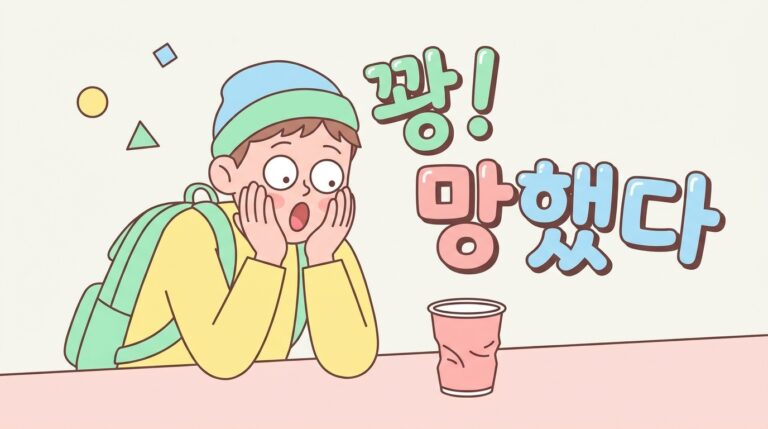
Failure is Just a Game! Level Up Your K-Variety Show Vocabulary 🎮
Phase 1: Empathy (공감)
안녕하세요! (An-nyeong-ha-se-yo!) Hello, my lovely language learners! It’s your K-Culture Navigator from Daily Hangul (매일한글). 🌸
Have you ever watched a Korean variety show like Runing Man or 2 Days & 1 Night and seen the cast members completely lose a game, drop their food, or get wet in the winter? They look so dramatic, and suddenly a huge caption pops up on the screen. You hear them scream a short word, and the whole crew bursts into laughter.
But when you look up “failure” in a standard dictionary, you get long, stiff words like 실패 (sil-pae). Nobody screams “실패했습니다!” while falling into a pool!
Today, we are going to learn 3 super simple, super dramatic words used in Korean variety shows when someone fails. These are perfect for A1 beginners—they are short, easy to say, and will make you sound like a true K-entertainment insider! Let’s dive in! 🚀
Phase 2: Core Expressions (핵심 표현 3선)
1. 망했다 (mang-haet-da)
- Pronunciation: [Mang-haet-da] (Sounds like “Mung-hate-da” with a dramatic sigh)
- Meaning: “I’m ruined!” / “Oh no, it’s a disaster!”
- K-Culture Moment: When a cast member tries to flip a coin or guess a quiz answer, makes a huge mistake, and realizes they get zero food for dinner. A big skull icon usually appears next to their face.
- Editor’s Insight: Literally, it means “to go bankrupt,” but in daily life and variety shows, it just means “I totally messed up!” It’s perfect when you burn your toast or drop your phone.
- Situation Spectrum: Casual ✅ | Semi-formal ⚠️ | Formal 🚫
- 🤔 Think About It: Why do you think Koreans use a heavy word like “bankrupt” (망했다) for tiny daily mistakes? It shows how Koreans love dramatic, expressive humor!
2. 꽝 (kkwang)
- Pronunciation: [Kkwang] (Sounds like a balloon popping: “K-wahng!”)
- Meaning: “Wrong!” / “Better luck next time!” / “Boom (Empty/Zero)”
- K-Culture Moment: When picking a lucky card or a random box. If a member opens a box and it only contains a single piece of paper saying “꽝”, they get absolutely nothing.
- Editor’s Insight: This is an onomatopoeia for a crashing sound. In games, it represents the “dud” or the “losing option.”
- Situation Spectrum: Casual ✅ | Semi-formal ⚠️ | Formal 🚫
- 🤔 Think About It: What is the “losing ticket” word in your country? Is it a sound or a word?
3. 아깝다 (a-kkap-da)
- Pronunciation: [A-kkap-da] (Sounds like “Ah-cop-da” with a pout)
- Meaning: “So close!” / “What a waste!”
- K-Culture Moment: When a player almost catches a ball but drops it at the very last second. The whole team groans, “Ah~!”
- Editor’s Insight: Use this when you miss your bus by one second or when your favorite team loses by one point.
- Situation Spectrum: Casual ✅ | Semi-formal ⚠️ | Formal 🚫
- 🤔 Think About It: Koreans love to encourage people who almost made it. Saying “아깝다!” is actually a warm way to comfort someone who failed.
Phase 3: Textbook vs. Real Life (교과서 vs. 진짜 한국어)
Situation 1: Dropping your ice cream scoop
- 📖 Textbook Korean: 실패했습니다. (sil-pae-haet-seup-ni-da.) – “I have failed.” (Too robotic!)
- 🗣️ 진짜 한국어: 망했다! (mang-haet-da!) – *”Oh no, I’m ruined!”
- 💡 Why? Real people don’t use dry, academic nouns when tragedy strikes their ice cream. They go dramatic!
Situation 2: Choosing the wrong key to open a chest
- 📖 Textbook Korean: 틀렸습니다. (teul-lyeot-seup-ni-da.) – “It is incorrect.” (Sounds like a school exam)
- 🗣️ 진짜 한국어: 꽝! (kkwang!) – “Wrong! Better luck next time!”
- 💡 Why? variety shows use sensory, fun sounds to keep the energy high and humorous.
Phase 4: K-Culture Deep Dive & Mannerisms
4-1. The “Failure” Gestures (비언어적 매너)
When you say these words, your body language must match!
* For “망했다”: Put both hands on your cheeks (like the painting The Scream) or drop your head to your chest.
* For “꽝”: Make an “X” shape with your forearms in front of your chest.
* For “아깝다”: Clench your fists, stomp one foot lightly, and sigh “Ah~.”
4-2. The Soul of Korean Variety: “Ddaeng!” (땡)
In Korean shows, the PD (Producer) holds a small brass bell. If a player gets an answer wrong, the PD hits the bell: 땡! (Ddaeng!). If they are correct, it’s 딩동댕! (Ding-dong-daeng!). “Ddaeng” is the ultimate, cute sound of failure in Korea!
Phase 5: Real-Life Roleplay Scenario
Setting: You are playing a random game at a Korean university festival with Minjun (your Korean buddy). You have to pick one of three paper cups to win a snack.
Characters:
* 민준 (Minjun): Your energetic Korean friend who wants you to win.
* You: A cute A1 learner trying your luck!
Dialogue:
- 민준: “자, 골라 봐! 하나, 둘, 셋!”
(Ja, gol-ra bwa! Ha-na, dul, set! / “Okay, choose! One, two, three!”) - You: 🎭 (Hesitantly pointing at Cup A) “이거!”
(I-geo! / “This one!”) - 민준: 🎭 (Lifting the cup with drama) “과연… 결과는?”
(Gwa-yeon… gyeol-gwa-neun? / “Indeed… the result is?”) - You: 🎭 (Peeking inside the empty cup) “어? 아무것도 없어요?”
(Eo? A-mu-geot-do eop-seo-yo? / “Huh? There is nothing?”) - 민준: “아쉽다! 꽝이야!”
(A-swip-da! Kkwang-i-ya! / “Too bad! It’s a dud!”) - You: 🎭 (Dropping your head) “아, 진짜요? 망했다!”
(Ah, jin-jja-yo? Mang-haet-da! / “Ah, really? I’m ruined!”) - 민준: “너 아까 진짜 거의 맞췄는데!”
(Neo a-kka jin-jja geo-ui mat-chwot-neun-de! / “You almost guessed it right earlier!”) - You: 🎭 (Stomping feet lightly) “맞아요, 진짜 아깝다!”
(Ma-ja-yo, jin-jja a-kkap-da! / “Right, so close!”)
🔀 Choose Your Reaction!
What do you say when Minjun reveals the empty cup?
* A. “실패했습니다.” (sil-pae-haet-seup-ni-da.)
* Feedback: 🚫 Too cold! Minjun will feel like he is in a military camp, not a fun festival.
* B. “망했다! 아깝다!” (Mang-haet-da! A-kkap-da!)
* Feedback: 🏆 Perfect! Dramatic, friendly, and matches the high energy of the game!
* C. “괜찮아요.” (Gwen-cha-na-yo. / “It’s okay.”)
* Feedback: ⚠️ A bit boring. It’s polite, but it doesn’t keep the fun game vibe going.
Phase 6: 10-Second Emotion Shadowing Drill
Let’s practice speaking with real variety show feelings! Pay attention to the pauses (/) and emotional cues.
[🥺 Desperate & Sad]망했다… / 진짜 / 망했다…
(Mang-haet-da… / jin-jja / mang-haet-da…)- “I’m ruined… seriously, I’m ruined…”
[🙅♀️ Cute & Cheerful]이거 / 꽝이야! / 다시 / 해봐!
(I-geo / kkwang-i-ya! / da-si / hae-bwa!)- “This is a dud! Try again!”
[😭 Disappointed & Whining]아깝다! / 진짜 / 아까웠어요!
(A-kkap-da! / jin-jja / a-kka-wot-seo-yo!)- “So close! It was really close!”
Phase 7: K-Culture Mini Dictionary
- 벌칙 (Beol-chik) | Penalty/Punishment | The funny punishment variety show members get when they fail (e.g., eating spicy food, wearing silly outfits).
- 금지 (Geum-ji) | Prohibited/Forbidden | Often used in “No English” games where players fail if they speak a foreign word.
- 탈락 (Tal-rak) | Eliminated | When a player fails and has to step out of the game.
- 성공 (Seong-gong) | Success | The opposite of failure! The golden word everyone wants to hear.
Phase 8: Travel Survival Kit
Survival Phrases for Games
- 한 번만 더요! (Han beon-man deo-yo!)
- Meaning: “Just one more time, please!” (Use with puppy eyes when you fail).
- 봐주세요! (Bwa-ju-se-yo!)
- Meaning: “Please go easy on me!” / “Give me a pass!”
- 통과 (Tong-gwa)
- Meaning: “Pass!” (When you successfully avoid failure).
Editor’s Travel Note 🗺️
If you visit Korea, you must try the Claw Machine Arcades in Hongdae! If you fail to grab a plushie, you can shout “아깝다!” out loud. Everyone nearby will understand your pain! To find the best arcades, download the Naver Map App which is much more accurate in Korea than Google Maps. (Note: Arcade machine rates may vary by location).
Phase 9: Deep Thoughts (한 발 더 깊이)
In western cultures, failure in games is often brushed off quickly. But in Korean variety shows, failure is celebrated as the best source of entertainment! In Korea, there is a saying: “예능신이 도왔다” (The Variety Show God helped you). It means failing in such a funny, epic way that you get the most screen time. It teaches us that making mistakes can actually bring people closer and create the best laughs.
💬 Your Turn: Do you get stressed when you fail a game, or do you laugh like they do in Korean shows? Let us know in the comments!
Phase 10: FAQ & Common Mistakes
Q: Can I use “망했다” to my boss at work?
A: Absolutely not! “망했다” is very casual and dramatic. If you fail a project at work, use professional terms like “문제가 생겼습니다” (mun-jae-ga saeng-gyeot-seup-ni-da / A problem has occurred).
Q: What is the difference between “틀렸다” and “꽝”?
A: “틀렸다” (teul-lyeot-da) means an answer is logically incorrect (like math). “꽝” (kkwang) is used for luck-based results, like lottery tickets or game show choices.
Q: Can I shout “꽝!” when my friend fails a test?
A: No, that might hurt their feelings! “꽝” is for games and playful situations. If they fail a real test, just say “아쉽다” (a-swip-da / That’s too bad) or comfort them.
🚨 Common Mistakes Alert!
- Mistake 1: Shouting “실패!” (sil-pae!) to your friend. (Too formal/cold! Use “꽝!” instead.)
- Mistake 2: Saying “망했어요” to older strangers. (It’s too slangy. Keep it with friends!)
- Mistake 3: Pronouncing “꽝” as “Koo-ang” in two syllables. (It should be one fast, explosive syllable: [Kkwang!])
Phase 11: Action Mission
- Bronze Medal: Say “망했다!” out loud next time you drop your pen today.
- Silver Medal: Share a funny 3-second clip of a Korean variety show failure on your SNS and tag it
#DailyHangul. - Gold Medal: Watch an episode of Running Man or Going SEVENTEEN and count how many times they say “꽝” or “아깝다”!
Phase 12: Interactive Quiz Challenge
Q1. Which word is best when you miss a claw machine prize by just 1 millimeter?
a) 실패 (sil-pae)
b) 아깝다 (a-kkap-da)
c) 성공 (seong-gong)
Q2. True or False: You should say “망했다” to your teacher when you don’t do your homework.
🔍 Click here to see the answers!
- A1: b) 아깝다 (a-kkap-da). It means “so close!” which is perfect for near-misses.
- A2: False! “망했다” is too casual for a teacher. It’s better to say “죄송합니다” (joe-song-hap-ni-da / I am sorry).







