

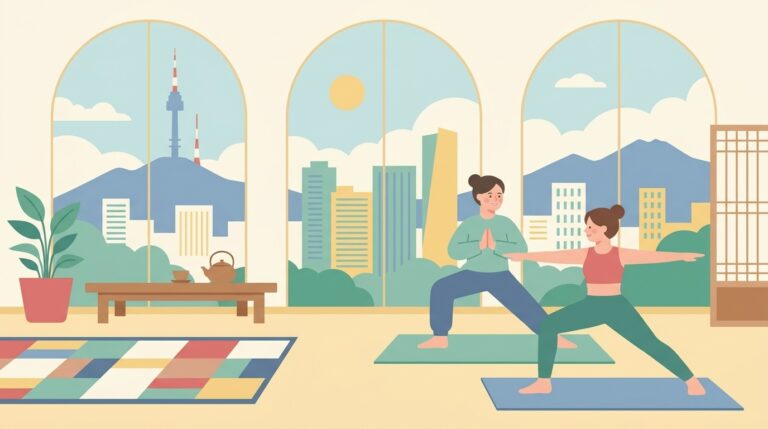
Stay Flexible, Stay Calm: Mastering Yoga in Korea (요가하다)
Phase 1: Empathy (Your Yoga Journey in Seoul!)
안녕하세요! (An-nyeong-ha-se-yo!) Hello! It’s your favorite Daily Hangul editor and your personal cultural navigator here! 🧘♀️✨
Picture this: You are walking through the trendy streets of Mapo or Gangnam on a crisp spring morning. You see a beautiful, serene yoga studio. You want to walk in, stretch your tired muscles after a long flight, and blend in with the local yogis. But suddenly, your heart rates spikes—not from a cardio workout, but from the fear of not understanding the instructor!
“What if they tell me to breathe and I accidentally hold my breath?” “How do I ask if I need to bring my own mat?”
Don’t worry, my friend! We’ve all been there. Today, we are going to learn how to comfortably say and use the expression 요가하다 (yoga-hada)—to do yoga—and navigate a Korean yoga class like a true local. This guide is crafted specifically for absolute beginners (A1), tested by real learners who went from feeling lost in translation to doing perfect downward dogs in Seoul! Let’s stretch our minds and Korean skills together!
Phase 2: Deep Dive into 3 Essential Expressions
Let’s look at the absolute must-know phrases for your yoga journey. These are super simple, easy to pronounce, and highly practical!
1. 요가해요 (Yoga-hae-yo)
- Pronunciation: yo-ga-hae-yo (Sounds like: “Yo-gah? Hey, yo!”)
- Meaning: I do yoga / Let’s do yoga.
- K-Culture Moment: You will hear this a lot in lifestyle K-Dramas like Work Later, Drink Now where characters talk about their morning routines to stay healthy.
- Editor’s Insight: In Korean, we don’t say “play yoga” or “make yoga.” We simply combine the noun 요가 (yoga) with 해요 (hae-yo – to do). Keep it simple!
- Situation Spectrum: Casual ✅ | Semi-formal ✅ | Formal ⚠️
- 🤔 Think About It: In English, we say “I do yoga.” In Korean, it’s “요가 해요.” Notice how Korean drops the subject (“I”) when it is obvious. Why do you think Korean values saving words and focusing on the action?
2. 매트 있어요? (Maet-teu is-seo-yo?)
- Pronunciation: maet-teu eet-suh-yo? (Sounds like: “Mat-teu? Is saw yo?”)
- Meaning: Do you have a mat? / Is there a mat?
- K-Culture Moment: Walking into a stylish studio in Hongdae, you want to know if you can rent or use a communal mat.
- Editor’s Insight: 매트 (maet-teu) is the phonetic spelling of “mat.” 있어요? (is-seo-yo?) means “Do you have?” or “Is there?”. This is a magic survival pattern for any situation in Korea!
- Situation Spectrum: Casual ✅ | Semi-formal ✅ | Formal ⚠️
- 🤔 Think About It: Many sports words in Korean are loanwords from English. Does this make learning Korean feel a bit closer to home?
3. 천천히 하세요 (Cheon-cheon-hi ha-se-yo)
- Pronunciation: chuhn-chuhn-hee ha-seh-yo (Sounds like: “Chon-chon-he ha-say-yo”)
- Meaning: Please take your time / Go slowly.
- K-Culture Moment: Your instructor sees you struggling with a balance pose and kindly reassures you with this phrase.
- Editor’s Insight: This comes from 천천히 (cheon-cheon-hi – slowly) and 하세요 (ha-se-yo – please do). It’s a warm, gentle way to encourage someone not to rush.
- Situation Spectrum: Casual ⚠️ | Semi-formal ✅ | Formal ✅
- 🤔 Think About It: Korea is famous for its fast-paced “Pali-Pali” (hurry, hurry) culture, but inside a yoga studio, “Cheon-cheon-hi” reigns supreme. It’s a beautiful oasis of slow living.
Phase 3: Textbook Korean vs. Real-Life Korean
Let’s compare what dry textbooks teach you versus how cool, real Koreans actually speak!
Situation 1: Talking about your hobby
- 📖 Textbook Korean: “저의 취미는 요가하기입니다.” (Jeo-ui chwi-mi-neun yo-ga-ha-gi-im-ni-da. – My hobby is doing yoga.) – Sounds like a robot reciting a resume!
- 🗣️ Real Korean: “요즘 요가 배워요.” (Yo-jeum yo-ga bae-wo-yo. – Lately, I’m learning/doing yoga.)
- 💡 Why is it different? Real Koreans prefer active, trendy verbs like 배워요 (bae-wo-yo – to learn) or simply 해요 (hae-yo – to do) instead of formal noun-defining sentences.
Situation 2: Expressing fatigue/difficulty in a pose
- 📖 Textbook Korean: “이 자세는 고통스럽습니다.” (I ja-se-neun go-tong-seu-reop-seum-ni-da. – This posture is painful/difficult.) – Way too dramatic, like you need to go to the emergency room!
- 🗣️ Real Korean: “어우, 조금 힘들어요!” (Eou, jo-geum him-deul-eo-yo! – Oof, it’s a bit tough/hard!)
- 💡 Why is it different? 힘들어요 (him-deul-eo-yo) is the go-to word for anything physically or mentally challenging. It sounds natural and invites encouraging smiles from your instructor.
Phase 4: K-Culture Deep Dive & Non-verbal Manners
4-1. Nunchi (눈치) & Studio Etiquette
- The Shoe Rule: The moment you enter a Korean yoga studio, look down. You must take off your shoes at the entrance and put on the indoor slippers provided, or go barefoot immediately.
- Silence is Golden: Korean yoga studios are spaces of deep relaxation. Keep your voice at a soft whisper before the class starts.
4-2. Culture Code: Yoga in K-Pop & K-Beauty
In Korea, yoga (especially “Hot Yoga” or “Flying Yoga”) is incredibly popular among K-Pop stars and actresses (like Blackpink’s Jennie or actress Park Min-young) not just for fitness, but for mental detox. Doing yoga in Seoul isn’t just a workout; it’s a vital part of the “Self-Care & Mindset” wellness culture.
Phase 5: Real-Life Roleplay Scenario
Scenario: You walk into
Frequently Asked Questions (FAQ)
Q: What does "요가해요 (Yoga-hae-yo)" mean in Korean and how do you pronounce it?
A: In Korean, "요가해요 (Yoga-hae-yo)" is pronounced [yo-ga-hae-yo (Sounds like: "Yo-gah? Hey, yo!"] and means: I do yoga / Let's do yoga.
Q: What does "매트 있어요? (Maet-teu is-seo-yo?)" mean in Korean and how do you pronounce it?
A: In Korean, "매트 있어요? (Maet-teu is-seo-yo?)" is pronounced [maet-teu eet-suh-yo? (Sounds like: "Mat-teu? Is saw yo?"] and means: Do you have a mat? / Is there a mat?
Q: What does "천천히 하세요 (Cheon-cheon-hi ha-se-yo)" mean in Korean and how do you pronounce it?
A: In Korean, "천천히 하세요 (Cheon-cheon-hi ha-se-yo)" is pronounced [chuhn-chuhn-hee ha-seh-yo (Sounds like: "Chon-chon-he ha-say-yo"] and means: Please take your time / Go slowly.







