

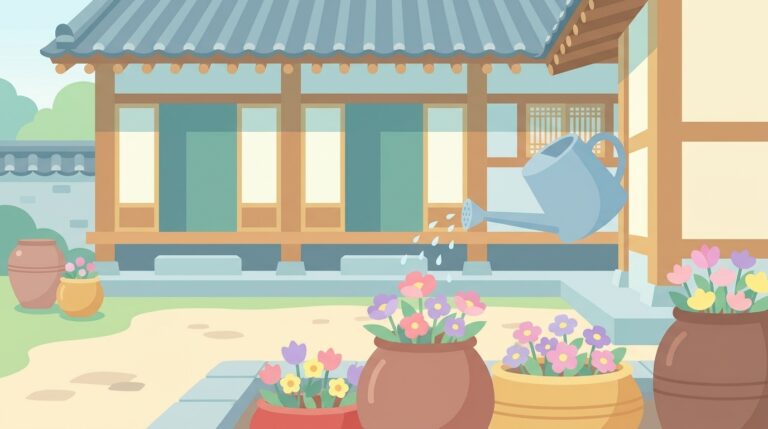
Bring Your K-Drama Garden to Life: How to Say “Watering the Flowers” in Korean!
Phase 1: Empathy (Your Cozy K-Garden Opening)
안녕하세요! (An-nyeong-ha-se-yo!) Hello, my lovely Daily Hangul friends! It’s your favorite local cultural navigator and tutor here.
Have you ever watched a cozy K-Drama where the main lead gently waters beautiful flower pots outside a cute neighborhood cafe? Maybe you’ve dreamt of doing the same while staying in a charming hanok (traditional house) in Seoul. But then reality hits: you want to ask your Airbnb host if you can water their beautiful daisies, or maybe you want to tell your Korean friend that you love gardening, but you have no idea how to say it without sounding like a clunky online translator.
Don’t worry! Today, we are diving into the lovely world of plants to learn the most essential, beginner-friendly way to say “watering the flowers.” This guide is built based on real questions from our global learners who wanted to talk about their green friends in natural Korean. Let’s grow your Korean skills together! 🌸
Phase 2: Key Expressions Deep Dive
Let’s look at the absolute must-know phrase and its variations for A1 levels.
1. 꽃에 물을 줘요 (Kkot-e mul-eul jwo-yo)
- Pronunciation: Kkot-eh mool-eul jwo-yo (Think “Kkot” like “coat” but with a sharp ‘k’ sound at the start, and “jwo-yo” like “jo-yo”).
- Meaning: I water the flowers / I give water to the flowers.
- K-Culture Moment: You will hear this in healing slice-of-life K-dramas (like Hometown Cha-Cha-Cha) when characters are doing light, peaceful morning chores.
- Editor’s Insight: Literally, “꽃” (kkot) means flower, “물” (mul) means water, and “줘요” (jwo-yo) means “give.” So in Korean, you literally say “I give water to the flowers!”
- Situation Spectrum: Casual ✅ | Semi-formal ✅ | Formal ⚠️
- 🤔 Think About It: In English, “water” is both a noun and a verb (“to water”). In Korean, we use the noun “water” (물) and pair it with the active verb “to give” (주다 -> 줘요). How does this change the way you picture the action of caring for a plant?
2. 물 주기 (Mul ju-gi)
- Pronunciation: Mool joo-gee (Sounds like “mool” + “ju” as in juice + “gi” as in geese).
- Meaning: Watering / Giving water (Noun form).
- K-Culture Moment: This is the exact phrase you will see written on cute plant care tags in hipster flower shops in Hongdae or Seongsu-dong.
- Editor’s Insight: Adding “-기” (-gi) to a verb verb-stem makes it a noun. “주다” (to give) becomes “주기” (giving/watering).
- Situation Spectrum: Casual ✅ | Semi-formal ✅ | Formal ✅
- 🤔 Think About It: Why do you think Korean plant tags use short noun forms like “물 주기” instead of full sentences? (Hint: It’s clean, neat, and super easy to read at a glance!)
3. 화분 (Hwabun)
- Pronunciation: Hwa-boon (Think “Hwa” as in flower + “boon” as in spoon).
- Meaning: Flowerpot / Potted plant.
- K-Culture Moment: In Korea, giving a “화분” is a very common housewarming (집들이 – jip-deul-i) or store-opening gift to wish someone good luck and fresh air!
- Editor’s Insight: While “꽃” is specifically a flower, “화분” refers to the whole potted plant. If you are watering a green, leafy plant without flowers, you say “화분에 물을 줘요” (I water the flowerpot).
- Situation Spectrum: Casual ✅ | Semi-formal ✅ | Formal ✅
- 🤔 Think About It: Gift-giving is a huge part of Korean culture. Why do you think Koreans love gifting living plants (화분) rather than just cut bouquets?
Phase 3: Textbook Korean vs. Real Korean
Let’s compare the stiff textbook phrases with what real Koreans actually say under their breath or to friends!
Situation 1: Explaining what you are doing right now
- 📖 Textbook Korean: “저는 지금 꽃에 물을 주고 있습니다.” (Jeo-neun ji-geum kkot-e mul-eul ju-go is-seum-ni-da.) – “I am currently giving water to the flowers.” (Very robotic and overly formal for daily life).
- 🗣️ Real Korean: “지금 꽃에 물 줘요.” (Ji-geum kkot-e mul jwo-yo.) – “Watering the flowers now.”
- 💡 Why the difference? Real Koreans love efficiency! They drop particles like “을/를” (eul/reul) in comfortable daily conversations. It sounds much warmer and more natural.
Situation 2: Asking if the plants need water
- 📖 Textbook Korean: “꽃에 물을 주어야 합니까?” (Kkot-e mul-eul ju-eo-ya hap-ni-ka?) – “Must I give water to the flowers?” (Sounds like a military order!).
- 🗣️ Real Korean: “꽃에 물 줘야 해요?” (Kkot-e mul jwo-ya hae-yo?) – “Do I need to water the flowers?”
- 💡 Why the difference? The pattern “~야 해요” (~ya hae-yo) is the everyday, friendly way to express “need to” or “have to.”
Phase 4: K-Culture Deep Dive & Non-Verbal Manners
4-1. The “Soft Eye-Contact” and “Two Hands” Rule
When watering plants in front of elders, or if your Airbnb host is showing you their garden, always show care. If they hand you a watering can (물뿌리개 – mul-ppu-ri-gae), receive it with two hands as a sign of respect. When watering, look at the plant gently—Koreans believe that plants grow beautifully when you look at them with love and speak kindly to them!
4-2. The Korean “Pet Plant” Trend: 반려식물 (Ban-ryeo Sing-mul)
Did you know? In Korea, plants are no longer just decorations; they are “companion plants” (반려식물 – ban-ryeo sing-mul), treated just like pets! Because many young Koreans live in cozy single-room apartments (원룸 – won-rum), they adopt tiny succulents or foliage plants, give them cute names, and talk to them while watering them. Watering your “companion plant” is a major modern ritual for self-care and mental health in busy Seoul!
Phase 5: Interactive Roleplay Scenario
Setting: You are staying at a beautiful traditional Hanok guesthouse in Bukchon Hanok Village. The kind host, Min-woo, is organizing some pots in the courtyard. You want to offer some help.
Characters:
- Min-woo (Guesthouse Host): Friendly, loves his small garden.
- You (A1 Korean Learner): Eager to practice basic phrases.
Dialogue:
- You: 안녕하세요, 민우 씨! (An-nyeong-ha-se-yo, Min-woo ssi!)
🎭 (Smiling warmly, giving a polite little bow)
“Hello, Min-woo!” -
Min-woo: 아, 안녕하세요! 좋은 아침이에요. (Ah, an-nyeong-ha-se-yo! Jo-eun a-chim-i-e-yo.)
🎭 (Wiping his hands on his apron and smiling back)
“Oh, hello! Good morning.” -
You: 와, 화분이 정말 예뻐요. (Wa, hwa-bun-i jeong-mal yeop-peo-yo.)
🎭 (Pointing gently to the colorful flowerpots in the yard)
“Wow, the potted plants are really pretty.” -
Min-woo: 감사합니다. 제가 아주 아끼는 꽃들이에요. (Gam-sa-hap-ni-da. Je-ga a-ju ak-ki-neun kkot-deul-i-e-yo.)
🎭 (Proudly looking at his daisies)
“Thank you. They are flowers I cherish very much.” -
You: 제가 꽃에 물 줄까요? (Je-ga kkot-e mul jul-kka-yo?)
🎭 (Mimicking a watering action with a cute smile)
“Shall I water the flowers?” -
Min-woo: 정말요? 그래주시면 정말 감사하죠! (Jeong-mal-yo? Geu-rae-ju-si-myeon jeong-mal gam-sa-ha-jyo!)
🎭 (Handing you a cute green watering can with both hands)
“Really? If you do that, I’d be so grateful!” -
You: 네! 물 많이 줄게요. (Ne! Mul ma-ni jul-ge-yo.)
🎭 (Taking the watering can with both hands carefully)
“Yes! I will give them lots of water.” -
Min-woo: 하하, 고마워요. 꽃들이 좋아할 거예요. (Ha-ha, go-ma-wo-yo. Kkot-deul-i jo-a-hal geo-yeo-yo.)
🎭 (Nodding happily)
“Haha, thank you. The flowers will love it.”
🔀 Choose Your Next Move!
What will you say next to Min-woo?
* A: “매일 물 줘요?” (Mae-il mul jwo-yo? / Do you water them every day?)
* 💖 Feedback (Best!): Excellent choice! This is an easy, natural A1-level question that keeps the conversation going beautifully. Min-woo will be impressed!
* B: “이 식물은 죽었어요.” (I sing-mul-eun juk-eot-eo-yo. / This plant is dead.)
* ⚠️ Feedback (Risk): Yikes! Even if a plant looks dry, saying “it is dead” so bluntly might break your host’s heart. A bit too direct!
* C: “물 싫어요.” (Mul sil-eot-yo. / I hate water.)
* 🚫 Feedback (Bad): Oh no! This sounds like you are suddenly complaining about water itself, which makes the situation very awkward after offering to help.
Phase 6: 10-Second Emotion Shadowing Drill
Let’s practice speaking like a native speaker! Use the slash (/) for a tiny pause, and bring your emotions to life!
- [😊 Friendly & Helpful]
제가 / 꽃에 / 물 줄까요?
Je-ga / kkot-e / mul jul-kka-yo?
(Shall I / to the flowers / give water?) -
[🌱 Excited & Caring]
우와, / 이 화분 / 진짜 예뻐요!
Oo-wa, / i hwa-bun / jin-ja yeop-peo-yo!
(Wow, / this flowerpot / is really pretty!) -
[💧 Reassuringly]
걱정 마세요, / 물 줄게요!
Geok-jeong ma-se-yo, / mul jul-ge-yo!
(Don’t worry, / I will water them!)
Phase 7: K-Culture Mini Dictionary
- 화분 (Hwabun) | Potted Plant / Flowerpot
- Useful in flower shops or cafes to compliment the green decor.
- 초록색 (Chorok-saek) | The color green
- Perfect for describing lush, healthy leaves.
- 물뿌리개 (Mul-ppu-ri-gae) | Watering Can
- A essential gardening tool compound word (“물” water + “뿌리개” sprayer).
- 반려식물 (Ban-ryeo Sing-mul) | Pet Plant / Companion Plant
- The trending concept in Korea representing plants raised as life companions.
Phase 8: Survivor Kit for Travelers
survival expressions TOP 3
- 이거 이름이 뭐예요? (I-geo i-reum-i mwo-yeo-yo?)
- Pro Tip: “What is the name of this?” Use this to ask about beautiful flowers you see in Hanok gardens.
- 사진 찍어도 돼요? (Sa-jin jjik-eo-do dwae-yo?)
- Pro Tip: “Can I take a picture?” Always ask this politely before photographing gorgeous private gardens or cafe displays.
- 이거 키우기 쉬워요? (I-geo ki-oo-gi swi-wo-yo?)
- Pro Tip: “Is this easy to grow?” Great to ask a flower shop owner in Korea!
📌 Editor’s Travel Note:
Want to find the prettiest flower cafes in Seoul? Download the Naver Map App instead of Google Maps. Google Maps doesn’t work well for walking directions in South Korea! Search for “플라워 카페” (Flower Cafe) to find stunning spots filled with plants where you can practice your new gardening terms. (Note: App availability and details are subject to change over time.)
Phase 9: “A Step Deeper” (Cultural Reflection)
In western countries, gardening is often seen as a practical hobby or home improvement task. In Korea, however, tending to plants—especially “꽃에 물 주기” (watering the flowers)—is closely tied to emotional healing and mindfulness. Because Korea transitioned very quickly into a dense, high-tech society, connecting with nature through small apartment plants is a way for people to slow down. When a Korean asks you if you like plants, they are often asking if you enjoy finding peace in the small, quiet moments of life.
💬 Your Turn: Do you have “반려식물” (companion plants) at your home? What are their names? Let us know in the comments below! We’d love to hear your green stories!
Phase 10: FAQ & Common Mistakes
Q: Can I use “물 주다” for pets as well?
A: Yes! You can absolutely say “강아지한테 물 줘요” (I give water to the dog). In Korean, “물 주다” works beautifully for plants, animals, and even people when you hand them a glass of water!
Q: What is the difference between “식물” (sing-mul) and “꽃” (kkot)?
A: “식물” is the broad scientific word for “plant.” “꽃” specifically means “flower.” If you are watering leafy greens, use “식물에 물을 줘요” or “화분에 물을 줘요.”
Q: Is there a specific polite word for water?
A: In very formal settings or when serving elders, the respectful word for water is “기운” or “생수” (bottled water), but for plants, standard “물” is always used. No need to worry!
🚨 Common Mistakes Alert!
- Wrong: “꽃을 물해요.” (Kkot-eul mul-hae-yo.)
- Why: Learners think “to water” is a verb like “to study” (공부하다). But “물하다” does not exist!
- Correct Action: Always say “물을 줘요” (give water).
- Wrong: “꽃에 물을 마셔요.” (Kkot-e mul-eul ma-syeo-yo.)
- Why: “마셔요” means to drink. You are not making the flowers drink from a cup!
- Correct Action: Use “줘요” (give).
Phase 11: Action Mission!
- Bronze Mission: Say “꽃에 물을 줘요” 3 times out loud while mimicking watering a plant.
- Silver Mission: Take a photo of your own plant at home, post it on social media, and caption it with “우리 집 화분” (My home flowerpot) and “물 주기” (Watering)!
- Gold Mission: Find a K-Drama scene where a character waters plants, video record a 5-second reaction using your phone, and say: “와! 꽃에 물을 줘요!”
🎮 K-Culture Hunt: Next time you watch a romance K-drama, look at the background of the main character’s room. Can you spot a cute “화분” on their desk? Write down the drama name in our comment section!
Phase 12: Interactive Quiz Challenge
Test your skills before you go! Can you get 3/3?
1. How do you say “flowerpot” or “potted plant” in Korean?
* A) 꽃 (Kkot)
* B) 화분 (Hwabun)
* C) 물 (Mul)
2. Fill in the blank: “꽃에 물을 ____.” (I water the flowers.)
* A) 마셔요 (ma-syeo-yo)
* B) 줘요 (jwo-yo)
* C) 예뻐요 (yeop-peo-yo)
3. True or False: “반려식물” (companion plant) is a trend where Koreans treat plants with pet-like care.
* A) True
* B) False
🔍 Click here to reveal the answers and explanations!
- Answer: B) 화분 (Hwabun). Flowers are “꽃”, and water is “물”.
- Answer: B) 줘요 (jwo-yo). Remember, we “give” (줘요) water to flowers, we don’t “drink” (마셔요) them, and “예뻐요” means pretty!
- Answer: A) True. It’s a huge healing trend among young single-person households in South Korea!







