

Master the Art of Tracking: How to Share Tracking Numbers in Korea like a Pro!
Phase 1: Empathy (Welcome to Your K-Delivery Lifeline!)
안녕하세요! (Annyeonghaseyo!) Your friendly neighborhood Korean language companion from Daily Hangul here!
We’ve all been there. You’ve just sent a box full of Korean skincare, cute K-Pop merch, or delicious snacks to your friend back home, or maybe you are reselling a concert ticket online to a fellow fan. You are standing outside the post office, looking at a receipt full of Korean characters, and you want to tell them, “Here is your tracking number!”
But wait, how do you say that in Korean without sounding like a robotic translator? In Korea’s lightning-fast delivery culture (where “Pbali-Pbali” or hurry-hurry is a lifestyle), being able to smoothly share a tracking number is a super practical skill.
Today, based on hundreds of real feedback sessions from our intermediate learners, we will break down the absolute best ways to share tracking numbers in Korean. By the end of this guide, you will sound incredibly natural and polite!
Phase 2: Deep Dive into Top 3 Expressions
1. 송장 번호 보내드릴게요 (Song-jang beon-ho bo-nae-deu-ril-gae-yo)
- Pronunciation: Song-jang (like “song” + “jang” as in jargon) beon-ho (bun-ho) bo-nae-deu-ril-gae-yo (bo-neh-deu-reel-geh-yo)
- Meaning: I will send you the tracking (invoice) number.
- K-Culture Moment: You will hear this constantly when buying items from independent sellers on Danggundesert (Karrot Market) or Instagram markets.
- Editor’s Insight: 송장 (Song-jang) technically means “invoice” or “bill of lading,” but in everyday life, it is the most common word for a parcel’s tracking slip. Combining it with 보내드릴게요 (I will send it to you as a favor) shows great manners.
- Situation Spectrum: Casual (⚠️) / Semi-formal (✅) / Formal (✅)
- 🤔 Think About It: In Korean, we use “드릴게요” (to do something as a gift/favor for you) instead of just “I will send.” Why do you think Korean culture places such an emphasis on framing actions as helpful gestures to the listener?
2. 배송 조회 번호는 ~입니다 (Bae-song jo-hoe beon-ho-neun ~im-ni-da)
- Pronunciation: Bae-song (beh-song) jo-hoe (jo-hweh) beon-ho-neun (bun-ho-noon) ~im-ni-da (eem-nee-dah)
- Meaning: The delivery tracking number is ~.
- K-Culture Moment: This is the standard, polite automated text message you get from courier services like CJ Logistics or Coupang Rocket Delivery.
- Editor’s Insight: 배송 (Bae-song) means delivery, and 조회 (Jo-hoe) means inquiry/search. This is slightly more formal than 송장 번호 and is perfect for business communications or official inquiries.
- Situation Spectrum: Casual (🚫) / Semi-formal (✅) / Formal (✅)
- 🤔 Think About It: How does your native language split the words “shipping,” “delivery,” and “tracking”? Korean combines them very logically!
3. 이거 치면 배송 어디쯤 왔는지 나와요 (I-geo chi-myeon bae-song eo-di-jjeum wan-neun-ji na-wa-yo)
- Pronunciation: I-geo (ee-goh) chi-myeon (chee-myun) bae-song (beh-song) eo-di-jjeum (uh-dee-jjeum) wan-neun-ji (wahn-noon-jee) na-wa-yo (nah-wah-yo)
- Meaning: If you type this in, it shows where the delivery is around.
- K-Culture Moment: A casual KakaoTalk message sent between close friends after mailing a birthday present.
- Editor’s Insight: This uses 치다 (chi-da) which means “to type/hit keys” and 나오다 (na-o-da) meaning “to come out/show up.” It’s incredibly conversational and friendly!
- Situation Spectrum: Casual (✅) / Semi-formal (⚠️) / Formal (🚫)
- 🤔 Think About It: Using “어디쯤” (around where) shows the soft, indirect nature of casual Korean speech compared to a direct “This tracks the location.”
Phase 3: Textbook Korean vs. Real-Life Korean
Let’s compare the stiff textbook sentences with what native Koreans actually say!
Situation A: Texting a friend the tracking code
- 📖 Textbook: 운송장 번호를 당신에게 알려드립니다. (Un-song-jang beon-ho-reul dang-sin-e-ge al-ryeo-deu-rim-ni-da.)
- 🗣️ Real-Life: 송장 번호 찍어 보낼게! (Song-jang beon-ho jji-geo bo-nael-gae!)
- 💡 Why the difference? Textbooks often use “당신” (you), which can actually sound awkward or confrontational in real Korean. Also, 찍어 보낼게 literally means “I’ll snap a photo and send it,” reflecting how everyone just texts photos of receipts now!
Situation B: Asking a customer service agent if they sent the number
- 📖 Textbook: 배송 추적 번호를 제 메일로 주십시오. (Bae-song chu-jeok beon-ho-reul je me-il-ro ju-sip-si-o.)
- 🗣️ Real-Life: 혹시 송장 번호 문자나 카톡으로 받을 수 있을까요? (Hok-si song-jang beon-ho mun-ja-na ka-tok-eu-ro ba-deul su is-seul-kka-yo?)
- 💡 Why the difference? Koreans rarely use email for personal package tracking; we prefer SMS (문자) or KakaoTalk (카톡). Asking with 혹시 (by any chance) and 있을까요? makes the request incredibly polite.
Phase 4: K-Culture Deep Dive & Non-Verbal Etiquette
4-1. The “Receipt Photo” Gesture
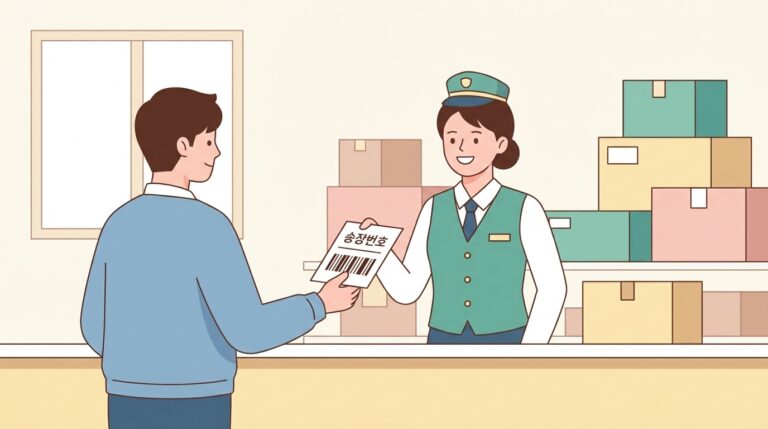
In Korea, when you ship a package at a convenience store (GS25, CU) or the Post Office (우체국), you get a paper receipt with a barcode. Instead of typing out a long 12-digit number (and risking a typo!), the ultimate polite shortcut is to lay the receipt flat, take a clear, well-lit photo from directly above, and send it. When sending the photo, it’s polite to crop or highlight the 송장번호 (tracking number) so the receiver doesn’t have to squint to find it.
4-2. Korea’s “Ppali-Ppali” Delivery Culture
Korea’s delivery infrastructure is world-class. You have “Dawn Delivery” (새벽배송) and “Same-Day Delivery” (당일배송). Because things move so fast, sharing the tracking number as soon as you step out of the post office is considered basic courtesy. Leaving a buyer waiting for a tracking number for more than a few hours might make them anxious that they’ve been scammed!
Phase 5: Real-Life Roleplay Scenario
The Setup: Minjun (민준) has just sent a box of Korean snacks to Sophie (소피), an exchange student friend who moved back home. They are chatting on KakaoTalk.
- 민준: 소피! 방금 우체국에서 택배 보냈어.
(Sophie! Bang-geum u-che-guk-e-seo taek-bae bo-naes-seo.)
“Sophie! I just sent the parcel from the post office.” - 소피 (🎭 Excitedly): 우와, 정말? 고마워 민준아! 벌써 기대된다.
(U-wa, jeong-mal? Go-ma-wo Min-jun-a! Beol-sseo gi-dae-doen-da.)
“Wow, really? Thanks, Minjun! I’m already looking forward to it.” - 민준 (🎭 Sending a photo): 📷 [사진] 여기 송장 번호 찍어 보낼게!
(Yeo-gi song-jang beon-ho jji-geo bo-nael-gae!)
“[Photo] Here, I’ll snap a picture of the tracking number and send it!” - 소피: 오, 사진 잘 보인다! 이거 조회는 어디서 해?
(O, sa-jin jal bo-in-da! I-geo jo-hoe-neun eo-di-seo hae?)
“Oh, the photo is very clear! Where do I track this?” - 민준: 네이버에 ‘우체국 택배 조회’ 검색하고 번호 치면 바로 나와.
(Ne-i-beo-e ‘u-che-guk taek-bae jo-hoe’ geom-saek-ha-go beon-ho chi-myeon ba-ro na-wa.)
“Just search ‘Post Office Delivery Tracking’ on Naver and type the number, it will show up right away.” - 소피 (🎭 Grateful): 아하, 그렇구나. 알려줘서 고마워!
(A-ha, geu-reoh-gu-na. Al-ryeo-jwo-seo go-ma-wo!)
“Ah, I see. Thanks for letting me know!” - 민준: 응, 도착하면 연락해 줘!
(Eung, do-chak-ha-myeon yeon-rak-hae jwo!)
“Yep, let me know when it arrives!” - 소피: 응, 도착하자마자 바로 인증샷 보낼게!
(Eung, do-chak-ha-ja-ma-ja ba-ro in-jeung-syat bo-nael-gae!)
“Yes, as soon as it arrives, I’ll send a proof shot!”
🔀 Choose Your Reply!
If you were Sophie, how would you respond when Minjun sends the photo?
- Option A: “확인했어요! 감사합니다.” (Hwa-gin-haes-seo-yo! Gam-sa-ham-ni-da.)
- Feedback (Risk): Too formal! Minjun spoke casually (반말), so answering in high formal Korean makes a distance between friends.
- Option B: “응, 확인했어! 진짜 고마워!” (Eung, hwa-gin-haes-seo! Jin-jja go-ma-wo!)
- Feedback (Best!): Perfect! It matches his casual tone, confirms you got it, and expresses warm gratitude.
- Option C: “응, 송장 번호 받았음.” (Eung, song-jang beon-ho ba-dat-eum.)
- Feedback (Bad): Ending with “-음” is a very blunt, robotic texting style. It can make you sound annoyed or cold to a close friend.
Phase 6: 10-Second Emotion Shadowing Drill
Let’s practice speaking with real Korean emotion! Watch the slashes / for natural pauses.
- [😊 Expressing helpful enthusiasm]
- 송장 번호 / 바로 / 보내드릴게요!
- Song-jang beon-ho / ba-ro / bo-nae-deu-ril-gae-yo!
- “I’ll send you the tracking number / right away!”
- [🥺 Softly requesting information]
- 혹시 / 송장 번호 / 알려주실 수 있나요?
- Hok-si / song-jang beon-ho / al-ryeo-ju-sil su in-na-yo?
- “By any chance / the tracking number / could you let me know?”
Phase 7: K-Culture Mini Dictionary
- 택배 (Taek-bae) | Parcel / Courier Delivery. The ultimate backbone of modern Korean convenience.
- 인증샷 (In-jeung-syat) | Proof shot / Certification photo. Taking a picture to prove you received a package or visited a cool place.
- 송장 (Song-jang) | Shipping invoice / tracking sticker attached to a box.
- 우체국 (U-che-guk) | Post office. Highly trusted and beloved for international EMS shipping.
Phase 8: Survival Kit for Travelers
Survival Expressions TOP 3
- “이거 해외 배송 돼요?” (I-geo hae-woe bae-song dwae-yo?)
- Meaning: Does this ship internationally?
- Pro Tip: Ask this at souvenir shops or pop-up stores in Insadong or Myeongdong!
- “송장 번호 어디 있어요?” (Song-jang beon-ho eo-di is-seo-yo?)
- Meaning: Where is the tracking number (on this paper)?
- Pro Tip: Use this if you can’t find the numbers on a busy post office receipt.
- “택배 상자 어디서 사요?” (Taek-bae sang-ja eo-di-seo sa-yo?)
- Meaning: Where do I buy delivery boxes?
- Pro Tip: At Korean post offices, you can buy boxes of various sizes near the packing station.
Editor’s Travel Note
When tracking a package in Korea, you don’t need fancy software. Simply open the Naver App (your absolute go-to search engine in Korea) and type 택배 조회 (delivery search). A simple form will appear where you can select the courier company and paste your tracking number. Easy-peasy!
Phase 9: “Going Deeper” (Thought Reflection)
In Korea, delivery workers are affectionately called 택배 기사님 (Taek-bae Gi-sa-nim). The term 기사님 is a title of respect used for skilled professionals (like taxi and bus drivers). This linguistic detail highlights Korea’s community-centric mindset; despite the fast-paced transactions, there is a cultural acknowledgment of the hard work done by delivery personnel to bring convenience to your doorstep. Next time you receive a package, typing a quick “기사님 감사합니다!” (Thank you, Mr. Delivery Driver!) is a beautiful way to practice your Korean values.
💬 Your Turn: Have you ever sent a package in Korea, or received one from a Korean friend? Let us know in the comments below how you handled the tracking!
Phase 10: FAQ & Common Mistakes
Q: Can I use “추적 번호” (Chu-jeok beon-ho) for tracking number?
A: While “추적” (chu-jeok) literally translates to “tracking/tracing” (like in detective movies), native Koreans rarely say “추적 번호” for retail deliveries. Use 송장 번호 (invoice number) or 배송 조회 번호 (delivery inquiry number) instead.
Q: Is it okay to say “송장 번호 주세요” to an older store owner?
A: To keep it incredibly polite, add “혹시” (by any chance) and use the ending “-해주실 수 있으세요?” (Could you please do…?). Say: “혹시 송장 번호 알려주실 수 있으세요?”
Q: What is the difference between 택배 (Taek-bae) and 우편 (U-pyeon)?
A: 택배 refers to box parcels sent via courier services, while 우편 refers to traditional paper letters or documents handled by the government post office.
🚨 Common Mistakes Alert!
- Saying “트래킹 번호” (Tracking beon-ho): While some younger Koreans might understand, it sounds very unnatural. Stick to 송장 번호.
- Confusing “배송” (Bae-song) with “배달” (Bae-dal): Use 배송 for packages shipped in trucks/cargo. Use 배달 for local restaurant food deliveries (like fried chicken via Baemin!).
- Sending a blurry photo of the barcode: If the barcode or the numbers are blurred, the Naver tracking system won’t recognize it. Always double-check your photo focus!
Phase 11: Action Mission & K-Culture Challenge
- 🥉 Bronze Mission: Write “송장 번호 보내드릴게요” on a piece of paper or type it in your notes app 3 times to build muscle memory.
- 🥈 Silver Mission: Take a screenshot of a fake tracking number (or a real one you have) and write a mock message to an imaginary friend using: “송장 번호 찍어 보낼게!”
- 🥇 Gold Mission: Use this phrase next time you buy K-goods online or ship something at a Korean convenience store!
🎮 K-Culture Mission
Watch a slice-of-life K-Drama (like Our Blues or Because This Is My First Life). Listen closely when characters receive phone calls or text messages about packages. Can you spot the word 택배 (Taek-bae)? Report back in the comments!
Phase 12: Interactive Quiz Challenge
Test your knowledge below!
1. Which expression is the most natural to use when texting a close friend a photo of the receipt?
- A) 운송장 추적 번호를 알립니다.
- B) 송장 번호 찍어 보낼게!
- C) 택배를 보냈으니 확인하십시오.
2. True or False: “배달 (Bae-dal)” is the correct term to use when checking on a box of clothes shipped from Seoul to Busan.
🔍 Click here to reveal Answers & Explanations!
- Correct Answer: B
- Explanation: “송장 번호 찍어 보낼게!” is casual, friendly, and uses the highly natural colloquial phrase “찍어 보낼게” (I’ll snap a photo and send it).
- Correct Answer: False
- Explanation: Shipped packages use 배송 (Bae-song). 배달 (Bae-dal) is reserved for local food deliveries (like jajangmyeon or pizza) or local courier runs.







