

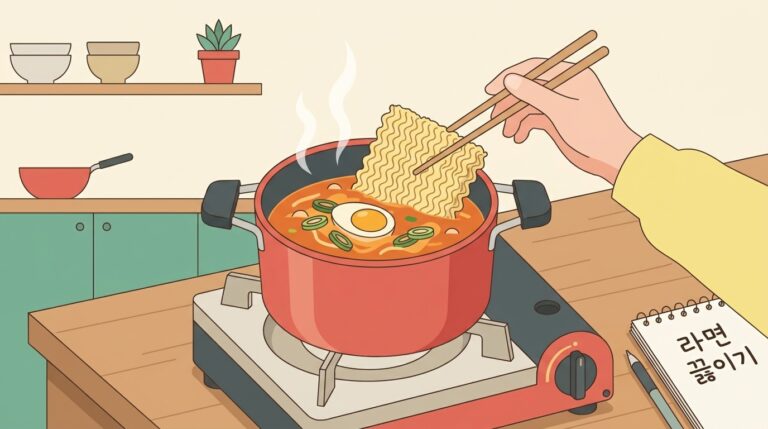
Master the Art of Instant Ramen: How to Say “Put in the Noodles” in Korean!
Phase 1: Empathy (스토리 몰입형 오프닝)
안녕하세요! (Annyeonghaseyo!) Hello there, my wonderful language learner and K-food lover! It’s your friendly neighborhood K-culture navigator from Daily Hangul (매일한글).
Picture this: You are in a cozy kitchen with your Korean friends. A beautiful pot of spicy Army Stew (Budae Jjigae, 부대찌개) or spicy ramen (Ramyeon, 라면) is bubbling furiously on the portable stove. The broth is rich, red, and smelling absolutely divine. Your friend looks at you, holds up a block of instant noodles, and asks: “Should we put the noodles in now?”
Suddenly, you freeze. You know the word for noodle (myeon, 면), and maybe you know “to put” (neota, 넣다). But how do you say it naturally without sounding like an instruction manual?
Don’t worry! This is a very common “pain point” for A2 learners. You want to cook together, share a meal, and use those cute, friendly phrases you hear in K-dramas, but textbook Korean often feels too stiff. Today, we are going to master the exact, natural phrases to say “Put the noodles in!” so you can be the ultimate cooking companion. Let’s dive in!
Phase 2: Deep-Dive into 3 Essential Expressions (핵심 표현 3선 심층 분석)
Let’s look at three ways to say this, from friendly to ultra-casual.
1. 면 넣을까요? (Myeon neoul-kkayo?)
- Pronunciation: Myeon nuh-eul-kka-yo? (Sounds like “Myun nuh-ool-cka-yo?”)
- Meaning: “Shall we put the noodles in?” / “Should I add the noodles?”
- K-Culture Moment: You will hear this in cooking reality shows (like Korean Hostel in Spain) when someone is checking in with the main chef before taking action.
- Editor’s Insight: This uses the grammar structure -(으)ㄹ까요? which means “Shall we…?” or “Do you want me to…?” It is the safest, most polite, yet friendly way to suggest adding the noodles. It shows great manners (nunchi!) in the kitchen.
- Situation Spectrum: Casual ✅ | Semi-formal ✅ | Formal ⚠️
- 🤔 Think About It: In Korean culture, cooking is rarely a solo activity when eating with others; we constantly check in with our dining partners. How does your language express this shared decision-making?
2. 면 넣어 주세요. (Myeon neoeo juseyo.)
- Pronunciation: Myeon nuh-uh ju-se-yo. (Sounds like “Myun nuh-uh joo-seh-yo.”)
- Meaning: “Please put the noodles in.”
- K-Culture Moment: A classic line in K-Dramas when the older friend (Eonni/Oppa) gently directs the younger friend who is assisting with the cooking.
- Editor’s Insight: Combining 넣다 (to put in) with -어/아 주다 (to do something for someone) softens the command. Instead of saying “Put it in!” (Neoeo!), adding 주세요 makes it a polite, warm request.
- Situation Spectrum: Casual ✅ | Semi-formal ✅ | Formal ⚠️
- 🤔 Think About It: Why does adding “do it for me” (-어 주다) make requests sound so much warmer in Korean compared to direct English imperatives?
3. 면 넣자! (Myeon neot-ja!)
- Pronunciation: Myeon nuht-ja! (Sounds like “Myun nut-jah!”)
- Meaning: “Let’s put the noodles in!”
- K-Culture Moment: Two best friends sitting in a college dorm, eagerly watching a pot of Han River instant ramen bubble up.
- Editor’s Insight: This is the banmal (반말, casual/informal) version using -자 (Let’s). Only use this with close friends of the same age or younger. It’s enthusiastic and full of high-energy hunger!
- Situation Spectrum: Casual ✅ | Semi-formal 🚫 | Formal 🚫
- 🤔 Think About It: Using banmal creates instant intimacy, but using it too early can feel rude. Do you have a similar distinction of closeness in your native tongue?
Phase 3: Textbook Korean vs. Real-Life Korean (교과서 한국어 vs. 진짜 한국어)
Let’s see how school books compare to real life at a Korean dinner table!
Situation A: Suggesting it’s time to add noodles
- 📖 Textbook: “이제 국수를 냄비에 넣으십시오.” (Ije guksu-reul naembi-e neoeusipsio. – “Now, please insert the noodles into the pot.”)
- 🗣️ Real Life: “이제 면 넣을까요?” (Ije myeon neoul-kkayo? – “Shall we put the noodles in now?”)
- 💡 Why is it different? Textbook phrases use “guksu” (traditional wheat noodles) and extremely formal imperatives (-하십시오). Real life prefers “myeon” (instant/ramen noodles) and friendly suggestions.
Situation B: Urging your friend because the water is boiling
- 📖 Textbook: “물이 끓고 있으니 면을 투하하십시오.” (Muri kkeulko isseuni myeoneul tuhahasipsio. – “Since the water is boiling, please drop the noodles.”)
- 🗣️ Real Life: “물 끓는다! 면 넣어!” (Mul kkeulneunda! Myeon neoeo! – “Water’s boiling! Put the noodles in!”)
- 💡 Why is it different? In fast-paced cooking, Koreans drop particles like ‘을/를’ and use short, exciting exclamations to keep the energy up.
Phase 4: K-Culture Deep-Dive & Non-Verbal Etiquette (K-Culture 딥다이브)
4-1. The Art of the Noodle Slide (Gesture & Nunchi)
When adding instant noodles (ramyeon) to a boiling pot, never splash!
* The Gesture: Use tongs or clean chopsticks to gently slide the noodle block into the broth. Hold the noodle block close to the surface of the water, and let it slide in away from you to avoid splashing hot spicy soup on your friends.
* Nunchi Tip: Always offer to put the noodles in for others. It shows you are caring and paying attention to the group’s needs!
4-2. Ramyeon Culture in K-Media
In Korea, sharing instant noodles is a bonding ritual. From the famous “Do you want to eat ramyeon before you leave?” (라면 먹고 갈래? – a classic romantic invitation) to cooking together in In the SOOP, ramen represents comfort and intimacy. Adding the noodles is the climax of the cooking phase—it means eating is just 3 minutes away!
Phase 5: Real-Life Roleplay Scenario (실전 롤플레이 시나리오)
Setting: You are cooking Budae Jjigae (Army Stew) at home with your friendly Korean classmate, Minho (민호). The stew is starting to boil beautifully.
- Minho: “와, 냄새 진짜 좋다!” (Wow, the smell is really good!)
- You: “맞아요! 국물이 엄청 빨개요.” (Agree! The soup is super red.)
- Minho: “슬슬 배고프다. 우리 슬라이스 치즈도 넣었어?” (Getting hungry. Did we put the sliced cheese in?)
- You: “네, 치즈는 벌써 넣었어요.” (Yes, I already put the cheese in.)
- Minho: “오, 나이스! 그럼 이제 뭐 해야 되지?” (Oh, nice! Then what should we do now?)
- You (🎭 Excitedly pointing to the ramen pack): “이제 면 넣을까요?” (Shall we put the noodles in now?)
- Minho: “좋아! 빨리 넣자. 배고파서 현기증 나!” (Great! Let’s put them in quick. I’m dizzy from hunger!)
- You (🎭 Carefully sliding the noodles in): “면 넣었어요! 3분만 기다려요.” (I put the noodles in! Just wait 3 minutes.)
- Minho: “최고다! 먹을 준비 하자!” (You’re the best! Let’s get ready to eat!)
🔀 Interactive Choice Points
If Minho asks: “물이 끓는데 면 언제 넣을까?” (The water is boiling, when should we put the noodles in?)
- Choice A: “지금 면 넣자!” (Let’s put the noodles in now!)
- Choice B: “면을 투하하십시오.” (Please drop the noodles – textbook style.)
- Choice C: “면 넣지 마세요.” (Don’t put the noodles in.)
Feedback:
- Best (Choice A): Perfect! It’s casual, natural, and shows great chemistry with Minho.
- Risk (Choice B): Too robotic! Minho might laugh because you sound like an army general.
- Bad (Choice C): Oh no! Why are we starving poor Minho? The noodles are the best part!
Phase 6: 10-Second Emotion Shadowing Drill (10초 감정 섀도잉 드릴)
Let’s practice speaking with real Korean feelings!
- [😊 Friendly & Checking in]
- “이제 / 면 / 넣을까요?“
- I-je / myeon / neoul-kkayo?
- [🔥 Hungry & Urgent]
- “물 끓는다! / 면 넣어!“
- Mul kkeulneunda! / Myeon neoeo!
- [🥳 Super Excited]
- “와! / 면 넣자!“
- Wa! / Myeon neot-ja!
Phase 7: K-Culture Mini-Dictionary (K-Culture 미니 사전)
- 사리 (Sari): Extra add-ins for stews, most commonly ramen noodles (ramyeon sari, 라면 사리).
- 꼬들꼬들 (Kkodeul-kkodeul): The perfect “al dente” texture for Korean noodles. Slightly chewy!
- 퍼지다 (Peojida): When noodles get soggy and overcooked. (e.g., “면 불었어!” – The noodles are bloated!)
- 국물 (Gungmul): The precious, savory broth or soup of the dish.
Phase 8: Survivor Kit for Travelers (여행자를 위한 생존 키트)
Survival Phrases TOP 3
- “라면 사리 추가해 주세요.” (Ramyeon sari chuga-hae juseyo.) – “Please add a ramen noodle refill.” (Useful in restaurants!)
- “육수 더 부어 주세요.” (Yuksu deo bueo juseyo.) – “Please pour more broth.” (Do this before adding new noodles so they cook well!)
- “면이 꼬들해요.” (Myeoni kkodeul-haeyo.) – “The noodles are perfectly chewy.”
💡 Editor’s Travel Note: When traveling and looking for the best noodle joints, make sure to search on the Naver Map App using the keyword “부대찌개 맛집” (Army Stew hot places) or “라면 사리 무한리필” (Unlimited noodle refills)! Note: Restaurant policies may change, so always check recent reviews.
Phase 9: “One Step Deeper” Reflection (한 발 더 깊이)
In Korea, eating instant ramen is not just a cheap meal; it is a shared social bonding experience. By asking “Shall we put the noodles in?”, you are inviting others into a collective timing ritual. In a society that highly values doing things together (uri, 우리 – “we”), cooking ramyeon is a micro-collaboration of heat, soup, and time.
💬 Your Turn: Do you prefer your noodles kkodeul-kkodeul (chewy) or soft? Let me know in the comments below!
Phase 10: FAQ & Common Mistakes (자주 묻는 질문)
Q: Can I use “면 넣으세요” (Myeon neoeuseyo) to my boss?
A: It is grammatically polite, but since it is a direct command (“Please put it in”), it is better to ask “면 넣을까요?” (Shall I/we put the noodles in?) to show deference and give them the choice.
Q: What is the difference between 국수 (Guksu) and 면 (Myeon)?
A: Guksu usually refers to traditional Korean wheat noodles (like warm banquet noodles). Myeon is a broader term and is almost always used for instant ramen, pasta, or Chinese-style noodles.
Q: My friend said “면 불겠다!” (Myeon bulgetda!). What does that mean?
A: It means “The noodles are going to get soggy/overcooked!” It’s a signal to start eating immediately!
🚨 Common Mistakes Alert!
- Saying “면을 던져요” (Myeoneul deonjyeoyo – “Throw the noodles”): Please don’t throw them into the boiling soup! Use 넣다 (neota – to put in) instead.
- Using “면 넣자” to an elder: This is banmal. To your older friends or colleagues, always stick to “면 넣을까요?”.
Phase 11: Action Mission (액션 미션)
- 🥉 Bronze: Say “면 넣을까요?” out loud 3 times in front of your mirror today.
- 🥈 Silver: Post a photo of your next noodle meal on Instagram and tag us with the caption: “이제 면 넣자! 🍜”
- 🥇 Gold: Next time you cook noodles with a friend or family member, ask them in Korean: “면 넣을까요?”
Phase 12: Interactive Quiz Challenge (인터랙티브 퀴즈)
1. What is the most natural, polite way to ask a group “Shall we add the noodles?”
a) 면 넣어라!
b) 면 넣을까요?
c) 면을 투하하십시오.
2. True or False: “꼬들꼬들” (Kkodeul-kkodeul) means soggy, overcooked noodles.
👀 Click here to reveal the Answers & Explanations!
- Correct Answer: b) 면 넣을까요?
- Explanation: It’s the perfect mix of friendly, polite, and natural!
- Correct Answer: False!
- Explanation: “꼬들꼬들” means perfectly chewy and al dente. Soggy noodles are “불었다” (bureotda).






