

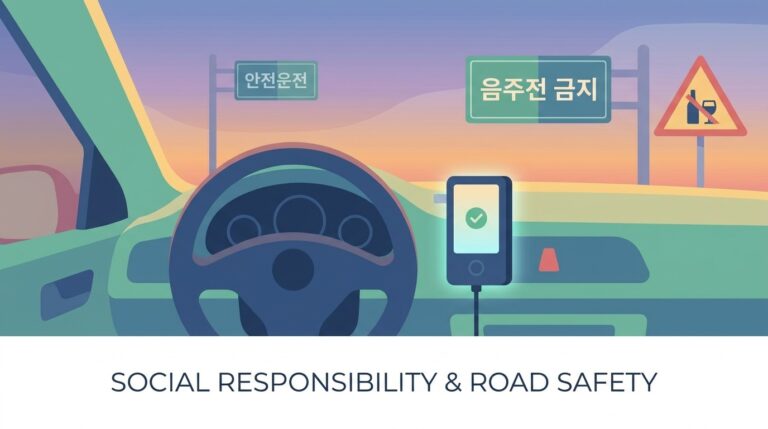
Navigating Social Responsibility: Korea’s Heated Debate on Ignition Interlock Devices (음주 운전 시동 잠금 장치)
안녕하세요! It’s your Daily Hangul editor and your cultural navigator. Have you ever been out with Korean friends or colleagues for a round of chimaek (치맥 – chicken and beer) or hoe-sik (회식 – company dinner), only to wonder how everyone plans to get home safely? In Korea, driving under the influence (DUI) is not just a legal violation; it is one of the most socially condemned actions, often sparking intense national debates.
Today, we are diving deep into a highly sophisticated, real-world topic that dominates Korean newsrooms, legal forums, and dinner-table debates: The implementation of Ignition Interlock Devices (음주 운전 시동 잠금 장치).
As a C2 (Mastery) level learner, you are ready to move beyond basic survival phrases. This guide will equip you with the nuanced, high-level vocabulary and cultural contexts needed to hold your own in serious debates, professional meetings, or intellectual conversations with native speakers about Korean public policy and social responsibility.
Phase 2: High-Level Vocabulary & Expression Analysis
To discuss complex policy issues, you need vocabulary that goes beyond everyday slang. Here are three critical terms essential for discussing legal and social reforms in Korean.
1. 음주 운전 시동 잠금 장치 (Eum-ju un-jeon si-dong jam-geum jang-chi)
- Pronunciation: Oom-ju oon-jeon shi-dong jahm-gum jahng-chi (Think of “oom” as in “gloom”, “si-dong” as starting a car engine, and “jang-chi” as a mechanical device)
- Meaning: Ignition Interlock Device (IID) / Breath Alcohol Ignition Interlock Device (BAIID)
- K-Culture Moment: You will hear this term frequently on Korean investigative journalism shows like SBS I Want to Know That (그것이 알고 싶다) or evening news broadcasts discussing road safety laws.
- Editor’s Insight: This compound noun is made of three distinct concepts: 음주 운전 (DUI/drunk driving) + 시동 (engine ignition) + 잠금 장치 (locking mechanism). Mastering compound nouns like this is a hallmark of C2-level proficiency.
- Situation Spectrum: Casual: ⚠️ | Semi-formal: ✅ | Formal: ✅
- 🤔 Think About It: How does your home country regulate repeat DUI offenders compared to Korea’s emerging policies?
2. 예방적 차원 (Ye-bang-jeok cha-won)
- Pronunciation: Yeh-bahng-jeok cha-won (Rhymes with “yay-bang” + “cha-one”)
- Meaning: As a preventive measure / On a preventative level
- K-Culture Moment: Used by policymakers in administrative meetings or when experts debate the efficacy of new laws on debate panels.
- Editor’s Insight: While “예방” means prevention, adding “~적 차원” elevates your speech, signaling that you are analyzing the issue from a systemic or philosophical perspective rather than just stating personal opinions.
- Situation Spectrum: Casual: 🚫 | Semi-formal: ✅ | Formal: ✅
- 🤔 Think About It: Is it better for laws to be strictly punitive, or should they focus heavily on the ye-bang-jeok cha-won?
3. 실효성 논란 (Sil-hyo-seong nol-lan)
- Pronunciation: Sheel-hyo-seong nol-lahn (Note the nasalization: “nol-lan” sounds closer to “nol-lan” rather than “nol-ran”)
- Meaning: Controversy over effectiveness/practicality
- K-Culture Moment: This phrase is the ultimate headline-maker in Korean media. Whenever a new government policy is proposed, journalists analyze its sil-hyo-seong nol-lan.
- Editor’s Insight: “실효성” translates to “actual effectiveness” or “fruitfulness”. When combined with “논란” (controversy/dispute), it describes a situation where critics question whether a proposed solution will actually solve the problem in reality.
- Situation Spectrum: Casual: ⚠️ | Semi-formal: ✅ | Formal: ✅
- 🤔 Think About It: Why do many well-intentioned public safety devices face sil-hyo-seong nol-lan when first introduced?
Phase 3: Textbook Korean vs. Real-World Debate Korean
When discussing complex policies, textbook phrasing can sound overly rigid or unnaturally simplistic. Let’s look at how to sound like an articulate legal expert or informed citizen.
Scenario 1: Expressing that a law should be implemented
- 📖 Textbook Korean: 음주 운전을 막기 위해 장치를 설치해야 합니다. (We must install devices to stop drunk driving.)
- 🗣️ Real-World Korean: 재범률을 낮추기 위해 시동 잠금 장치 도입을 의무화해야 한다는 목소리가 높습니다. (There is a strong public voice demanding that the installation of ignition interlocks be mandated to reduce recidivism rates.)
- 💡 Why the Difference? C2 speakers use passive public opinion structures (“~해야 한다는 목소리가 높습니다”) and precise terms like 재범률 (recidivism rate) and 의무화 (mandating) to convey objective social trends.
Scenario 2: Pointing out potential loopholes
- 📖 Textbook Korean: 다른 사람이 불어주면 시동이 걸릴 수 있어요. (If someone else blows into it, the car might start.)
- 🗣️ Real-World Korean: 대리 측정이나 시스템 우회 등 원천적 차단이 불가능하다는 기술적 한계가 존재합니다. (Technical limitations exist, making absolute prevention impossible due to proxy blowing or system bypassing.)
- 💡 Why the Difference? Instead of simple verbs, high-level Korean uses Hanja-based nouns like 대리 측정 (proxy measurement), 원천적 차단 (fundamental prevention), and 기술적 한계 (technical limitation) to build a sophisticated argument.
Phase 4: K-Culture Deep Dive & Non-Verbal Nuances
4-1. Physicality & Debate Etiquette
When debating hot-button social issues like DUI laws in Korea, maintaining professional decorum is vital:
* The Head Nod (끄덕임): Even if you disagree completely with the other party’s point, nod slightly while they speak. This shows you are intellectually engaging with their perspective, not dismissing it.
* Softening Prefaces: Always soften counter-arguments. Use phrases like “말씀하신 취지에는 전적으로 공감합니다만…” (I fully agree with the intent of your point, but…) to keep the conversation collaborative.
4-2. The Cultural Landscape of DUI in Korea
Korea has a unique drinking culture deeply tied to corporate networking (hoe-sik). While drinking together is highly encouraged to build team cohesion, driving afterward is strictly taboo. The introduction of 대리운전 (designated driver service apps) revolutionized Korean nightlife. Now, the debate surrounding the Ignition Interlock Device (음주 운전 시동 잠금 장치) represents the next step: using technology to enforce moral and legal compliance when social responsibility fails.
Phase 5: Interactive Roleplay Scenario
Setting: A high-level public policy forum panel. You (Ji-hoon) are debating with Eun-jung, a representative from a legal reform NGO.
Character Profiles:
- 지훈 (Ji-hoon – You): A pragmatic legal consultant advocating for tech-based prevention.
- 은정 (Eun-jung): A human rights and policy analyst concerned about cost, privacy, and systemic loopholes.
은정: 지훈 씨, 이번에 발의된 음주 운전 시동 잠금 장치 의무화 법안에 대해 어떻게 생각하십니까?
      (Ji-hoon, what are your thoughts on the newly proposed bill mandating ignition interlocks?)

지훈: 🎭 [단호하면서도 이성적인 톤으로]
      재범률을 낮추기 위한 예방적 차원에서는 확실히 도입해야 할 시점이라고 봅니다.
      (From a preventive perspective to lower recidivism rates, I believe it is definitely time to introduce it.)

은정: 취지에는 공감하지만, 장치 설치 비용을 운전자 개인에게 전가하는 것은 또 다른 규제가 아닐까요?
      (I agree with the intent, but isn't passing the installation cost onto individual drivers another form of regulation?)

지훈: 🎭 [고개를 가볍게 끄덕이며]
      재정적 부담 문제는 보조금 지원이나 단계별 도입을 통해 해결할 수 있다고 생각합니다.
      (I think the financial burden issue can be resolved through subsidies or phased implementation.)

은정: 하지만 대리 측정이나 우회 시도를 기술적으로 원천 차단하기 어렵다는 실효성 논란도 뜨겁습니다.
      (But there is also a heated controversy over its effectiveness, as it is technologically difficult to fundamentally block proxy blowing or bypass attempts.)

지훈: 🎭 [논리적인 미소를 지으며]
      물론 완벽한 기술은 없지만, 안면 인식 카메라 탑재 등 기술적 보완이 병행된다면 실효성을 극대화할 수 있습니다.
      (Of course, no technology is perfect, but if technological supplements like facial recognition cameras are run in parallel, we can maximize its effectiveness.)

은정: 결국은 처벌 수위를 높이는 사법적 해결이 선행되어야 근본적인 해결책이 되지 않을까요?
      (In the end, shouldn't judicial solutions that raise punitive sentencing take precedence to become a fundamental solution?)

지훈: 🎭 [차분하게 경청한 후 대답하며]
      사법적 처벌도 중요하지만, 기술을 통한 선제적 차단이 소중한 생명을 살리는 가장 확실한 안전장치입니다.
      (Judicial punishment is also important, but preemptive prevention through technology is the most certain safety device to save precious lives.)
🔀 Your Move: How will you respond to Eun-jung’s final counter-point?
- Choice A: “맞는 말씀입니다만, 처벌만으로는 한계가 있기에 병행해야 합니다.” (You are right, but punishment alone has limits, so they must be done in tandem.)
- Choice B: “처벌 강화는 아무 소용 없습니다. 오직 기술만이 답입니다.” (Strengthening punishment is useless. Only technology is the answer.)
- Choice C: “그 문제는 법조계에서 알아서 할 일이라고 생각합니다.” (I think that issue is for the legal community to handle on their own.)
🧐 Turn Feedback:
- Choice A (Best): Excellent! It shows diplomatic communication, acknowledging her point before introducing your balanced, dual-track solution.
- Choice B (Bad): Too dismissive and aggressive. In Korean professional settings, stating a technology-only approach so bluntly can make you sound combative.
- Choice C (Risk): Deflective. This ends the debate abruptly and signals a lack of critical engagement with the policy issue.
Phase 6: 10-Second Emotional Shadowing Drill
To sound truly native, you must practice the rise and fall of professional debate cadence. Pay close attention to the pause markers (/) and emotional cues.
Sentence 1: Presenting a balanced, logical argument
- Expression: “예방적 차원에서의 도입은 / 더 이상 미룰 수 없는 / 시대적 과제입니다.”
- Pronunciation Guide: Ye-bang-jeok cha-won-e-seo-ui do-ib-eun / deo i-sang mi-rul su eob-neun / si-dae-jeok gwa-je-im-ni-da.
- Emotion Target:
[😎 Calm, authoritative, and deeply persuasive] - English Meaning: “Introduction as a preventive measure is a timely task that can no longer be delayed.”
Sentence 2: Softening a disagreement
- Expression: “우려하시는 부분도 / 충분히 이해하지만, / 기술적 보완이 가능합니다.”
- Pronunciation Guide: U-ryeo-ha-si-neun bu-bun-do / chung-bun-hi i-hae-ha-ji-man, / gi-sul-jeok bo-wan-i gang-eung-ham-ni-da.
- Emotion Target:
[🤝 Empathetic yet confident] - English Meaning: “I fully understand your concerns, but technological supplements are highly possible.”
Phase 7: K-Culture Mini-Dictionary
- 재범률 (Jae-beom-ryul) | Recidivism Rate
- Essential in policy discussions. It refers to the percentage of repeat offenders who commit the same crime again.
- 소잃고 외양간 고치기 (So-il-go oe-yang-gan go-chi-gi) | Mending the barn after losing the cow
- A classic Korean idiom equivalent to “locking the stable door after the horse has bolted.” Frequently used to criticize retroactive laws rather than preventive technology.
- 대리측정 (Dae-ri cheuk-jeong) | Proxy Measurement
- In the context of ignition interlocks, this refers to a third party blowing into the device on behalf of an intoxicated driver.
- 입법 공백 (Ip-beob gong-baek) | Legislative Vacuum / Loophole
- A high-level political term referring to a period or area where laws do not yet exist to regulate a new phenomenon or technology.
Phase 8: Navigator’s Survival Kit for Drivers
If you plan to drive in Korea, these survival tools and expressions are absolute necessities.
Survival Expressions:
- “대리운전 좀 불러주세요.” (Dae-ri-un-jeon jom bul-leo-ju-se-yo.)
- Pro Tip: Use this at a restaurant if your phone battery is dead and you need the staff to call a designated driver service.
- “음주 단속 중입니다.” (Eum-ju dan-sok jung-im-ni-da.)
- Pro Tip: If you see police flashlights on the road, they are conducting a random breathalyzer test. Remain calm, roll down your window, and blow into the device when instructed.
- “대리 기사님 호출했습니다.” (Dae-ri gi-sa-nim ho-chul-haet-seom-ni-da.)
- Pro Tip: Inform your colleagues or parking attendants that you have already summoned a designated driver.
🚗 Editor’s Travel Note:
When drinking in Korea, never risk driving. The easiest way to get home safely is by using the Kakao T App to call a designated driver (대리운전). The driver will meet you at your car, drive you home in your own vehicle, and park it safely for you. Note: Prices vary depending on weather, demand, and distance.
Phase 9: “A Step Deeper” – Cultural Reflection
Korea’s debate over the 음주 운전 시동 잠금 장치 reflects a fascinating shift in the collective consciousness. Historically, Korean society viewed drinking with a degree of leniency—often calling it gwan-yong (관용 – tolerance) towards social interactions. However, a series of tragic, high-profile incidents led to the creation of the Yoon Chang-ho Law (윤창호법), drastically increasing penalties for DUI. Today, the collective mindset prioritizes public safety over individual convenience. It demonstrates that the modern Korean community is increasingly intolerant of social hazards, driving technological and legislative innovations to protect the collective well-being.
💬 Your Turn: How does your home country balance technological prevention (like IIDs) with punitive measures? Leave a comment below with your thoughts!
Phase 10: FAQ & Common Mistakes
Q: Is the Ignition Interlock Device currently mandatory for all cars in Korea?
A: No, it is not mandatory for all drivers. However, recent legislation mandates its installation specifically for habitual DUI offenders as a condition for reinstating their driver’s licenses.
Q: Can I say “술 마시고 운전했어요” in a formal debate?
A: While grammatically correct, it sounds too informal. In professional, legal, or debate settings, always use the formal term 음주 운전 (Eum-ju un-jeon) instead of “술 마시고 운전”.
Q: What is the difference between 대리운전 (Dae-ri un-jeon) and 택시 (Taxi)?
A: A taxi transports you in the taxi driver’s car. Dae-ri un-jeon is a service where a professional driver drives your own car home for you because you are intoxicated.
🚨 Common Pitfall Alert for C2 Learners:
- Incorrect: 음주 운전 예방 기계를 설치합시다. (Let’s install drunk driving prevention machines.)
- Correct Action: Use the official legislative term: 음주 운전 시동 잠금 장치 (Ignition Interlock Device). Using “기계” (machine) instead of “장치” (device) sounds unpolished in legal debates.
Phase 11: Action Mission & Challenge
- Bronze Challenge: Write a 3-sentence opinion in Korean about whether DUI laws should focus on punishment or prevention.
- Silver Challenge: Record yourself reading our Phase 6 Shadowing Drill and focus on achieving a professional, calm debate tone.
- Gold Challenge: Watch a Korean news debate regarding 시동 잠금 장치 on YouTube and write down three additional vocabulary words you identify.
Phase 12: Interactive Quiz Challenge
Test your mastery of today’s C2-level driving and policy lesson!
Q1. Which phrase means “controversy over actual effectiveness”?
- A) 실효성 논란 (Sil-hyo-seong nol-lan)
- B) 예방적 차원 (Ye-bang-jeok cha-won)
- C) 의무화 도입 (Ui-mu-hwa do-ib)
Reveal Answer & Explanation
Correct Answer: A
* Explanation: 실효성 논란 means “controversy over effectiveness.” B means “preventive level/measure,” and C means “mandatory introduction.”
Q2. True or False: “대리 측정” refers to hiring a designated driver to take you home safely.
Reveal Answer & Explanation
Correct Answer: False
* Explanation: Hiring a driver is 대리운전 (Dae-ri un-jeon). 대리 측정 (Dae-ri cheuk-jeong) refers to proxy breathalyzer measurement (having someone else blow into the interlock device for you, which is illegal).







