

안녕하세요! Welcome back to Daily Hangul! 🌸
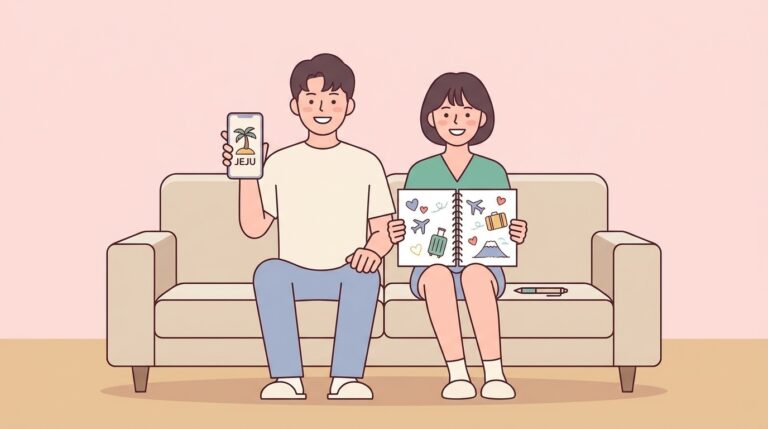
Are you and your partner dreaming of the perfect honeymoon? Planning a honeymoon—or as we call it in Korea, 신혼여행 (sin-hon-yeo-haeng)—is one of the most exciting yet dizzying parts of getting married.
In Korea, choosing the ultimate honeymoon spot is a major milestone. Do we go for the classic tropical paradise of Hawaii, or do we opt for the trendy, domestic beauty of Jeju Island? Modern Korean couples spend weeks debating budgets, itineraries, and “Instagrammable” spots.
If you’ve ever felt overwhelmed by planning a trip with your partner, or if you want to understand how young Koreans discuss, negotiate, and finalize their dream getaways, you are in the right place! Today, we’ll dive into the essential mid-intermediate (B2) Korean expressions used during honeymoon planning, complete with cultural nuances that will make you sound like a local. Let’s get planning! ✈️
Phase 2: Top 3 Essential Expressions for Honeymoon Planning
1. 의견을 조율하다 (ui-gyeon-eul jo-yul-ha-da)
- Pronunciation: Wee-gyeon-eul jo-yool-ha-da (Sounds like “we” + “gyun” + “ool” + “jo” + “yool” + “ha-da”)
- Meaning: To tune/align opinions; to compromise.
- K-Culture Moment: You will hear this constantly in Korean wedding reality shows. When one partner wants a relaxing beach resort (휴양지 – hyu-yang-ji) and the other wants an active city tour (관광지 – gwan-gwang-ji), they must “조율하다” to find middle ground.
- Editor’s Insight: The word “조율” originally refers to tuning a musical instrument (like a piano). Using it for human opinions suggests a delicate, harmonious process of alignment, rather than a harsh argument.
- Situation Spectrum: Casual ⚠️ | Semi-formal ✅ | Formal ✅
- 🤔 Think About It: In your culture, is planning a trip seen as an individual task or a collaborative project of compromise? How does the metaphor of “tuning an instrument” change how you view compromises?
2. 가성비가 좋다 (ga-seong-bi-ga jot-da)
- Pronunciation: Ga-seong-bee-ga jot-tah (Sounds like “gah” + “sung” + “bee” + “gah” + “jot” + “tah”)
- Meaning: Great cost-performance ratio; highly cost-effective.
- K-Culture Moment: Young Korean couples are highly practical. While a honeymoon is a once-in-a-lifetime luxury, discussing “가성비” (Value for Money) is no longer taboo—it is considered smart and realistic.
- Editor’s Insight: The opposite is “가심비” (ga-sim-bi), which means “emotional satisfaction regardless of the price.” For a honeymoon, couples often balance both!
- Situation Spectrum: Casual ✅ | Semi-formal ✅ | Formal 🚫
- 🤔 Think About It: Why do you think modern couples prioritize “cost-effectiveness” even for their honeymoons? Is there a similar slang word in your native language?
3. 일정을 짜다 (il-jeong-eul jja-da)
- Pronunciation: Eel-jeong-eul jja-da (Sounds like “eel” + “jung” + “ool” + “jah” + “dah” with a double ‘j’ sound)
- Meaning: To map out/make a schedule.
- K-Culture Moment: In K-Dramas, the hyper-organized partner usually pulls out a color-coded iPad or Notion page to “일정을 짜다,” much to the horror of their more spontaneous partner.
- Editor’s Insight: The verb “짜다” means to weave or knit. When you weave a schedule, you are carefully interlocking different times, places, and activities together.
- Situation Spectrum: Casual ✅ | Semi-formal ✅ | Formal ⚠️
- 🤔 Think About It: Are you a meticulous planner (“일정을 꼼꼼히 짜는 스타일”) or a go-with-the-flow traveler?
Phase 3: Textbook Korean vs. Real-Life Korean
Situation 1: Deciding on the honeymoon destination
- 📖 Textbook: “신혼여행지로 어디가 좋습니까?” (Where is a good place for a honeymoon?)
- 🗣️ Real-Life: “우리 신혼여행 어디로 조율해 볼까? 휴양지가 좋아, 관광지가 좋아?” (Where should we align our honeymoon destination? Do you prefer a relaxing spot or a sightseeing spot?)
- 💡 Why the difference?: Modern Koreans prefer specific, lifestyle-focused options (휴양 vs. 관광) rather than open-ended, overly polite textbook questions.
Situation 2: Discussing the budget
- 📖 Textbook: “비용이 너무 비쌉니다.” (The cost is too expensive.)
- 🗣️ Real-Life: “여기는 가성비가 너무 떨어지는 것 같아. 가심비로 가든지, 아니면 다른 데 알아보자.” (I think this place has terrible cost-effectiveness. Let’s either go for emotional satisfaction, or look elsewhere.)
- 💡 Why the difference?: Using slang terms like “가성비가 떨어지다” (poor value) or “가심비” (emotional value) makes the financial conversation sound more casual and less stressful.
Phase 4: K-Culture Deep Dive & Non-Verbal Manners
4-1. The Art of “Nunchi” (눈치) in Travel Planning
When planning a honeymoon in Korea, “Nunchi” (tact/social reading) is key. If your partner says “아무 데나 괜찮아” (Anywhere is fine), doing a quick “Nunchi scan” is vital. It usually means “I want you to take the lead, but please choose something I secretly like.” Pay attention to their sighs or facial expressions when browsing hotel photos!
4-2. Cultural Code: “Jeju-do” (제주도) vs. “Overseas” (해외)
Historically, Jeju Island was the ultimate honeymoon destination for Koreans in the 1980s. While overseas travel became the standard later, Jeju made a massive comeback during recent years as a trendy, premium alternative. Many couples now do “반반” (half-and-half): luxury resorts in Jeju combined with high-end dining.
Phase 5: Real-Life Roleplay Scenario
Characters:
- Min-jun (민준): The practical, budget-conscious groom-to-be who loves spreadsheet planning.
- Ji-won (지원): The romantic bride-to-be who values unique experiences (“가심비”).
Min-jun: 지원아, 우리 신혼여행 일정 슬슬 짜야 하지 않을까?
        (Ji-won-ah, shouldn't we start weaving our honeymoon schedule soon?)

Ji-won: 🎭 (눈반짝이며 핸드폰을 보여주며) 응! 안 그래도 하와이 호텔 알아보고 있었어. 여기 어때? 너무 예쁘지?
        (Yeah! Actually, I was looking up hotels in Hawaii. How about here? Isn't it gorgeous?)

Min-jun: 🎭 (가격을 보고 침을 삼키며) 와, 진짜 예쁘다. 근데... 1박에 이 가격이면 가성비가 좀 떨어지지 않아?
        (Wow, it really is pretty. But... at this price per night, isn't the cost-effectiveness a bit low?)

Ji-won: 🎭 (살짝 시무룩해지며) 신혼여행이잖아~ 일생에 딱 한 번인데 가심비로 가야지!
        (It's our honeymoon~ It only happens once in a lifetime, so we should go for emotional satisfaction!)

Min-jun: 🎭 (미안한 듯 손을 저으며) 당연하지! 내가 눈치가 없었네. 그럼 우리 예산을 조금만 조율해 볼까?
        (Of course! I was being tactless. Then, shall we align our budget just a little bit?)

Ji-won: 🎭 (미소를 지으며) 그래! 휴양지 숙소는 좋은 데로 하고, 쇼핑 예산을 좀 줄이자.
        (Okay! Let's get a nice place for the resort, and cut down our shopping budget instead.)

Min-jun: 🎭 (안도하며 하이파이브를 하며) 좋아! 의견 조율 완료! 이제 세부 일정을 짜보자.
        (Perfect! Opinion alignment complete! Now let's map out the detailed schedule.)

Ji-won: 🎭 (노트를 펴며) 오케이, 첫날은 무조건 무계획 휴식이야!
        (Okay, the first day is strictly unplanned relaxation!)
🔀 Interactive Choice Points
How should Min-jun respond to Ji-won’s request for the expensive hotel?
* Option A: “우리 형편에 여기는 너무 무리야. 다른 데 찾아봐.” (This is too much for our financial situation. Look elsewhere.)
* 🚨 Feedback (Bad): Too direct and blunt! This might hurt your partner’s feelings during an already stressful wedding planning phase.
* Option B: “그래, 인생 한 번뿐인데 제일 비싼 데로 다 예약하자!” (Sure, it’s once in a lifetime, let’s book the most expensive spots!)
* ⚠️ Feedback (Risk): Super romantic, but financially risky. Real-life planning requires compromise.
* Option C: “여기 진짜 예쁘다! 우리 여기서 2박 하고, 남은 3박은 가성비 좋은 숙소로 섞는 건 어떨까?” (This is beautiful! How about we stay here for 2 nights, and mix the remaining 3 nights with cost-effective places?)
* 🏆 Feedback (Best!): Perfect “조율” (alignment)! It respects your partner’s desires while keeping the budget realistic.
Phase 6: 10-Second Emotion Shadowing Drill
Practice saying these out loud with the exact emotional markers to sound natural!
[😊 Excited & Hopeful]- “우리 / 신혼여행 / 일정 짜는 거 / 너무 설렌다!”
- U-ri / sin-hon-yeo-haeng / il-jeong jja-neun geo / neo-mu seol-ren-da!
[🥺 Slightly disappointed but cute]- “이 호텔 / 진짜 가고 싶었는데… / 가성비 / 많이 떨어져?”
- I ho-tel / jin-jja ga-go si-peot-neun-de… / ga-seong-bi / ma-ni tteo-leo-jyeo?
[🤝 Collaborative & Gentle]- “서로 양보하면서 / 의견을 조율해 봐요.”
- Seo-ro yang-bo-ha-myeon-seo / ui-gyeon-eul jo-yul-hae bwa-yo.
Phase 7: K-Culture Mini Dictionary
- 휴양지 (Hyu-yang-ji) | Resort destination focused on relaxation and rest.
- 관광지 (Gwan-gwang-ji) | Sightseeing destination focused on activities and tours.
- 인생샷 (In-saeng-syat) | The best photo of your life (literally “life shot”). Korean couples plan their itineraries around these spots.
- 패키지 vs. 자유여행 (Pae-ki-ji vs. Ja-yu-yeo-haeng) | Package tour vs. Free independent travel. This is the first major debate for every Korean couple.
Phase 8: Survivor Kit for Travelers
Survival Phrases TOP 3
- “신혼여행 특별 할인이나 이벤트가 있나요?”
- Sin-hon-yeo-haeng teuk-byeol hal-in-i-na i-ben-teu-ga it-na-yo?
- Pro Tip: Ask this at hotels in Korea to see if they offer honeymoon perks like free champagne or room upgrades!
- “추천해 주실 만한 사진 명소가 어디인가요?”
- Chu-cheon-hae ju-sil man-han sa-jin myeong-so-ga eo-di-in-ga-yo?
- Pro Tip: Great for finding those “인생샷” (life shots) in romantic areas like Jeju Island.
- “예약을 변경하거나 취소할 수 있나요?”
- Ye-yak-eul byeon-gyeong-ha-gona chwi-so-hal su it-na-yo?
- Pro Tip: Crucial when travel plans inevitably shift.
Editor’s Travel Note 🗺️
When planning travel within Korea, forget Google Maps! It doesn’t update transit routes well due to security laws. Make sure to download the Naver Map App for flawless directions, and use Triple App to co-create itineraries with your partner in real time.
Phase 9: “A Step Deeper” (Cultural Essay)
In Korea, a honeymoon is historically not just a private holiday, but the official “transition” of a couple from their original families to their new household. Traditionally, right after the honeymoon, couples had to visit both sets of parents wearing formal wear to hand over gifts called 예단 (ye-dan).
Even though modern Korean couples have simplified these traditions, the emphasis on harmony and mutual respect during the planning process remains. The ability to “조율하다” (compromise) on a honeymoon budget is often seen as the very first test of a successful marriage.
💬 Your Turn: How do couples in your country handle the planning of a honeymoon? Is it stressful or purely fun? Let us know in the comments below!
Phase 10: FAQ & Common Mistakes
Q: Can I use “가성비” in formal wedding discussions with elder family members?
A: It is better to avoid it. “가성비” is conversational slang. When talking to elders or formal wedding consultants, use “실용적이다” (practical) or “합리적인 가격” (reasonable price) instead.
Q: Does “일정을 짜다” sound rude to partners?
A: Not at all! It is a very natural and collaborative term. However, if you want to sound even more affectionate, you can say “우리 신혼여행 계획 세워볼까?” (Shall we make our honeymoon plans?).
Q: What is the difference between “조율하다” and “타협하다”?
A: “조율하다” (to tune) sounds gentle and cooperative, aiming for harmony. “타협하다” (to compromise) can sometimes carry a slightly cold, business-like transaction nuance in everyday conversations.
🚨 Common Mistakes Alert!
- Mistake 1: Saying “가성비가 비싸다” (The cost-performance is expensive).
- Correct Action: Cost-performance cannot be “expensive.” Use 가성비가 좋다/나쁘다 (good/bad) or 가성비가 떨어지다 (drops/poor).
- Mistake 2: Using “일정을 만들다” (to make a schedule) literally.
- Correct Action: While understandable, native speakers always say 일정을 짜다 (weave a schedule) or 계획을 세우다 (set up plans).
Phase 11: Action Mission!
- 🥉 Bronze Mission: Write a comment below naming your dream honeymoon destination in Korean (e.g., “제 신혼여행지는 하와이입니다!”).
- 🥈 Silver Mission: Share this post on your social media with the hashtag
#DailyHanguland write down your preference: 관광지 (Sightseeing) vs. 휴양지 (Resorting)! - 🥇 Gold Mission: Use the phrase “의견을 조율하다” in a text to a friend or partner today when deciding what to eat for dinner!
Phase 12: Interactive Quiz Challenge!
Test your knowledge before you go!
1. Which word refers to “emotional satisfaction over price”?
a) 가성비 (ga-seong-bi)
b) 가심비 (ga-sim-bi)
c) 눈치 (nunchi)
2. Fill in the blank: “우리 내일 여행 ______ 같이 짜자!”
a) 의견
b) 일정
c) 눈치
🔍 Click here to reveal the answers and explanations!
- Answer: b) 가심비 (ga-sim-bi)
- Explanation: While ‘가성비’ is about budget efficiency, ‘가심비’ prioritizes emotional happiness even if the price is a bit high!
- Answer: b) 일정 (il-jeong)
- Explanation: ‘일정을 짜다’ is the set natural phrase for weaving or planning a schedule!







