

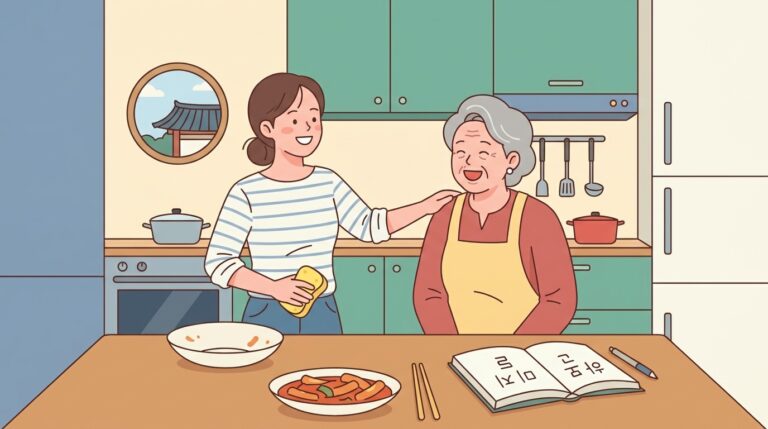
Let Me Do the Dishes! How to Master the Art of Post-Dinner Politeness in Korea
Phase 1: Empathy (The Korean Dinner Dilemma)
안녕하세요! (An-nyeong-ha-se-yo!) It’s your favorite Korean culture navigator and Daily Hangul’s editor!
Picture this: You’ve just finished a mouth-watering, home-cooked Korean meal at your close friend’s house. The belly is full of bulgogi and kimchi찌개, and everyone is happy. Your host gets up to clear the table. You want to be the perfect guest, so you follow them to the sink. You reach for the sponge, but your friend gently pushes your hand away, saying, “아니야, 내가 할게!” (No, I’ll do it!).
What do you do? Do you walk away? Or do you fight for that sponge like your life depends on it?
In Korea, offering to do the dishes isn’t just about cleaning; it’s a beautiful dance of Jeong (정 – affection) and Nunchi (눈치 – social wits). Walk away too quickly, and you might seem cold. Insist too aggressively, and you might make your host uncomfortable. Don’t worry! Today, we’ll teach you exactly how to navigate this cozy post-dinner battle like a true local.
Phase 2: Key Expressions (The Dish-Duty Trio)
Here are three essential expressions you can use to win the “let me wash the dishes” debate.
1. 설거지는 내가 할게! (Seol-geo-ji-neun nae-ga hal-ge!)
- Pronunciation: Suhl-guh-jee-neun nae-gah hal-geh! (Sounds like: “Sull-ghee-jean” is on me!)
- Meaning: I’ll do the dishes!
- K-Culture Moment: You see this in cozy slice-of-life K-dramas (like Reply 1988 or Hospital Playlist). After a warm group dinner, the sweetest friend always rolls up their sleeves and says this naturally.
- Editor’s Insight: This is the most standard, friendly casual way to offer. By using “~는” (topic marker) on 설거지 (dishes), you are subtly saying: “You did the cooking, so as for the dishes, I’ll handle them!”
- Situation Spectrum: Casual (✅) | Semi-formal (⚠️ – change to 설거지는 제가 할게요) | Formal (🚫)
- 🤔 Think About It: In your culture, is it polite to immediately start cleaning at someone else’s house, or is it seen as intrusive?
2. 가만히 있어, 내가 할 테니까. (Ga-man-hi is-seo, nae-ga hal te-ni-kka.)
- Pronunciation: Gah-mahn-hee eet-suh, nae-gah hal teh-nee-kkah.
- Meaning: Just stay still, because I’m going to do it.
- K-Culture Moment: This is a slightly more assertive, caring tone often used by older siblings or close friends who want to pamper you.
- Editor’s Insight: “가만히 있어” literally means “stay quiet/still.” It sounds strong, but in this context, it is deeply affectionate. You’re telling your host to relax after hard work.
- Situation Spectrum: Casual (✅) | Semi-formal (🚫) | Formal (🚫)
- 🤔 Think About It: Why does being bossy in a caring way feel so warm in Korean relationships?
3. 치우는 것만이라도 도울게요. (Chi-u-neun geot-man-i-ra-do do-ul-ge-yo.)
- Pronunciation: Chee-oo-neun gut-mahn-ee-rah-doh doh-ool-geh-yoh.
- Meaning: Let me at least help with clearing/cleaning up.
- K-Culture Moment: Used when visiting a senior’s house or your partner’s parents’ house for the first time.
- Editor’s Insight: The magic word here is “~만이라도” (at least / even if it’s just). It shows immense humility and eagerness to help, even if the host refuses to let you do the actual washing.
- Situation Spectrum: Casual (⚠️) | Semi-formal (✅) | Formal (✅)
- 🤔 Think About It: How does showing eagerness to do small tasks help build trust in social hierarchies?
Phase 3: Textbook vs. Real Life
Let’s look at how textbooks teach this versus how we actually say it over a messy dining table!
Scenario A: Offering to help
- 📖 Textbook: “제가 설거지를 하겠습니다.” (Je-ga seol-geo-ji-reul ha-get-seup-ni-da. – I will perform the dishwashing.)
- 🗣️ Real Life: “언니, 설거지는 내가 할게! 손대지 마~” (Eon-ni, seol-geo-ji-neun nae-ga hal-ge! Son-dae-ji ma~ – Sis, I’ve got the dishes! Don’t even touch them~)
- 💡 Why the difference? The textbook version is grammatically perfect but sounds like a military contract. Real-life Korean uses soft relationship titles (Eonni/Oppa/Noona/Hyeong) and playful commands to show intimacy.
Scenario B: When the host refuses
- 📖 Textbook: “아닙니다, 제가 해야 합니다.” (An-im-ni-da, je-ga hae-ya ham-ni-da. – No, I must do it.)
- 🗣️ Real Life: “에이, 맛있는 밥도 얻어먹었는데 이 정도는 해야지!” (Ey, mas-in-neun bap-do eo-deo-meog-eon-neun-de i jeong-do-neun hae-ya-ji! – Oh come on, you fed me a delicious meal, I should at least do this!)
- 💡 Why the difference? Culturally, reciprocity is huge in Korea. Mentioning that you “received a delicious meal” (밥도 얻어먹었는데) justifies your insistence and makes the host feel appreciated.
Phase 4: K-Culture Deep Dive & Non-Verbal Manners
4-1. The “Sponge Tug-of-War” & Body Language
In Korea, a simple oral offer is rarely accepted on the first try. Expect an automatic “괜찮아~ 안 해도 돼!” (It’s okay, you don’t have to!).
* The Trick: You must physicalize your intention. Walk to the sink, grab the dish soap or sponge, and gently block them with your shoulder. A playful, physical determination shows you genuinely want to help, not just asking out of obligation.
4-2. The Golden Rule of “Nunchi”
If your host aggressively defends the sink and looks genuinely stressed by your insistence, stop. Sometimes, hosts prefer doing their own dishes because they have a specific organizing system or don’t want guests seeing their messy kitchen setup. If they refuse twice with high energy, transition to: “그럼 다 치우고 디저트 타임은 제가 쏠게요!” (Then after we clean up, dessert is on me!).
Phase 5: Real-Life Roleplay Scenario
Setting: Minji’s cozy studio apartment after a delicious Tteokbokki party. Minji (Host) is starting to gather the bowls. Min-su (Guest/You) wants to do the dishes.
- Minji: 아~ 잘 먹었다! 배부르네. (Ah~ that was good! I’m so full.)
- Min-su: 🎭 [Standing up quickly and grabbing empty bowls] 민지야, 떡볶이 진짜 맛있었어! 이제 설거지는 내가 할게. (Minji, the tteokbokki was seriously delicious! Now, I’ll do the dishes.)
- Minji: 에이, 무슨 소리야. 손님인데 그냥 앉아 있어. 내가 금방 해. (Hey, what are you talking about? You’re a guest, just sit down. I’ll do it quickly.)
- Min-su: 🎭 [Gently nudging Minji away from the sink with a smile] 아니야~ 요리하느라 힘들었잖아. 가만히 있어, 내가 할 테니까! (No~ you worked hard cooking. Just stay still, because I’m doing it!)
- Minji: 진짜 괜찮은데… 그러면 물만 대충 헹궈줘! (I’m really okay… but if you insist, just rinse them with water!)
- Min-su: 🎭 [Rolling up sleeves confidently] 오케이, 완벽하게 닦아 놓을게! (Okay, I’ll wash them to perfection!)
🔀 Interactive Choice Point
What do you do next?
- A. “귀찮으니까 대충 해야지.” (Rinse them with cold water without soap and leave them in the sink.)
- B. “세제 듬뿍 묻혀서 깨끗이 닦고 수저통에 정리해야지.” (Wash them thoroughly with plenty of soap and organize them neatly in the drying rack.)
- C. “그럼 진짜 그냥 앉아 있을게! 고마워!” (Immediately stop and go sit on the couch to watch TV.)
Feedback:
- A (Risk): Oh no! Doing a half-hearted job is worse than not offering at all. Your friend might have to wash them again secretly.
- B (Best): Excellent! This is the ultimate guest behavior. You show respect for their home and their hard work.
- C (Bad): Too sudden! Even if they said “rinse them,” giving up immediately makes your previous insistence look fake.
Phase 6: 10-Second Shadowing Drill
Let’s practice the natural rhythm. Pay attention to the pauses (/) and the emotion indicator!
[😊 Playfully and firmly]
*
Frequently Asked Questions (FAQ)
Q: What does "설거지는 내가 할게! (Seol-geo-ji-neun nae-ga hal-ge!)" mean in Korean and how do you pronounce it?
A: In Korean, "설거지는 내가 할게! (Seol-geo-ji-neun nae-ga hal-ge!)" is pronounced [Suhl-guh-jee-neun nae-gah hal-geh! (Sounds like: "Sull-ghee-jean" is on me!] and means: I'll do the dishes!
Q: What does "가만히 있어, 내가 할 테니까. (Ga-man-hi is-seo, nae-ga hal te-ni-kka.)" mean in Korean and how do you pronounce it?
A: In Korean, "가만히 있어, 내가 할 테니까. (Ga-man-hi is-seo, nae-ga hal te-ni-kka.)" is pronounced [Gah-mahn-hee eet-suh, nae-gah hal teh-nee-kkah.] and means: Just stay still, because I'm going to do it.
Q: What does "치우는 것만이라도 도울게요. (Chi-u-neun geot-man-i-ra-do do-ul-ge-yo.)" mean in Korean and how do you pronounce it?
A: In Korean, "치우는 것만이라도 도울게요. (Chi-u-neun geot-man-i-ra-do do-ul-ge-yo.)" is pronounced [Chee-oo-neun gut-mahn-ee-rah-doh doh-ool-geh-yoh.] and means: Let me at least help with clearing/cleaning up.







