

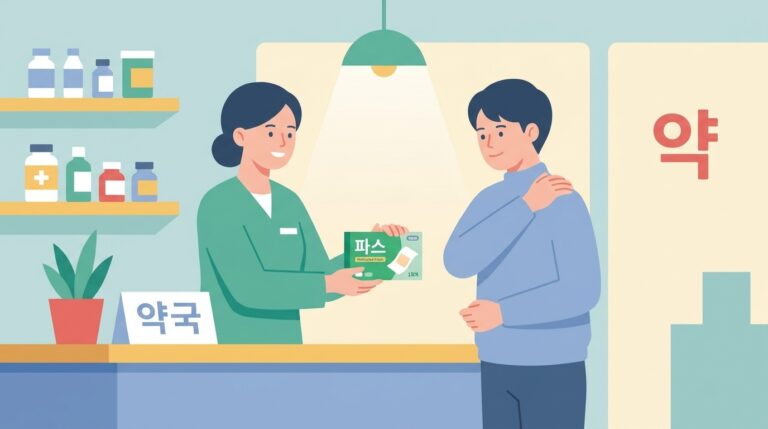
Ouch, My Muscles! Navigating Muscle Pain and Pas (파스) in Korea
Phase 1: Empathy (스토리 몰입형 오프닝)
안녕하세요! (An-nyeong-ha-se-yo!) Daily Hangul’s Senior Editor and your K-culture navigator here!
Imagine this: You’ve just finished a fantastic Han-gang River bicycle ride or pushed your limits at a trendy F45 class in Gangnam. You feel like a K-fitness champion! But the next morning… ouch. Your thighs feel like stone, and your shoulders won’t budge. You have developed serious muscle pain (근육통 – Geun-yuk-tong).
In many Western countries, you might reach for ibuprofen or an icy-hot gel. But in Korea, there is one undisputed king of muscle relief: the magical, medicated patch known as 파스 (Pas).
I remember helping Sarah, an intermediate learner from Chicago. She went to a pharmacy and asked for “band-aids for pain” because she didn’t know the word 파스 (Pas) or how to describe her deep muscle aches. The pharmacist was confused, and Sarah left with tiny round bandages! Today, we’re going to make sure you can walk into any Korean pharmacy (약국 – Yak-guk) or convenience store (편의점 – Pyeon-ui-jeom) and get exactly what your sore body needs like a true local!
Phase 2: Core Expressions Deep Dive (핵심 표현 3선 심층 분석)
1. 근육통이 심해요 (Geun-yuk-tong-i sim-hae-yo)
- Pronunciation: Geun-yook-tong-ee seem-hae-yo (Sounds like “Goon-yook” + “tongue” + “E” + “seem” + “hey-yo”)
- Meaning: I have severe muscle pain / My muscles are so sore.
- K-Culture Moment: You will hear this in almost every sports-themed K-variety show (like Physical: 100 or Running Man) when cast members complain after a grueling physical challenge.
- Editor’s Insight: 근육통 (Geun-yuk-tong) literally translates to “muscle pain” (근육 = muscle, 통 = pain). While in English you might say “I’m sore,” Koreans use this noun-focused structure to describe the medical state of soreness.
- Situation Spectrum:
- Casual: 근육통 대박이야 (Geun-yuk-tong dae-bak-i-ya) ⚠️
- Semi-formal: 근육통이 심해요 (Geun-yuk-tong-i sim-hae-yo) ✅
- Formal: 근육통이 심합니다 (Geun-yuk-tong-i sim-hap-ni-da) ✅
- 🤔 Think About It: In English, “I am sore” focuses on the self feeling the pain. In Korean, “근육통이 심해요” focuses on the pain itself being severe. How does this shift your perspective on how we describe physical conditions?
2. 파스 좀 주세요 (Pas jom ju-se-yo)
- Pronunciation: Pas jom joo-seh-yo (Sounds like the word “pass” + “jom” + “ju-say-yo”)
- Meaning: Please give me some medicated patches (Pas).
- K-Culture Moment: In K-dramas, you often see an elderly grandmother or an overworked office worker slapping a white patch on their neck. That’s 파스 (Pas), derived from the German word “Plaster.”
- Editor’s Insight: Adding 좀 (jom), which literally means “a little,” doesn’t actually mean you want a small amount. It is a magic word that softens your request, making you sound extremely polite and natural.
- Situation Spectrum:
- Casual: 파스 좀 줘 (Pas jom jwo) ⚠️
- Semi-formal: 파스 좀 주세요 (Pas jom ju-se-yo) ✅
- Formal: 파스 좀 부탁드립니다 (Pas jom bu-tak-deu-rip-ni-da) ✅
- 🤔 Think About It: Why do you think Koreans adopted the German word “Plaster” into “Pas” instead of using a traditional Sino-Korean word? It shows how Korea modernized its medical terms during the 20th century!
3. 붙이는 파스랑 바르는 파스 중에 어떤 게 좋아요? (But-i-neun pa-seu-rang ba-reu-neun pa-seu jung-e eo-tteon ge jo-a-yo?)
- Pronunciation: Boot-ee-neun pas-eurang ba-reun-eun pas-eu joong-eh eo-tteon ge jo-ah-yo?
- Meaning: Which is better, the patch type or the roll-on/gel type?
- K-Culture Moment: If you enter a pharmacy, the pharmacist will almost always ask: “붙이는 거 드릴까요, 바르는 거 드릴까요?” (Shall I give you the patch type or the roll-on type?). Knowing this sentence helps you lead the conversation.
- Editor’s Insight: 붙이다 (but-i-da) means “to stick/paste,” and 바르다 (ba-reu-da) means “to apply/rub.”
- Situation Spectrum:
- Casual: 붙이는 거랑 바르는 거 중에 뭐가 좋아? (But-i-neun geo-rang ba-reu-neun geo jung-e mwo-ga jo-a?) ⚠️
- Semi-formal: 붙이는 파스랑 바르는 파스 중에 어떤 게 좋아요? (But-i-neun pa-seu-rang ba-reu-neun pa-seu jung-e eo-tteon ge jo-a-yo?) ✅
- Formal: 붙이는 타입과 바르는 타입 중 어떤 것을 추천하십니까? (But-i-neun ta-ip-gwa ba-reu-neun ta-ip jung eo-tteon geos-eul chu-cheon-ha-sip-ni-ka?) ✅
Phase 3: Textbook Korean vs. Real Korean (교과서 한국어 vs. 진짜 한국어)
Let’s compare stiff, literal translations with what locals actually say.
Situation 1: Expressing that your body is aching all over
- 📖 Textbook Korean: 온몸에 통증이 있습니다. (On-mom-e tong-jeung-i is-seup-ni-da.)
- Translation: “There is pain in my entire body.”
- 🗣️ 진짜 한국어: 온몸이 쑤셔요. (On-mom-i ssu-syeo-yo.)
- Translation: “My whole body is aching/throbbing.”
- 💡 왜 다를까? Koreans use the verb 쑤시다 (ssu-si-da) to describe a deep, throbbing, or aching pain (like a needle poking you). It sounds way more visceral and natural than the clinical word 통증 (tong-jeung – pain).
Situation 2: Asking for a warm patch vs. a cool patch
- 📖 Textbook Korean: 따뜻한 파스와 차가운 파스를 주세요. (Tta-tteut-han pa-seu-wa cha-ga-un pa-seu-reul ju-se-yo.)
- Translation: “Please give me a warm patch and a cold patch.”
- 🗣️ 진짜 한국어: 핫파스랑 쿨파스 주세요. (Hat-pa-seu-rang kul-pa-seu ju-se-yo.)
- Translation: “Please give me a hot-pas and a cool-pas.”
- 💡 왜 다를까? Pharmacists and locals use Konglish terms 핫파스 (Hot-Pas) for heat-generating patches (best for chronic stiffness) and 쿨파스 (Cool-Pas) for cooling patches (best for sudden swelling/acute pain).
Phase 4: K-Culture Deep Dive & Non-verbal Manners (비언어적 매너)
4-1. Gestures and Body Language
- The Pain Point Touch: When explaining where it hurts, don’t just speak. Gently touch or tap the area (your neck, shoulder, or lower back) and grimace slightly. This universal body language combined with “여기가 좀…” (Yeo-gi-ga jom… / Here is a bit…) works wonders in Korean pharmacies.
- The Two-Handed Hand-off: When the pharmacist hands you the box of Pas, always receive it with both hands as a sign of respect, and give a slight head bow.
4-2. The Culture of “Pas” in Korea
In Korea, 파스 (Pas) is a cultural bonding tool. If you work in a Korean office and sigh while stretching your neck, a colleague might pull a Pas out of their drawer and offer to stick it on your back. Asking someone “파스 좀 붙여줄래?” (Can you stick this Pas on me?) is a sign of close friendship (반말 – Banmal) or a comfortable relationship, as it requires physical touch.
Phase 5: Real-Life Roleplay Scenario (실전 롤플레이 시나리오)
Setting: A cozy neighborhood pharmacy in Mapo-gu, Seoul. You are speaking to Pharmacist Kim (약사 김 씨), a friendly guide.
- 약사 (Pharmacist): 어서 오세요. 어디가 불편하세요?
(Eo-seo o-se-yo. Eo-di-ga bul-pyeon-ha-se-yo?)- “Welcome. Where is bothering you? / What brings you in?”
- 나 (You): 🎭 [Gently holding your shoulder with a painful smile]
어제 운동을 너무 열심히 해서 근육통이 심해요.
(Eo-je un-dong-eul neo-mu yeol-sim-hi hae-seo geun-yuk-tong-i sim-hae-yo.)- “I worked out too hard yesterday, so my muscle pain is severe.”
- 약사 (Pharmacist): 아이고, 고생하셨네요. 어깨 쪽이 많이 뭉치셨어요?
(Ai-go, go-saeng-ha-syeot-nae-yo. Eo-kkae jjok-i ma-ni mung-chi-syeos-seo-yo?)- “Oh dear, you must be suffering. Is your shoulder area very knotted up?”
- 나 (You): 네, 맞아요. 온몸이 쑤셔요. 파스 좀 주세요.
(Ne, ma-ja-yo. On-mom-i ssu-syeo-yo. Pas jom ju-se-yo.)- “Yes, that’s right. My whole body is aching. Please give me some Pas.”
- 약사 (Pharmacist): 붙이는 파스가 있고, 바르는 물파스가 있는데 어떤 걸로 드릴까요?
(But-i-neun pa-seu-ga it-go, ba-reu-neun mul-pa-seu-ga in-deun-de eo-tteon geol-lo deu-ril-kka-yo?)- “We have stick-on patches and roll-on liquid Pas. Which one should I give you?”
- 나 (You): 음, 효과가 빠른 걸로 원해요. 어떤 게 더 좋아요?
(Eum, hyo-gwa-ga ppa-reun geol-lo won-hae-yo. Eo-tteon ge deo jo-a-yo?)- “Hmm, I want something fast-acting. Which one is better?”
- 약사 (Pharmacist): 바로 붙여서 오래 효과를 보시려면 붙이는 파스가 좋습니다. 핫파스로 드릴까요, 쿨파스로 드릴까요?
(Ba-ro but-i-yeo-seo o-rae hyo-gwa-reul bo-si-ryeo-myeon but-i-neun pa-seu-ga jop-ni-da. Hat-pa-seu-ro deu-ril-kka-yo, kul-pa-seu-ro deu-ril-kka-yo?)- “If you want long-lasting effects right away, the stick-on patch is good. Shall I give you hot-pas or cool-pas?”
- 나 (You): 지금 부은 건 없으니까 핫파스로 주세요.
(Ji-geum bu-eun geon eop-seu-ni-kka hat-pa-seu-ro ju-se-yo.)- “Since there is no swelling right now, please give me the Hot-Pas.”
🔀 Interactive Choice Points
What would you say next to ask for a scissors-cut patch?
* Option A: “이거 가위로 잘라 쓰는 거예요?” (Is this the kind you cut with scissors?)
* Option B: “가위 주세요.” (Give me scissors.)
* Option C: “그냥 큰 거 주세요.” (Just give me a big one.)
Feedback:
- Option A (Best): 🌟 Excellent! This politely asks if the patch needs cutting. (Many Korean Pas are large, and pharmacists recommend cutting them to fit smaller joints).
- Option B (Risk): ⚠️ Too Blunt. Asking a pharmacist for scissors directly might sound like you want to cut something in the pharmacy right now.
- Option C (Bad): 🚫 Vague. This doesn’t help clarify the application method.
Phase 6: 10-Second Emotion Shadowing Drill (10초 감정 섀도잉 드릴)
Practice saying these out loud with the correct emotional rhythm. / indicates a micro-pause.
- [🥺 Suffering & Tired]
- 아고… / 온몸이 쑤셔요. / 파스 좀… / 주세요.
- A-go… / On-mom-i ssu-syeo-yo. / Pas jom… / ju-se-yo.
- [😊 Relieved & Polite]
- 아, / 시원해요! / 핫파스가 / 최고네요.
- Ah, / si-won-hae-yo! / Hat-pa-seu-ga / choe-go-ne-yo.
Phase 7: K-Culture Mini Dictionary (K-Culture 미니 사전)
- 물파스 (Mul-pas):
- Translation: Liquid roll-on Pas.
- Usage: A liquid medicated formula with a sponge applicator. Great for hard-to-reach areas or mosquito bites!
- 동전패치 (Dong-jeon-pae-chi):
- Translation: Coin-sized round patches.
- Usage: Small, circular patches highly popular for pinpoint pain relief (especially on wrists or fingers).
- 담 (Dam):
- Translation: Muscle spasm / stiff neck.
- Usage: When your neck is locked up, you say: “어깨에 담 걸렸어” (I got a ‘Dam’ in my shoulder).
- 시원하다 (Si-won-ha-da):
- Translation: To be cool/refreshing.
- Usage: Used paradoxically for both icy-cold sensation and burning hot soup/patch heat that relieves pain.
Phase 8: Survivor Kit for Travelers (여행자를 위한 생존 키트)
Survival Expressions TOP 3
- 이거 붙이는 파스예요? (I-geo but-i-neun pa-seu-yeo-yo?)
- Pro Tip: Use this to confirm you bought a sticker patch, not a cream.
- 가장 강한 걸로 주세요. (Ga-jang gang-han geol-lo ju-se-yo.)
- Pro Tip: Use this if you want the strongest heat/cool formula available.
- 편의점에 파스 있어요? (Pyeon-ui-jeom-e pa-seu is-seo-yo?)
- Pro Tip: Convenience stores in Korea carry basic Pas near the register, but pharmacies have a wider variety.
📝 Editor’s Travel Note
- Finding Pharmacies late at night: If you have severe muscle pain late at night, search “약국” on Naver Map App (네이버 지도 앱 다운로드) to find “24-hour safe medicine” (안전상비의약품) retailers or late-night pharmacies near you.
- Disclaimer: Operating hours of pharmacies can change without notice. Double-check before visiting.
Phase 9: “A Step Deeper” – Cultural Reflection (“한 발 더 깊이”)
In Western cultures, pain is often managed internally with pills. In Korea, pain relief is highly visual and tactile. Wearing a 파스 (Pas) openly on your neck or arm is not seen as an embarrassing medical issue, but rather as a badge of hard work or an active lifestyle. It also acts as a silent social cue: “I’m a bit sore today, so be gentle with me!”
💬 Your Turn: Do you prefer oral pain relievers or external patches when your muscles ache? Have you ever tried a Korean Pas? Let us know in the comments below!
Phase 10: FAQ & Common Mistakes (FAQ & 오해 방지)
Q: Can I buy Pas at any time of day?
A: Yes! While specialized strong prescription patches must be bought at pharmacies (약국), general pain-relief patches (파스) are available at most 24-hour convenience stores (편의점).
Q: What is the difference between Hot-Pas and Cool-Pas?
A: Use Cool-Pas (쿨파스) for fresh, swollen injuries (first 48 hours) to reduce swelling. Use Hot-Pas (핫파스) for chronic, dull muscle aches to promote blood circulation.
Q: Can I take a hot shower right after taking off a Pas?
A: Never do this! The active ingredients (like capsaicin in Hot-Pas) stay on the skin. Showering immediately in warm water will cause an intense, painful burning sensation. Wait at least 30–60 minutes after removal.
🚨 Common Mistakes Alert!
- Mistake 1: Asking for “band-aid” (밴드 – Baen-deu) instead of “Pas”. Pharmacies will give you small cuts-and-scrapes bandages!
- Mistake 2: Applying a Hot-Pas to a freshly sprained, swollen ankle. This makes the swelling worse!
- Mistake 3: Not washing your hands after applying liquid Mul-pas, then rubbing your eyes. Ouch!
Phase 11: Action Mission & K-Culture Challenge
- 🥉 Bronze Mission: Write “근육통이 심해요” (I have bad muscle pain) in your journal three times while practicing the pronunciation.
- 🥈 Silver Mission: Go to a convenience store or a local Asian market, find the health section, and locate 파스 or 물파스.
- 🥇 Gold Mission: Next time you exercise, practice saying “온몸이 쑤셔요!” to your workout buddy!
Phase 12: Interactive Quiz Challenge (인터랙티브 퀴즈 챌린지)
- Which term refers to “liquid roll-on pain reliever”?
- A) 동전패치
- B) 물파스
- C) 핫파스
Reveal Answer & Explanation
- Correct Answer: B) 물파스 (Mul-pas)
- Explanation: ‘물’ (Mul) means water/liquid. Hence, 물파스 is the liquid form of the patch!
- True or False: You should apply Hot-Pas (핫파스) when your wrist is immediately swollen after a heavy lift.
Reveal Answer & Explanation
- Correct Answer: False
- Explanation: For fresh swelling, you should use Cool-Pas (쿨파스) to cool down the inflammation. Hot-pas is for chronic stiffness!







