

Finding Your Perfect Spot: How to Ask About Nearby Amenities in Korea!
Phase 1: Empathy (Your Friendly Neighbor Opening)
안녕하세요! (Annyeonghaseyo!) I’m your Daily Hangul editor and your personal Korean culture navigator!
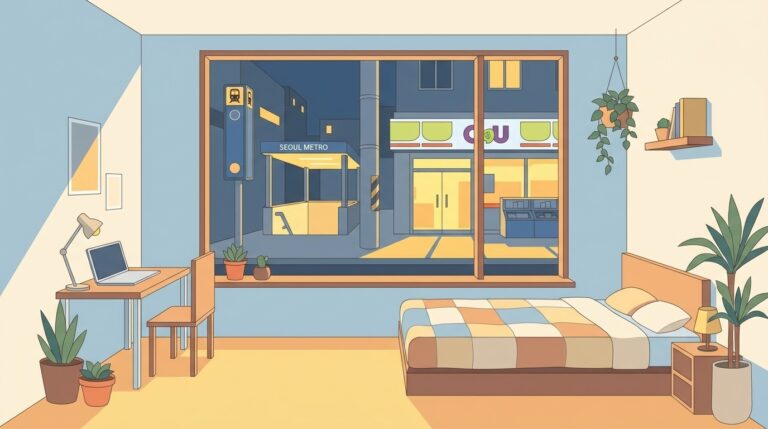
Imagine this: You’ve found a beautiful, cozy room (원룸, wonrum) in Seoul. The wallpaper is clean, the rent is perfect, and the view is amazing. But wait! You step outside, and you realize… where is the nearest convenience store? Where do you do your laundry if your washing machine breaks? How far is the subway station?
In Korea, having the right amenities nearby is a massive part of daily life. We even have special words like 편세권 (Pyeon-se-gwon)—meaning a residential area within walking distance of a 24/7 convenience store! Asking about nearby facilities before signing a contract will save you from sleepless nights.
Don’t worry about sounding awkward. Today, we’re going to master exactly how to ask real estate agents (부동산 중개인) about the neighborhood like a seasoned local. Let’s dive in!
Phase 2: Deep Dive into 3 Key Expressions
1. 근처에 편의점 있어요? (Geuncheo-e pyeon-uijeom isseoyo?)
- Pronunciation: Geun-chuh-eh pyun-ee-jum eet-suh-yo? (Sounds like “Guhn-chuh-eh pyuhn-ee-juhm is-suh-yo?”)
- Meaning: Is there a convenience store nearby?
- K-Culture Moment: In K-Dramas, the convenience store (편의점) is where characters eat late-night ramyeon, share secrets, and have romantic encounters. It’s the ultimate neighborhood hub!
- Editor’s Insight: “근처” means “nearby” or “vicinity.” You can swap “편의점” with any noun (like 마트/supermarket, 세탁소/laundromat) to ask about other facilities!
- Situation Spectrum:
- Casual: 근처에 편의점 있어? (⚠️ Only with close friends)
- Semi-formal: 근처에 편의점 있어요? (✅ Best for agents and strangers)
- Formal: 근처에 편의점이 있습니까? (🚫 Too stiff for house hunting)
- 🤔 Think About It: In your home country, what is the one “must-have” facility within a 5-minute walk? Is it a grocery store, a cafe, or a park?
2. 지하철역에서 얼마나 걸려요? (Jihacheol-yeog-eseo olmana geollyeoyo?)
- Pronunciation: Jee-hah-chuhl-yuhk-eh-suh uhl-mah-nah guhl-lyuh-yo?
- Meaning: How long does it take from the subway station?
- K-Culture Moment: Koreans love efficiency. The concept of 역세권 (Yeok-se-gwon)—being near a subway station—directly affects house prices and daily happiness.
- Editor’s Insight: “얼마나 걸려요?” means “How long does it take?” It is a golden survival phrase for any traveler in Korea.
- Situation Spectrum:
- Casual: 역에서 얼마나 걸려? (⚠️)
- Semi-formal: 지하철역에서 얼마나 걸려요? (✅)
- Formal: 역에서 시간이 얼마나 소요됩니까? (🚫 Too formal for daily conversations)
3. 주변이 조용해요? (Jubyeon-i joyong-haeyo?)
- Pronunciation: Joo-byuhn-ee jo-yong-hae-yo?
- Meaning: Is the surrounding area quiet?
- K-Culture Moment: Many residential buildings in Seoul are located near bustling university districts or nightlife areas. Asking this ensures you don’t accidentally rent a place above a noisy barbecue restaurant!
- Editor’s Insight: “주변” means “surroundings/neighborhood.” “조용하다” means “to be quiet.”
- Situation Spectrum:
- Casual: 주변 조용해? (⚠️)
- Semi-formal: 주변이 조용해요? (✅)
- Formal: 주변 환경이 정숙합니까? (🚫 Sounds like a police report!)
Phase 3: Textbook Korean vs. Real-World Korean
Situation 1: Asking if there is a supermarket nearby
- 📖 Textbook: 근처에 슈퍼마켓이 존재합니까? (Does a supermarket exist in the vicinity?)
- 🗣️ Real-World: 근처에 마트 있어요? (Is there a mart nearby?)
- 💡 Why the difference? Koreans rarely use the verb “존재하다” (to exist) in casual daily conversations. Also, “마트” (mart) is much more commonly used than “슈퍼마켓” (supermarket).
Situation 2: Asking if the area is safe at night
- 📖 Textbook: 밤에 이 지역이 안전합니까? (Is this region safe at night?)
- 🗣️ Real-World: 밤에 골목길 안 어두워요? (Is the alleyway not too dark at night?)
- 💡 Why the difference? Korea is generally very safe, so instead of asking “is it safe?”, locals ask if the specific alleyways (골목길) leading to the house are well-lit and not dark (안 어두워요?).
Phase 4: K-Culture Deep Dive & Non-Verbal Manners
4-1. The “Nunchi” (눈치) of House Hunting
When looking at a house with a real estate agent (공인중개사), use the “Nod and Point” technique. Koreans value active listening. Nod your head slightly while saying “아, 네~” (Ah, yes~) to show you are following. When asking about amenities, point towards the window or the door to indicate the outside environment. This shows you are observant and respectful of the space.
4-2. The Rise of the “-Sgwon” (-세권) Culture
Koreans love creating new words by combining an amenity with “세권” (area/zone).
* 슬세권 (Seul-se-gwon): An area so close to amenities that you can wear your slippers (슬리퍼) to get there.
* 스세권 (Seu-se-gwon): An area close to Starbucks (스타벅스).
* 맥세권 (Maek-se-gwon): An area where McDonald’s (맥도날드) delivers.
Phase 5: Real-Life Roleplay Scenario
Setting: Inside a bright real estate office in Mapo, Seoul. You are talking to Mr. Kim, a friendly middle-aged agent with a big smile.
- Agent Kim: 어서 오세요! 어떤 방 찾으세요?
(Welcome! What kind of room are you looking for?) - You (A2): 안녕하세요! 지하철역 근처 방 있어요?
(Hello! Is there a room near the subway station?) - Agent Kim: 네, 좋은 방이 하나 있어요. 역에서 아주 가깝습니다.
(Yes, there is one good room. It is very close to the station.) - You (A2): 🎭 (Smiling curiously) 지하철역에서 얼마나 걸려요?
(How long does it take from the subway station?) - Agent Kim: 걸어서 5분 정도 걸려요. 완전 역세권이죠!
(It takes about 5 minutes on foot. It’s completely in the station area!) - You (A2): 🎭 (Nodding happily) 좋아요. 혹시 근처에 편의점도 있어요?
(Great. By any chance, is there also a convenience store nearby?) - Agent Kim: 네, 건물 바로 1층에 편의점이 있어요. 아주 편할 거예요.
(Yes, there is a convenience store right on the first floor of the building. It will be very convenient.) - You (A2): 우와, 최고네요! 주변은 조용해요?
(Wow, that’s the best! Is the surrounding area quiet?) - Agent Kim: 네, 대로변이 아니라서 아주 조용하고 살기 좋습니다.
(Yes, it’s not on the main road, so it’s very quiet and good to live in.)
🔀 Interactive Choice Point
What would you say next to lock down the deal?
* A) “지금 바로 방 보러 가요!” (Let’s go see the room right now!) -> Best! Real estate moves fast in Korea. Showing enthusiasm is great!
* B) “돈이 없어요. 깎아주세요.” (I don’t have money. Please discount it.) -> Bad. Asking for discounts before even looking at the room is considered impolite.
* C) “나중에 다시 올게요.” (I’ll come back later.) -> Risk. Good rooms in Seoul get rented out within hours. You might lose the spot!
Phase 6: 10-Second Emotion Shadowing Drill
Practice speaking with real Korean emotion! Notice the pauses (/) and tone cues.
- [😊 Exited & Relieved]
- 근처에 / 편의점 / 있어요?
- Geun-cheo-e / pyeon-ui-jeom / isseoyo?
- [🤔 Curious & Wondering]
- 역에서 / 얼마나 / 걸려요?
- Yeog-eseo / ol-ma-na / geollyeoyo?
- [🥺 Hoping for a quiet room]
- 주변이 / 진짜 / 조용해요?
- Ju-byeon-i / jin-jja / jo-yong-hae-yo?
Phase 7: K-Culture Mini Dictionary
- 원룸 (Won-rum) | Studio apartment. The most common housing type for students and young professionals in Korea.
- 공인중개사 (Gong-in-jung-gae-sa) | Licensed Real Estate Agent. Always look for this official title to avoid housing scams.
- 보증금 (Bo-jeung-geum) | Key money / Rental deposit. A large sum of money paid upfront that is returned when you move out.
- 월세 (Wol-se) | Monthly rent.
Phase 8: Survival Kit for Travelers & Expats
Survival Phrases TOP 3
- 버스 정류장 어디예요? (Beoseu jeongnyujang eodiyeyo?) – Where is the bus stop?
- 근처에 코인세탁소 있어요? (Geuncheoe koin-setakso isseoyo?) – Is there a coin laundromat nearby?
- 여기 치안 어때요? (Yeogi chian eottaeyo?) – How is the safety/security here?
💡 Editor’s Travel Note
Before house hunting or exploring a new neighborhood, make sure to download the Naver Map App or KakaoMap. Google Maps does not work well for walking navigation in South Korea due to local security regulations. These local apps will show you every convenience store, subway exit, and cafe in real-time!
Phase 9: “Going One Step Deeper” (Cultural Reflection)
In many Western cultures, having a quiet suburban house with a big backyard far from busy streets is the dream. However, in Korea, convenience, speed, and density are highly valued. Living in a “Seul-se-gwon” (slippers-zone) where you can access a pharmacy, a library, a gym, and a subway station within 5 minutes of walking is considered the ultimate luxury. It reflects the fast-paced, community-centric lifestyle of modern Korean society.
💬 Your Turn: Would you prefer a quiet house in nature, or a bustling “slippers-zone” apartment in the middle of Seoul? Let us know in the comments below!
Phase 10: FAQ & Common Mistakes
Q: Can I negotiate the rent or deposit in Korea?
A: Yes! While not always successful, you can politely ask the agent: “혹시 보증금 조절이 가능한가요?” (Is it possible to adjust the deposit?). Sometimes landlords will lower the monthly rent if you offer a higher deposit.
Q: What is “관리비” (Gwallibi)?
A: It is the building maintenance fee. Always ask: “관리비에 뭐가 포함되어 있어요?” (What is included in the maintenance fee?) to check if internet, water, or cleaning is included.
Q: Is it safe to rent a room without a real estate agent?
A: It is highly recommended to use a licensed 공인중개사 to protect your deposit and ensure the contract is legally binding.
🚨 Common Mistakes Alert!
- Mistake 1: Calling every grocery store a “슈퍼마켓”.
- Correct Action: Use 마트 (Mart) for local grocery stores, or 편의점 (Pyeon-ui-jeom) for 24/7 stores.
- Mistake 2: Saying “지하철역 가깝다” to mean “It is close.”
- Correct Action: Add the polite ending: “지하철역이랑 가까워요.”
Phase 11: Action Mission!
- Bronze Medal 🥉: Read the 3 key expressions out loud 5 times in front of a mirror.
- Silver Medal 🥈: Open Naver Maps, find your favorite spot in Seoul, and identify 3 convenience stores near it!
- Gold Medal 🥇: Share this post on Instagram or Twitter/X with the hashtag
#DailyHanguland write down your favorite “-sgwon” word!
Phase 12: Interactive Quiz Challenge
1. Match the word to its meaning:
* A. 역세권
* B. 편세권
* C. 슬세권
(1) Slippers-zone (2) Subway-zone (3) Convenience-store-zone
👉 Click to reveal answers!
Answer:
* A – (2) 역세권 is the Subway-zone.
* B – (3) 편세권 is the Convenience-store-zone.
* C – (1) 슬세권 is the Slippers-zone.
Great job! You are ready to talk like a real Seoulite! 🥳






