

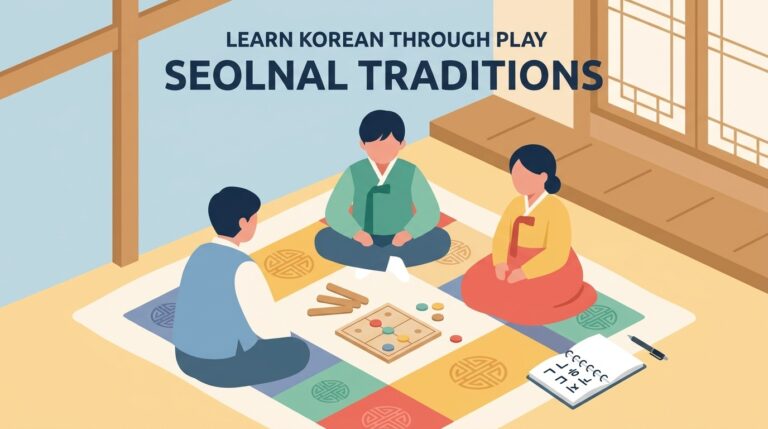
Master Seollal with Yutnori: The Ultimate Beginner’s Guide to Korea’s Favorite Traditional Game!
Phase 1: Empathy (An Invitation to the Game Board)
안녕하세요! (An-nyeong-ha-se-yo!) Hello! It’s your friendly Korean study bestie from Daily Hangul!
Imagine this: It’s Seollal (설날 – Korean Lunar New Year). You are invited to a Korean friend’s family home. The house smells like delicious, warm Tteokguk (떡국 – rice cake soup). Suddenly, your friend’s grandmother rolls out a large blanket on the living room floor, tosses four wooden sticks into the air, and everyone screams, “Do! Gae! Geol! Yut! Mo!”
Your heart beats fast. What is happening? Am I supposed to throw these sticks? What do I say when it’s my turn?
Don’t panic! You are about to play Yutnori (윷놀이), Korea’s ultimate traditional family board game. It’s loud, it’s dramatic, and it’s the absolute best way to bond with Koreans. Today, we are going to learn 3 super-easy, high-energy phrases that will make you look like a Yutnori pro—even if it’s your very first time!
Phase 2: Key Expressions Deep Dive (Three Magic Words)
Let’s learn the three most important phrases you need to shout during the game.
1. 던집니다! (Deon-jim-ni-da!)
- Pronunciation: Deon-jim-ni-da! (Sounds like: “Dawn-jim-nee-dah!” with a strong, energetic finish)
- Meaning: “I am throwing!” / “Here I go!”
- K-Culture Moment: Think of variety shows like Runnning Man or BTS Run. Before a member throws the sticks, they pose dramatically and yell this to gather everyone’s attention.
- Editor’s Insight: In Korea, gaming is a shared experience. Yelling “Deon-jim-ni-da!” builds tension and gets everyone looking at your hands. It’s polite and super fun!
- Situation Spectrum: Casual ✅ | Semi-formal ✅ | Formal ⚠️
- 🤔 Think About It: In your culture, do you announce your turn out loud before rolling dice? Why do you think Koreans love to announce their actions together?
2. 제발 모 나와라! (Je-bal mo na-wa-ra!)
- Pronunciation: Je-bal mo na-wa-ra! (Sounds like: “Jay-bal mo nah-wah-rah!”)
- Meaning: “Please let it be a ‘Mo’!” (A ‘Mo’ is the highest score, letting you move 5 spaces and throw again!)
- K-Culture Moment: In K-Dramas, characters clasp their hands together, look to the heavens, and pray for a miracle right before throwing the sticks.
- Editor’s Insight: Je-bal means “please” (begging), and na-wa-ra means “come out.” It shows your passion and makes your Korean friends laugh at your cute desperation!
- Situation Spectrum: Casual ✅ | Semi-formal ⚠️ | Formal 🚫
- 🤔 Think About It: “Mo” represents the horse in traditional Korean culture, which moves the fastest. What animal represents speed or luck in your country?
3. 잡았다! (Ja-bat-da!)
- Pronunciation: Ja-bat-da! (Sounds like: “Jah-baht-dah!” with a sharp, punchy sound at the end)
- Meaning: “I caught you!” / “Gotcha!”
- K-Culture Moment: In Yutnori, if your token lands on the exact same spot as your opponent’s token, you “catch” them, send them back to the start, and get to throw again! It is the ultimate plot twist.
- Editor’s Insight: Shout this with a big smile! It’s highly competitive but all in good fun.
- Situation Spectrum: Casual ✅ | Semi-formal ⚠️ | Formal 🚫
- 🤔 Think About It: Catching an opponent’s piece is the most exciting part of Yutnori. How do you express playful victory in your favorite childhood board games?
Phase 3: Textbook Korean vs. Real-Life Korean
Let’s look at how textbooks teach game vocabulary versus how Koreans actually talk on the living room floor!
Situation 1: Expressing excitement about your turn
- 📖 Textbook Korean: 저는 이제 윷을 던지겠습니다. (Jeo-neun i-je yut-eul deon-ji-get-seom-ni-da.) – “I will throw the Yut sticks now.”
- 🗣️ Real-Life Korean: 나 던진다! (Na deon-jin-da!) – “I’m throwing! / Watch me!”
- 💡 Why the difference? Textbook Korean is grammatically perfect but too robotic for a fast-paced game. Real Korean uses short, punchy active verbs to keep the high energy going!
Situation 2: Celebrating a great throw
- 📖 Textbook Korean: 기분이 아주 좋습니다. (Gi-bun-i a-ju jop-seom-ni-da.) – “I feel very good.”
- 🗣️ Real-Life Korean: 대박! (Dae-bak!) – “Awesome! / Jackpot!”
- 💡 Why the difference? Dae-bak is the ultimate exclamation of surprise and joy in Korea. Saying “I feel very good” during a game makes you sound like a textbook reading itself!
Phase 4: K-Culture Deep Dive & Non-Verbal Manners
4-1. The Art of the “Yut” Toss (Nunchi & Gestures)
- The Height Rule: When you toss the four wooden sticks, they must go above your shoulders (or at least above the blanket level). Throwing them too low is considered “bad manners” or cheating!
- The Soft Landing: Try to keep the sticks inside the blanket. If even one stick rolls off the blanket, it’s called “Nak” (낙), and your turn is completely wasted! Practice a gentle, spinning toss.
4-2. The Spirit of Seollal
- Yutnori isn’t just a game; it’s about Jeong (정)—the deep feeling of connection and affection in Korea. By laughing, shouting, and gently teasing each other over the board, family members wash away the stress of the past year and wish each other good luck (Bok) for the new year.
Phase 5: Real-Life Roleplay Scenario
Background: You are at your Korean friend Minjun’s house on Seollal. His mother (Eomoni) and younger sister (Sujin) are sitting around a big red blanket. It’s your turn to throw!
👥 Characters:
- Minjun (민준): Your supportive Korean friend.
- Sujin (수진): Minjun’s competitive younger sister.
- You: The rising Yutnori superstar!
💬 Dialogue (8 Turns):
- Minjun: 자, 이제 네 차례야! 던져 봐!
(Ja, i-je ne cha-rye-ya! Deon-jyeo bwa!)
“Okay, now it’s your turn! Throw them!” -
You: 🎭 [Holding the sticks high and smiling] 던집니다!
(Deon-jim-ni-da!)
“Here I go!” -
Sujin: 🎭 [Watching closely] 오, 살살 던져요! 담요 밖으로 나가면 안 돼요!
(O, sal-sal deon-jyeo-yo! Dam-yo bak-eu-ro na-ga-myeon an dwae-yo!)
“Oh, throw gently! It shouldn’t go outside the blanket!” -
You: 🎭 [Closing eyes, wishing] 제발 모 나와라!
(Je-bal mo na-wa-ra!)
“Please let it be a Mo!” -
Minjun: 🎭 [Cheering] 오! 윷 나왔다! 한 번 더 던져!
(O! Yut na-wat-da! Han beon deo deon-jyeo!)
“Oh! You got a Yut! Throw one more time!” -
You: 🎭 [Excited, tossing again] 와! 또 던져요!
(Wa! Tto deon-jyeo-yo!)
“Wow! Throwing again!” -
Sujin: 아! 우리 말을 잡았어요!
(A! U-ri mal-eul ja-bat-eo-yo!)
“Ah! You caught our token!” -
You: 🎭 [High-fiving Minjun] 잡았다! 미안해, 수진아!
(Ja-bat-da! Mi-an-hae, Su-jin-a!)
“Gotcha! Sorry, Sujin!”
🔀 Interactive Choice Point
Now, Sujin’s token is right in front of yours. What do you say to keep the game fun and friendly?
- Choice A: “I am going to destroy you!” (In English)
- Choice B: 잡았다! (Ja-bat-da! – Gotcha!) with a playful smile.
- Choice C: “미안합니다.” (Mi-an-ham-ni-da. – I am sorry) with a very sad, formal face.
💡 Feedback on Your Choice:
- Best Choice – Choice B: Perfect! “Ja-bat-da!” is playful, energetic, and fits the exact mood of the game. It shows you understand Korean game culture!
- Risk Choice – Choice A: Might sound a bit too aggressive or intense for a warm family holiday gathering!
- Bad Choice – Choice C: Too serious! Yutnori is about fun. Saying “I’m sorry” too formally makes the atmosphere awkward.
Phase 6: 10-Second Emotion Shadowing Drill
Let’s practice speaking like a native speaker! Read these aloud with the correct emotion guide. The / shows where to take a micro-pause.
- [😊 Energetic & Confident]
- 던집니다!
- Deon / jim / ni / da!
- “I am / throwing!”
- [🥺 Praying & Desperate]
- 제발 / 모 나와라!
- Je-bal / mo / na-wa-ra!
- “Please / Mo / come out!”
- [🎉 Joyful & Victorious]
- 대박! / 잡았다!
- Dae-bak! / Ja / bat / da!
- “Awesome! / I caught / you!”
Phase 7: K-Culture Mini Dictionary
- 설날 (Seollal) | Lunar New Year
- One of the biggest traditional holidays in Korea, spent eating Tteokguk and playing games with family.
- 윷 (Yut) | Yut Sticks
- The four wooden sticks used as dice in the game. One side is flat, and the other side is round.
- 말 (Mal) | Token / Game Piece
- Literally means “horse.” These are the markers you move around the Yut map.
- 세배 (Sebae) | New Year’s Bow
- A formal bow to elders to wish them a happy new year, often rewarded with pocket money (Sebaetdon).
Phase 8: Traveler’s Survival Kit
Survival Expressions for Seollal
- 새해 복 많이 받으세요! (Sae-hae bok man-i bat-eu-se-yo!)
- Pro Tip: This is the golden phrase! It means “Receive a lot of good fortune in the New Year.” Say this to everyone you meet on Seollal.
- 맛있게 드세요! (Mas-it-ge deu-se-yo!)
- Pro Tip: Say this to the host when they serve you Tteokguk (rice cake soup).
- 한 번 더! (Han beon deo!)
- Pro Tip: Means “One more time!” Perfect when you want to throw the Yut sticks again.
📝 Editor’s Travel Note:
During Seollal, many shops in Seoul close for 2 to 3 days. Before heading out, use the Naver Map App to check if restaurants or cafes are open. Also, take advantage of free cultural events at royal palaces like Gyeongbokgung, where you can play giant Yutnori on the grass!
Phase 9: Go Deeper (Cultural Insight)
In Western board games, players usually have their own individual tokens. But in Yutnori, you can stack your tokens together (“Up-gi” – 업기) to move them as a group. This is risky because if they get caught, they all go back to the start together!
This reflects Korea’s “Uri” (우리 – We/Our) culture. Koreans value community and doing things together over going alone. Sharing risks and rewards is deeply rooted in the Korean soul.
💬 Your Turn: Would you risk stacking all your pieces together for a fast win, or play it safe? Tell us in the comments below!
Phase 10: FAQ & Avoiding Common Mistakes
Q: Can I play Yutnori with only two people?
A: Absolutely! While it’s usually played in teams, you can play one-on-one. It’s just as intense and fun!
Q: What happens if a stick stands upright on its side?
A: This is extremely rare, but if a stick lands perfectly on its side, it is usually counted as a “Gae” (two spaces) or you get to throw again, depending on the house rules!
Q: Can I yell “Ya!” when I catch someone’s piece?
A: Be careful! “Ya!” (야!) means “Hey!” and can sound rude to elders. Stick to “Jab-at-da!” to keep it polite and fun.
🚨 Common Mistakes Alert!
- Throwing the sticks too high: Don’t throw them so high that they hit the ceiling or lights! Keep it safe.
- Stepping on the blanket: The blanket is the sacred game board. Avoid stepping on it during the game.
- Forgetting to say thank you: Always say “Gom-ap-seom-ni-da” if someone gives you food during the game!
Phase 11: Action Mission
- 🥉 Bronze Mission: Practice saying “던집니다!” (Deon-jim-ni-da!) in front of your mirror with a big smile.
- 🥈 Silver Mission: Share this post with a friend and ask them, “Do you want to play Yutnori with me?”
- 🥇 Gold Mission: Watch a variety show clip of Koreans playing Yutnori on YouTube, and try to spot the moment someone shouts “잡았다!”.
Phase 12: Interactive Quiz Challenge
Test your new Korean skills! Click the boxes below to check your answers.
1. What does “잡았다!” (Ja-bat-da) mean?
🔍 Click to see the answer
Answer: “Gotcha!” / “I caught you!” You shout this when you land on and catch your opponent’s piece!
2. Which phrase should you say when you are about to toss the sticks?
🔍 Click to see the answer
Answer: “던집니다!” (Deon-jim-ni-da!) – “I am throwing!”
3. True or False: If your stick rolls off the blanket, it’s a good thing.
🔍 Click to see the answer
Answer: False! It is called “Nak” (낙), and your turn is cancelled. Keep those sticks on the blanket!







