

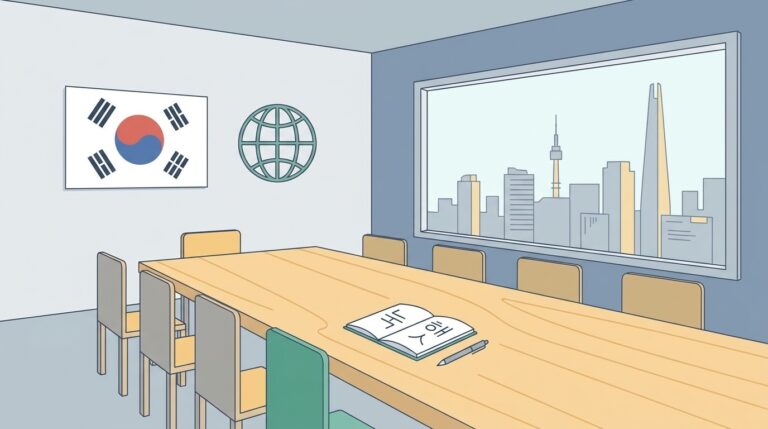
Talk Like a Diplomat: Master the Language of International Organizations (UN/WHO) in Korean
Phase 1: Empathy (스토리 몰입형 오프닝)
안녕하세요! Welcome back to another edition of Daily Hangul, your premium ticket to mastering high-level, culturally authentic Korean. I’m your head editor and local culture navigator.
Imagine this: You’re watching a fast-paced K-Drama political thriller like Chief of Staff (보좌관) or a global crisis series, and characters are arguing passionately in a high-stakes committee meeting. They aren’t using the simple classroom Korean you learned in beginner textbooks. Instead, they are tossing around sophisticated, sharp diplomatic terms that carry heavy institutional weight.
As a C1 (Advanced) learner, your biggest pain point isn’t just knowing the dictionary definition of words like “cooperation” or “resolution.” It’s understanding the subtle nuances, formal hierarchy, and passive-aggressive politeness used in real-world professional spheres like the UN, WHO, or international NGOs. Today, we are moving past dry vocabulary lists. We’re going to look at the exact expressions and non-verbal cues that will make you sound like a seasoned diplomat representing Korea on the global stage. Let’s dive in!
Phase 2: Key Expressions In-Depth (핵심 표현 3선 심층 분석)
1. 인도주의적 차원에서 (Indojuijeok chawoneoseo)
- Pronunciation: In-do-ju-ui-jeok cha-won-eo-seo (Sounds like: “In-doe-joo-ee-jeok cha-won-uh-suh”)
- Meaning: “From a humanitarian perspective” / “On humanitarian grounds”
- K-Culture Moment: Often heard in documentary narrations about global medical teams or in dramas when a high-ranking official is trying to justify sending aid to a sensitive region despite geopolitical conflicts.
- Editor’s Insight: 차원 (chawon) literally means “dimension” or “level.” When combined with 인도주의적 (humanitarian), it shifts the focus of the debate away from political gains to human lives. It’s a highly sophisticated shield phrase used in diplomatic stalemates.
- Situation Spectrum: Casual 🚫 | Semi-formal ⚠️ | Formal ✅
- 🤔 Think About It: In English, we say “on grounds of.” Why do you think Korean uses 차원 (dimension/level)? It reflects a worldview of categorized, layered perspectives. How does this compare to your native language?
2. 결의안을 채택하다 (Gyeoryianeul chaetaekhada)
- Pronunciation: Gyul-ui-an-eul chae-taek-ha-da (Sounds like: “Gyul-ee-ahn-eul chae-tek-ha-da”)
- Meaning: “To adopt a resolution”
- K-Culture Moment: A staple phrase in news broadcasts covering the UN Security Council (유엔 안전보장이사회) or the WHO General Assembly regarding global health policies.
- Editor’s Insight: 결의 (resolution/determination) and 안 (proposal/draft) combine to form a formal resolution. 채택하다 (to adopt) is used instead of 통과시키다 (to pass) to signify a formal, collective agreement to embrace a standard.
- Situation Spectrum: Casual 🚫 | Semi-formal ⚠️ | Formal ✅
- 🤔 Think About It: Think of how “adopt” is used both for children and resolutions in English. Korean uses different verbs: kids are 입양하다, while policies are 채택하다. Keeping these apart is crucial for C1 precision!
3. 상호 협력을 공고히 하다 (Sangho hyeopryeokeul gonggohi hada)
- Pronunciation: Sang-ho hyup-ryuk-eul gong-go-hi ha-da (Sounds like: “Sahng-ho hyup-ryuk-eul gohng-go-he-ha-da”)
- Meaning: “To solidify mutual cooperation”
- K-Culture Moment: The ultimate closing statement in joint press conferences, bilateral treaty signings, or international summits.
- Editor’s Insight: While 굳건히 하다 (to strengthen) is common, the Hanja-derived 공고히 하다 (to make firm/solid) sounds incredibly prestigious, intellectual, and formal.
- Situation Spectrum: Casual 🚫 | Semi-formal ⚠️ | Formal ✅
- 🤔 Think About It: Why does Korean diplomatic language rely so heavily on Sino-Korean (Hanja) roots? It creates a distinct boundary between everyday speech and authoritative, state-level declarations.
Phase 3: Textbook Korean vs. Real-World Korean
Let’s compare the dry expressions found in academic textbooks with the actual, sophisticated phrasings used by global professionals.
Situation 1: Proposing to work together on a global health crisis
- 📖 Textbook Korean: 같이 문제를 해결합시다. (Gachi munje-reul haegyeol-hapsida. – “Let’s solve the problem together.”)
- 🗣️ Real Korean: 공동의 위기 대응을 위해 긴밀히 공조해 나가야 합니다. (Gongdong-ui wigi dae-eung-eul wihae ginmilhi gongjohae nagaya hamnida. – “We must cooperate closely for a joint crisis response.”)
- 💡 Why it’s different: The textbook version sounds like a high school group project. The real-world C1 version uses 공조하다 (to coordinate/cooperate) and 긴밀히 (closely) to project strategic weight.
Situation 2: Emphasizing the WHO’s guiding role
- 📖 Textbook Korean: WHO가 사람들을 도와줍니다. (WHO-ga saram-deul-eul dowajumnida. – “The WHO helps people.”)
- 🗣️ Real Korean: WHO는 국제 보건 규범을 선도하는 중추적 역할을 수행합니다. (WHO-neun gukje bogeon gyubeom-eul seondohaneun jungchujeok yeokhwal-eul suhaenghamnida. – “The WHO plays a pivotal role in leading international health norms.”)
- 💡 Why it’s different: Active diplomatic speech avoids passive verbs like “help.” Instead, words like 선도하다 (to lead) and 중추적 역할 (pivotal/central role) define institutional power.
Phase 4: K-Culture Deep Dive & Non-Verbal Manners
4-1. The Art of the Diplomatic Bow & Gaze
In international organizations like the UN, Korean diplomats balance Western global standards with deeply ingrained Korean etiquette:
* The Eye-Contact Equilibrium: Unlike the intense, unbroken eye contact expected in the West, Korean diplomatic protocol values 시선 처리 (eye-gaze management). Staring directly into a senior official’s eyes throughout a whole sentence can feel confrontational. Look at the bridge of their nose occasionally to soften the gaze.
* The Micro-Bow: When exchanging business cards (명함) at a UN reception, always present and receive cards with both hands, accompanied by a subtle 15-degree micro-bow of the head. It shows peerless sophistication.
4-2. Cultural Spotlight: The Global Leadership Wave
Korea’s role in international bodies is no longer peripheral. Ever since Ban Ki-moon (반기문) served as the 8th Secretary-General of the United Nations, Korea’s diplomatic voice has been highly regarded. In Korean media, dramas depicting global organizations emphasize 국격 (guk-gyeok – national prestige), showcasing characters who speak with flawless honorifics and a calm, deliberate tone.
Phase 5: Real-World Roleplay Scenario
Setting: A formal UN-led international committee meeting in Seoul discussing humanitarian aid distribution.
Characters:
* 민우 (Min-woo): Senior Representative of the Republic of Korea.
* 사라 (Sarah): WHO Regional Director.
🎭 Dialogue:
- 민우: 이번 사태는 인도주의적 차원에서 매우 신속히 다뤄져야 합니다.
(Ibeon sataeneun indojuijeok chawoneoseo maeu sinsokhi daryeojyeoya hamnida.)
“This issue must be addressed very swiftly from a humanitarian perspective.” -
사라: 동감합니다. WHO도 백신 공급을 위해 긴밀히 공조할 준비가 되어 있습니다.
(Donggamhamnida. WHO-do baeksin gonggeubeul wihae ginmilhi gongjohal junbiga doeeo isseumnida.)
“I agree. The WHO is also ready to coordinate closely for vaccine distribution.” -
민우: 🎭 (진중하게 미소를 지으며) 고맙습니다. 양측의 협력을 공고히 할 파트너십이 필요합니다.
(Gomapseumnida. Yangcheuk-ui hyeopryeokeul gonggohi hal pateuneosibi piryohamnida.)
“Thank you. We need a partnership that solidifies the cooperation of both sides.” -
사라: 맞습니다. 이번 결의안이 조속히 채택되기를 희망합니다.
(Matseumnida. Ibeon gyeoryiani josokhi chaetaekdoe-gireul huimanghamnida.)
“Indeed. I hope this resolution is adopted as soon as possible.” -
민우: 한국 정부도 재정적, 기술적 지원을 아끼지 않을 것입니다.
(Hanguk jeongbudo jaejeongjeok, gisuljeok jiwoneul akkiji aneul geosimnida.)
“The Korean government will also spare no financial or technological support.” -
사라: 🎭 (고개를 끄덕이며) 아주 든든하네요. 회원국들의 동참을 이끌어내 봅시다.
(Aju deundeunhaneyo. Hoewonguk-deul-ui dongchameul ikkeoleonae bopsida.)
“That is highly reassuring. Let’s encourage participation from member states.” -
민우: 맞습니다. 국제사회의 단합된 목소리가 절실한 시점입니다.
(Matseumnida. Gukjesahoeyi danhapdoen moksoriga jeolsilhan sijeomimnida.)
“Correct. A united voice from the international community is crucial at this juncture.” -
사라: 내일 총회에서 공식 성명으로 이 내용을 발표하겠습니다.
(Naeil chonghoeeseo gongsik seongmyeongeuro i naeoyngeul balpyohagesseumnida.)
“We will announce this in an official statement at tomorrow’s general assembly.”
🔀 Interactive Choice Point
How would you respond to Sarah’s offer to make the official announcement?
* Choice A: “좋아요, 부탁해요.” (Joyayo, butakhaeyo. – “Great, please do.”)
* Choice B: “공식 성명 발표를 통해 당사의 확고한 의지를 천명해 주시기 바랍니다.” (Gongsik seongmyeong balpyoreul tonghae dangsa-ui hwakgohan uijireul cheonmyeonghae jusigi baramnida.)
* Choice C: “대충 대답해 주시면 고맙겠습니다.” (Daechung daedaphae jusiyeon gomapgesseumnida.)
Feedback:
- Choice A (Risk): Too casual. It sounds like you are talking to a classmate, not a WHO Regional Director.
- Choice B (Best): Peerless C1 diplomat! 천명하다 (to declare/make clear) and 확고한 의지 (firm resolve) show magnificent executive vocabulary.
- Choice C (Bad): Disastrous! 대충 means “half-heartedly” or “sloppily.” You just asked her to give a lazy answer!
Phase 6: 10-Second Emotion Shadowing Drill
Practice delivery with emotional coloring. Pay attention to the pauses (/).
- [💼 Deeply Professional & Firm]
이번 사태는 / 인도주의적 차원에서 / 신속히 / 다뤄져야 합니다.
(Ibeon sataeneun / indojuijeok chawoneoseo / sinsokhi / daryeojyeoya hamnida.) -
[🤝 Hopeful & Collaborative]
양측의 / 상호 협력을 / 더욱 / 공고히 / 해 나갑시다.
(Yangcheuk-ui / sangho hyeopryeokeul / deouk / gonggohi / hae nagapsida.)
Phase 7: K-Culture Mini-Dictionary
- 의장국 (Uijangguk) | Chair Country
- Usage: Korea acting as the presiding country in a UN committee session.
- 성명서 (Seongmyeongseo) | Official Statement / Manifesto
- Usage: Releasing a written stance on behalf of an international body.
- 비정부기구 (Bijeongbugigu) | NGO (Non-Governmental Organization)
- Usage: Discussing partnerships with non-profits in humanitarian work.
- 인도적 지원 (Indojeok Jiwon) | Humanitarian Aid
- Usage: Sending food, medicine, or resources to disaster zones.
Phase 8: Survivor Kit for Travelers & Expats
Survival Expressions TOP 3
- 비상구는 어디에 있나요? (Bisangguneun eodie innayo?)
- Pro Tip: Essential during international conferences for safety protocols.
- 대표단 등록 데스크가 어디죠? (Daepyodan deungrok deseukeuga eodijo?)
- Pro Tip: “Where is the delegation registration desk?”
- Wi-Fi 비밀번호를 알 수 있을까요? (Wi-Fi bimilbeonhoreul al su isseulkkayo?)
- Pro Tip: Vital at any global summit.
Editor’s Travel Note
If you are attending international summits or academic forums in Korea (often held at COEX in Seoul or BEXCO in Busan), make sure to download the Naver Map App beforehand to navigate complex subway lines. Also, use T-money Card for effortless, high-tech transit payment.
Note: Travel services and application features are subject to update by their respective providers.
Phase 9:
Frequently Asked Questions (FAQ)
Q: What does "인도주의적 차원에서 (Indojuijeok chawoneoseo)" mean in Korean and how do you pronounce it?
A: In Korean, "인도주의적 차원에서 (Indojuijeok chawoneoseo)" is pronounced [In-do-ju-ui-jeok cha-won-eo-seo (Sounds like: "In-doe-joo-ee-jeok cha-won-uh-suh"] and means: "From a humanitarian perspective" / "On humanitarian grounds"
Q: What does "결의안을 채택하다 (Gyeoryianeul chaetaekhada)" mean in Korean and how do you pronounce it?
A: In Korean, "결의안을 채택하다 (Gyeoryianeul chaetaekhada)" is pronounced [Gyul-ui-an-eul chae-taek-ha-da (Sounds like: "Gyul-ee-ahn-eul chae-tek-ha-da"] and means: "To adopt a resolution"
Q: What does "상호 협력을 공고히 하다 (Sangho hyeopryeokeul gonggohi hada)" mean in Korean and how do you pronounce it?
A: In Korean, "상호 협력을 공고히 하다 (Sangho hyeopryeokeul gonggohi hada)" is pronounced [Sang-ho hyup-ryuk-eul gong-go-hi ha-da (Sounds like: "Sahng-ho hyup-ryuk-eul gohng-go-he-ha-da"] and means: "To solidify mutual cooperation"







