

How to Say Thank You Like a True Local When Getting Free Items on Karrot (당근마켓)
Phase 1: Empathy (공감 – Connection & Storytelling)
안녕하세요! Welcome back to Daily Hangul, your favorite Korean culture and language navigator. I’m your editor, and today we are diving into one of the most exciting, heartwarming, and highly active subcultures in modern South Korea: 중고 거래 (junggo georae – secondhand trading), specifically the art of getting free stuff through 무료 나눔 (muryo nanum – free sharing)!
Imagine this: You just moved into a cozy officetel in Seoul. You’re on a budget, so you open Karrot (당근마켓 – Danggeun Market), Korea’s mega-popular hyper-local secondhand app. You spot a beautiful, near-perfect standing lamp listed for ₩0 (무료 나눔). You message the seller, meet them near the subway exit, and they hand you the lamp with a warm smile.
Now, here is the ultimate Korean learner’s pain point: What do you say?
Just saying a simple, textbook “감사합니다 (gamsahamnida)” feels a bit cold. On the other hand, using overly formal business Korean sounds stiff and awkward. How do you convey genuine, warm-hearted gratitude that reflects true Korean politeness and community spirit (정 – Jeong)? Today, we will master the exact phrases, cultural manners, and digital etiquette to make your next free-sharing interaction absolutely flawless. Let’s get started!
Phase 2: Deep Dive into 3 Key Expressions (핵심 표현 3선 심층 분석)
1. 잘 쓸게요! (jal sseulgeyo!)
- Pronunciation: Jal sseul-gae-yo! (Sounds like “Jal” + “sul-get-yoh” with a soft ‘g’)
- Meaning: “I will use it well!” (Literal: “Well I will write/use”)
- K-Culture Moment: In K-Dramas, when a friendly neighbor hands over side dishes (반찬 – banchan) or a colleague passes down a useful book, this is the go-to phrase of appreciation.
- Editor’s Insight: This is the absolute gold standard for receiving physical items. In Korean culture, showing the giver that their cherished item won’t go to waste is the ultimate form of respect and gratitude.
- Situation Spectrum: Casual (✅ – 잘 쓸게!), Semi-formal (✅ – 잘 쓸게요!), Formal (⚠️ – 잘 쓰겠습니다!)
- 🤔 Think About It: In Western cultures, we often say “Thank you so much!” focusing on our current feeling. Why do you think Korean gratitude focuses so heavily on the future action of using the item well?
2. 나눔해 주셔서 정말 감사합니다. (nanumhae jusyeoseo jeongmal gamsahamnida.)
- Pronunciation: Nah-num-hae joo-syuh-suh jung-mal gam-sah-ham-nee-dah.
- Meaning: “Thank you so much for sharing/gifting this.”
- K-Culture Moment: This is the textbook-perfect, polite text message you send right after securing a pickup slot on Karrot Market.
- Editor’s Insight: The word 나눔 (nanum) comes from the verb 나누다 (nanuda – to share/divide). By explicitly acknowledging their act as “sharing” rather than just “giving,” you elevate the interaction from a simple transaction to an act of community kindness.
- Situation Spectrum: Casual (🚫), Semi-formal (✅ – 나눔해 주셔서 감사해요), Formal (✅ – 나눔해 주셔서 정말 감사합니다)
- 🤔 Think About It: How does using a specific verb like “sharing” (나눔) change the dynamic between two strangers compared to just saying “giving” (주다)?
3. 소중히 잘 간직할게요. (sojunghi jal ganjikhalgeyo.)
- Pronunciation: Soh-joong-hee jal gan-jik-hal-gae-yoh.
- Meaning: “I will cherish and keep it well.”
- K-Culture Moment: Commonly used when receiving items with sentimental value, like a vintage vinyl record, a book, or handmade crafts.
- Editor’s Insight: If the seller mentions in their listing that they loved this item but have to let it go due to moving, this phrase will literally melt their heart. It reassures them that their memories are in safe hands.
- Situation Spectrum: Casual (✅ – 소중히 잘 간직할게), Semi-formal (✅ – 소중히 잘 간직할게요), Formal (⚠️ – 소중히 잘 간직하겠습니다)
- 🤔 Think About It: Think of an item you had to part with. Wouldn’t you feel happier giving it away for free if the receiver promised to “cherish” it?
Phase 3: Textbook Korean vs. Real-Life Korean (교과서 한국어 vs 진짜 한국어)
Situation 1: Sending a text to confirm you arrived at the pickup spot.
- 📖 Textbook Korean: “저는 약속 장소에 도착했습니다. 어디에 계십니까?” (I have arrived at the appointment location. Where are you?) – Sounds like a textbook robot or a formal investigator.
- 🗣️ 진짜 한국어: “안녕하세요! 저 약속 장소(CU 편의점 앞) 도착했어요! 😊” (Hello! I’ve arrived at the meetup spot (in front of CU convenience store)! 😊)
- 💡 Why the difference? Real Koreans heavily rely on emojis (like 😊, !), softening particles (-요), and specific landmarks to make the meeting friendly and stress-free.
Situation 2: Expressing gratitude when handing over the item.
- 📖 Textbook Korean: “무료로 물건을 주셔서 대단히 감사합니다.” (Thank you very much for giving me the item for free.) – Extremely transactional and overly stiff.
- 🗣️ 진짜 한국어: “우와, 상태가 너무 좋네요! 진짜 잘 쓸게요. 감사합니다!” (Wow, it’s in such great condition! I will really use it well. Thank you!)
- 💡 Why the difference? Complimenting the item’s condition (상태 – sangtae) before expressing thanks shows that you truly appreciate the quality of their gift, making the giver feel proud.
Phase 4: K-Culture Deep Dive & Non-Verbal Manners (비언어적 매너)
4-1. The Double-Hand Handover (두 손 매너)
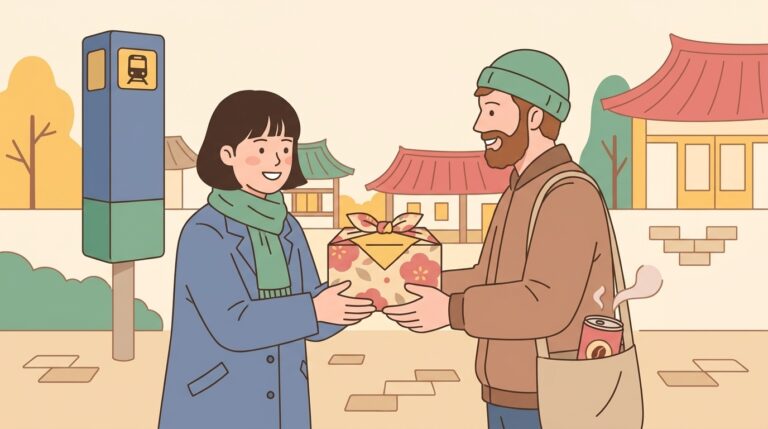
When receiving a free item, never grab it with one hand. This is considered highly casual or even rude. Always extend both hands (두 손) to receive the item. Gently bow your head at about a 15 to 30-degree angle as you say “감사합니다.”
4-2. The “Small Treat” Code (소소한 정)
In Korea, there is a beautiful, unwritten rule when receiving a high-value or highly useful item for free: 뇌물 (noemul – literal ‘bribe’, but used playfully here as a tiny gift). It is highly customary to bring a small treat to hand to the giver in return.
* Popular choices: A warm can of coffee, a pouch of fruit juice, or a couple of sweet snacks (like Choco Pie or gummy candies).
* When handing it over, you can say: “이거 약소하지만 드세요!” (igeo yaksohajiman deuseyo! – “It’s small, but please have this!”)
Phase 5: Real-Life Roleplay Scenario (실전 롤플레이)
The Setup
- Location: Mapo Station, Exit 3 (마포역 3번 출구)
- Characters:
- Ji-woo (지우): A friendly local resident who is giving away an electric kettle for free.
- Alex (알렉스): An international student (You!) who needs a kettle for ramyeon nights.
Dialogue
- 지우: 혹시… 당근마켓 알렉스님 맞으세요?
(hoksi… Danggeunmarket Alex-nim majeuseyo?)
(🎭 Looking around holding a clean, boxed kettle) - 알렉스: 아, 네! 맞아요! 지우님 안녕하세요.
(a, ne! majayo! Ji-woo-nim annyeonghaseyo.)
(🎭 Bowing politely with a bright smile) - 지우: 아, 반가워요! 여기 약속했던 무선 주전자예요. 상태 깨끗하게 닦아두었어요.
(a, bangawoyo! yeogi yaksokhaetdeon museon jujeonjayeyo. sangtae kkaekkeuthage dakka-dueosseoyo.)
(🎭 Handing over the box with both hands) - 알렉스: 우와, 박스째 주시다니… 정말 감사합니다! 안 그래도 꼭 필요했거든요.
(uwa, bakseu-jjae jusidani… jeongmal gamsahamnida! an geuraedo kkok piryohaetgeodeunyo.)
(🎭 Receiving the box with both hands, bowing slightly) - 지우: 잘 작동하니까 안심하고 쓰셔도 돼요. 혼자 자취하시는 데 도움이 되면 좋겠네요.
(jal jakdonghanikka ansimhago sseusyeodo dwaeyo. honja jachwihasineun de doumi doemyeon joketneyo.)
(🎭 Smiling warmly) - 알렉스: 네, 진짜 잘 쓸게요! 아, 참! 이거 약소하지만 오는 길에 샀어요. 드셔보세요.
(ne, jinja jal sseulgeyo! a, cham! igeo yaksohajiman oneun gile sasseoyo. deusyeoboseyo.)
(🎭 Reaching into the bag to pull out a warm canned coffee) - 지우: 어머나, 안 그러셔도 되는데… 감동이네요! 잘 마실게요.
(eomoneo, an geureosyeodo doeneunde… gamdong-ineyeyo! jal masilgeyo.)
(🎭 Surprised and delighted, receiving the coffee) - 알렉스: 별거 아니에요. 추운 날씨에 나와주셔서 다시 한번 감사드려요. 조심히 들어가세요!
(byeolgeon anieyo. chuun nalssie nawajusyeoseo dasi hanbeon gamsadeuryeoyo. josimhi deureogaseyo!)
(🎭 Waving warmly as they part ways)
🔀 Interactive Choice Point
How would you follow up on the app after returning home?
* Option A: Send no message. (The transaction is already finished face-to-face.)
* Option B: Send a message: “잘 도착했습니다. 주전자 작동 잘 되네요. 수고하세요.”
* Option C: Send a message: “지우님! 집에 와서 켜봤는데 정말 작동 잘 되네요. 주신 커피포트로 따뜻한 겨울 보낼게요. 다시 한번 나눔 감사드리고, 매너 온도 99도 되세요! 🔥”
Feedback
- Option A (Bad): While not a crime, it leaves a cold impression. Karrot is built on community warm-heartedness!
- Option B (Risk): Too dry and business-like. “수고하세요” can sometimes sound slightly dismissive to peer individuals.
- Option C (Best!): Perfect! It shows you actually tested the item, expresses deep appreciation, and references the cute Karrot “Manner Temperature” system. You’ll get a glowing review!
Phase 6: 10-Second Emotion Shadowing Drill (10초 감정 섀도잉 드릴)
Practice saying these lines with the indicated emotional pausing (/ represents a tiny pause, capital letters represent soft stress for friendly intonation):
[😊 Exited & Grateful]
우와, / 진짜 깨끗하네요! / 정말 / 잘 쓸게요!
(U-wa / jin-ja kkae-kkeut-ha-nae-yo! / jeong-mal / jal sseul-gae-yo!)-
[🥺 Touched & Appreciative]
나눔해 주셔서 / 너무 감사해요. / 소중히 / 잘 간직할게요!
(Nanum-hae ju-syuh-suh / neo-mu gam-sa-hae-yo. / soh-joong-hee / jal gan-jik-hal-gae-yoh!)
Phase 7: K-Culture Mini Dictionary (미니 사전)
- 나눔 (Nanum) | Free Sharing / Donation | The beautiful act of giving away things you don’t use anymore for free to help neighbors and reduce waste.
- 매너 온도 (Maeneon Ondo) | Manner Temperature | Karrot’s rating system starting at 36.5°C (human body temp). Outstanding behavior raises it up to 99°C!
- 자취 (Jachwi) | Living alone (especially for students/young professionals) | The independence era of young Koreans, heavily relying on secondhand items to decorate their first rooms.
- 소소한 (Sosohan) | Small but certain / Humble | Used to describe small gestures, gifts, or happiness that bring warmth to everyday life.
Phase 8: Survivor Kit for Travelers (여행자 생존 키트)
Top 3 Phrases
- 혹시 당근이세요? (hoksi danggeun-iseyo?)
- “Excuse me, are you Karrot?” (The universal ice-breaker phrase when looking for your trading partner near subway exits.)
- 이거 약소하지만 드세요. (igeo yaksohajiman deuseyo.)
- “This is small, but please have it.” (The magic phrase to hand over a warm drink or snack in return.)
- 조심히 들어 가세요! (josimhi deureogaseyo!)
- “Go home safely!” (The perfect parting words after a successful meetup.)
Editor’s Travel Note
To experience Korea’s amazing neighborhood culture, download the Karrot App (search for 당근 on Google Play or iOS App Store). Note that to trade, you will need a verified Korean phone number and GPS location set within Korea. It’s a fantastic way to meet locals and practice natural Korean conversation!
Phase 9: “Going Deeper” (생각 질문 – A Cultural Reflection)
In many Western cultures, giving away something for free is seen as a purely functional clearing-out process. However, in Korea, “나눔” (sharing) is deeply rooted in 정 (Jeong – affection and communal bond) and 품앗이 (Pumasi – historical mutual aid). By saying “잘 쓸게요” (I will use it well), you are assuring the other person that their resource is still valuable and respected.
💬 Your Turn: Does your country have a similar culture of giving away things for free to neighbors? How do you say “I will make good use of this” in your native language? Let us know in the comments below!
Phase 10: FAQ & Common Mistakes (자주 묻는 질문 & 실수)
Q: Can I use “고마워” (gomawo) instead of “잘 쓸게요”?
A: Only if the person giving you the item is younger than you or a very close friend. Since most Karrot transactions are with strangers, you should stick to 존댓말 (polite language) such as “감사합니다” and “잘 쓸게요!”
Q: Should I offer money even if it is a “무료 나눔”?
A: No, offering money can sometimes make the transaction awkward since they explicitly listed it for free. Instead, giving a small drink or snack valued at ₩1,000 ~ ₩2,000 is considered much more polite and culturally appropriate.
Q: What if the item has minor flaws when I meet them?
A: Since it is a free share (무료 나눔), it is bad etiquette to complain about small scratches or cosmetic issues on the spot. If the item doesn’t work at all, contact them politely via the app later.
🚨 Common Mistakes Alert!
- Mistake 1: Grabbing the item with one hand.
- Correct Action: Extend both hands with a slight bow.
- Mistake 2: Saying “수고하세요” (sugohaseyo) to older people.
- Correct Action: Use “감사합니다, 조심히 들어가세요” instead, as “수고하세요” can sometimes sound like telling someone to “keep laboring.”
- Mistake 3: Texting too late after the meetup.
- Correct Action: Send a warm thank-you chat message within 1-2 hours of getting home.
Phase 11: Action Missions & Challenges (액션 미션)
- Bronze Mission (Solo): Stand in front of a mirror and practice bowing at a 15-degree angle while saying *







