

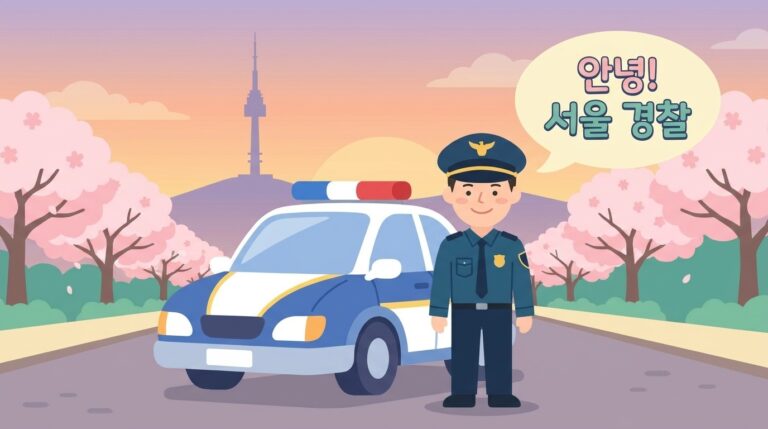
How to Call 112 in Korea: Your Simple, Stress-Free Guide
Phase 1: Empathy (Your Korean Bestie is Here!)
안녕하세요! (An-nyeong-ha-se-yo!) Your Korean bestie and Daily Hangul editor is here.
Imagine this: You are walking down a beautiful street in Seoul at night, enjoying the cool breeze. Suddenly, you witness a minor car accident, or you realize your backpack with your passport inside has gone missing. Your heart starts racing. You want to call for help, but your mind goes blank. “How do I dial emergency in Korea? What do I say? What if they don’t understand English?”
Take a deep breath. We have all been there, and it is completely normal to feel scared! In Korea, calling 112 (the police hotline) is incredibly safe, fast, and foreigner-friendly. Today, we are going to learn 3 simple, life-saving Korean phrases that will get you help in seconds. No complex grammar, no textbook stiffness—just real, practical Korean to keep you safe!
Phase 2: Top 3 Core Expressions (Deep Dive)
Let’s look at the absolute most important phrases you need when calling 112.
1. 도와주세요! (Do-wa-ju-se-yo!)
- Pronunciation: “Do-wah-joo-seh-yo” (Sounds like “Do-ah” + “Juice” + “Yo”)
- Meaning: Please help me!
- K-Culture Moment: You have definitely heard this in K-Dramas! Whenever the main character is in trouble, they shout this out. It’s the universal cry for help.
- Editor’s Insight: This is the most direct way to get attention. If you are too panicked to say anything else, just yell or say this phrase clearly into the phone.
- Situation Spectrum: Casual: 🚫 | Semi-formal: ✅ | Formal: ✅ (Always use polite form in emergencies!)
- 🤔 Think About It: In Korean culture, asking for help politely using “-요” (-yo) is natural even in high-stress situations because respect is deeply embedded in the language.
2. 경찰을 불러주세요. (Gyeong-chal-eul bul-leo-ju-se-yo.)
- Pronunciation: “Gyung-chahl-eul bool-luh-joo-seh-yo” (Rhymes with “Young-chahl” + “bool-luh” + “joo-seh-yo”)
- Meaning: Please call the police.
- K-Culture Moment: Often heard in thriller K-Dramas when a neighbor hears a strange noise next door.
- Editor’s Insight: Gyeong-chal means “police.” If you are asking a nearby Korean passerby to call 112 for you because your phone is dead, this is the perfect phrase to use.
- Situation Spectrum: Casual: 🚫 | Semi-formal: ✅ | Formal: ✅
- 🤔 Think About It: Why does Korean use “불러주세요” (please call/summon) instead of “전화해주세요” (please make a phone call)? It shows the urgency of bringing the police physically to the scene!
3. 여기에 사고가 났어요. (Yeo-gi-e sa-go-ga nas-seo-yo.)
- Pronunciation: “Yuh-gi-eh sah-go-gah-naht-suh-yo” (Sounds like “Yuh-key” + “Sah-go” + “Nat-suh-yo”)
- Meaning: An accident happened here.
- K-Culture Moment: Commonly used when reporting traffic incidents or minor street clashes on busy Seoul roads.
- Editor’s Insight: Yeo-gi means “here” and sa-go means “accident.” This tells the dispatcher immediately that something went wrong at your location.
- Situation Spectrum: Casual: 🚫 | Semi-formal: ✅ | Formal: ✅
Phase 3: Textbook Korean vs. Real-Life Korean
Let’s compare what dry textbooks teach you versus how real life actually works.
Situation A: Reporting a theft
- 📖 Textbook Korean: “제 가방을 분실하였습니다.” (Je ga-bang-eul bun-sil-ha-yeot-seub-ni-da. – “I have lost my bag.”)
- 🗣️ Real-Life Korean: “가방을 잃어버렸어요!” (Ga-bang-eul il-eo-beo-ryeot-seo-yo! – “I lost my bag!”)
- 💡 Why is it different? The textbook version is extremely formal and sounds like a written report. In a real emergency, real people use “잃어버렸어요” (il-eo-beo-ryeot-seo-yo) which is natural, polite, and quick to say.
Situation B: Needing an English translator
- 📖 Textbook Korean: “영어 통역 서비스를 제공해 주시겠습니까?” (Yeong-eo tong-yeok seo-bi-seu-reul je-gong-hae ju-si-get-seub-ni-kka? – “Would you kindly provide an English translation service?”)
- 🗣️ Real-Life Korean: “영어 통역 부탁해요!” (Yeong-eo tong-yeok bu-tak-hae-yo! – “English translation, please!”)
- 💡 Why is it different? When you call 112, you don’t need a 10-word grammar puzzle. Simply saying “영어” (Yeong-eo – English) and “부탁해요” (bu-tak-hae-yo – please/request) will instantly prompt the operator to connect you to a translation service.
Phase 4: K-Culture Deep Dive & Non-Verbal Manners
4-1. The “Calm But Firm” Manner
In Korea, calling the police is taken very seriously. To get the fastest help, try to maintain eye contact with landmarks around you (like a convenience store name or a subway exit number). Hand gestures aren’t helpful over the phone, but speaking in a stable, clear voice without yelling excessively helps the operator locate you faster.
4-2. The Safety Culture of Korea
Korea is famous for being incredibly safe. You will see people leaving their laptops on cafe tables to go to the restroom! Because of this high trust, if you actually do call 112, the police response time is extremely fast (usually under 3-5 minutes in Seoul). Don’t hesitate to call if you are in genuine trouble.
Phase 5: Interactive Roleplay Scenario
Let’s practice! You are near Hongdae Station Exit 9 and you just saw a minor fender bender. You dial 112. The police officer (Officer Park) answers.
- Officer Park: 🎭 (Calm and professional) “112 경찰입니다. 무슨 일이신가요?”
(112 Gyeong-chal-im-ni-da. Mu-seun il-i-sin-ga-yo? – “112 Police. What is the emergency?”) - You: 🎭 (Nervous but trying to be clear) “도와주세요! 사고가 났어요.”
(Do-wa-ju-se-yo! Sa-go-ga nas-seo-yo. – “Please help! An accident happened.”) - Officer Park: 🎭 (Typing quickly) “네, 어디신가요? 위치를 말씀해 주세요.”
(Ne, eo-di-sin-ga-yo? Wi-chi-reul mal-sseum-hae ju-se-yo. – “Yes, where are you? Please tell me the location.”) - You: 🎭 (Looking around, pointing to the sign) “홍대입구역 9번 출구 앞이에요.”
(Hong-dae-ip-gu-yeok gu-beon chul-gu ap-i-e-yo. – “In front of Hongdae Station Exit 9.”) - Officer Park: 🎭 (Confirming details) “다친 사람이 있습니까?”
(Da-chin sa-ram-i is-seub-ni-kka? – “Is anyone hurt?”) - You: 🎭 (Shaking your head) “아니요, 안 다쳤어요. 차가 부딪혔어요.”
(An-i-yo, an da-chyeot-seo-yo. Cha-ga bu-dit-hyeot-seo-yo. – “No, not hurt. Cars bumped into each other.”) - Officer Park: 🎭 (Reassuring) “알겠습니다. 경찰차를 바로 보내겠습니다.”
(Al-get-seub-ni-da. Gyeong-chal-cha-reul ba-ro bo-nae-get-seub-ni-da. – “Understood. We will send a police car immediately.”) - You: 🎭 (Relieved) “감사합니다!”
(Gam-sa-ham-ni-da! – “Thank you!”)
🔀 Your Turn: What would you do if you didn’t know your location?
- Choice A: Panick and hang up.
- Choice B: Look for the nearest convenience store (like GS25 or CU) and read the store branch name on the sign.
- Choice C: Try to walk back to your hotel first.
Feedback:
- Best Choice: B! Convenience stores in Korea are everywhere, and their signs show the exact branch name (e.g., “GS25 Hongdae Main Branch”). Giving this name to 112 allows them to locate you instantly.
Phase 6: 10-Second Emotion Shadowing Drill
Let’s practice speaking with real emotion. Pause at the / marks!
- [🥺 Panic & Urgent]
- 도와주세요! / 사고가 / 났어요!
- (Do-wa-ju-se-yo! / Sa-go-ga / nas-seo-yo!)
- “Please help! / An accident / happened!”
- [😰 Worried & Requesting English]
- 영어 / 통역 / 부탁해요.
- (Yeong-eo / tong-yeok / bu-tak-hae-yo.)
- “English / translation / please.”
Phase 7: K-Culture Mini-Dictionary
- 경찰차 (Gyeong-chal-cha) | Police car | You will see white-and-blue patrol cars with yellow stripes in Korea.
- 112 (Il-il-i) | 112 | The emergency number for police in Korea (pronounced il-il-i).
- 도움 (Do-um) | Help / Assistance | The noun form of “to help.”
- 외국어 (Wae-guk-eo) | Foreign language | Used when requesting translation services.
Phase 8: Traveler’s Survival Kit
Survival Phrases TOP 3
- 지갑을 잃어버렸어요. (Ji-gap-eul il-eo-beo-ryeot-seo-yo.) – I lost my wallet.
- 여기 아파요. (Yeo-gi a-pa-yo.) – It hurts here (if you are injured).
- 도와주실 수 있나요? (Do-wa-ju-sil su in-na-yo?) – Can you help me?
Editor’s Travel Note
Before wandering around Korea, make sure to download the Naver Map App which shows exact street addresses in English. Also, did you know that if you dial 112, you can ask for the 1330 Korea Travel Helpline for free, instant translation?
Note: Local emergency response procedures are subject to change depending on municipal policies.
Phase 9: “A Step Deeper” (Cultural Insight)
In Korea, police officers are often called “Min-jung-ui-ji-pang-i” (민중의 지팡이), which translates to “the staff/cane of the people”—meaning they are there to support and guide citizens, like a walking cane. This warm perspective makes Korean police very approachable. Don’t feel guilty or scared to call them even for minor issues like lost belongings.
💬 Your Turn: Have you ever had to call emergency services in another country? How did it feel? Let me know in the comments below!
Phase 10: FAQ & Common Mistakes
Q: Can I speak English when I call 112?
A: Yes! When you call 112 and speak English, the operator will immediately connect you to an English-speaking interpreter who will translate your conversation in real-time.
Q: Does calling 112 cost money?
A: No, emergency calls are completely free of charge from any phone, even if your SIM card is deactivated.
Q: What is the difference between 112 and 119?
A: Call 112 for security, crimes, theft, and traffic accidents. Call 119 for fires, medical emergencies, and ambulances.
🚨 Common Mistakes Warning Board
- Mistake 1: Saying “Help me” in English too quickly.
- Correct Action: Say “도와주세요” (Do-wa-ju-se-yo) or simply say “English, please” slowly.
- Mistake 2: Hanging up because you don’t know the address.
- Correct Action: Keep the line open. Korean police can trace your GPS location.
Phase 11: Action Mission & Engagement
- Bronze Medal: Write “도와주세요!” 3 times in your notebook.
- Silver Medal: Read the Phase 6 shadowing drill out loud twice.
- Gold Medal: Share this post on your Instagram and tag a friend you are traveling to Korea with!
Phase 12: Interactive Quiz Challenge
Test your skills below!
Q1. How do you say “Please call the police” in Korean?
Click to reveal the answer!
Answer: 경찰을 불러주세요. (Gyeong-chal-eul bul-leo-ju-se-yo.)
Explanation: Gyeong-chal means police, and bul-leo-ju-se-yo means please call!
Q2. True or False: You should call 112 if your hotel room is on fire.
Click to reveal the answer!
Answer: False!
Explanation: For fires and medical emergencies, you should call 119!







