

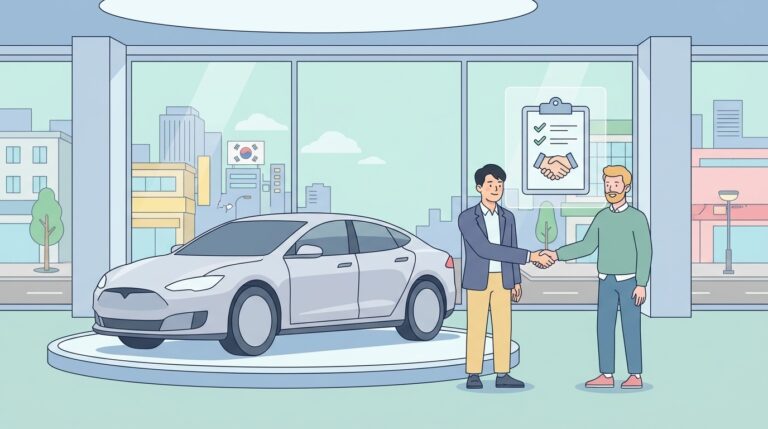
Master the Art of Used Car Dealings in Korea: Haggle Like a Pro at C1 Level
Phase 1: Empathy (Our Shared Journey)
안녕하세요! It’s your trusty Daily Hangul editor here. Have you ever scrolled through Korean secondhand car platforms like K-Car or Encar, only to feel your heart beat a little too fast?
Buying a used car is daunting in any language, but doing it in Korea adds layers of cultural nuances. You aren’t just reading specs; you are navigating the subtle art of nun-chi (눈치 – situational wit) and negotiation. Many of our advanced C1 learners tell us, “I know the vocabulary, but I don’t know how to push back on a dealer’s price without sounding rude or getting ripped off.”
Today, we are diving deep into the actual linguistic chess match played in Korean used car dealerships. Based on real-world experiences from expats and savvy locals, this guide will arm you with the precise phrases to show dealers you are not a clueless foreigner, but a sharp negotiator who knows the market cold.
Phase 2: Deep Dive into 3 Essential Expressions
1. 감가 요인 (Gam-ga Yo-in)
- Pronunciation: Gam-ga yo-in (Sounds like “Kahm-gah yoh-een”)
- Meaning: Depreciation factors / Reasons for price reduction.
- K-Culture Moment: You will often hear this on popular Korean YouTube channels like Bobaedream or CarGirl/CarBoy when experts dissect a vehicle’s history, pointing out tiny scratches or past fender-benders to justify a lower price.
- Editor’s Insight: Instead of just asking for a discount (깎아주세요 – which sounds too casual and amateurish), using “감가 요인” signals that you speak the professional language of car valuation. You are asking for a justified price drop based on objective data.
- Situation Spectrum: Casual: 🚫 | Semi-formal: ✅ | Formal: ✅
- 🤔 Think About It: How does your culture handle negotiation? Is it purely numbers-driven, or do you, like Koreans, need to build a logical case based on “factors” to keep the interaction polite?
2. 삼박자 사고 (Sam-bak-ja Sa-go)
- Pronunciation: Sam-bak-ja sah-goh (Sounds like “Sahm-bahk-jah sah-goh”)
- Meaning: The “Triple-Whammy” Accident (Specifically referring to damage involving the front fender, hood, and radiator support).
- K-Culture Moment: In K-Dramas featuring gritty legal battles or white-collar crimes, shady dealers might try to hide a “삼박자 사고” car by calling it a “simple repair” (단순 교환).
- Editor’s Insight: In Korea, if a car has “삼박자” damage, its market value plummets because the core frame was likely affected. Bringing this term up shows the dealer you know exactly where the skeleton in the closet might be hidden.
- Situation Spectrum: Casual: ✅ | Semi-formal: ✅ | Formal: ⚠️
- 🤔 Think About It: Why do you think Korean car buyers are uniquely sensitive to frame damage compared to cosmetic paint jobs?
3. 네고 가능할까요? (Nego Ganeung-hal-kka-yo?)
- Pronunciation: Nego gah-neung-hahl-kkah-yoh? (Sounds like “Neh-go gah-noong-hahl-kah-yo?”)
- Meaning: Is there any room for negotiation? (Derived from “Negotiation”).
- K-Culture Moment: This is the universal phrase across all Korean secondhand apps (Karrot Market/당근마켓, Joonggonara). It’s smooth, polite, and doesn’t sound demanding.
- Editor’s Insight: It is much more professional than “디스카운트 해주세요” (Discount, please). It frames the discount as a mutual agreement rather than a one-sided favor.
- Situation Spectrum: Casual: ✅ | Semi-formal: ✅ | Formal: ⚠️
- 🤔 Think About It: Using loanwords like “네고” (Nego) soft-pedals the confrontational nature of bargaining. How does your native language soften direct financial requests?
Phase 3: Textbook Korean vs. Real-world Korean
Situation 1: Asking if the price is negotiable
- 📖 Textbook: 가격을 좀 낮춰 주실 수 있습니까? (Ga-gyeok-eul jom nat-chwo ju-sil su it-seup-ni-ka? – “Could you lower the price?”)
- 🗣️ Real-world: 혹시 절충 여지가 있을까요? (Hok-si jeol-chung yeo-ji-ga is-seul-kka-yo? – “Is there perhaps any room for compromise/adjustment?”)
- 💡 Why the difference? The textbook version is grammatically perfect but feels stiff and confrontational. “절충 여지” (room for compromise) is a elegant, indirect way to initiate haggling without putting the dealer on the defensive.
Situation 2: Pointing out a flaw to get a discount
- 📖 Textbook: 차에 하자가 있으니 돈을 깎아주세요. (Cha-e ha-ja-ga is-seu-ni don-eul kkak-a-ju-se-yo. – “There is a defect in the car, so give me a discount.”)
- 🗣️ Real-world: 이 부분은 성능 기록부랑 좀 달라서 감가 항목이 될 것 같은데요. (I bu-bun-eun seong-neung gi-rok-bu-rang jom dal-la-seo gam-ga hang-mok-i doel geot gat-eun-de-yo. – “This part is a bit different from the performance record sheet, so I believe it should be a depreciation item.”)
- 💡 Why the difference? Directly demanding money off sounds rude. By referring to the official “성능기록부” (Performance Record), you are letting the paperwork do the heavy lifting for your argument.
Phase 4: K-Culture Deep Dive & Non-verbal Manners
4-1. The Art of the “Silent Sucker” Look (눈치 게임)
When inspecting a used car in Korea, never look too excited. If you say “Wow, the interior is so clean!”, you lose all bargaining power.
* The Gesture: Lightly tap the tires with your shoe while crossed-armed, squinting slightly. This signals you are assessing the tire tread wear (타이어 트레드 잔존량).
* The Silence: After the dealer gives a price, pause for exactly 3 seconds while looking at the car’s front grill. In Korea, this silence pressure often forces the dealer to fill the gap with a concession.
4-2. The “Lemon Market” Culture in Korea
Historically, the Korean used car market was dubbed a “Hwang-sa-jang” (황사장 – yellow dust market, meaning dusty and untrustworthy). To combat this, platforms like KB Cha-Cha-Cha and Encar introduced certified diagnostic cars (진단 차량). Knowing this history means you should always demand “엔카진단” (Encar Certified) or “K-Car 직영” (K-Car Directly Managed) vehicles to ensure you aren’t being sold a flooded car (침수차).
Phase 5: Real-world Roleplay Scenario
Setting: A modern, sleek used car pavilion in Incheon.
Characters:
* Min-jun (민준): A sharp-eyed car dealer who uses high-level industry jargon to justify his prices.
* You (C1 Learner): A well-prepared buyer who knows how to spot hidden details and negotiate gracefully.
Dialogue:
1. 민준: (미소를 지으며) 고객님, 이 매물은 정말 귀해요. 전 차주분이 병적으로 관리하셨거든요.
(Go-gaek-nim, i mae-mul-eun jeong-mal gwi-hae-yo. Jeon cha-ju-bun-i byeong-jeok-eu-ro gwan-ri-ha-syeot-geon-dun-yo.)
“Customer, this specific car is very rare. The previous owner took pathologically good care of it.”
2. You: (성능기록부를 꼼꼼히 살피며) 네, 내외관은 깔끔하네요. 그런데 여기 자잘한 덴트랑 앞범퍼 탈부착 흔적이 있네요?
(Ne, nae-oe-gwan-eun kkal-kkeum-ha-nae-yo. Geo-reon-de yeo-gi ja-jal-han den-teu-rang ap-beom-peo tal-bu-chak heun-jeok-i it-nae-yo?)
“Yes, the interior and exterior look clean. But I see some minor dents here and signs of the front bumper being detached and reattached?”
3. 민준: (약간 당황하며) 아, 그거야 범퍼는 소모품이라 단순 교환된 겁니다. 골격에는 전혀 지장 없어요.
(Ah, geu-geo-ya beom-peo-neun so-mo-pum-i-ra dan-sun gyo-hwan-doen geom-ni-da. Gol-gyeok-e-neun jeon-hyeo ji-jang eop-seo-yo.)
“Ah, that’s just because the bumper is a consumable, so it was a simple replacement. The frame is completely untouched.”
4. You: (팔짱을 끼고 고개를 끄덕이며) 프레임 데미지가 없는 건 다행이지만, 이 정도 연식에 무사고 기준으로 책정된 금액치고는 아쉽네요.
(Peu-rei-im de-mi-ji-ga eop-neun geon da-haeng-i-ji-man, i jeong-do yeon-sik-e mu-sa-go gi-jun-eu-ro chaek-jeong-doen geu-maek-chi-go-neun a-swip-ne-yo.)
“It’s a relief there’s no frame damage, but considering this model year and the price set based on a completely ‘accident-free’ standard, it’s a bit disappointing.”
5. 민준: 그럼… 혹시 생각하고 오신 가이드라인이 있으신가요?
(Geu-reom… hok-si saeng-gak-ha-go o-sin ga-i-deu-ra-in-i is-seu-sin-ga-yo?)
“Then… do you perhaps have a budget guideline in mind?”
6. You: 여기서 소모품 교체 비용 생각해서 50만 원 정도만 네고해 주시면 오늘 바로 계약서 쓸게요.
(Yeo-gi-seo so-mo-pum gyo-che bi-yong saeng-gak-hae-seo o-sip-man won jeong-do-man ne-go-hae ju-si-myeon o-neul ba-ro gye-yak-seo sseul-ge-yo.)
“If you could negotiate just about 500,000 KRW off, taking into account the cost of replacing consumables, I will sign the contract right here today.”
7. 민준: (계산기를 두드리며) 에이, 50은 너무 많고… 30까지는 맞춰 드릴게요. 어떠세요?
(Ei, o-sip-eun neo-mu man-ko… sam-sip-kka-ji-neun mat-chwo deu-ril-ge-yo. Eo-tteo-se-yo?)
“Oh, 500,000 is too much… I can do up to 300,000 KRW. How does that sound?”
8. You: (미소를 지으며 손을 내밀며) 좋습니다. 그럼 등록세 대행 수수료는 서비스로 처리해 주시는 걸로 하시죠!
(Jo-seup-ni-da. Geu-reom deung-rok-se dae-haeng su-su-ryo-neun seo-bi-seu-ro cheo-ri-hae ju-si-neun geol-ro ha-si-jyo!)
“Deal. Then, let’s agree that you will wave the registration agency fee as a complimentary service!”
🔀 Interactive Choice Point
How do you respond when the dealer says, “This car has absolutely zero room for negotiation (절대 네고 불가)”?
- A: “그럼 다른 매물 알아볼게요. 수고하세요.” (Then I will look at other listings. Good day.)
- B: “차 상태가 이렇게 완벽한데 왜 시세보다 비싸게 파시는 거예요?” (The car condition is perfect, so why are you selling it higher than market price?)
- C: “사장님 마음은 알겠지만, 성능지 상 미세누유 부분 고려해서 조금만 조율해 주세요.” (I understand your position, Boss, but please adjust the price slightly considering the micro-leak noted on the inspection sheet.)
Feedback:
- Best (Choice C): Professional and evidence-based. Pointing out the “미세누유” (micro-oil leak) from the official papers gives them an honorable exit to lower the price.
- Bad (Choice B): Aggressive and emotional. This ruins the rapport and closes any chance of a secret discount.
- Risk (Choice A): Good if you are genuinely ready to walk away, but you might lose a actually decent car over a small amount of money.
Phase 6: 10-Second Emotion Shadowing Drill
Practicing these with the correct intonation changes everything. Read out loud with the emotional cues!
- [😊 Friendly but Firm]
“혹시 / 성능 기록부상 / 미세누유 부분 / 감가 가능할까요?”
(Hok-si / seong-neung gi-rok-bu-sang / mi-se-nu-yu bu-bun / gam-ga ga-neung-hal-kka-yo?)
“Is a depreciation adjustment possible / based on the micro-leak / on the performance record?” -
[😎 Confident & Knowledgeable]
“삼박자 사고차는 / 가격 방어가 힘든데 / 이 금액은 / 좀 과한 것 같습니다.”
(Sam-bak-ja sa-go-cha-neun / ga-gyeok bang-eo-ga him-deun-de / i geu-maek-eun / jom gwa-han geot gat-seup-ni-da.)
“Triple-whammy accident cars / struggle to hold their value, / so this price / seems a bit excessive.”
Phase 7: K-Culture Mini Dictionary
- 침수차 (Chim-su-cha) | Flooded Car
Cars damaged by heavy summer rains (especially during the Seoul monsoon season). Always check the seatbelt tensioners for mud residues! - 용도 이력 (Yong-do I-ryeok) | Rental/Commercial History
Whether the car was previously used as a rental car (허, 하, 호 plates). Cars with this history should be priced significantly lower. - 1인 신조 (Ir-in Sin-jo) | One-Owner Car
A car that has only had one owner since its factory release. Highly valued and commands a premium in the Korean resale market. - 미세누유 (Mi-se-nu-yu) | Micro-Oil Leak
Tiny leaks that do not fail official inspection but serve as the perfect leverage point for a buyer to negotiate a discount.
Phase 8: Traveler’s & Expat’s Survival Kit
Survival Phrases
- 이 차 삼박자 사고 있었나요? (I cha sam-bak-ja sa-go is-seot-na-yo?) – “Did this car have a triple-whammy accident?”
- 실차주 매물 맞죠? (Sil-cha-ju mae-mul mat-jyo?) – “Is this listing from the actual owner (not a middleman broker)?”
- 취등록세 포함 가격인가요? (Chwi-deung-rok-se po-ham ga-gyeok-in-ga-yo?) – “Does this price include the acquisition and registration tax?”
🚗 Editor’s Travel Note
When buying a car in Korea, always download the Encar 공식 앱 (Encar Official App) to cross-reference market prices before visiting physical complexes like Incheon’s M-Park or Suwon’s Autohub. Disclaimer: Used car market regulations and tax rates in Korea may change; always check the latest guidelines on the Ministry of Land, Infrastructure and Transport website.
Phase 9: “A Step Deeper” (Cultural Reflection)
In Korea, business negotiations are rarely just transactional; they are deeply rooted in relational dynamics. The term “서비스” (Service) doesn’t mean customer service in the Western sense—it refers to complimentary freebies thrown in to seal a deal. When a dealer says they can’t lower the cash price anymore, asking for “블랙박스 최신형으로 교체해 주세요” (Please replace the blackbox dashboard camera with the latest model) or “엔진오일 갈아주세요” (Please change the engine oil) is a culturally accepted way to win the negotiation without making the dealer lose face.
💬 Your Turn: Have you ever negotiated for a big purchase in Korea or in your own country? What “services” are common to ask for where you live? Let us know in the comments below!
Phase 10: FAQ & Avoiding Pitfalls
Q: Can foreigners get car loans (할부) in Korea?
A: Yes, but it requires a stable visa status (typically F-series visas like F-2, F-5, or F-6) and proof of income. D-series or E-7 visas might require a higher down payment or have higher interest rates.
Q: What is the most common scam to watch out for?
A: “허위매물” (Heo-wi-mae-mul – Bait-and-switch listings). If a car’s price is too good to be true on an unregistered website, it doesn’t exist. Stick to certified apps.
Q: Do I need a Korean driver’s license to buy a car?
A: You can purchase and register a car under your name with an Alien Registration Card (ARC) and passport, but to drive it off the lot, you must have valid insurance, which requires a Korean or International Driver’s License.
🚨 Common Mistakes Board
- Mistake 1: Demanding discounts based on personal budget rather than vehicle history.
👉 Correct Action: Use “성능지” (inspection papers) flaws as your reasoning. - Mistake 2: Forgetting to check the “보험이력” (Insurance History).
👉 Correct Action: Always ask for the CarHistory report to see total payout amounts. - Mistake 3: Saying “깎아주시면 바로 살게요” too early.
👉 Correct Action: Save your commitment statement for the final 100,000 KRW push.
Phase 11: Action Missions
- Bronze Mission: Open the Encar app and find three cars listed as “1인 신조”. Write down their prices.
- Silver Mission: Practice saying “혹시 절충 여지가 있을까요?” in front of the mirror with your best neutral, non-excited face.
- Gold Mission: Visit a local secondhand shop (even for smaller items) and use the phrase “네고 가능한가요?” to secure a small discount or a “service” item.
Phase 12: Interactive Quiz Challenge
Test your savvy car negotiation skills!
1. Which term refers to the severe accident affecting the hood, fender, and radiator support?
- A) 삼박자 사고
- B) 단순 교환
- C) 미세누유
View Answer
Answer: A) 삼박자 사고. This is the classic triple-whammy frame damage you want to avoid or use for deep discount negotiations.
2. True or False: In Korea, asking for “서비스” (Service) is considered rude and should be avoided in car dealerships.
View Answer
Answer: False. Asking for free engine oil changes, new floor mats, or blackbox upgrades is a standard and expected part of closing a deal in Korea.







