

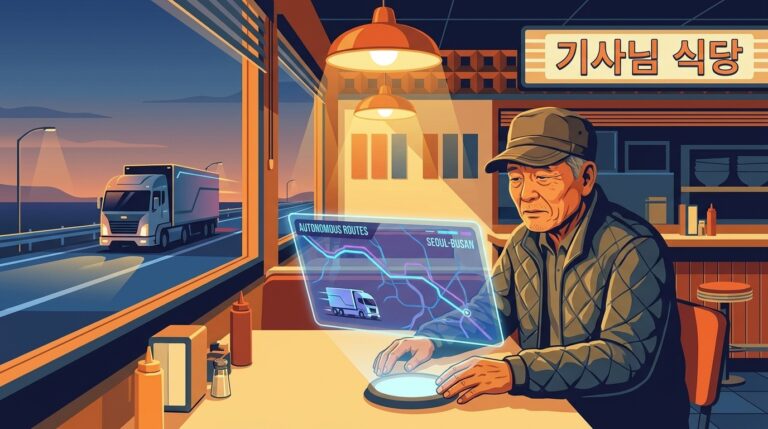
Navigating the Future: Coping with Automation Fears and Retraining in the AI Era
Phase 1: Empathy (스토리 몰입형 오프닝)
안녕하세요! Welcome back, family! It’s your trusty Daily Hangul editor and cultural navigator.
Imagine driving a heavy-duty truck through the misty dawn on the Gyeongbu Expressway (경부고속도로), keeping yourself awake with a hot can of convenience store coffee. For decades, long-haul trucking has been the backbone of Korea’s logistics. But lately, the buzz in the rest stops isn’t about fuel prices—it’s about the sleek, driverless autonomous trucks being tested on the highways.
If you are an advanced C2 learner analyzing Korean social issues, or perhaps working in tech, logistics, or HR, you’ve probably felt the weight of “job displacement anxieties” (일자리 도태 우려). Today, we’re diving deep into a highly sophisticated, real-world scenario: How Korean truck drivers face the rise of AI, express their fears of being replaced, and navigate the challenging path of vocational retraining (재교육).
Through this guide, you’ll master the high-level vocabulary, subtle socio-political nuances, and emotional idioms necessary to discuss AI disruption, labor rights, and career transition like a native intellectual.
Phase 2: Deep Dive into 3 Key Expressions
1. 밥그릇을 빼앗기다 (bap-geureut-eul bbae-at-gi-da)
- Pronunciation: Bahp-gurut-eul bbaet-gee-da (Sounds like “bob-groot-ool” + “bbaht-gee-dah”)
- Meaning: Literally “to have one’s rice bowl stolen.” Idiomatically, it means to lose one’s livelihood, job, or market share to someone (or something) else.
- K-Culture Moment: You’ll hear this constantly in Korean labor union protests, socio-economic news panel debates, and modern workplace dramas (like Misaeng or Start-Up) when automated systems or corporate mergers threaten existing staff.
- Editor’s Insight: The “rice bowl” (밥그릇) is the ultimate symbol of survival and dignity in Korea. Using this phrase shows a deep, empathetic understanding of the human cost of technology, going far beyond the sterile academic term “일자리 축소” (job reduction).
- Situation Spectrum: Casual (✅) | Semi-formal (✅) | Formal (✅ – frequently used in editorials to add emotional weight)
- 🤔 Think About It: How does your native language metaphorically describe losing one’s livelihood? Is it as deeply tied to food and survival as the Korean “rice bowl”?
2. 고사(枯死) 직전에 몰리다 (go-sa jik-jeon-e mol-li-da)
- Pronunciation: Go-sah jik-jeon-eh mohl-lee-da
- Meaning: To be driven to the brink of dying/withering away (like a plant drying up).
- K-Culture Moment: Used by industry representatives in documentary interviews or news reports describing sectors devastated by rapid technological shifts or sudden policy changes.
- Editor’s Insight: This C2-level hanja (Sino-Korean) expression, where Go (枯) means to wither and Sa (死) means to die, paints a vivid picture of a slow, agonizing decline. It conveys a sense of systemic neglect rather than sudden termination.
- Situation Spectrum: Casual (🚫) | Semi-formal (⚠️) | Formal (✅)
- 🤔 Think About It: Why do you think Korean public discourse prefers highly visual, nature-based metaphors (like withering plants) to describe macroeconomic struggles?
3. 발등에 불이 떨어지다 (bal-deung-e bul-i tteo-reo-ji-da)
- Pronunciation: Bal-deung-eh bool-ee ddoh-ruh-jee-da (Sounds like “bahl-deung-eh” + “bool-ee” + “duh-ruh-jee-da”)
- Meaning: Literally, “fire has fallen on the top of one’s foot.” Idiomatically, it means an emergency has occurred right in front of you, leaving no time to hesitate; a crisis is imminent.
- K-Culture Moment: Used in daily life when exams are tomorrow, but in this context, it refers to workers who suddenly realize their skills will be obsolete within a couple of years and must find a retraining program immediately.
- Editor’s Insight: It emphasizes the transition from a vague, distant threat (“AI is coming”) to an active, painful crisis requiring immediate action.
- Situation Spectrum: Casual (✅) | Semi-formal (✅) | Formal (✅)
- 🤔 Think About It: How do you handle “fires falling on your foot” in your own professional life? Do you plan ahead, or do you perform best under immediate pressure?
Phase 3: Textbook Korean vs. Real-Life Korean
Situation 1: Expressing fear of being replaced by AI
- 📖 Textbook Korean: “인공지능 기술의 발전으로 제 직업이 없어질까 봐 걱정이 됩니다.” (I am worried my job might disappear due to the development of AI technology.)
- 🗣️ Real-Life Korean: “AI한테 언제 내 밥그릇 빼앗길지 몰라 솔직히 불안해 죽겠어요.” (Honestly, I’m scared to death of when AI is going to snatch away my rice bowl.)
- 💡 Why the difference? The textbook sentence is grammatically flawless but emotionally detached. In real Korean life, especially among blue-collar workers, expressing anxiety involves visceral, emphatic phrases like “불안해 죽겠다” (scared to death/extremely anxious) and structural idioms like “밥그릇을 빼앗기다.”
Situation 2: Demanding retraining support from the government
- 📖 Textbook Korean: “정부는 실직자를 위한 재교육 프로그램을 신속히 지원해야 합니다.” (The government must promptly support retraining programs for displaced workers.)
- 🗣️ Real-Life Korean: “하루아침에 길거리에 나앉게 생겼는데, 정부가 손 놓고 있을 때가 아니죠. 실효성 있는 재교육 대책이 시급합니다.” (We’re about to end up on the streets overnight; this is no time for the government to fold its hands. Practical retraining measures are urgent.)
- 💡 Why the difference? Real-life advocacy and debates utilize strong physical metaphors like “길거리에 나앉다” (to end up sitting on the street/homeless) and “손을 놓다” (to fold one’s hands/do nothing) to emphasize urgency.
Phase 4: K-Culture Deep Dive & Non-Verbal Etiquette
4-1. Nunchi & Gestures: The Body Language of Economic Despair
When discussing career crises or expressing solidarity with workers facing displacement in Korea, your physical demeanor must match the weight of the topic:
* The Head Tilt and Sigh (한숨): When a senior driver or colleague expresses worry, a deep, silent sigh while slightly tilting your head down and nodding slowly is a powerful sign of empathy (공감).
* Avoid Direct Eye Contact During Vulnerable Moments: In Korean culture, staring intently into someone’s eyes while they are sharing their deepest fears of financial ruin can feel confrontational or overly intrusive. Cast your eyes slightly downward, looking at the table or their hands, to show respectful listening.
* The Gentle Shoulder Touch: Between close colleagues (especially of similar age/gender), a light squeeze on the shoulder while saying “힘내야죠” (We’ve got to stay strong) is the standard physical comfort.
4-2. Cultural Code: The Korean “Jeong” (정) and the Solidarity of the “Gig-Workers”
In K-Dramas like Our Blues or My Mister, we see characters who are struggling financially but are bound by an invisible string of mutual duty and affection (정 – Jeong). In the logistics sector, truck drivers often refer to each other as 기사님 (Gisanim – driver/sir) or 동료 (Dongryo – colleague). When automation threatens their livelihood, the struggle is rarely seen as purely individualistic. It becomes a community crisis. Thus, discussions about AI displacement in Korea frequently center around “상생” (Sang-saeng – mutual survival/co-existence) rather than just personal adaptation.
Phase 5: Real-Life Roleplay Scenario
The Setting
A roadside small restaurant (기사식당 – Driver’s Diner) near the Daejeon Interchange. Two veteran container truck drivers, Mr. Kim (김 기사) and Mr. Park (박 기사), are eating spicy pork bulgogi after hearing a news report about a pilot program for autonomous heavy-duty trucks on their main route.
The Characters
- Mr. Kim (김 기사): 52 years old, 25-year veteran driver. Cynical, family-oriented, highly anxious about the future.
- Mr. Park (박 기사): 43 years old, forward-thinking but equally worried. Currently looking into coding and drone piloting academies.
The Dialogue (8 Turns)
- 김 기사: 🎭 (숟가락을 탁 내려놓으며 한숨을 쉰다) 박 기사, 방금 뉴스 봤어? 자율 주행 트럭이 벌써 고속도로 시범 주행에 성공했다네. 진짜 우리 밥그릇 빼앗길 날이 머지않았어.
(Sut-garak-eul tak nae-ryeo-noh-myeo han-sum-eul swinda. Park Gisanim, bang-geum nyu-seu bwat-eo? Ja-yul ju-haeng teo-reok-i beol-seo go-sok-do-ro si-beom ju-haeng-e seong-gong-haet-da-ne. Jin-jja u-ri bap-geureut bbae-at-gil nal-i meo-ji-an-at-eo.)
(Puts down his spoon with a clack and sighs) Park, did you just see the news? They say autonomous trucks have already succeeded in highway pilot testing. The day our rice bowls get snatched away is truly not far off. -
박 기사: 🎭 (심각한 표정으로 고개를 끄덕인다) 그러게요. 남 일인 줄만 알았는데, 진짜 발등에 불이 떨어진 기분이에요. 당장 몇 년 뒤에 뭐 먹고살아야 하나 막막합니다.
(Geu-reo-ge-yo. Nam il-in jul-man ar-at-neun-de, jin-jja bal-deung-e bul-i tteo-reo-jin gi-bun-i-e-yo. Dang-jang myeot nyeon dwi-e mwo meok-go-sal-a-ya ha-na mak-mak-ham-ni-da.)
(Nods with a serious face) Tell me about it. I thought it was someone else’s business, but it really feels like fire has fallen on the top of my foot. It’s daunting to think about what to live on in just a few years. -
김 기사: 내 말이! 운전대만 잡고 평생을 살았는데, 이제 와서 뭘 새로 배운단 말인가? 우리 같은 쉰 넘은 먹통들이 인공지능인지 뭔지 하는 걸 어떻게 따라가?
(Nae mal-i! Un-jeon-dae-man jap-go pyeong-saeng-eul sar-at-neun-de, i-je wa-seo mwol sae-ro bae-un-dan mal-in-ga? U-ri gat-eun swin neom-eun meok-tong-deul-i in-gong-ji-neung-in-ji mwon-ji ha-neun geol eo-tteo-ke tta-ra-ga?)
(My thoughts exactly! I’ve spent my whole life holding a steering wheel, and now I’m supposed to learn something new? How are fifty-something blockheads like us supposed to keep up with AI or whatever that is?) -
박 기사: 🎭 (목소리를 낮추며) 그래도 형님, 마냥 손 놓고 있을 수는 없잖아요. 요즘 정부에서 ‘내일배움카드’ 지원금도 늘려주고, 전직 지원 프로그램도 꽤 다양해졌대요.
(Geu-rae-do hyeong-nim, ma-nyang son noh-go is-seul su-neun eop-jan-a-yo. Yo-jeum jeong-bu-e-seo ‘Nae-il-bae-um-ka-deu’ ji-won-geum-do neul-ryeo-ju-go, jeon-jik ji-won pro-grem-do kkwae da-yang-hae-jyeot-dae-yo.)
(Lowering his voice) Still, hyung-nim, we can’t just sit here with our hands folded. Apparently, these days the government expanded the ‘Tomorrow Learning Card’ subsidy, and career transition programs have become quite diverse. -
김 기사: 🎭 (코방귀를 뀌며) 에이, 그거 다 탁상공론이야. 컴퓨터 근처에도 안 가본 사람들을 데리고 무슨 스마트 물류니 코딩이니 가르친다는 거야? 실효성이 전혀 없어.
(E-i, geu-geo da tak-sang-gong-ron-i-ya. Com-pyu-teo geun-cheo-e-do an ga-bon sa-ram-deul-eul de-ri-go mu-seun seu-ma-teu mul-ryu-ni co-ding-i-ni ga-reul-chin-dan geo-ya? Sil-hyo-seong-i jeon-hyeo eop-seo.)
(Snorts) Oh, that’s all academic theory. Teaching people who haven’t even gone near a computer things like smart logistics or coding? It’s completely impractical. -
박 기사: 맞아요, 현장 괴리감이 크긴 하죠. 그래도 저는 자율 주행 차량 관제사나 산업용 드론 조종 쪽으로 알아보려고요. 운전 경력을 살릴 수 있는 길을 찾아야죠.
(Ma-ja-yo, hyeon-jang goe-ri-gam-i keu-gin ha-jyo. Geu-rae-do jeo-neun ja-yul ju-haeng cha-ryang gwan-je-sa-na san-eop-yong deu-ron jo-jong jjok-eu-ro a-ra-bo-ryeo-go-yo. Un-jeon gyeong-ryeok-eul sal-ril su in-neun gil-eul cha-ja-ya-jyo.)
(True, the gap between the training and the actual field is huge. But still, I’m planning to look into autonomous vehicle controllers or industrial drone piloting. I need to find a path where I can utilize my driving experience.) -
김 기사: 🎭 (박 기사의 어깨를 다독이며) 자네는 젊고 똘똘하니 잘 헤쳐 나가겠지만… 난 솔직히 눈앞이 캄캄하네. 당장 내일 출근길 고속도로가 무섭게 느껴질 줄은 몰랐어.
(Ja-ne-nun jeolm-go ttol-ttol-ha-ni jal he-chyeo na-ga-get-ji-man… Nan sol-jik-hi nun-ap-i kam-kam-ha-ne. Dang-jang nae-il chul-geun-gil go-sok-do-ro-ga mu-seop-ge neu-kyeo-jil jul-eun mol-las-eo.)
(Patting Park’s shoulder) You are young and smart, so you’ll navigate it well… but honestly, my mind is blank. I never imagined that my commute highway tomorrow would feel so terrifying. -
박 기사: 형님, 혼자 고민하지 마시고 우리 주말에 일자리 지원 센터 같이 가봐요. 제가 같이 상담 신청해 드릴게요. 길은 분명히 있습니다.
(Hyeong-nim, hon-ja go-min-ha-ji ma-si-go u-ri ju-mal-e il-ja-ri ji-won sen-teo gat-i ga-bwa-yo. Jae-ga gat-i sang-dam sin-cheong-hae deu-ril-ge-yo. Gil-eun bun-myeong-hi is-seum-ni-da.)
(Hyung-nim, don’t worry about it alone; let’s go to the job support center together this weekend. I’ll apply for the consultation with you. There is definitely a way.)
🔀 Interactive Choice Point
Now it’s your turn. If you were Mr. Park, how would you motivate Mr. Kim to register for the retraining program?
- Option A: “형님, 대세는 이미 기울었어요. 고집 부리지 마시고 당장 등록하세요!”
(Hyung-nim, the tide has already turned. Don’t be stubborn and register immediately!) - Option B: “형님 같은 베테랑의 현장 경험이 인공지능 시스템 관리에도 꼭 필요하대요. 우리 경력을 살려서 같이 도전해 봐요.”
(Hyung-nim, they say the on-site experience of a veteran like you is absolutely necessary for AI system management too. Let’s utilize our experience and challenge this together.) - Option C: “그럼 그냥 이번 달까지만 일하고 같이 사직서 냅시다. 더러워서 못 해 먹겠네요.”
(Then let’s just work until this month and hand in our resignations together. This is too dirty to keep doing.)
💡 Feedback on Your Choice:
- If you chose A (Bad): Too direct and blunt. Using “고집 부리지 마세요” (Don’t be stubborn) to an older veteran senior in Korea breaks conversational etiquette and will likely make him close his heart.
- If you chose B (Best!): Perfect! It honors his seniority and valuable experience (베테랑의 현장 경험) while presenting retraining not as a total restart, but as an upgrade of his existing skills. Extremely culturally appropriate.
- If you chose C (Risk): Empathizing with anger is okay, but giving up rashly leaves both of you stranded in the real world. A bit too emotional for a constructive professional partnership.
Phase 6: 10-Second Emotional Shadowing Drill
Practice speaking these high-stress sentences with the exact emotional intonation of a stressed Korean worker.
- Sentence 1: [🥺 Despair and anxiety]
“AI한테 / 언제 내 밥그릇 빼앗길지 몰라 / 솔직히 눈앞이 캄캄해요.”
(AI-han-te / eon-je nae bap-geureut bbae-at-gil-ji mol-la / sol-jik-hi nun-ap-i kam-kam-hae-yo.)
Pause Point: Take a sharp breath after “AI한테” and drop your voice low at “눈앞이 캄캄해요” (the future looks completely black/blank). -
Sentence 2: [💪 Resolute encouragement]
“발등에 불이 떨어졌으니 / 우리 손 놓고 있지 말고 / 부딪쳐 봅시다!”
(Bal-deung-e bul-i tteo-reo-jyeot-eu-ni / u-ri son noh-go it-ji mal-go / bu-dit-chyeo bop-si-da!)
Pause Point: Pronounce “부딪쳐 봅시다” (let’s clash/confront it directly) with strong emphasis on “부” to convey grit.
Phase 7: K-Culture Mini-Dictionary
- 일자리 도태 (Il-ja-ri Do-tae) | Job Displacement / Tech Obsolescence
- The systemic fading away of human jobs as automation replaces them. Used heavily in economics and HR.
- 내일배움카드 (Nae-il-bae-um-ka-deu) | Tomorrow Learning Card
- A government-issued training voucher card that offers substantial subsidies for Korean citizens to learn coding, barista skills, heavy machinery operation, or languages.
- 탁상공론 (Tak-sang-gong-ron) | Desk-bound Empty Talk
- Armchair philosophy or impractical policies decided by politicians or bureaucrats who have never stepped onto the actual construction site or truck cabin.
- 현장 괴리감 (Hyeon-jang Goe-ri-gam) | Disconnect from the Real Field
- The feeling of discrepancy between what is taught in academic textbooks and what actually happens on the grinding floor of real industries.
Phase 8: Navigator’s Survival Kit
Survival Expressions for Professional Crisis
- “먹고살 길이 막막합니다.”
- Mok-go-sal gil-i mak-mak-ham-ni-da.
- Pro Tip: Use this when describing severe economic anxiety to express that you literally see “no open roads to eat and live.”
- “상생(相生) 방안을 마련해야 합니다.”
- Sang-saeng bang-an-eul ma-ryeon-hae-ya ham-ni-da.
- Pro Tip: Essential formal vocabulary for business meetings meaning “We must establish a win-win/co-existence policy.”
- “현실성이 떨어지는 대책입니다.”
- Hyeon-sil-seong-i tteo-reo-ji-neun dae-chaek-im-ni-da.
- Pro Tip: A polite yet devastating critique for corporate or governmental plans that lack practical value.
Editor’s Travel & Life Note
If you are currently living in Korea and facing your own career transition or looking to upgrade your skills, download the official HRD-Net App (고용노동부 HRD-Net). It’s the gatekeeper to the 내일배움카드 (Tomorrow Learning Card) program. It allows foreigners with certain visa statuses (like F-series visas) to receive thousands of dollars in vocational training support. Note: Program availability and visa eligibility conditions are subject to change, so always verify through official Ministry of Employment and Labor announcements.
Phase 9: “Going Deeper” (한 발 더 깊이)
Korea’s response to the fourth industrial revolution is unique. On one hand, the country boasts the highest density of industrial robots in the world and prides itself on ultra-fast tech integration. On the other hand, the traditional Confucian values of social harmony and collective responsibility mean that leaving elderly workers behind to face poverty is viewed as a massive social failure.
When we talk about 밥그릇을 지키다 (protecting one’s rice bowl) in Korea, it is not merely about individual greed. It is about a father’s duty to provide for his family and maintain his dignity as a contributing member of society. Therefore, the discussion around retraining is not just economic; it is deeply moral.
💬 Your Turn: Do you believe AI will create more jobs than it destroys, or are we truly on the verge of losing our collective “rice bowls”? Let us know your thoughts in the comments below!
Phase 10: FAQ & Common Mistakes
Q: Can “밥그릇” be used in formal business letters?
A: No, “밥그릇을 빼앗기다” is an idiom with high emotional resonance. While frequently found in journalistic editorials and labor strikes, you should avoid it in official, dry business contracts or academic research papers. Use “생존권을 위협받다” (to have one’s right to survival threatened) instead.
Q: What is the difference between 재교육 (Jaegyoyuk) and 전직 교육 (Jeonjik-gyoyuk)?
A: 재교육 (Retraining/Re-education) is a broad term for upgrading or changing your skillset. 전직 교육 (Outplacement/Career Transition Training) specifically refers to education focused on completely changing your job category (e.g., from a truck driver to a software coder).







