

Master Counting Days in Korean: Why Do Koreans Say ‘Sagheul’ for 3 Days?
Phase 1: Empathy (An Invitation to the Day-Counting Puzzle)
안녕하세요! (Annyeonghaseyo!) I’m your Daily Hangul editor, your personal Korean culture navigator! 👋
Imagine this scenario: You are watching your favorite K-Drama. The lead actor dramatically says, “Let’s meet after 사흘 (sagheul).” You quickly look it up on a translation app, or you try to guess. Wait… Sagheul starts with “Sa” (사), and “Sa” (사) means “four” (4) in Sino-Korean, right? So it must mean “four days”!
You confidently show up on Day 4, only to realize your Korean friend has been waiting for you since Day 3! 😱
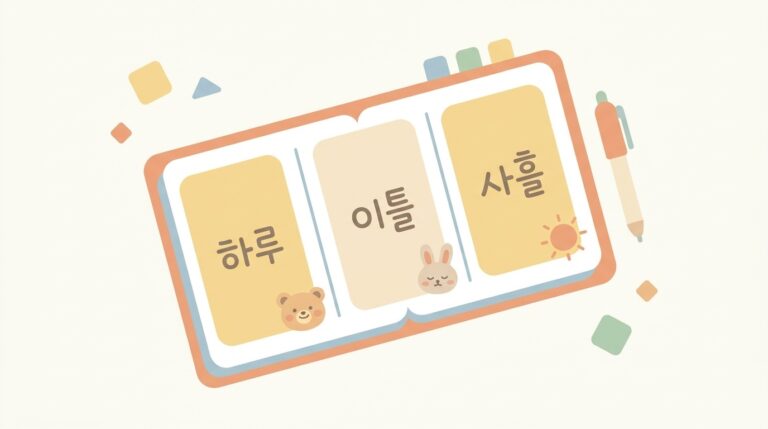
Don’t worry, you are not alone. This is one of the most common pitfalls not just for English speakers, but sometimes even for young Koreans themselves! Native Korean date-counting words—하루 (haru), 이틀 (iteul), 사흘 (sagheul)—are completely different from standard numbers.
Learning these terms is a total game-changer. Whether you’re booking a boutique Hanok stay in Bukchon for “two days” or scheduling a quick meetup with friends, mastering this will instantly make you sound like a local. Let’s solve this mystery together! 🕵️♀️
Phase 2: In-Depth Analysis of the Top 3 Expressions
Let’s look at the three most essential day-counting words you need to survive in Korea.
1. 하루 (Haru)
- Pronunciation: Ha-ru (Sounds like “ha” in “haha” + “ru” in “ruby”)
- Meaning: One day (1 day)
- K-Culture Moment: You will hear this constantly in K-Pop! Think of the iconic song titles like “Haru Haru” (Day by Day) by BIGBANG. It means “day after day” or “every single day.”
- Editor’s Insight: While the Sino-Korean word il-il (일일) is used in formal documents (like a 1-day pass: 일일 패스), Koreans always use haru (하루) when talking about their daily lives or expressing “just one day” of rest.
- Situation Spectrum: Casual (✅) / Semi-formal (✅) / Formal (✅)
- 🤔 Think About It: In English, “one day” can mean “someday in the future.” In Korean, “하루 (haru)” strictly refers to the span of 24 hours. How does your language separate “one day” as a duration from “one day” as an abstract future?
2. 이틀 (Iteul)
- Pronunciation: Ee-teul (Sounds like “ee” in “meet” + “teul” similar to “tool” but with a flat “eu” sound)
- Meaning: Two days (2 days)
- K-Culture Moment: When booking a trendy cafe tour or renting a Hanbok near Gyeongbokgung Palace, you’ll ask for an “이틀 (iteul)” rental.
- Editor’s Insight: People often confuse iteul (이틀) with it-da (to forget) because they sound slightly similar. Remember: iteul is strictly “two days.” If you want to say “two days and one night,” Koreans say “일박 이틀” (il-bak i-teul) or more commonly “일박 이일” (il-bak i-il).
- Situation Spectrum: Casual (✅) / Semi-formal (✅) / Formal (✅)
- 🤔 Think About It: Why do you think Korean has unique words for counting days instead of just saying “one day” or “two days”? It stems from Korea’s deep agricultural history where tracking daily cycles was vital!
3. 사흘 (Sagheul)
- Pronunciation: Sa-heul (Sounds like “sa” in “soccer” + “heul” like “hull” but with a flat “eu” sound)
- Meaning: Three days (3 days) — NOT four days!
- K-Culture Moment: In K-Dramas, when someone goes on a short trip or gets a cold, the doctor might say, “Take this medicine for 사흘 (sagheul).”
- Editor’s Insight: WARNING! Do not confuse Sagheul (사흘, 3 days) with Naheur (나흘, 4 days). Because “Sino-Korean 4” is “Sa” (사), many beginners (and even some native teens!) mistakenly think Sagheul means 4 days. It is the ultimate Korean language trap!
- Situation Spectrum: Casual (✅) / Semi-formal (✅) / Formal (✅)
- 🤔 Think About It: Misunderstandings about “사흘” make national headlines in Korea every few years! It shows how language evolution can sometimes confuse even native speakers.
Phase 3: Textbook Korean vs. Real-Life Korean
Let’s compare how textbooks teach date counting versus how actual Koreans talk on the streets of Seoul.
Situation 1: Asking how long a friend is staying in Korea
- 📖 Textbook Korean: “몇 일 동안 한국에 있습니까?” (Myeot il dong-an han-guk-e it-seumnikka? – “For how many days are you in Korea?”) – Too robotic!
- 🗣️ 진짜 (Real-Life) Korean: “한국에 며칠(동안) 있어요?” (Han-guk-e myeochil (dong-an) isseo-yo? – “How many days are you here?”)
- 💡 Why the difference? Real Koreans rarely use “몇 일” in speech. They always blend it into “며칠” (myeochil) for natural, smooth pronunciation.
Situation 2: Planning a weekend trip
- 📖 Textbook Korean: “삼 일 동안 여행을 갈 것입니다.” (Sam il dong-an yeo-haeng-eul gal geot-imnida. – “I will go on a trip for three days.”) – Sounds like a news broadcast.
- 🗣️ 진짜 (Real-Life) Korean: “우리 사흘 동안 여행 가요!” (Uri sagheul dong-an yeo-haeng ga-yo! – “We’re going on a trip for three days!”)
- 💡 Why the difference? Using native words like sagheul makes you sound warm, friendly, and natural, whereas Sino-Korean numbers (sam-il) sound clinical and dry.
Phase 4: K-Culture Deep-Dive & Non-Verbal Manners
4-1. The Finger-Counting Gesture (Nunchi & Body Language)
When Koreans count days with their hands, they don’t always start with an open palm.
* One Day (하루): Instead of raising an index finger like in western cultures, some Koreans fold their thumb into a closed fist to indicate “one.”
* To show sincerity: When asking for a “just one day” extension on a hotel checkout or a favor, press your hands together in a quick prayer gesture while saying “하루만요…” (Haru-manyo… – “Just one day, please…”) with a warm, apologetic smile. This uses Korea’s famous 눈치 (Nunchi – situational wit) to get friendly service!
4-2. Cultural Code: The “100-Day” Celebration (백일 – Baek-il)
In Korea, counting days is deeply cultural. The most famous milestone is 백일 (Baek-il – 100 Days). Couples celebrate their 100th day together with matching rings, and families celebrate a baby’s 100th day with rice cakes! Counting the exact days of a relationship is so important that there are special mobile apps dedicated purely to counting days for couples.
Phase 5: Live Roleplay Scenario
Meet Minho (민호): A friendly guesthouse owner in Hongdae, Seoul. He is helping you finalize your booking dates.
- Scene: Guesthouse Front Desk, Hongdae, Seoul.
- Minho (NPC): “어서 오세요! 예약 확인해 드릴게요.” (Eoseo oseyo! Yeyak hwagin-hae deurilgeyo. – “Welcome! Let me check your reservation.”)
8-Turn Dialogue
- Minho: “안녕하세요! 오늘부터 묵으시나요?” 🎭 [Smiling warmly, checking his computer]
(Annyeonghaseyo! Oneul-buteo mugeu-sinayo? / “Hello! Are you staying starting from today?”) - You: “네, 오늘부터 이틀 동안 지낼 거예요.” 🎭 [Politely nodding your head]
(Ne, oneul-buteo iteul dong-an jinael geoyeyo. / “Yes, I will stay for two days starting today.”) - Minho: “아, 이틀이요? 그런데 예약 창에는 사흘로 되어 있네요?” 🎭 [Looking slightly confused]
(Ah, iteuryo? Geureonde yeyak chang-eneun sagheullo doe-eo inneyo? / “Ah, two days? But on the booking screen, it says three days?”) - You: “앗, 정말요? 제가 예약을 잘못했나 봐요.” 🎭 [Surprised, scratching your head]
(At, jeongmaryo? Jega yeyageul jalmothaenna bwayo. / “Oh, really? I must have made a mistake with the booking.”) - Minho: “괜찮습니다! 금요일부터 일요일까지 맞으시죠?” 🎭 [Reassuring you with a gentle wave of his hand]
(Gwenchan-seumnida! Geum-yoil-buteo il-yoil-kkaji majeusi-jyo? / “No worries! It’s from Friday to Sunday, right?”) - You: “금, 토, 일… 아! 그럼 사흘이 맞네요! 죄송해요.” 🎭 [Realizing that 3 days is indeed ‘sagheul’]
(Geum, to, il… Ah! Geureom sagheulli manneyo! Joesong-haeyo. / “Fri, Sat, Sun… Oh! Then three days is correct! I’m sorry.”) - Minho: “하하, 아닙니다. 많은 분들이 사흘을 헷갈려 하세요!” 🎭 [Laughing heartily to make you feel comfortable]
(Haha, animnida. Maneun bundeori sagheureul hetgallryeo haseyo! / “Haha, no worries. Many people get confused about ‘sagheul’!”) - You: “네! 하루 더 묵을 수 있어서 다행이에요.” 🎭 [Relieved, handing over your passport]
(Ne! Haru deo mugeul su isseo-seo dahaeng-ieyo. / “Yes! I’m glad I can stay for one more day.”)
🔀 Interactive Choice Points
Now, how will you respond to Minho when he gives you your room key?
* A: “감사합니다. 이틀 동안 잘 부탁드립니다!” (Thank you. Please take care of me for two days!)
* B: “감사합니다! 사흘 동안 편하게 쉴게요.” (Thank you! I will rest comfortably for three days.)
* C: “감사합니다. 하루만 있다가 갈게요.” (Thank you. I’ll just stay for one day and leave.)
💡 Feedback on Your Choice
- Best Choice – B: Perfect! You acknowledged that Fri-Sun is indeed 사흘 (3 days). Minho will be impressed by your perfect Korean!
- Risk Choice – A: Uh-oh! You said “이틀” (2 days) again. If you only pay for 2 days, you’ll have to check out on Saturday! 😮
- Bad Choice – C: This will confuse Minho because your room is booked until Sunday! He might think you want a partial refund.
Phase 6: 10-Second Emotion Shadowing Drill
Practice speaking like a true Korean actor. Pay attention to the pauses (/) and the emotional cues!
- [😊 Expressing relief and excitement]
- “와! / 하루 / 더 있을 수 있다!”
- Wa! / haru / deo isseul su it-da!
- “Wow! / One more day / I can stay!”
- [🥺 Shyly asking for a small favor]
- “저기… / 딱 / 이틀만 / 안 될까요?”
- Jeogi… / ttak / iteul-man / an doelkkayo?
- “Excuse me… / Just / two days / is it not possible?”
- [🤯 Mind-blown realization]
- “아! / 사흘이 / 삼 일이었구나!”
- Ah! / Sagheulli / sam irieot-guna!
- “Ah! / ‘Sagheul’ / meant three days!”
Phase 7: K-Culture Mini Dictionary
- 금토일 (Geum-To-Il) | Friday, Saturday, and Sunday | The ultimate weekend golden combo! Often used when looking for travel deals or weekend guesthouse bookings.
- 연박 (Yeon-bak) | Consecutive Stay | A vital travel word. If you stay at a hotel for “이틀” (2 days) without checking out, that’s a “2일 연박.”
- 하루살이 (Haru-sari) | Mayfly / Living day-to-day | Literally means “living for just one day.” Culturally used to describe a busy modern lifestyle where you only focus on surviving today.
- 작심삼일 (Jak-sim-sam-il) | Resolution lasting only three days | A famous Korean proverb. It means a decision or resolution that fails after “사흘” (3 days).
Phase 8: Survival Kit for Travelers
Survival Expressions TOP 3
- “이틀 연장해 주세요.” (Iteul yeonjang-hae juseyo.)
- Pro Tip: “Please extend my stay for two days.” Use this at hotels or car rentals!
- “사흘 뒤에 올게요.” (Sagheul dwi-e olgeyo.)
- Pro Tip: “I will come back in three days.” Great for telling your favorite restaurant owner when you’ll return.
- “하루만 더 생각해 볼게요.” (Haru-man deo saenggak-hae bolgeyo.)
- Pro Tip: “I will think about it for just one more day.” Perfect when shopping in Dongdaemun and you want to walk away politely.
Editor’s Travel Note ✈️
When planning a trip in Korea, do not rely on machine translations for train bookings or guesthouses. Download the official 네이버 지도 (Naver Map APP) to check actual travel times. Also, remember that most popular weekend getaways like Busan or Gangneung need to be booked at least “사흘” (3 days) in advance to get a good seat! (Note: Ticket prices and availability fluctuate based on seasons.)
Phase 9:
Frequently Asked Questions (FAQ)
Q: What does "하루 (Haru)" mean in Korean and how do you pronounce it?
A: In Korean, "하루 (Haru)" is pronounced [Ha-ru (Sounds like "ha" in "haha" + "ru" in "ruby"] and means: One day (1 day)
Q: What does "이틀 (Iteul)" mean in Korean and how do you pronounce it?
A: In Korean, "이틀 (Iteul)" is pronounced [Ee-teul (Sounds like "ee" in "meet" + "teul" similar to "tool" but with a flat "eu" sound] and means: Two days (2 days)
Q: What does "사흘 (Sagheul)" mean in Korean and how do you pronounce it?
A: In Korean, "사흘 (Sagheul)" is pronounced [Sa-heul (Sounds like "sa" in "soccer" + "heul" like "hull" but with a flat "eu" sound] and means: Three days (3 days) — NOT four days!







