

Finding Your Rhythm: How to Ask for Instrument Recommendations in Korean like a Local
Phase 1: Empathy & Storytelling
안녕하세요! (Annyeonghaseyo!) Welcome back to Daily Hangul. It’s your favorite K-Culture Navigator and Korean bestie!
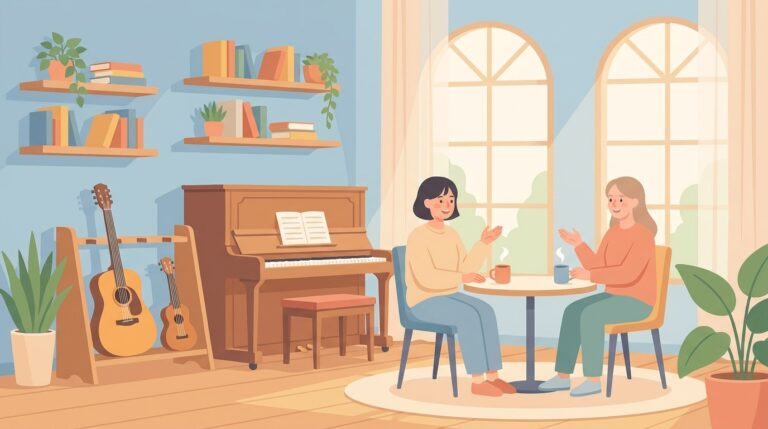
Imagine this: You are watching your favorite K-Drama, and the main lead plays a beautiful, melancholic melody on a piano. Or maybe you’re watching a K-Band like DAY6 or The Rose shredding on stage, and you suddenly get that intense itch to pick up an instrument. You walk into a cozy music studio in Hongdae, Seoul, surrounded by guitars, ukuleles, and traditional haegeum (해금) fiddles. You want to ask the friendly instructor for a recommendation, but your mind goes blank.
Should you say “무엇이 좋습니까?” (Too stiff!) or “추천해 주세요” (A bit too generic)?
Don’t worry! Asking for recommendations in a way that sounds natural, polite, yet friendly is an art. Today, we’re going to master how to ask for instrument recommendations in Korean. By the end of this guide, you’ll be able to walk into any silbi-eumak-hagwon (실비음악학원 – private music academy) or talk to your Korean friends about starting a new musical hobby with absolute confidence!
Phase 2: Deep Dive into 3 Key Expressions
Let’s break down the three most natural ways to ask for instrument recommendations, ranging from casual chat with friends to polite conversations with instructors.
1. 요즘 악기 하나 배우고 싶은데, 뭐가 좋을까요? (Yo-jeum ak-gi ha-na bae-u-go sip-eun-de, mwo-ga jo-eul-kka-yo?)
- Pronunciation: Yo-jeum (like “yo” + “zoom” with a soft ‘z’) ak-gi (ahk-gee) ha-na bae-u-go sip-eun-de (bah-oo-go ship-eun-deh), mwo-ga jo-eul-kka-yo? (mwah-gah jo-eul-kah-yo?)
- Meaning: “I’d love to learn an instrument these days; what would be good?”
- K-Culture Moment: This is the ultimate “soft-opener.” You’ll hear characters in slice-of-life K-Dramas say this when they want to start a new hobby to escape their mundane daily routine.
- Editor’s Insight: The ending -ㄴ데/는데 (-nde/neunde) is a magic Korean grammar point. It provides background context (“I want to learn…”) before asking a question (“what would be good?”). It sounds much softer and more natural than just asking, “What instrument is good?” directly.
- Situation Spectrum: Casual ✅ | Semi-formal ✅ | Formal ⚠️
- 🤔 Think About It: In Korean culture, starting a sentence by sharing your personal background context first is considered much more polite and less abrupt than jumping straight into a question. How does this compare to your native language?
2. 초보자가 시작하기에 부담 없는 악기가 있을까요? (Cho-bo-ja-ga si-jak-ha-gi-e bu-dam eop-neun ak-gi-ga is-seul-kka-yo?)
- Pronunciation: Cho-bo-ja-ga (choh-boh-jah-gah) si-jak-ha-gi-e (she-jahk-hah-ghee-eh) bu-dam eop-neun (boo-dahm uhp-neun) ak-gi-ga is-seul-kka-yo? (ahk-ghee-gah ees-seul-kah-yo?)
- Meaning: “Is there an instrument that is easy/not burdensome for a beginner to start with?”
- K-Culture Moment: Imagine walking into a music shop in Nakwon Music Arcade (낙원상가) in Seoul. You want to try something but don’t want to invest thousands of dollars or 10 hours a day practicing.
- Editor’s Insight: 부담 없다 (budam eopda) literally means “no burden/pressure.” In Korean, this is a very high-utility phrase. It can refer to financial burden (not too expensive), physical burden (not too heavy/hard to play), or time burden.
- Situation Spectrum: Casual ✅ | Semi-formal ✅ | Formal ✅
- 🤔 Think About It: Why do you think Koreans use the word “burden” (부담) so often when discussing hobbies? It reflects a cultural desire to integrate activities seamlessly into a busy, fast-paced life (Pali-Pali culture) without feeling overwhelmed.
3. 혹시 저한테 잘 어울릴 만한 악기 추천해 주실 수 있나요? (Hok-si jeo-han-te jal eo-ul-ril man-han ak-gi chu-cheon-hae ju-sil su in-na-yo?)
- Pronunciation: Hok-shi (hawk-shee) jeo-han-te (juh-hahn-teh) jal eo-ul-ril man-han (jahl uh-wool-reel mahn-hahn) ak-gi chu-cheon-hae ju-sil su in-na-yo? (ahk-gee choo-chuhn-hae joo-sheel soo een-nah-yo?)
- Meaning: “By any chance, could you recommend an instrument that might suit me well?”
- K-Culture Moment: This is what you ask a music mentor or a close friend who knows your personality well. It’s warm, personal, and invites the other person to think about your unique vibe.
- Editor’s Insight: 혹시 (hok-si) means “by any chance” or “perhaps.” Starting a request with 혹시 is the ultimate way to sound polite and non-demanding in Korean. It softens the tone instantly.
- Situation Spectrum: Casual ✅ | Semi-formal ✅ | Formal ✅
- 🤔 Think About It: Matching an instrument to someone’s “vibe” or personality (어울리다 – to suit/match) is a very common topic in Korea, often connected to analyzing one’s MBTI or general energy!
Phase 3: Textbook Korean vs. Real-Life Korean
Let’s compare what textbooks teach you versus how Koreans actually talk in 2024.
Situation 1: Asking a friend what instrument you should play
- 📖 Textbook Korean: “어떤 악기를 배우는 것이 좋습니까?” (Which instrument is it good to learn? – Sounds like a written exam question!)
- 🗣️ Real-Life Korean: “나 요즘 악기 하나 배우고 싶은데, 나랑 뭐 잘 어울릴 것 같아?” (I want to learn an instrument these days, what do you think would suit me?)
- 💡 Why the difference? Real-life Korean focuses heavily on personal connection (“what suits ME?”) rather than objective facts (“which is good?”).
Situation 2: Asking a music teacher for an easy instrument
- 📖 Textbook Korean: “쉬운 악기를 추천해 주십시오.” (Please recommend an easy instrument. – Feels too demanding and robotic.)
- 🗣️ Real-Life Korean: “제가 악기는 처음이라… 시작하기 제일 무난한 게 뭐가 있을까요?” (Since it’s my first time playing an instrument… what would be the most hassle-free one to start with?)
- 💡 Why the difference? Saying “제가 ~은/는 처음이라…” (Since it’s my first time…) is a very polite, humble way to set expectations. The word 무난하다 (munanhada) means “safe, standard, or hassle-free,” which is much more natural than just saying “easy” (쉽다).
Phase 4: K-Culture Deep Dive & Non-Verbal Manners
4-1. The Art of “Humble Hesitation” (음… 저기…)
When asking for recommendations in Korea, especially to an expert, do not be too direct. Use non-verbal cues:
* Scratching the back of your neck slightly or tilting your head while saying “제가 악기는 아예 처음이라…” (Since I’m a complete beginner…) shows humility.
* Avoid direct eye contact for the first 2 seconds of your query to show respect, then lock eyes with a warm smile once they start giving recommendations.
4-2. The “K-Hobby” Culture (원데이 클래스)
Did you know that Korea is obsessed with One-day Classes (원데이 클래스)? Before committing to a 3-month academy contract, Koreans love to book a 1-hour trial lesson for instruments like the kalimba, ukulele, or even the traditional gayageum (가야금). When asking for recommendations, you can ask if they have a “one-day class” first!
Phase 5: Real-Life Roleplay Scenario
Meet Ji-won (지원), a friendly instructor at a cozy Hongdae music studio, and You (the eager learner).
- Setting: A warm studio filled with acoustic guitars, a grand piano, and soft indie music playing in the background.
1. You: 저기… 안녕하세요! 혹시 상담 좀 받을 수 있을까요?
(Jeo-gi… an-nyeong-ha-se-yo! Hok-si sang-dam jom ba-deul su is-seul-kka-yo?)
🎭 [Politely bowing slightly with hands folded in front]
“Excuse me… hello! By any chance, could I get a quick consultation?”
2. Ji-won: 네, 당연하죠! 어서 오세요. 이쪽에 앉으세요. 어떤 취미 찾고 계세요?
(Ne, dang-yeon-ha-jo! Eo-seo o-se-yo. I-jjo-ge an-jeu-se-yo. Eo-tteon chwi-mi chat-go gye-se-yo?)
🎭 [Smiling warmly and gesturing toward a wooden chair]
“Yes, of course! Welcome. Please sit here. What kind of hobby are you looking for?”
3. You: 요즘 퇴근하고 배울 만한 악기를 찾고 있는데, 뭐가 좋을지 모르겠어요.
(Yo-jeum toe-geun-ha-go bae-ul man-han ak-gi-rreul chat-go in-neun-de, mwo-ga jo-eul-ji mo-reu-get-seo-yo.)
🎭 [Smiling sheepishly, gesturing with hands]
“I’m looking for an instrument to learn after work these days, but I don’t know what would be good.”
4. Ji-won: 아, 퇴근 후에 하시는 거군요! 혹시 이전에 다뤄보신 악기가 있으신가요?
(A, toe-geun hu-e ha-si-neun geo-gun-yo! Hok-si i-jeon-e da-ryeo-bo-sin ak-gi-ga is-seu-sin-ga-yo?)
🎭 [Nodding with interest, leaning forward]
“Ah, doing it after work! Have you played any instruments before?”
5. You: 아니요, 완전 처음이에요! 그래서 시작하기에 부담 없는 악기면 좋겠어요.
(A-ni-yo, wan-jeon cheo-eum-i-e-yo! Geu-rae-seo si-jak-ha-gi-e bu-dam eop-neun ak-gi-myeon jo-ket-seo-yo.)
🎭 [Shaking head slightly with an honest, bright smile]
“No, I’m a complete beginner! So I’d like an instrument that is not too burdensome to start with.”
6. Ji-won: 그렇다면 칼림바나 우쿨렐레 어떠세요? 소리도 예쁘고 배우기 정말 쉽거든요.
(Geu-reot-da-myeon kal-lim-ba-na u-kul-rel-le eo-tteo-se-yo? So-ri-do ye-ppeu-go bae-u-gi jeong-mal swip-geor-dun-yo.)
🎭 [Pointing gently toward a shelf with small instruments]
“In that case, how about the kalimba or ukulele? The sound is beautiful and they are really easy to learn.”
7. You: 오, 우쿨렐레 재미있겠네요! 혹시 원데이 클래스도 예약 가능한가요?
(O, u-kul-rel-le jae-mi-it-get-ne-yo! Hok-si won-de-i keul-rae-seu-do ye-yak ga-neung-han-ga-yo?)
🎭 [Eyes lighting up with excitement]
“Oh, ukulele sounds fun! By any chance, can I book a one-day class for that?”
8. Ji-won: 네, 이번 주 토요일에 한 자리 비어있어요. 바로 예약 도와드릴까요?
(Ne, i-beon ju to-yo-il-e han ja-ri bi-eo-is-seo-yo. Ba-ro ye-yak do-wa-deu-ril-kka-yo?)
🎭 [Checking the tablet screen and smiling]
“Yes, we have one spot left this Saturday. Shall I help you reserve it right away?”
🔀 Choose Your Next Move!
- Option A: “네, 토요일 수업으로 예약해 주세요!” (Yes, please book the Saturday class!)
- Feedback: BEST! Clear, polite, and seals the deal naturally.
- Option B: “우쿨렐레는 너무 쉬울 것 같아서 피아노 할래요.” (I think ukulele might be too easy, so I’ll do piano instead.)
- Feedback: RISK. While honest, changing your mind so abruptly after they checked the schedule might feel slightly awkward. Use “혹시 피아노 수업은 어떨까요?” (By any chance, how would piano lessons be?) to sound gentler.
- Option C: “생각해보고 올게요.” (I’ll think about it and come back.)
- Feedback: BAD. While acceptable, saying it too bluntly can sound cold. Instead, try: “조금만 더 고민해보고 연락드릴게요!” (I’ll think about it a little more and contact you!).
Phase 6: 10-Second Emotion Shadowing Drill
Speak like a native by practicing these sentences with the right emotion and rhythmic pauses (/).
- [🥺 Shy & Humble]
- “제가 / 악기는 처음이라… / 부담 없는 게 / 좋을 것 같아요.”
- (Je-ga / ak-gi-neun cheo-eum-i-ra… / bu-dam eop-neun ge / jo-eul geot ga-ta-yo.)
- “Since it’s my first time playing an instrument… I think something not burdensome would be good.”
- [😊 Excited & Curious]
- “요즘 / 취미로 / 악기 하나 배우고 싶은데, / 뭐가 잘 어울릴까요?”
- (Yo-jeum / chwi-mi-ro / ak-gi ha-na bae-u-go sip-eun-de, / mwo-ga jal eo-ul-ril-kka-yo?)
- “I want to learn an instrument as a hobby these days, what do you think would suit me?”
Phase 7: K-Culture Mini-Dictionary
- 반려악기 (Ban-ryeo-ak-gi) | “Companion Instrument”
- Just like “companion pet” (반려동물), Koreans now use this term to describe an instrument they play to soothe their soul and keep them company throughout life.
- 방구석 캐스터 (Bang-gu-seok Ca-seu-teo) | “Corner-of-the-room player/caster”
- A slang term for someone who practices a hobby (like playing guitar or singing) strictly alone in their bedroom, without showing anyone.
- 장비빨 (Jang-bi-ppal) | “Gear/Equipment Power”
- The hilarious phenomenon where a beginner buys the most expensive, professional-grade instrument before they even know how to play a single chord. “Don’t rely on 장비빨, practice first!”
- 현타 오다 (Hyeon-ta O-da) | “Reality hit me”
- The feeling of sudden realization or frustration. For example, when you try to play the guitar but your fingers hurt so bad you want to quit on day one.
Phase 8: Survivor’s Travel Kit
Survival Phrases for Music Lovers
- “이거 소리 한번 들어볼 수 있나요?” (I-geo so-ri han-beon deu-reo-bol su in-na-yo?)
- Pro Tip: “Can I hear the sound of this once?” Use this at instrument shops in Seoul!
- “초보자용 교재도 같이 추천해 주세요.” (Cho-bo-ja-yong gyo-jae-do ga-chi chu-cheon-hae ju-se-yo.)
- Pro Tip: “Please also recommend a beginner textbook.” Great when buying at bookstores.
- “대여 가능한 악기도 있나요?” (Dae-yeo ga-neung-han ak-gi-do in-na-yo?)
- Pro Tip: “Are there instruments available for rent?” Many studios rent out guitars/violins so you don’t have to buy one.
🧳 Editor’s Travel Note: If you want to experience the ultimate music heaven in Seoul, visit the Nakwon Music Arcade (낙원상가) near Insadong. You can find thousands of instruments. Make sure to download the Naver Map App to find your way there, as Google Maps isn’t optimized for walking directions in Korea!
Phase 9: “One Step Deeper” (Cultural Insight)
In Korea, the concept of 소확행 (So-hwak-haeng – Small but Certain Happiness) heavily influences the hobby culture. People living in busy metropolitan areas like Seoul often feel overwhelmed by intense competition. Picking up a “companion instrument” (반려악기) is seen as a form of active meditation. It is not about becoming a master musician; it is about reclaiming personal space and time away from digital screens.
💬 Your Turn: What is your “companion instrument”? Or is there one you’ve been dying to try? Tell me in the comments below! I read every single one!
Phase 10: FAQ & Common Mistakes
Q: What is the difference between 배우다 (bae-u-da) and 치다 (chi-da) when talking about instruments?
A: 배우다 means “to learn” (general process). 치다 means “to play/strike” (used for piano, guitar, drums, or keyboards). For string instruments with bows like violins, we use 켜다 (kyeo-da). For wind instruments like flutes, we use 불다 (bul-da).
Q: Can I say “쉬운 악기 추천해 주세요” to a teacher?
A: Yes, but it sounds a bit childish. Using “초보자가 시작하기에 부담 없는…” (something with no burden for a beginner…) makes you sound incredibly refined and culturally aware.
Q: How do I ask if they have weekend classes?
A: You can ask: “주말 반도 있나요?” (Ju-mal ban-do in-na-yo?) which means “Are there weekend classes/sections too?”
🚨 Common Mistakes Alert!
- Wrong: “나 피아노 불고 싶어요.” (I want to blow the piano. ❌)
- Right: “나 피아노 치고 싶어요.” (I want to play/strike the piano. ✅)
- Wrong: “악기 추천하세요.” (Recommend an instrument! ❌ – Sounds like a harsh command)
- Right: “악기 추천해 주실 수 있나요?” (Could you recommend an instrument? ✅)
Phase 11: Action Mission!
- Bronze Medal 🥉: Speak this sentence aloud 3 times: “뭐가 좋을까요?” (What would be good?)
- Silver Medal 🥈: Share this post on your Instagram Story and write down the name of the instrument you want to learn in Korean!
- Gold Medal 🥇: Next time you watch a K-Drama where a character plays an instrument, listen closely to see if they use the word “취미” (hobby) or “배우다” (to learn) and comment the drama name below!
Phase 12: Interactive Quiz Challenge
Test your knowledge! Click on the toggle to check the answers.
1. Which word means “beginner” in Korean?
- A) 전문가 (Jeon-mun-ga)
- B) 초보자 (Cho-bo-ja)
- C) 음악가 (Eum-ak-ga)
Click to reveal the Answer!
Correct Answer: B) 초보자 (Cho-bo-ja)
* Explanation: 전문가 means “expert,” and 음악가 means “musician.”
2. Fill in the blank: “요즘 악기 하나
___________ 싶은데, 뭐가 좋을까요?”
* A) 치고 (chi-go)
* B) 배우고 (bae-u-go)
* C) 불고 (bul-go)
Click to reveal the Answer!
Correct Answer: B) 배우고 (bae-u-go)
* Explanation: Since we are talking about wanting to learn (싶은데) an instrument in general, “배우고” is the correct fit.
3. True or False: “부담 없다” means you have a heavy financial burden.
Click to reveal the Answer!
Correct Answer: False!
* Explanation: “부담 없다” (budam eopda) means “no burden/pressure”—meaning it is budget-friendly, easy to play, or not time-consuming!







