

Talk About Your Grandparents Like a Native Korean! (A1 Level)
안녕하세요! (An-nyeong-ha-se-yo!) I’m your Korean bestie and Daily Hangul senior editor. Have you ever watched a heartwarming K-Drama like Home Town Cha-Cha-Cha or Navillera? If so, you’ve probably noticed how special, warm, and highly respected grandparents are in Korean culture.
Introducing your family is one of the very first milestones in learning a new language. But when it comes to Korean, many beginners get stuck. “How do I say ‘grandpa’ without sounding like a textbook from the 1950s?” “How do I show proper respect without being overly formal?”
Don’t worry! Today, we are going to master the sweet, simple, and culturally perfect ways to talk about your 할아버지 (grandpa) and 할머니 (grandma). Let’s dive in!
Phase 2: Top 3 Essential Expressions
1. 할아버지 (Hal-a-beo-ji) / 할머니 (Hal-meo-ni)
- Pronunciation: Hal-ah-buh-jee (rhymes with “gee”) / Hal-muh-nee (rhymes with “knee”)
- Meaning: Grandfather / Grandmother
- K-Culture Moment: In K-Dramas, you will often hear children running and shouting “Hal-meo-ni!” when they visit the countryside. It is a word filled with warmth and the smell of delicious, homemade food.
- Editor’s Insight: These are the standard, respectful terms. In English, we might say “Grandpa” or “Grandma” casually, but in Korean, 할아버지 and 할머니 are perfectly polite and can be used directly to address them or when talking about them to others.
- Situation Spectrum: Casual ✅ | Semi-formal ✅ | Formal ✅
- 🤔 Think About It: In many Western cultures, calling an older stranger “Grandma” might feel intrusive. In Korea, calling an elderly street food vendor “Hal-meo-ni” is actually a very warm, polite way to show affection! How does this compare to your culture?
2. 건강하세요 (Geon-gang-ha-se-yo)
- Pronunciation: Gun-gang-ha-seh-yo (sounds like “gun-gang” + “ha-say-yo”)
- Meaning: “Please stay healthy” / “Be healthy”
- K-Culture Moment: This is the ultimate golden phrase. Whenever young characters leave their grandparents’ house or end a phone call in a drama, they always bow and say this phrase.
- Editor’s Insight: This is more than just a phrase; it’s a blessing. For grandparents, wishing them good health is the highest form of love and respect you can express in Korean.
- Situation Spectrum: Casual ⚠️ | Semi-formal ✅ | Formal ✅
- 🤔 Think About It: Why do you think wishing for “health” is more common than wishing for “wealth” when talking to elders in Korea?
3. 우리 할머니예요 (U-ri Hal-meo-ni-ye-yo)
- Pronunciation: Oo-ree hal-muh-nee-yeh-yo
- Meaning: “This is my grandmother” (Literally: “Our grandmother”)
- K-Culture Moment: When introducing family members to friends, Koreans proudly use this phrase.
- Editor’s Insight: Notice the word 우리 (U-ri) which means “our.” Koreans rarely say “my grandma” (내 할머니 – Nae hal-meo-ni). Instead, they say “our grandma” because Korean culture values the collective community and family unit. Using “우리” makes you sound 100% like a native!
- Situation Spectrum: Casual ✅ | Semi-formal ✅ | Formal ⚠️
- 🤔 Think About It: Sharing is caring! How does it feel to refer to your own grandmother as “Our grandmother”?
Phase 3: Textbook Korean vs. Real Korean
Let’s look at how textbooks teach you vs. how real Koreans actually talk!
Situation 1: Introducing your grandpa
- 📖 Textbook: 저의 조부입니다. (Jeo-ui jo-bu-im-ni-da. – “This is my paternal grandfather.” – Very cold and clinical.)
- 🗣️ Real Korean: 우리 할아버지예요. (U-ri hal-a-beo-ji-ye-yo. – “This is my grandpa.” – Warm, natural, and friendly.)
- 💡 Why is it different? “조부” (Jo-bu) is a Chinese-character-based legal term. Unless you are filling out official government paperwork, stick to “할아버지”!
Situation 2: Saying “Grandma, I love you”
- 📖 Textbook: 할머니를 사랑합니다. (Hal-meo-ni-reul sa-rang-ham-ni-da. – Too stiff, sounds like a formal speech.)
- 🗣️ Real Korean: 할머니, 사랑해요! (Hal-meo-ni, sa-rang-hae-yo! – Sweet, polite, and full of emotion.)
- 💡 Why is it different? The “-해요” (hae-yo) ending keeps it respectful while letting your genuine warmth and affection shine through.
Phase 4: K-Culture Deep Dive & Non-Verbal Manners
4-1. The Double-Handed Respect (Nunchi & Gestures)
When you meet Korean grandparents, what you do is just as important as what you say.
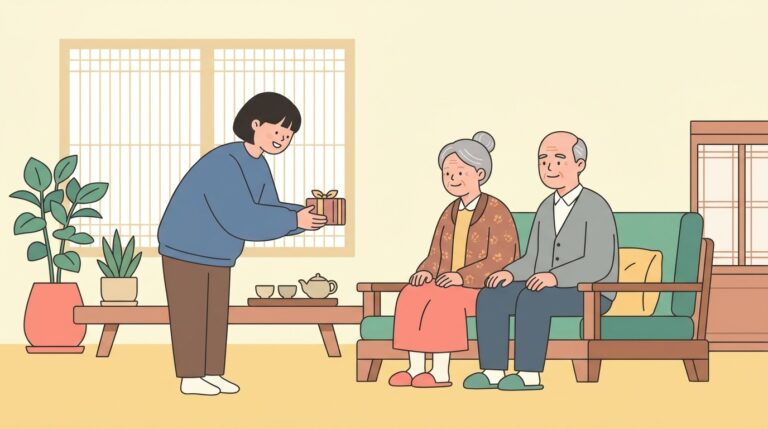
* Two Hands, Always: When giving a gift, pouring a drink, or receiving something from your grandparents, always use two hands. Hold the object with both hands, or support your right forearm with your left hand.
* The Head Bow: A gentle 30-degree bow while saying “안녕하세요” (An-nyeong-ha-se-yo) shows that you understand Korean manners (예의 – ye-ui).
4-2. The K-Drama Sweet Spot: “K-Grandmothers”
If you watch the movie Minari or the K-Drama Our Blues, you’ll see that Korean grandmothers are famous for one big thing: feeding you. To a Korean grandma, love is measured in rice bowls. If she keeps piling food onto your plate and saying “많이 먹어” (Man-i meog-eo – Eat a lot), the best response is a big smile and a happy “잘 먹겠습니다!” (Jal meok-get-seum-ni-da – I will eat well!).
Phase 5: Real-Life Roleplay Scenario
Let’s practice! You are visiting your Korean friend Minjun’s house. Minjun’s warm and energetic grandmother (할머니) comes out to greet you with a plate of fresh fruit.
Dialogue (8 Turns)
- 할머니 (Grandma): “어머, 친구야? 반가워요!”
(Eo-meo, chin-gu-ya? Ban-ga-wo-yo!)
「 🎭 Smiling widely, holding a plate of sliced apples 」
“Oh, a friend? Nice to meet you!” -
You: “안녕하세요, 할머니! 처음 뵙겠습니다.”
(An-nyeong-ha-se-yo, hal-meo-ni! Cheo-eum boep-get-seum-ni-da.)
「 🎭 Bowing politely at a 30-degree angle 」
“Hello, Grandmother! Nice to meet you for the first time.” -
할머니 (Grandma): “한국말 아주 잘하네! 이름이 뭐예요?”
(Han-guk-mal a-ju jal-ha-ne! I-reum-i mwo-ye-yo?)
「 🎭 Clapping hands in delight 」
“Your Korean is so good! What is your name?” -
You: “저는 [Your Name]입니다. 만나서 반갑습니다.”
(Jeo-neun [Your Name]-im-ni-da. Man-na-seo ban-gap-seum-ni-da.)
「 🎭 Smiling warmly 」
“I am [Your Name]. Nice to meet you.” -
할머니 (Grandma): “이 사과 좀 먹어봐요. 아주 달아!”
(I sa-gwa jom meog-eo-bwa-yo. A-ju dal-a!)
「 🎭 Handing you a piece of apple with a toothpick 」
“Try some of this apple. It’s very sweet!” -
You: “우와, 감사합니다! 잘 먹겠습니다.”
(U-wa, gam-sa-ham-ni-da! Jal meok-get-seum-ni-da.)
「 🎭 Receiving the apple with both hands 」
“Wow, thank you! I will eat well.” -
할머니 (Grandma): “그래요, 많이 먹고 건강해요!”
(Geu-rae-yo, man-i meok-go geon-gang-hae-yo!)
「 🎭 Patting your shoulder affectionately 」
“Yes, eat a lot and stay healthy!” -
You: “네, 할머니도 건강하세요!”
(Ne, hal-meo-ni-do geon-gang-ha-se-yo!)
「 🎭 Making a small finger heart or smiling warmly 」
“Yes, Grandma, you stay healthy too!”
🔀 Interactive Choice Point
How do you respond when Grandma offers you a second helping of food, but you are completely full?
- Choice A: “배불러요. 안 먹어요.” (Bae-bul-leo-yo. An meog-eo-yo. – “I’m full. Not eating.”)
- Choice B: “할머니, 진짜 맛있어요! 하지만 배가 너무 불러요. 감사합니다!” (Hal-meo-ni, jin-cha mas-it-seo-yo! Ha-ji-man bae-ga neo-mu bul-leo-yo. Gam-sa-ham-ni-da!)
- Choice C: Just walk away quietly without saying anything.
💡 Feedback:
- Choice A (Risk ⚠️): While grammatically correct, “안 먹어요” sounds a bit too blunt and cold to a grandparent.
- Choice B (Best ✅): Perfect! You complimented her food first (“It’s really delicious!”) and politely explained that you are full. She will love you for this!
- Choice C (Bad 🚫): Leaving without saying anything is considered very impolite in Korean culture.
Phase 6: 10-Second Emotion Shadowing Drill
Let’s practice speaking with real Korean feelings! Pay attention to the pauses (/) and the emotion prompts.
- [😊 Expressing warm gratitude with a big smile]
“할머니, / 진짜 / 맛있어요!”
(Hal-meo-ni, / jin-cha / mas-it-seo-yo!)
“Grandma, it’s really delicious!” -
[🥺 Wishing health with deep sincerity]
“할머니, / 꼭 / 건강하세요!”
(Hal-meo-ni, / kkok / geon-gang-ha-se-yo!)
“Grandma, please stay healthy!”
Phase 7: K-Culture Mini Dictionary
- 효도 (Hyo-do) | Filial Piety
The cultural duty and desire to show love, respect, and support for one’s parents and grandparents. Taking them on trips or buying them delicious meals is ultimate Hyo-do. - 시골 (Si-gol) | Countryside
In Korea, “Si-gol” often evokes warm memories of visiting grandparents, running in green fields, and eating slow-cooked traditional food. - 정 (Jeong) | Deep Attachment/Affection
A unique Korean concept of emotional warmth, bonding, and kindness that grows over time. Grandparents are the absolute definition of “Jeong.” - 손주 (Son-ju) | Grandchildren
The apple of any Korean grandparent’s eye. Grandmothers love to show off photos of their Son-ju to their friends at the local senior center!
Phase 8: Travel Survival Kit
Survival Phrases for Travelers
- 사진 찍어드릴까요? (Sa-jin jjik-eo-deu-ril-kka-yo?)
- “Shall I take a photo for you?” (Great to use when you see elderly tourists trying to take selfies at beautiful sights!)
- 어르신, 먼저 앉으세요. (Eo-reu-sin, meon-jeo an-jeu-se-yo.)
- “Please sit here first, elder.” (An amazing phrase to use on the subway when offering your seat to a grandparent.)
- 도와드릴까요? (Do-wa-deu-ril-kka-yo?)
- “May I help you?” (Perfect if you see an elderly person struggling with heavy bags or navigating a ticketing machine.)
Editor’s Travel Note
When traveling in South Korea, you will find special designated seats in subways for the elderly, pregnant women, and the disabled. Even if the train is completely packed, locals usually leave these seats empty out of respect. To easily navigate the Korean subway system, make sure to use KakaoMap or download the Seoul Subway App. Note: App interface and features may change over time.
Phase 9: “A Step Deeper” (Cultural Reflection)
In many Western societies, independence is the highest virtue, and calling attention to someone’s old age can sometimes feel sensitive. However, in South Korea, aging is viewed as a accumulation of wisdom, life experience, and honor. The honorific language (존댓말 – Jondetmal) is not a cold wall; rather, it is a beautiful framework designed to show care and respect for those who walked the path of life before us.
💬 Your Turn: How does your culture show respect to grandparents? Do you have special terms of endearment for them? Let me know in the comments below!
Phase 10: FAQ & Avoiding Common Mistakes
Q: Can I use “안녕” (An-nyeong) to say hello to my friend’s grandfather?
A: No! “안녕” is casual slang. You must always use the polite form “안녕하세요” (An-nyeong-ha-se-yo) to grandparents.
Q: What is the difference between 외할머니 (Oe-hal-meo-ni) and 친할머니 (Chin-hal-meo-ni)?
A: “외” (Oe) means “outside” or maternal. So, 외할머니 is your mother’s mother, and 친할머니 (Chin-hal-meo-ni) is your father’s mother. In casual conversation, you can just call both “할머니”!
Q: Do I need to bow every single time I see them?
A: A polite bow is expected when you first greet them and when you say goodbye. You don’t need to bow every time they walk into the kitchen!
🚨 Common Mistakes Alert!
- Calling them “너” (Neo – You): Never use “너” with grandparents. Instead, just call them “할머니” or “할아버지.”
- Handing things with one hand: Remember, using one hand to hand over a cup of water looks very disrespectful. Use both hands!
- Eating before they do: At the dinner table, wait until the oldest person (grandpa or grandma) picks up their spoon before you start eating.
Phase 11: Action Mission!
- Bronze Mission 🥉: Practice saying “우리 할머니” (U-ri hal-meo-ni) and “우리 할아버지” (U-ri hal-a-beo-ji) out loud 5 times in front of your mirror.
- Silver Mission 🥈: Share a picture of your grandparents on Instagram and write a caption using: “우리 할머니, 할아버지 건강하세요! ❤️” (Our grandma and grandpa, please stay healthy!)
- Gold Mission 🥇: Next time you watch a K-Drama, listen closely and try to spot the word “할머니” or “할아버지.” Note down how the younger characters behave around them!
Phase 12: Interactive Quiz Challenge!
1. Situation Quiz
You want to introduce your grandfather to your teacher. Which phrase is the most natural and polite?
* A) 이 사람은 내 할아버지야. (I sa-ram-eun nae hal-a-beo-ji-ya.)
* B) 우리 할아버지예요. (U-ri hal-a-beo-ji-ye-yo.)
* C) 조부입니다. (Jo-bu-im-ni-da.)
Click here for the Answer & Explanation!
Correct Answer: B
Explanation: “우리 할아버지예요” is warm, natural, and polite. Option A is too casual (panmal), and Option C is too stiff and formal.
2. Fill in the Blank
Complete the ultimate blessing for grandparents:
“할머니, 꼭 _________세요!” (Grandma, please stay healthy!)
* Hint: It starts with “건강” (Geon-gang).
Click here for the Answer & Explanation!
Correct Answer: 건강하 (geon-gang-ha)
Explanation: The full sentence is “할머니, 꼭 건강하세요!” (Hal-meo-ni, kkok geon-gang-ha-se-yo!).
3. True or False Culture Quiz
In Korea, it is polite to start eating your food before the grandparents start eating theirs.
* True
* False
Click here for the Answer & Explanation!
Correct Answer: False
Explanation: You must always wait for the elders to pick up their utensils first. This is a very important dining etiquette in Korea!






